
 |

 Email Signup
|
Subscribe
|
Login
Email Signup
|
Subscribe
|
Login
For Divers since 1975 The Private, Exclusive Guide for Serious Divers Since 1975 |
"Best of the Web: scuba tips no other source dares to publish" -- Forbes |
Wakatobi Dive Resort, Sulawesi, IndonesiaContents of this Issue: Wakatobi Dive Resort, Sulawesi, Indonesia Another Georgia Dive Instructor Guilty Decaying WWII Wrecks Threaten Coral Reefs Divi Flamingo Beach Hotel, Dive Bonaire, N.W.I. Don't Let Bonaire's Easy Diving Fool You Apple Ultra Watch and App: The Future of Dive Management? Don't Hide Your Keys in the Bushes Malta Dive Accident Ruled Involuntary Homicide Anyone Can Get Bent, So Get Insured Avatars' Actors' Amazing Breath Holding Skills Conception Deaths Spark New Owner Liability Law Socorro Aggressor Fails the Test Editorial Office: Ben Davison Publisher and Editor Undercurrent 3020 Bridgeway, Suite 102 Sausalito, CA 94965 world-class diving, world-class dive resort from the January, 2023 issue of Undercurrent
Dear Fellow Diver: If just one thing sets aside a great dive resort from a good one, it's the ability to walk to the beach, strap on a tank, and get in some top-notch diving. And that describes Wakatobi and its House Reef Wall, which rates among the best anywhere. After descending the wooden stairs at the pier, a few kicks lead to a shallow gully opening to a sheer wall dropping to around 120 feet. A usually gentle current dictated whether to turn left or right; either direction provided beautiful soft coral trees, fans, and sponges. Our dive to the left brought a diversity of butterflyfish, including pyramid, long-nosed, ornate, and red-fin specimens, pennant bannerfish, crocodile fish, trumpetfish, pink and spine-cheeked anemonefish, and short-nosed boxfish. A juvenile scorpionfish and other diverse critters hid in the low corals. Two turtles feeding on a sponge put a finish to our dive. The diving is so exceptional that some visiting divers spend more time diving here than boat diving. If a current's running, the staff will motor divers up current so that they can drift all the way back to shore.
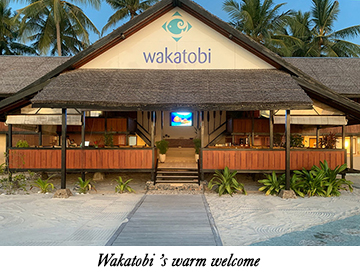
Wakatobi has several villas and nearly 30 palm bungalows. After arriving, I unpacked in my bungalow, had a fine lunch, and afterward listened to the dive briefing from divemaster Hery. Then off to the pier, where the crew carried our gear down the stairs to the water for our voluntary check-out dive. It was messy. My dive buddy's BC wouldn't hold air; seems the o-ring on the inflator hose had blown. The staff brought him a rental. The wristband on my Galileo Luna dive computer broke. While I had forgotten to check the strap before I left home, I checked my old ScubaPro Classic BC, which had seen me through 2000 dives. I found seven leaks. I bought a new version before I left. And I should have purchased a safety sausage too. Halfway through the dive trip, it disintegrated. Had John Bantin's predive checklist published in the November Undercurrent been available before I left home, I would have saved myself a lot of trouble. (click here to download it) Built by local craftsmen, Wakatobi's eight wooden inboard-engine dive boats easily navigate the seas. I found both the Wakatobi III and IX, about 75 feet long, comfortable, and spacious, with racks for 32 tanks and heads with showers. After no more than a 20-minute trip, the crew would help me gear up, and I'd then step off the side. Before exiting, I would hand up my BC and weights and climb the stable ladder, and the crew welcomed me with a hot washcloth. Between dives, you could pick from fruit, sandwiches, cookies, and pastries with water, tea, or hot cocoa. Some boats stayed out for a second dive; others returned between dives to drop off and pick up divers and snorkelers. The multi-national staff -- Indonesian, Swiss, British, Spanish, and Japanese -- included 10 divemasters and 17 instructors. While we asked to stick with one divemaster for our week, guests arrive and depart on Fridays and Mondays, so groups change, and divemasters rotate days off. I had four accomplished divemasters, diving most often with Andrea Balin, an Italian, seven-year Wakatobi veteran, and instructor trainer, who offered very detailed briefings. When we were to dive one site a second time, he had us jump in at a different location so we could cover a new area. A super-spotter excited about his discoveries, he was one of the best divemasters I have had.
The diving was splendid. Galaxy sported a technicolor wall bursting with soft corals and tunicates. Brooks, our divemaster, pointed out a sea squirt with clusters of delicate bell-shaped blue flowers among sea fans hanging from the wall. I spotted a colorful Chromodoris, Phyllidia nudibranchs, and a broadclub cuttlefish (two arms fan out from the body, like clubs), and a black tip shark swam by, one of many I saw on my dives. The Zoo was so awash with a variety of fish species that I didn't know where to look next! Staghorn and star corals dominated the landscape, and the barrel sponges were impressive. The corals at the Zoo supported a wealth of creatures, including a big cuttlefish, lionfish, Pantoni seahorses, three species of Chromodoris nudibranchs fluttering their rhinophores, and too many species of butterflyfish to count. Brooks gave an interesting visual presentation one afternoon about biodiversity, noting that Indonesia has over 600 species of coral, whereas the Caribbean has around 70. When he told us Wakatobi has more than 40 butterflyfish species, another diver and I were determined to outdo one another in identifying species. It was friendly fun, and we didn't declare a winner.
The resort measures up to the great diving. Wakatobi's original Long House, the welcoming center with lovely wood floors, includes a spacious, comfortable lounge, a camera room, a media room, a library, a boutique, and nearby, a small medical center. I enjoyed delicious buffet meals in the openair dining room alongside the sandy beach -- and often ate outside. The dining staff, led by Ibram and Adhi, was always on top of things. For breakfast, I stopped at the omelet center, then added a croissant (they make their breads), their blueberry yogurt, juice, fruit, and maybe a pancake or waffle. It was easy to overeat at lunch or dinner, which included cold and hot soups, pasta, grilled veggies, satay, rice dishes, and potatoes. My favorite dish was Laksa Bogor, a coconut and lime soup with noodles and toppings of prawns, shrimp, chicken, boiled egg, and vegetables. If you want to stick to European food, dinners featured leg of lamb, duck, rib eye roast, and roasted chicken. Salads and fresh fruit abounded. The wine was extensive and expensive. I relished the Chilean Sumaq Pinot at $93 a bottle; you might find a bottle in a U.S. retail store for $35. Desserts were masterpieces, especially the creme brulee, the opera cake, and homemade ice cream and sorbet, topped with a crunchy thin brandy snap tuile. After I asked for the recipe, the Pastry Chef, Pian, demonstrated how he made them while insisting that I assist. Steps from the ocean, my spacious and well-appointed high-ceilinged air-conditioned ocean bungalow held a small fridge, a pot to make supplied hot beverages, a table and chair, two comfortable cushioned chairs, and a king-sized bed draped with a light fabric. The spacious toilet room led to the private outdoor shower. The front porch, decked out with two cushioned couches and a coffee table, overlooked the ocean. Two lounge chairs were on the sand, but I gave the shaded hammock the most use because the days were sunny, in the low- to mid-80s, with a bit of rain only on the last day. Wakatobi has a relaxed and friendly atmosphere. The helpful staff numbers more than 200 and includes over a dozen security people, not uncommon at high-end resorts in third-world countries. It took a single call to the central number to make a spa appointment, request ice, or ask for something to be fixed. My internet went down one day, highlighting my dependence on the Net even in paradise. My buddy's room phone worked about one-third of the time. But, no snakes in the toilet. Guests, many of whom were snorkelers, became quick friends. We became eager to share the day's diving stories and places we'd been. My dive buddy, a scientist, gravitated toward a family of endocrinologists. I enjoyed conversations with a like-minded therapist. A diver from the UK was delighted to leave the cold water of home and dive in the warm sea. Divers from Australia joined us at happy hour and sunset-watching at the end of the long wide pier, where we relaxed in comfortable chairs and chatted long after dark thanks to a well-stocked bar.
Along the Long House are hanging areas for suits, baskets for gear, rinse tanks, and a salt-water shower, with a freshwater shower a short jaunt away. Our gear in baskets are loaded by the staff on our respective boats and set up on our tanks, with Nitrox 32 if you prefer. When the dive gear was returned to shore, I rinsed and hung it to dry. Although the resort's camera guru repaired my dive buddy's camera housing, they do not repair BCs or dive computers because of liability issues, they say. That said, a couple of divemasters had temporary creative fixes for the broken wristband on my dive computer, which I clipped to my BC. Jacques Cousteau once claimed Wakatobi has the world's best diving. Still, my buddy, who had been there more than 20 years ago, said it didn't quite measure up to that visit. He had been eager to return to see the sizable, colorful, swaying soft corals and large fish that so enthralled him during his 2000 trip, but they were not as prolific. When discussing this with Andrea before we left, he said that he could have arranged it had we requested these sites. So, maybe we didn't see the best. Perhaps schedules and fuel costs kept the trips to 20 minutes and the common dive sites. Maybe only Jacques Cousteau's disciples, today's paid publicists, get to see them.
After settling my bill on the last day, 15 of us boarded the boat for the short trip to the airport. When boarding passes were distributed, I was shocked to find they had none for me. Whaaat? Luckily, there were two boarding passes for the same person who was not there. I took one and boarded the plane -- essentially a Wakatobi charter -- something you can only do these days at a tiny airport with no security! By any standard, Wakatobi Resort excels in accommodating personal preferences, perfecting world-class diving, and offering excellent dining and first-rate bungalows. It's a diver's and snorkeler's dream. Don't wait to put it on your bucket list. Dip into that 401(k). Now's the time. -- J.D. Our undercover diver's bio: "I began diving 20 years ago, quickly becoming obsessed with observing fish and critter behavior. Two thousand dives later, with plenty of time to burn, I've made half my dives in the Caribbean and the remainder mostly in Indonesia, the Philippines, Japan, Palau, Papua New Guinea, the Solomon Islands and Turkey. Using the excuse of absorbing local culture, I've drunk kava in Fiji, penis soup in PNG, and spat betelnut juice in Palau. I'm convinced it helped my fish ID skills in those regions."
|


 En route,
my first stop
was Bali, where
a Wakatobi agent
whisked my buddy
and me through
immigration.
We were off
to decompress
at my favorite
Bali resort,
Puri Santrian,
30 minutes from
the airport. Three days later, a Wakatobi
rep at the airport escorted
us through check-in and to
the lounge to await our 8:00
a.m. two-hour flight to the
southeastern tip of Sulawesi,
where a boat would be waiting
for the 20-minute trip
to the isolated hotel. When
Wakatobi opened its doors in
1996, they posted instructions
over the toilets to check
for sea snakes before sitting
down. Twenty-five years later,
Wakatobi has morphed into a
true luxury dive resort.
En route,
my first stop
was Bali, where
a Wakatobi agent
whisked my buddy
and me through
immigration.
We were off
to decompress
at my favorite
Bali resort,
Puri Santrian,
30 minutes from
the airport. Three days later, a Wakatobi
rep at the airport escorted
us through check-in and to
the lounge to await our 8:00
a.m. two-hour flight to the
southeastern tip of Sulawesi,
where a boat would be waiting
for the 20-minute trip
to the isolated hotel. When
Wakatobi opened its doors in
1996, they posted instructions
over the toilets to check
for sea snakes before sitting
down. Twenty-five years later,
Wakatobi has morphed into a
true luxury dive resort.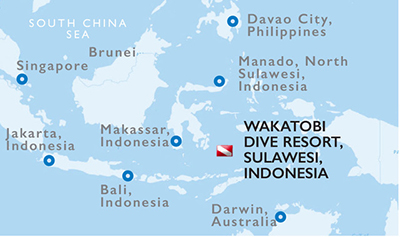 We dived in groups of four, it seems
always experienced senior citizen divers.
Dives were between 70 and 80 minutes,
no deeper than 77 feet, mostly around 40
feet in 82-degree water. Visibility often
ran 100 feet. Currents could be varied
and changeable.
We dived in groups of four, it seems
always experienced senior citizen divers.
Dives were between 70 and 80 minutes,
no deeper than 77 feet, mostly around 40
feet in 82-degree water. Visibility often
ran 100 feet. Currents could be varied
and changeable.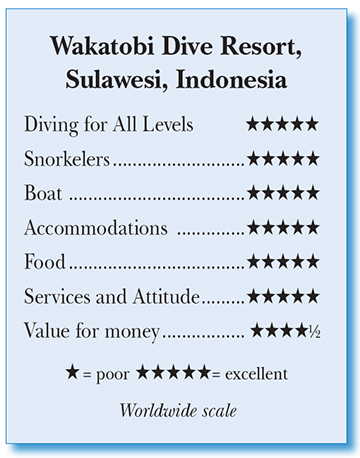 At Black Forest, before descending the
wall, I saw a leopard moray eel peering from
an outcropping graced by two nudibranchs
while a two-foot broadclub cuttlefish carefully
observed us. As I descended among
extensive colorful corals and fans, I spotted
several brown-spotted juvenile star puffers,
Papuan tobies (little sharp-nosed puffers),
and leaf scorpionfish. Fire dartfish danced
above the sand. I was tempted to explore the
deep ledges leading into a cave system, but
that was not on Andrea's agenda.
At Black Forest, before descending the
wall, I saw a leopard moray eel peering from
an outcropping graced by two nudibranchs
while a two-foot broadclub cuttlefish carefully
observed us. As I descended among
extensive colorful corals and fans, I spotted
several brown-spotted juvenile star puffers,
Papuan tobies (little sharp-nosed puffers),
and leaf scorpionfish. Fire dartfish danced
above the sand. I was tempted to explore the
deep ledges leading into a cave system, but
that was not on Andrea's agenda.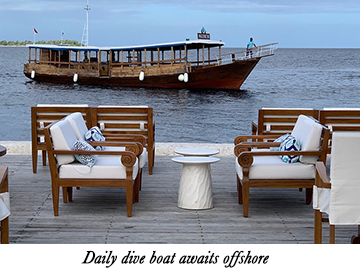 One day, after an easy
15-minute walk on a jungle
path, we descended wooden steps
to a cave with a central pool
of chilly water about two feet
deep. We only had one torch
among the three of us and no guide, so we did not explore the deeper chutes with
stalactites and stalagmites leading from the pool into the dark. The one staffer
who knew the details of the cave system was on vacation.
One day, after an easy
15-minute walk on a jungle
path, we descended wooden steps
to a cave with a central pool
of chilly water about two feet
deep. We only had one torch
among the three of us and no guide, so we did not explore the deeper chutes with
stalactites and stalagmites leading from the pool into the dark. The one staffer
who knew the details of the cave system was on vacation.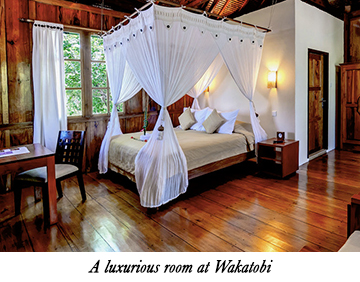 But I've got no complaints. All my dives featured sloping or nearly vertical
walls. Dunia Baru's sloping wall, coral gardens, and extensive finger and staghorn
corals harbored endless juveniles. With no current, I could meander among juvenile
ornate butterflyfish, cardinalfish, even the illusive pajama species. Large patches
of Xenia coral crown of polyps rhythmically pulsated. I homed in on the wellcamouflaged
tiny white crabs with my magnifying glass. From the dense coverage
along the wall, a whitemouth moray's head protruded. On many of my dives, the soft
corals were so thick they seemed to be fighting for space.
But I've got no complaints. All my dives featured sloping or nearly vertical
walls. Dunia Baru's sloping wall, coral gardens, and extensive finger and staghorn
corals harbored endless juveniles. With no current, I could meander among juvenile
ornate butterflyfish, cardinalfish, even the illusive pajama species. Large patches
of Xenia coral crown of polyps rhythmically pulsated. I homed in on the wellcamouflaged
tiny white crabs with my magnifying glass. From the dense coverage
along the wall, a whitemouth moray's head protruded. On many of my dives, the soft
corals were so thick they seemed to be fighting for space. Divers Compass: My package included meals, bungalow, and unlimited
diving. I paid for a single for three nights and had the bungalow
to myself for the seven nights. I also got a $234 repeat discount.
Total: $5215. Extras were private charter $765, and resort
charges for liquor and iced tea . . . There were three boat dives
a day, with the afternoon and evening alternating . . . The nearest
chamber is in Bali . . . Rooms were cleaned twice daily . .
. Because of long layovers, door-to-door to Bali from the Midwest
was 42 hours. In Singapore, I enjoyed a few hours of sleep at
the transit hotel. Coming home, the flight schedules necessitated overnights in
Bali's Novatel at the airport and then near the LAX airport . . . Wakatobi has
an excellent website:
Divers Compass: My package included meals, bungalow, and unlimited
diving. I paid for a single for three nights and had the bungalow
to myself for the seven nights. I also got a $234 repeat discount.
Total: $5215. Extras were private charter $765, and resort
charges for liquor and iced tea . . . There were three boat dives
a day, with the afternoon and evening alternating . . . The nearest
chamber is in Bali . . . Rooms were cleaned twice daily . .
. Because of long layovers, door-to-door to Bali from the Midwest
was 42 hours. In Singapore, I enjoyed a few hours of sleep at
the transit hotel. Coming home, the flight schedules necessitated overnights in
Bali's Novatel at the airport and then near the LAX airport . . . Wakatobi has
an excellent website: 
I want to get all the stories! Tell me how I can become an Undercurrent Online Member and get online access to all the articles of Undercurrent as well as thousands of first hand reports on dive operations world-wide

| Home | Online Members Area | My Account |
Login
|
Join
|
| Travel Index |
Dive Resort & Liveaboard Reviews
|
Featured Reports
|
Recent
Issues
|
Back Issues
|
|
Dive Gear
Index
|
Health/Safety Index
|
Environment & Misc.
Index
|
Seasonal Planner
|
Blogs
|
Free Articles
|
Book Picks
|
News
|
|
Special Offers
|
RSS
|
FAQ
|
About Us
|
Contact Us
|
Links
|
3020 Bridgeway, Ste 102, Sausalito, Ca 94965
All rights reserved.