
 |

 Email Signup
|
Subscribe
|
Login
Email Signup
|
Subscribe
|
Login
For Divers since 1975 The Private, Exclusive Guide for Serious Divers Since 1975 |
"Best of the Web: scuba tips no other source dares to publish" -- Forbes |
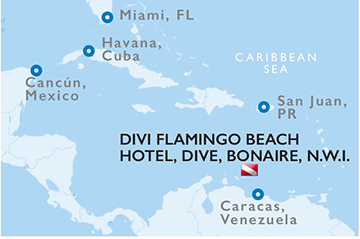
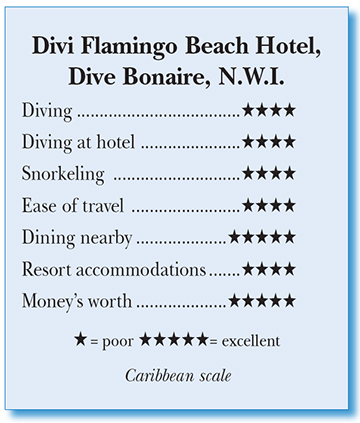
Divi Flamingo Beach Hotel, Dive Bonaire, N.W.I.Contents of this Issue: Wakatobi Dive Resort, Sulawesi, Indonesia Another Georgia Dive Instructor Guilty Decaying WWII Wrecks Threaten Coral Reefs Divi Flamingo Beach Hotel, Dive Bonaire, N.W.I. Don't Let Bonaire's Easy Diving Fool You Apple Ultra Watch and App: The Future of Dive Management? Don't Hide Your Keys in the Bushes Malta Dive Accident Ruled Involuntary Homicide Anyone Can Get Bent, So Get Insured Avatars' Actors' Amazing Breath Holding Skills Conception Deaths Spark New Owner Liability Law Socorro Aggressor Fails the Test Editorial Office: Ben Davison Publisher and Editor Undercurrent 3020 Bridgeway, Suite 102 Sausalito, CA 94965 an all-around good spot, from fish to food from the January, 2023 issue of Undercurrent
Dear Fellow Diver: I dive all over the world, but when I want a one-week trip from the Midwest, with good reefs, plenty of fish, easy diving, plus a comfortable hotel and good food, Bonaire is my go-to spot. You see .... Just two hours after arriving in Bonaire in late November, and before even going to my hotel room, my dive buddy and I were gearing up on the Woodwind dock at Divi Dive. A giant stride took me into 10 feet of crystal-clear water, and we were soon swimming over the coral rubble left by backwash from Hurricane Lenny in 1999. The wall starts 100 yards out, at about 30 feet. Over the wall, the coral got better quickly, although not up to par with other Bonaire reefs. Brain corals, fire coral, colorful tube sponges, soft coral fronds, and wire coral strands were everywhere. At 60 feet, a five-foot tarpon and his two buddies began tagging along, sometimes close enough to touch. French and gray angelfish, trumpetfish, peacock flounders, and myriads of small reef fish kept me interested. The resident octopus greeted us back at the dock before pouring itself into a hole. I carefully approached a school of needlefish just under the surface; by not blowing too many bubbles, I got my lens within a foot. If you want to go back for a night or dawn dive, they leave out full cylinders 24 hours per day. After diving, I went to the front desk to get my key (easy, since I had checked in online before arrival) and was greeted by the universally friendly staff, graced with a rum punch (or two), and given WIFI codes and a resort map. My simple ocean-view room, with two beds, a dresser, a TV, several electric outlets, and a bathroom with a shower, was on the waterfront, with waves occasionally splashing onto the veranda, where I could sit to enjoy the ocean view. There's no beach, but the lovely grounds featured two pools, palm trees inhabited by squabbling parrots, and an occasional curious iguana. On the street next door to the hotel, I picked up snacks and odds and ends at a convenience store and often took a leisurely walk downtown to many good restaurants and shops. I stay away from the small in-house casino, a cruise ship tourist trap with lousy odds; in the past, I rented a car in the hotel lobby for a drive past the solar salt works or a visit to the Sorobon windsurfing area on the island's east side. It's a good hotel, and the dive operation rates even a notch higher, with two docks, four Newton dive boats with low entry/exit decks, sturdy ladders, and an onsite dive shop with both new and rental gear. High-pressure hoses refilled the cylinders (nitrox always 31%-32%)-right on the boat, so my gear stayed at my station until the last dive, when I toted it to the lockers at the end of the dock. I washed it in the tanks or hosed it down and took a quick freshwater shower only 50 feet from my room. I traveled with two dozen folks, most of whom dived daily from the Pressure Drop, a 46-foot Newton. Like all their boats, this had cell phone access to the shore, camera rinse tubs, and DAN safety packs. But no head. We had two divemasters -- Laurel, Marco, or Carlos -- all with 20-plus years of experience in Bonaire, and they were still enthusiastic about diving. Initially, I had dreadful misgivings about having just two crew members in the water. You see, with as many as 20 divers, ranging from 14-year-old newbies to 76-year-olds with thousands of dives -- there was a lot to watch over. After two dives, my concerns evaporated, thanks to the skilled crew and reasonable restrictions. Entries were hassle-free, with some divers back-rolling off the sides and others giant striding off the back. We began with 40-minute dives under the guide's watchful eyes, then extended to an hour, and, as the week progressed, to 90 minutes, rarely deeper than 70 feet, with plenty of freedom to go off on our own. Even the 14- and 15-year-olds handled the diving well. I imagine, however, a less disciplined or skilled group might be messy. A petite 14-year-old girl diving with her parents used so little air with a cubic 80 that she could dive all day on a single tank. But she had buoyancy issues, and her dad asked me for tips. Weighing less than 90 pounds, she wore a wetsuit, 12 lbs. of lead, and an aluminum 80, totaling about 1/3 of her body weight. It was as if I were to dive with 40 lbs. of lead, twin cylinders, and two sling bottles! So, we tried a 63 cu. ft. tank and no weights. Soon, she had excellent buoyancy and exclaimed, "I go up and down by just inhaling and exhaling a little and not putting lots of air in my BC or dumping it!" If only clumsy adults would accept suggestions so easily.
By the way, each diver pays a $25 park fee to the nonprofit STINAPA, Bonaire's national park foundation, which manages both the Washington Slagbaai Park and the Marine Park. It oversees the island's shore diving sites and maintains about 90 dive boat moorings, about 20 of which are at Klein Bonaire, a small island a short boat ride from hotels.
At Klein Bonaire, Captain Don's dive site had the healthiest and most teeming reefs I've seen anywhere in the Caribbean. I spotted a sailfin blenny flickering his tiny sailfin flag while popping out of his coral hole. I saw another, then another, and then different types, such as baldheads and redheads. Perhaps hundreds lived in the coral rubble under the boat. As I tried to video them, they seemed offended by my floodlights and refused to come out. I spent 40 minutes getting but a couple of viewable clips and rejoined my buddy for 20 minutes along the wall, then revisited Blenny City for 20 minutes more. And I was not the last one back on the boat.
For a grand American-style Thanksgiving dinner with "all the fixin's," 20 of us headed to Sebastian's, one of Bonaire's top restaurants. Seated at one long table, we started with rounds of drinks, appetizers, and lots of diving stories when "poof," the lights went off. We were in absolute darkness. Soon, lots of cell phone lights came on, along with a few candles, which we used to light the way for servers and kitchen workers. The chefs switched to their barbecue grill to complete the cooking while we kept the wine flowing. We ended up having an excellent Thanksgiving dinner, paying in cash (no electricity for credit card charges), then carefully walked in the dark back to the resort and my equally dark room. Electricity was restored early the next morning. Loud aircraft noises from the nearby airport have not scared away the fish from Bachelor's beach dive site, a great dive with no current, 75- to 100-foot visibility, and 80-82°F water. During my 60-minute dive over healthy hard and soft corals leading to the wall sloping off to the abyss, I swam with clouds of brown Chromis and Creole wrasse, saw a couple of Caribbean squid, cruising jacks, scorpionfish, and spotted drums. A large brown spotted frogfish drew everyone's attention. Later, one of the divemasters said there were two frogfish, a male mating with a large female. So disguised were they that it was difficult to differentiate one from the other. Bonaire's a good place to see frogfish and seahorses as well -- I saw yellow, brown, and reddish seahorses on four different dives. The divemasters will find them for you.
Under the beautifully coral-encrusted structure, schools of yellowtails, French grunts, stripers, marauding horse-eyed jacks, and an occasional tarpon made it fascinating. While most divers were enthralled with the pilings and the fish, others focused on the macro universe that thrived on the pilings or the tiny crabs, shrimps, juvenile reef fish, anemones, and nudibranchs inhabiting the junkyard of discarded industrial materials. The 240-foot freighter, Hilma Hooker, was built in 1951. In 1984, after becoming disabled at sea, it was towed to Bonaire, where authorities found 25,000 pounds of marijuana behind a false bulkhead. They removed the pot and burned it at the end of the island, where they expected the wind to blow the smoke out to sea. Island folklore has it that the wind shifted, much to the pleasure of the island's inhabitants. The boat sank unexpectedly and lies on its side on the sand at 100 feet, not far from a coral reef wall. The upper side of the wreck is about 50 feet deep, and a huge propeller is a backdrop for photos. Dropping down to the bow, I moved along the now vertical deck and through the cargo holds festooned with ropes and cables, bent masts, and long tube sponges. An immense green moray peered from the dark depths of the hold. A huge tarpon prowled the dark, open holds. The bridge and other interior structures are easy to penetrate but are overhead environments, so unless you know what you are doing, you should only peek inside. Feisty sergeant majors guarded their purple eggs on the upper side of the wreck. We were limited to 20 minutes, then made a leisurely swim up the adjacent reef wall and back to our boat.
I'm sure I'll return to Bonaire. What it lacks in big fish encounters, it makes up for with good reefs, lots of tropical fish, and interesting critters that make decent material for your camera. The Flamingo is in a safe small urban environment with excellent culinary options nearby, making it a unique dive destination. -- D.D. PS: Bonaire's Reef Renewal Program, a mostly volunteer operation, propagates new coral by growing it until it is big enough to transplant on local reefs. RRP is also involved in coral genetics, selecting varieties that are more resistant to stress. If you have a couple or more weeks to spare, they will welcome you as a full-time volunteer. Even though you would be working, you would be diving. You can also donate. www.reefrenewalbonaire.org. Our undercover author's bio: The author is a master diver and has been diving for more than 30 years, making 1600 dives around the world. Retired from rebreather and technical diving, he is a DAN undersea referral physician and has written several pieces for Undercurrent.
|


 One of Bonaire's more popular shore
dives,1000 Steps,is named for stone stairs running
down a cliff to the rocky shore. While there
are only 330 steps down, it's a tough hike loaded
with gear, and you have to walk back up. I took
the easier route, a boat dive that moored just
offshore on a shallow sandy reef dotted with
hundreds of small coral heads. We back-rolled
into 100-foot visibility and dropped down to 60
feet along the wall, where a friendly hawksbill
turtle poked around colorful coral and sponges.
Schools of yellowtail stripers, horse-eyed jacks,
pairs of French angels, swarms of Creole wrasse,
Chromis, and a few queen angelfish surrounded
us. Working our way back up the wall, I found a
squid tending eggs under a rock. Not far away, I
noticed another diver with her head in a cloud of
sand. A four-foot-wide eagle ray was rooting in
the sand, and the diver had her GoPro two feet
from its nose. When I kicked over, the animal
swam away but soon returned to root again. A few
minutes later, a free-swimming octopus poured itself into a coral crevice, leaving
no trace other than its cold cephalopod eye staring out. This is why 1000 Steps
is one of Bonaire's favorite sites. With about 60 shore diving sites, some divers
eschew boat diving and reserve one of Divi Dive's four-door pickup trucks, getting
full tanks from their cylinder exchange in the parking lot.
One of Bonaire's more popular shore
dives,1000 Steps,is named for stone stairs running
down a cliff to the rocky shore. While there
are only 330 steps down, it's a tough hike loaded
with gear, and you have to walk back up. I took
the easier route, a boat dive that moored just
offshore on a shallow sandy reef dotted with
hundreds of small coral heads. We back-rolled
into 100-foot visibility and dropped down to 60
feet along the wall, where a friendly hawksbill
turtle poked around colorful coral and sponges.
Schools of yellowtail stripers, horse-eyed jacks,
pairs of French angels, swarms of Creole wrasse,
Chromis, and a few queen angelfish surrounded
us. Working our way back up the wall, I found a
squid tending eggs under a rock. Not far away, I
noticed another diver with her head in a cloud of
sand. A four-foot-wide eagle ray was rooting in
the sand, and the diver had her GoPro two feet
from its nose. When I kicked over, the animal
swam away but soon returned to root again. A few
minutes later, a free-swimming octopus poured itself into a coral crevice, leaving
no trace other than its cold cephalopod eye staring out. This is why 1000 Steps
is one of Bonaire's favorite sites. With about 60 shore diving sites, some divers
eschew boat diving and reserve one of Divi Dive's four-door pickup trucks, getting
full tanks from their cylinder exchange in the parking lot.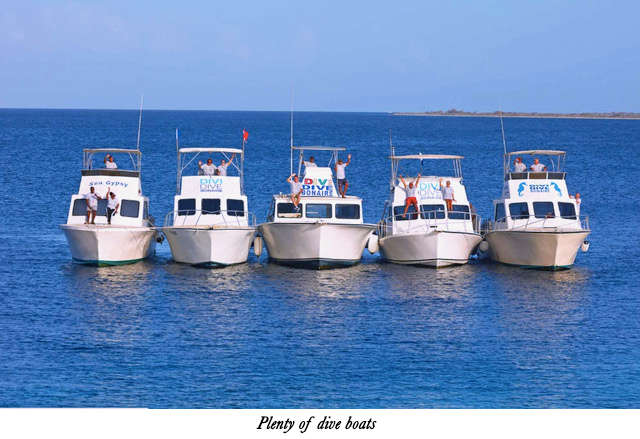
 Each day before 7:00 a.m. I would amble down the path to the shoreside Pure
Ocean dining room for the breakfast buffet of scrambled eggs, sausage, fried
potatoes, pancakes or waffles, corned beef hash, fresh fruits, biscuits, muffins,
cereals, yogurt, juices, and for Dutch guests, cold cuts. The first dive departed
about 8:30; after two tanks, we'd return for lunch -- fish tacos, cheeseburgers
-- then head out about 1:30 p.m. for an afternoon dive. Before dinner, I'd
join others for Happy Hour at the oceanside bar. Some divers would make a night
dive; others would walk to one of several excellent European-style restaurants in
Kralendijk. I dined a couple of nights at the Flamingo's Chibi Chibi, which had an extensive 3-5 course menu,
a wine list, and an excellent
chef. I had a surf and turf one
night, and a shrimp dish another
time. Expect to spend $50-$100.
Each day before 7:00 a.m. I would amble down the path to the shoreside Pure
Ocean dining room for the breakfast buffet of scrambled eggs, sausage, fried
potatoes, pancakes or waffles, corned beef hash, fresh fruits, biscuits, muffins,
cereals, yogurt, juices, and for Dutch guests, cold cuts. The first dive departed
about 8:30; after two tanks, we'd return for lunch -- fish tacos, cheeseburgers
-- then head out about 1:30 p.m. for an afternoon dive. Before dinner, I'd
join others for Happy Hour at the oceanside bar. Some divers would make a night
dive; others would walk to one of several excellent European-style restaurants in
Kralendijk. I dined a couple of nights at the Flamingo's Chibi Chibi, which had an extensive 3-5 course menu,
a wine list, and an excellent
chef. I had a surf and turf one
night, and a shrimp dish another
time. Expect to spend $50-$100.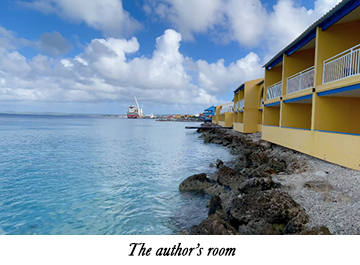 Bonaire has a vast solar-powered seawater evaporation pond that produces salt
sold worldwide. If ships aren't in at the Salt Pier, you can drift dive through
crystal-clear water under the huge pier with 80-foot pilings. It was an easy drift
dive at about half-a-knot.
Bonaire has a vast solar-powered seawater evaporation pond that produces salt
sold worldwide. If ships aren't in at the Salt Pier, you can drift dive through
crystal-clear water under the huge pier with 80-foot pilings. It was an easy drift
dive at about half-a-knot.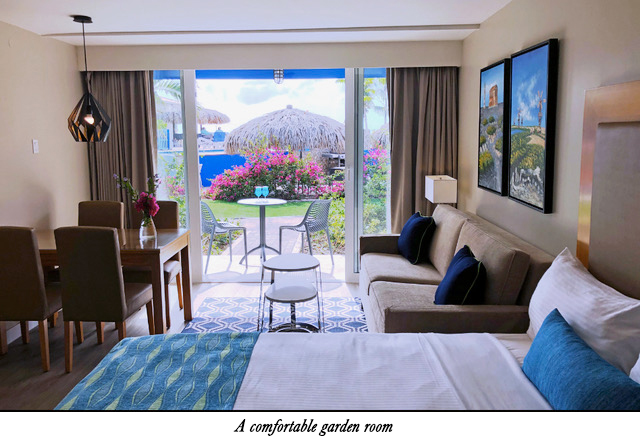
 Diver's Compass: Packages with six days of boat diving begin around
$2100/person double occupancy. . . . It's an online world at Divi,
with prearrival online hotel and dive shop registration. . . .
.Even though this is a Dutch colony, the American dollar is the
currency, and English is the universal language. . . Bonaire has
a recompression chamber . . . Up to a week before flying, you can
pay the $75/person entry tax and obtain a QR code to show at the
airport. If you don't pay in advance, it will add at least 30 minutes
to your arrival.
Diver's Compass: Packages with six days of boat diving begin around
$2100/person double occupancy. . . . It's an online world at Divi,
with prearrival online hotel and dive shop registration. . . .
.Even though this is a Dutch colony, the American dollar is the
currency, and English is the universal language. . . Bonaire has
a recompression chamber . . . Up to a week before flying, you can
pay the $75/person entry tax and obtain a QR code to show at the
airport. If you don't pay in advance, it will add at least 30 minutes
to your arrival. 
I want to get all the stories! Tell me how I can become an Undercurrent Online Member and get online access to all the articles of Undercurrent as well as thousands of first hand reports on dive operations world-wide

| Home | Online Members Area | My Account |
Login
|
Join
|
| Travel Index |
Dive Resort & Liveaboard Reviews
|
Featured Reports
|
Recent
Issues
|
Back Issues
|
|
Dive Gear
Index
|
Health/Safety Index
|
Environment & Misc.
Index
|
Seasonal Planner
|
Blogs
|
Free Articles
|
Book Picks
|
News
|
|
Special Offers
|
RSS
|
FAQ
|
About Us
|
Contact Us
|
Links
|
3020 Bridgeway, Ste 102, Sausalito, Ca 94965
All rights reserved.