
 |

 Email Signup
|
Subscribe
|
Login
Email Signup
|
Subscribe
|
Login
For Divers since 1975 The Private, Exclusive Guide for Serious Divers Since 1975 |
"Best of the Web: scuba tips no other source dares to publish" -- Forbes |
Flotsam & JetsamContents of this Issue: Wakatobi Dive Resort, Sulawesi, Indonesia Another Georgia Dive Instructor Guilty Decaying WWII Wrecks Threaten Coral Reefs Divi Flamingo Beach Hotel, Dive Bonaire, N.W.I. Don't Let Bonaire's Easy Diving Fool You Apple Ultra Watch and App: The Future of Dive Management? Don't Hide Your Keys in the Bushes Malta Dive Accident Ruled Involuntary Homicide Anyone Can Get Bent, So Get Insured Avatars' Actors' Amazing Breath Holding Skills Conception Deaths Spark New Owner Liability Law Socorro Aggressor Fails the Test Editorial Office: Ben Davison Publisher and Editor Undercurrent 3020 Bridgeway, Suite 102 Sausalito, CA 94965 from the January, 2023 issue of Undercurrent
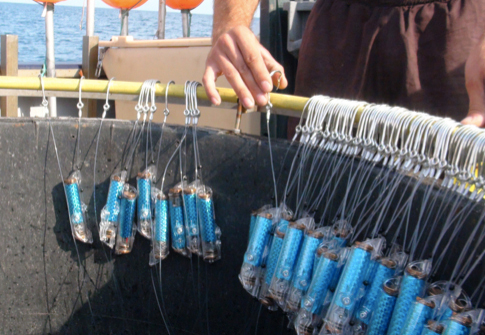
Technology May Save Sharks from Longlines. Sharks are a massive casualty of longline tuna fishing, but a new device has shown promising results in reducing the number accidentally slaughtered. SharkGuard, a cylindrical device attached to baited lines, emits a three-dimensional electric field that repulses sharks and rays. During testing in 2020 by two fishing vessels off the coast of France, shark bycatch fell by more than 90 percent, while rays snared were reduced by more than 70 percent.
Citizen Action in Bonaire. Dee Scarr found a load of broken glass and crockery under one of the cruise piers, and she and other divers began collecting and storing it in the yard of her Bonaire home. So far, they have pulled up about 250 pounds, roughly half of what was dumped. From the wine labels retrieved, she learned that only one cruise line serves those wines and is tracking down the ship that illegally dumped the trash. Because the trash is under a cruise pier, getting permission to continue the cleaning is tough, but when she gets it hauled out, you can bet the cruise line and the government will hear from her. Good work, detective. Diving Close to Home. Two teachers, Rich Cochrane and Henry Sadler from St. Petersburg FL, recently found a 10,000-year-old ice-age mastodon jawbone with several teeth and a pair of tusks while diving in local private waters of Pinellas County, Florida. As evidence that great discoveries wait for local freshwater divers anywhere, Sadler and Cochrane are confident they'll find more fossils there. He's Alive and Kicking. Comedian George Burns once said, "I get up every morning and read the obituary column. If my name's not there, I eat breakfast." Hopefully, Stan Waterman, the famed underwater cinematographer, doesn't read Facebook posts. Otherwise, he might have skipped breakfast a few weeks back. It seems a prominent dive photographer erroneously posted on his Facebook page that Stan had peacefully left our waterworld. Soon, the post was forwarded by others throughout the dive community before it was yanked. While Stan is 99 years old, he's still living the good life, and, no, we will not name the poster, who is embarrassed enough. What's the Longest Marine Animal? Did you think it was the blue whale? In 2020, about 2,000 feet down in an underwater canyon off the coast of Western Australia, scientists encountered what might prove to be the longest marine animal. It was a deep-sea siphonophore, a relative of the Portuguese man o' war, a long gelatinous creature suspended in a giant spiral, in a feeding posture employed by these types of siphonophores. Based on a rough calculation from the submersible's track, the spiral-shaped siphonophore was about 150 feet long, much longer than a blue whale or any animal, for that matter. Indonesia Selling Off its Heritage? Indonesia's Widi Reserve is among Earth's most intact coral atoll ecosystems. No matter, Indonesia's government has a contract with Sotheby's to auction off development rights (not protection rights) to the entire archipelago of more than 100 coral islands. Anyone with enough cash is welcome to bid for shares in an Indonesian development firm that has been licensed to build resorts and luxury villas in the reserve. The auction was scheduled for December but was delayed until January after an international backlash broke out over the sale. UNESCO Confirms the Great Barrier Reef in Danger. More than 1,400 miles long and comprising 2,500 individual reefs, with more than 1,500 species of fish, the GBR is considered a world heritage property, and UNESCO is placing it on the "in danger" list, largely due to climate change, a cause that the Australian government has sharply moved to deny. The U.N. mission experts listed nearly two dozen recommendations to protect the Great Barrier Reef, including setting "clear government commitments to reduce greenhouse gases, reducing excessive use of fertilizers and pesticides in nearby sugar cane and banana farming, and eliminating gill-net fishing." New York Times Before Diving, Children Need Medical Exams. The Dutch Society of Diving and Hyperbaric Medicine strongly advises a diving medical examination for all children who would like to take up diving and points out the self-declaration medical form used by many diving organizations is designed for adults to answer and inappropriate for children. Diving & Hyperbaric Medicine Volume 50 No. 4 December 2020 Boom! There Goes the Aquarium. On December 16, a 265,000-gallon aquarium, home to 1,500 Caribbean and Indo-Pacific tropical fish, burst in the lobby of Berlin's Radisson Blu hotel, flooding the hotel and nearby streets. The AquaDom was 46 feet high, the largest free-standing cylindrical aquarium in the world. Two people were injured by flying glass shards, and only a few fish survived at the bottom of the ruptured tank. Busy in Cozumel. Seven ships disembarked more than 18,000 passengers in Cozumel on Christmas Eve. Undoubtedly, each one used the toilet facilities ashore, leaving us to wonder if the local infrastructure was up to the task. The Mexican tourism industry remains pleased that it's enjoying a revival. A Fish with Human Teeth? The British Sun newspaper recently headlined a silly story about a frightened scuba diver being attacked by a "fish with human teeth." Experienced divers know to stay away from Titan triggerfish protecting their nests; their territory forms an ever-widening cone so that swimming upward does not spare you the aggressive attention of these toothy fish. Swim away horizontally. |



I want to get all the stories! Tell me how I can become an Undercurrent Online Member and get online access to all the articles of Undercurrent as well as thousands of first hand reports on dive operations world-wide

| Home | Online Members Area | My Account |
Login
|
Join
|
| Travel Index |
Dive Resort & Liveaboard Reviews
|
Featured Reports
|
Recent
Issues
|
Back Issues
|
|
Dive Gear
Index
|
Health/Safety Index
|
Environment & Misc.
Index
|
Seasonal Planner
|
Blogs
|
Free Articles
|
Book Picks
|
News
|
|
Special Offers
|
RSS
|
FAQ
|
About Us
|
Contact Us
|
Links
|
3020 Bridgeway, Ste 102, Sausalito, Ca 94965
All rights reserved.