
 |

 Email Signup
|
Subscribe
|
Login
Email Signup
|
Subscribe
|
Login
For Divers since 1975 The Private, Exclusive Guide for Serious Divers Since 1975 |
"Best of the Web: scuba tips no other source dares to publish" -- Forbes |
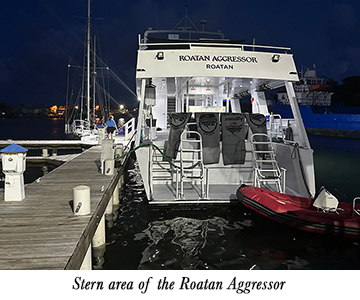
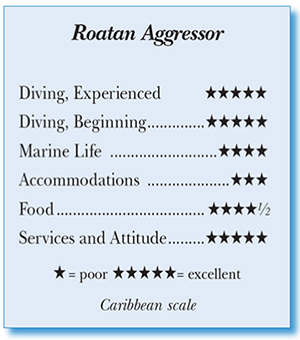
The Roatan AggressorContents of this Issue: North Fakarava, French Polynesia, Part II How Not to Become an Iron Diver Why Do You Dive Alone? Part Three Last Breath - a Dramatic Diving Story Record Male Great White Spotted off Florida Editorial Office: Ben Davison Publisher and Editor Undercurrent 3020 Bridgeway, Suite 102 Sausalito, CA 94965 the farther from Roatan, the better the diving from the March, 2025 issue of Undercurrent
Dear Fellow Diver,
It was Groundhog Day again. At about 5:15 a.m., just before daybreak, I wandered up to the dining room/lounge for coffee, a bagel, and a look at sea conditions. I checked my gear and suited up for the 5:45 briefing as the sun rose, and soon, I stepped off the transom into the Caribbean Sea. Returning an hour later, I took a quick hot shower, changed into dry clothes, and headed up for the 7:15 breakfast buffet: pancakes or French toast, eggs, sausage and/or bacon, yogurt, granola, fresh fruit, or a breakfast casserole. Then, I geared up for the next two dives at 9:00 a.m. and about 10:30. Afterward, I cleaned up for the 12:30 buffet lunch, which offered build-your-own hamburgers, fajitas, delicious soup, and other fare, and sumptuous desserts, while the captain moved the Aggressor to a different mooring. After the 1:30 briefing, I made two afternoon dives. Dinner came between 5:00 and 6:00 p.m., depending on whether the night dive would be before or after. Then, I cleaned up for socializing in the lounge or on the top deck. Beer, wine, and a few of the ship's select drinks were free, and they charge for better quality booze. Getting happy was encouraged. Getting soused was condemned. And then to bed for a sound sleep while the Aggressor motored to tomorrow's sites. Sunday through Friday, six weeks apart, I didn't have a moment to spare on board, so I relaxed underwater. Even booking the trip was relaxing. The reservation office guides you in filling out online immigration forms (and helps you maneuver past immigration), provides airport and hotel transfers and special gear transportation, arranges side trips or overnights, and registers your diet preferences. They'll book your air if you want. Of course, a good dive travel agent will do the same. I wanted to avoid a late flight arrival or misplaced baggage, so I flew in Friday, a day early, to relax at the Roatan Yacht Club and enjoy the locale before boarding Saturday afternoon. About 100 yards from the Aggressor's French Harbor dock, the hotel offers spacious basic rooms and a poolside bar. For dinner, I took a short walk --it's safe for tourists -- to Herbie's, an American-style sports bar, for tasty bar food and cold beer. Saturday morning, one has time to tour sloth, monkey, and parrot preserves, or join the Cara-Cara baited shark dive or the dolphin encounters at Anthony's Key before you board.
We began Monday morning with a checkout dive, accomplished professionally but informally, with divemasters just watching and sizing up everyone, an experienced group of divers. An occasional diver had to adjust something or modify weights a little, which they did at the stern diving platform. One of the best dives along Roatan's shore is Mary's Place, a heavily dived site on the south side of Roatan (a few years back, it was closed for a while) and not far from French Harbor or the CoCo View Resort. It's a flat reef at 30-40 feet, which then drops several hundred feet. In the moderate surge at the precipice, I rocked in rhythm with the fans swinging to and fro. A friendly school of Atlantic spadefish hovered in my face. I saw a few dead patches on the coral heads, but healthy soft corals were plentiful, and the usual reef fish were everywhere. It was a nice leisurely hour's dive with 70-foot visibility.
Back on board, we watched them surface and spout. Their dorsals curved to the side and were much broader than those of bottlenose and smaller dolphins. These were huge, jet-black cetaceans, maybe 15-20 feet long; they crowded together on the surface for 15 minutes, spouting, breathing, and resting. Then, as a group, they dived, only to rise half an hour later a hundred yards away. According to a crewman, an old sailor, we were watching pilot whales (a member of the dolphin family) that had just dived hundreds, maybe thousands of feet deep to feed. I picked up a Marine ID book to read about them. On the second dive at the Seamount, I stayed shallow, looking into cracks and crevices, never out of sight of the ship in the 100-foot-plus visibility. Small hidden crustaceans, nudibranchs, tunicates, green and spotted moray eels, and tiny reef fish were innumerable: arrow crabs, Pedersen cleaner shrimp, Caribbean lobsters and slipper lobsters, and a mantis shrimp in his hole. Golden crinoids bundled and unbundled. Above me, pairs of queen angels glided by as schools of bar jacks and blue runners swirled above while an occasional tarpon passed by. But no lionfish, not a one.
Our crew consisted of Chef Jena (the captain's sister), divemaster Kevin, and John, the ship mechanic and electrician. I was taken by how much fixing and adjusting was required -- from a leaking nitrox line to repairing a dead cabin air conditioner at 2:00 a.m. Alex, the divemaster and marine naturalist, provided details about marine life behavior and helped identify marine mammals, while Christine, the Aussie customer relations specialist and divemaster, produced excellent still and video zip-drive souvenirs for the customers.
Shore-based dive operators on Roatan have encouraged sport divers to cull lionfish with a speargun and offer courses. However, the Aggressor Fleet forbids spearguns, perhaps worried that some deranged diver will use one to commandeer the captain for a ride to Cuba, and disgruntled passengers, angry they have missed dives, will bring suit. If every operator were so skittish, lionfish would have overrun the marine protective areas by now. They are rare where divers hunt and more common away from readily dived areas (except for the Seamount, where I saw none). Now, we dived some sites close to Roatan, and while they were fine, with some bleached and dying coral, being on a liveaboard can get you away from dayboat sites. The remote sites, with healthy reefs and clouds of reef fish, were something special. Sites such as the Seamount were an 8 or 9 on a scale of 10 based on my couple of thousand dives worldwide. Getting there is all about the weather (in the winter, cold winds can blow from the north and affect the diving). In early September, the middle of hurricane season, I was lucky. In the April issue, I'll tell you about the Belize Aggressor. I got lucky there, too. -- D.D. Our undercover author's bio: The author is a master diver and has been diving for more than 30 years, making nearly 2000 dives around the world. Retired from rebreather and technical diving, as well as being a dive instructor, he is a DAN undersea referral physician and has written several pieces for Undercurrent.
|


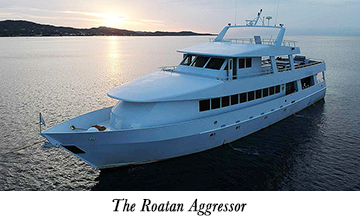 Second in length only to Australia's Great Barrier Reef, the 625-mile Mesoamerican Barrier Reef stretches from the northern tip of Mexico's Yucatan Peninsula, past Belize, to Honduras. Both the Roatan Aggressor and the Belize Aggressor IV operate on this reef system, about 100 miles apart. Curious about how the creatures and conditions might vary, I dived the Roatan reef section in late August and the Belize stretch in October. I found both Aggressor boats to have high standards for hospitality, food, divemasters' professionalism, briefings, and safety culture. While what I saw underwater differed considerably, my dive days were nearly identical on both craft.
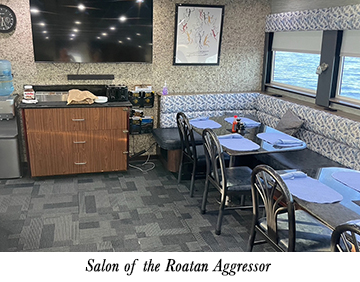 Everything was easy enough until I got to my tiny cabin, which had only 4 x 6 usable feet of floor space between the bunk bed and marine head, with a sink stuffed into the already small cabin space. I had the top bunk, with only 30 inches between the mattress and the ceiling; my head touched the wall on one end while my feet rested on the other. Getting up and down required acrobatic maneuvers to avoid stomping on my roommate in the lower below. Storage space was insufficient. The cramped bathroom held a marine toilet separated by a curtain from the shower stall. But aside from changing clothes or showering, I spent eight hours a day in my cabin only to zonk out, which is, thankfully, what five dives a day will do for you.
 The weather was beautiful, so we traveled 40 miles east to the Cayos Cochinos
Islands to dive into a seamount rising in the ocean. Across the glass-smooth sea,
the only land visible was the cloud-capped tops of the 8000-foot coastal mountains
30 miles south on the Honduran mainland. The Seamount rose steeply from the abyss
to a flat top the size of two football fields, 40 feet from the surface, and was
rich with life. In the bright sunlight, the pristine hard corals, with little algae,
were unusually colorful. Huge sea fans, soft corals, and wire corals covered the
Seamount. As I swam about, I came across virtually every endemic fish: parrotfish,
shoals of Creole wrasse and neon wrasse, groupers, schools of oceanic triggerfish,
a cloud of Bermuda chub intermixed with schools of horse-eyed jacks, eagle rays,
permit and Atlantic spadefish, hawksbill turtles, channel crabs, and lobsters. I
spotted bottlenose dolphins cruising off the edge, as well as a couple of gray reef
sharks and a free-swimming nurse shark. I was enchanted by what looked like large
black dolphins on the edge of the Seamount.
The weather was beautiful, so we traveled 40 miles east to the Cayos Cochinos
Islands to dive into a seamount rising in the ocean. Across the glass-smooth sea,
the only land visible was the cloud-capped tops of the 8000-foot coastal mountains
30 miles south on the Honduran mainland. The Seamount rose steeply from the abyss
to a flat top the size of two football fields, 40 feet from the surface, and was
rich with life. In the bright sunlight, the pristine hard corals, with little algae,
were unusually colorful. Huge sea fans, soft corals, and wire corals covered the
Seamount. As I swam about, I came across virtually every endemic fish: parrotfish,
shoals of Creole wrasse and neon wrasse, groupers, schools of oceanic triggerfish,
a cloud of Bermuda chub intermixed with schools of horse-eyed jacks, eagle rays,
permit and Atlantic spadefish, hawksbill turtles, channel crabs, and lobsters. I
spotted bottlenose dolphins cruising off the edge, as well as a couple of gray reef
sharks and a free-swimming nurse shark. I was enchanted by what looked like large
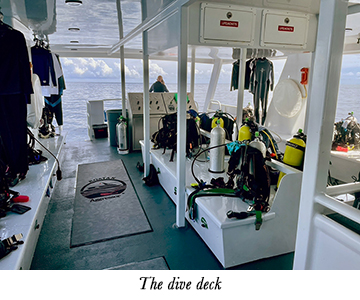
black dolphins on the edge of the Seamount.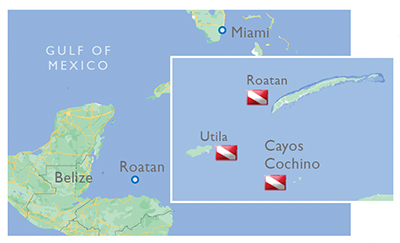 As I was to learn in October when I joined up with the Belize Aggressor, the cabins on the 120-foot (22-foot beam) Roatan Aggressor, as well as the lounge, are smaller than those on the 138-foot (26-foot beam) Belize Aggressor IV. That the dive deck and dive stations are smaller made little difference; the dive platform, access ladders, camera tables, rinse tanks, showers, hot towels, and concierge fin service were identical. The crews stored divers' fins on the dive platform wall. After I kitted up and stepped down to the platform, I held onto the fin rack while a crew member slipped on my fins as I bent each leg back. All I had to do was turn around and step into the water. It gets everyone off the boat quickly. But it also means divers don't have to walk around a rocking boat with their fins on, which sooner or later will land you on your ass. Before entering, they checked that my air was on -- too many divers jumped in with their valves closed. At the end of the dive, a crew member removed my fins from my feet once I had a firm grasp of the ladder. He retrieved my camera, handed it up, and someone dunked it and placed it on a dry shelf. After I doffed my gear, I flushed salt water from its crevices and behind the buttons.
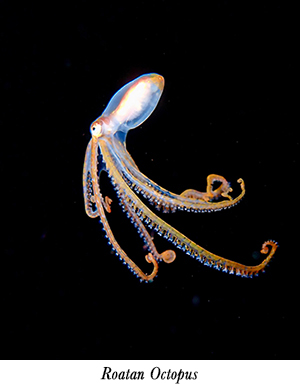
 After diving the Seamount, it was a 40-mile traverse to Utila Island, where we'd be in for "a blow" that night, said Captain Willie, a lifelong waterman born and raised in Utila. He headed for the protected Spanish Bay on Utila's western side, where we could shelter and dive. As we anchored, the clouds came in, the wind picked up, and heavy rain pounded, but we were protected from any waves. We were surrounded by many cayes covered with Casuarina Pine and mangroves; some cayes were inhabited by fishermen in homes on pilings over the water. The shallow, sandy, muddy bottom seemed to me a reasonable comparison to Indonesian muck diving. There was no current; visibility was about 50 feet, the water was 87 degrees, and the maximum depth was only 35 feet for my dives. Sunken tree trunks and branches housed colorful reef fish, including arrow blennies hiding in the eelgrass clumps, horned blennies, and sailfin blennies. Two hawksbill turtles fed in a large expanse of eelgrass. Nearly invisible on the pale bottom, several octopuses hunted. If I approached, they panicked and broke camouflage. On my first dive, I saw many southern stingrays (with jacks trailing as usual), peacock flounders, and clouds of baitfish. Schools of a dozen reef squid let me approach slowly. (The night dive here was excellent, with no change in the marine life from the day, but dive lights brought out unique elements, such as the squid flashing and glowing iridescent colors.) After my night dive, I exited in the pouring rain, grabbed a hot shower on the deck and a warm bathrobe, then climbed to the protected top deck for a tumbler of wine and endless stories about the day's dives.
 The following morning, under clear skies, we sailed around Utila's western tip to the sparsely inhabited north coast, mostly iron shore with small beaches between stretches of mangroves. It's seldom dived and not even listed on some dive maps. Here, a wall drops down into the west end of the Cayman Trench. The Pinnacle has partially broken away from the shear wall and stands just a few yards out toward the blue. The base is well below 100 feet, the diameter about 50 feet, like a large tower, with the top only 10 feet below the surface. The significant surge often sloshed me back and forth several feet. The coral was far healthier than off Roatan but a tad less than that at the Seamount. It was certainly fishy, with a profusion of the usual reef critters, especially those that like the open ocean. I moved into a massive bait ball of silversides that was trying to shelter between the pillar and the adjacent wall. Several tarpons startled me as they shot from behind at 30 miles per. Their wake jostled me, but all I saw was a flash of silver and a hole in the bait ball where they powered through. When a swell caught me just right, I found myself side by side and eye to eye with a tarpon as long as I. Quite a dive, indeed. Apparently, one can snorkel with whale sharks here during the summer season; it's about 80 miles from the south end of Glover's Reef in Belize.
 Nowadays, virtually every diver uses nitrox, though newly certified divers may not take a course immediately. On my trip, a fellow new to diving said his dive instructor had told him that he should never use nitrox, apparently because of a medical disclosure. I brought this up during a hardy dinner with other instructors and experienced divers. (Funny how divers on a liveaboard can start discussions like this with people they don't know!) The fellow had seizures as a child but never as an adult and was not on any medications. While I will not get further into medical details, DAN, UHMS, and others don't find this a contraindication to using nitrox (or diving), and there is not a shred of evidence it is. Not only had his dive instructor wrongly told this person to avoid nitrox, but his neurologist, who knew nothing about diving, also advised against EAN. By the end of the "aggressive" week of air diving, he was so tired (he had run out of bottom time on his computer) that he had to sit out dives. He was disappointed, unnecessarily. It's a good lesson for all novices; don't look to instructors for medical advice; seek it from physicians knowledgeable about how diving affects the body (DAN has a list).
 Divers Compass: Getting to Roatan HN is easy, with major air carriers and airline hubs in the southern USA connecting . . . . . Customs is straightforward and expedited if you complete the Honduran Customs and Immigration form online before departure from home . . . . Twin "staterooms" are 7" x 6'2"; Deluxe are 8'6" by 6'8", the one Master is 11'x10'; Avoid the top bunks when booking; if you sign up for an advertised discounted week (up to 35% off standard rates of $3200-$3900) to fill all bunks shortly before the sailing date, you will probably get a top bunk . . . . charge your gear on sheltered shelves on the deck; no room charging allowed, for obvious reasons . . . . In the winter, cold winds can blow from the north and affect where the boat can travel . . . . On Saturdays, the airport is jammed with flights, another good reason to arrive a day early (and depart a day late) . . . . Roatan's hyperbaric chamber is at Anthony's Key Resort.
I want to get all the stories! Tell me how I can become an Undercurrent Online Member and get online access to all the articles of Undercurrent as well as thousands of first hand reports on dive operations world-wide

| Home | Online Members Area | My Account |
Login
|
Join
|
| Travel Index |
Dive Resort & Liveaboard Reviews
|
Featured Reports
|
Recent
Issues
|
Back Issues
|
|
Dive Gear
Index
|
Health/Safety Index
|
Environment & Misc.
Index
|
Seasonal Planner
|
Blogs
|
Free Articles
|
Book Picks
|
News
|
|
Special Offers
|
RSS
|
FAQ
|
About Us
|
Contact Us
|
Links
|
3020 Bridgeway, Ste 102, Sausalito, Ca 94965
All rights reserved.