
 |

 Email Signup
|
Subscribe
|
Login
Email Signup
|
Subscribe
|
Login
For Divers since 1975 The Private, Exclusive Guide for Serious Divers Since 1975 |
"Best of the Web: scuba tips no other source dares to publish" -- Forbes |
Record Male Great White Spotted off FloridaContents of this Issue: North Fakarava, French Polynesia, Part II How Not to Become an Iron Diver Why Do You Dive Alone? Part Three Last Breath - a Dramatic Diving Story Record Male Great White Spotted off Florida Editorial Office: Ben Davison Publisher and Editor Undercurrent 3020 Bridgeway, Suite 102 Sausalito, CA 94965 from the March, 2025 issue of Undercurrent
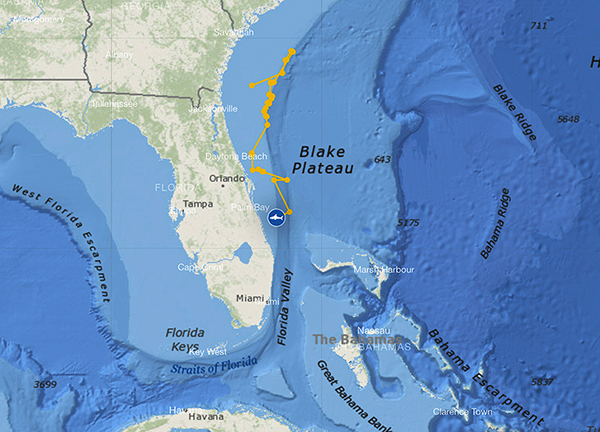
The largest great white male shark ever recorded, weighing 1,653 pounds and spanning almost 14 feet long, was captured and released off Florida's coast on January 17. Researchers have given the giant a fitting name for his terrifying physique: "Contender." Contender was detected and tagged by Ocearch, a global non-profit organization that uses ping technology to track shark movements, resulting in unprecedented information about the ocean's top predators. When the shark breaks the surface of the water, the signal is sent to a satellite. Contender traveled 168 miles over 20 days, at one point taking 72 hours to slowly cover just five miles, according to Ocearch's Shark Tracker. His latest 'ping' was located off Vero Beach, about a half-hour drive from Port Saint Lucie, when he briefly broke the surface on February 23. In January 2019, recreational divers in Hawaii swam with another giant white shark named "Deep Blue," possibly bigger than Contender. It was first seen off the coast of Mexico in 2013. The 2019 sighting became quite controversial when Ocean Ramsey, a shark tour operator, was photographed swimming close to it. (https://bit.ly/4bygjxl) Tiger sharks have long been believed to be mainly a coastal species. However, one tagged specimen has made more than 4,600-mile round-trip journeys every year between two vastly different ecosystems -- the Caribbean's coral reefs and the mid- North Atlantic's open waters. Caribbean reef sharks tend to have smaller ranges. (https://bit.ly/41Hbyy6) Shark enthusiasts can monitor many sharks' migration paths on Ocearch's tracking system. www.ocearch.org/tracker |



I want to get all the stories! Tell me how I can become an Undercurrent Online Member and get online access to all the articles of Undercurrent as well as thousands of first hand reports on dive operations world-wide

| Home | Online Members Area | My Account |
Login
|
Join
|
| Travel Index |
Dive Resort & Liveaboard Reviews
|
Featured Reports
|
Recent
Issues
|
Back Issues
|
|
Dive Gear
Index
|
Health/Safety Index
|
Environment & Misc.
Index
|
Seasonal Planner
|
Blogs
|
Free Articles
|
Book Picks
|
News
|
|
Special Offers
|
RSS
|
FAQ
|
About Us
|
Contact Us
|
Links
|
3020 Bridgeway, Ste 102, Sausalito, Ca 94965
All rights reserved.