
 |

 Email Signup
|
Subscribe
|
Login
Email Signup
|
Subscribe
|
Login
For Divers since 1975 The Private, Exclusive Guide for Serious Divers Since 1975 |
"Best of the Web: scuba tips no other source dares to publish" -- Forbes |
North Fakarava, French Polynesia, Part IIContents of this Issue: North Fakarava, French Polynesia, Part II How Not to Become an Iron Diver Why Do You Dive Alone? Part Three Last Breath - a Dramatic Diving Story Record Male Great White Spotted off Florida Editorial Office: Ben Davison Publisher and Editor Undercurrent 3020 Bridgeway, Suite 102 Sausalito, CA 94965 where the sharks think you are one of them from the March, 2025 issue of Undercurrent
Dear Fellow Diver, With half of our three-week trip left, I was excited to visit Fakarava, French Polynesia's second-largest atoll, about 37 miles by 13 miles, with under 1000 residents. I planned to dive both north and south Fakarava since each has exciting rides through narrow cuts with hundreds of sharks. But neither offered something this Floridian deemed essential in the tropics -- air conditioning.
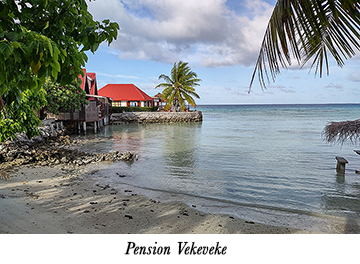
After a five-mile ride past modest buildings with a few stops to drop off other passengers, we arrived at the Pension Vekeveke Village, where we met Thierry, the friendly owner, dressed in cotton swim trunks, the only garment I saw him wear during our stay. A patriarch of a multigenerational family with a full head of wavy dark hair, he showed us to our quaint bungalow with a king bed shrouded in mosquito netting, a fan we never used, a coffee table, and a few shelves. The covered porch, with a beautiful beachfront view, had a card table and two chairs handy for assembling camera gear. Even from my bed, I could look over the peaceful lagoon. Our front room opened on a small beach where we soon snorkeled among damselfish and butterflyfish darting in and out of orchid and creamy yellow corals. The Pension is best described as a guest house, as is most Fakarava guest housing, with eight cottages. "Lagoon" bungalows open over the water, and beach bungalows open onto the beach, which is lined with palm trees; they are farther from the Wifi hotspot, and we had spotty cell service. Two thatch-covered picnic tables are in the water, not far from a dock, leading to a covered sitting area over the water. A large, open-air thatched-roof dining area with a high ceiling and fans had lovely lagoon views. Their simple breakfast included fruits, baguettes, cream cheese, and jam. For dinner, we ate the food put in front of us: the first night, pork loin with barbeque sauce, tuna poke, and green beans. The other meals, though short on vegetables, were fine. In the lagoon below, mullet and groupers begged for handouts, and nurse sharks appeared when someone tossed scraps. Beer and soft drinks ran $6, wine and booze around $15.
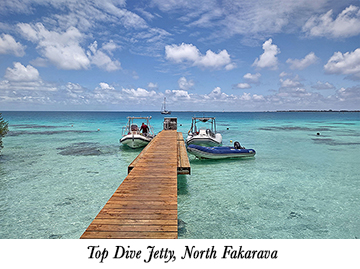
After dropping into the 80-degree water, our guide led us to a shelf at 90 feet that was loaded with rainbow runners, tuna, thousands of yellow goatfish, and scores of gray reef sharks. The sunlight was so bright that I forgot to turn on my strobes. After admiring the crowd, we let the current carry us over the rubble bottom, scoured by current, joining more reef sharks and plenty of colorful tropical fish that let me close enough for good photos. As we made our way farther into the channel, healthy plate corals descended down the sloping wall, with a garden of various finger corals along the top. Forty-five minutes into the dive, the air-sucking Czech frantically signaled he wanted to ascend. What? I still had half a tank of nitrox, but the choice was not ours. We surfaced together. Getting aboard was disorganized, with divers tossing gear into the boat and no regard for cameras. After I climbed the adequate ladder, warm tea and cookies were passed around, and the crew changed out our gear. Another Top Dive boat pulled alongside with more Czech divers, one of whom tossed a large baguette sandwich to their friends on our boat. Our second dive began at 85 feet, but we quickly rose up the reef, where coral seemed less healthy, with lots of dark green encrusting sponges. Entranced with great schools of jacks and barracuda, I almost didn't look up when I heard a shout. Four reef mantas slowly circled us, gradually disappearing into the blue. Just before 50 minutes, I began my safety stop, watching a manta below until two divers with another dive company rushed in, and the manta scurried. Thanks, guys. Having unwisely failed to make pretravel reservations with Top Dive for more days, we found they had no room. Somewhat in a panic, I inquired with half a dozen other companies before finding Kaina Plongee, which accepted for the next day and without a deposit. Their tiny dive shop by the main docks carried rental gear and provided the usual 15L tanks; nitrox must be ordered in advance. Vincent, the owner, took great care of us, especially getting us to and from the dive shop. They could take about 14 divers. Our first dive began with no current and slightly less visibility, still a good 80 feet. At the mouth of the pass, a school of yellowfin goatfish enshrouded me as gray reef sharks weaved through, then we passed through an enormous school of crescent-tail bigeyes while an 8-foot manta swam overhead. A 5-foot humphead wrasse almost bumped into me as it tossed aside slabs of coral foraging for a meal. Two whitetip reef sharks, four large coral groupers, and a titan triggerfish waited behind, hoping to nab an escaping critter. And that's just for starters. As we drifted into the pass, the current picked up, the water became clearer, and the temperature dropped from 79°F to 77°F. Stopping at a canyon called Ali Baba, I watched gray reef sharks swim past large schools of snappers. Diving on air, we had been briefed we might go into deco, and when one couple did, it was time for the dive to end. While others surfaced in rough seas to wait for our boat, my buddy and I joined the deco couple for an extended safety stop. It seems 45 minutes is the standard for drift dives, 50 minutes for reef dives. Back on shore, with three hours to spare between morning and afternoon dives, we grabbed a hamburger and fries at the next store snack bar; "Better than McDonald's," my buddy said.
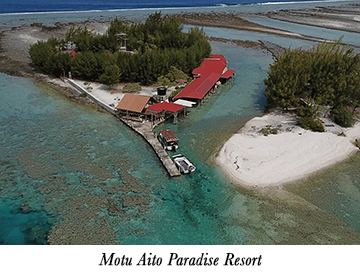
It was difficult to depart the Pension Vekeveke with its picture-perfect setting and responsive staff. At last, I let go of my irrational fear of no air conditioning as night temperature leveled at 72°F and the humidity at 65, similar to a Florida winter. I could hear the gentle waves lapping at the beach and the distant roar of ocean waves. I slept soundly with just the ocean breeze to keep me cool. Oh, there were minor inconveniences. One night, the lights flickered, and I heard a generator starting and stopping in response. We had no water pressure a few times. The misfit toilet seat detached, and I nearly slid onto the floor. None of it mattered; it was part of the charm. As we prepared to travel to South Fakarava, a Vekeveke staffer told us the homemade bus would drop us off at the marina, but we'd have to wait two hours in the afternoon sun for our boat transfer (there is no road). With no taxis on Fakarava, I called the Fakarava Yacht Services and arranged a $20 ride to the marina close to our transfer time with Top Dive. While the Vekeveke owner then offered to take us, Top Dive called to say another boat would pick us up and take us to the harbor. Everyone seems to cooperate in moving tourists about. As our boat from the harbor began its trip to south Fakarava, the Vekeveke owner, decked out in his swim trunks, darted by on a jet ski. An hour-and-a-half later, we were transferred to a small Top Dive boat for the short ride to Motu Aito, our island home for the next three days. Motu Aito has eight bungalows set up for two to five people. Our rustic palm-front bungalow reminded me of camping, with no hot water, air conditioning, or fan, and unscreened windows equipped only with fiberglass window covers propped up by sticks. I could see blacktip sharks swimming under our hut. Over the queen-sized bed, mosquito netting, which we never used, rippled in the gentle breeze. Our room hung over the water and had less of a mosquito problem than our neighbor's bungalow, which had more vegetation around it. He avoided spending time in his room because of the mosquitos.
Motu Aito runs on solar energy and only uses a generator when necessary, which is on an adjacent motu (island) to reduce noise. We used the desk and the sturdy benches in our bungalow to assemble camera gear. We were to charge large devices and laptops during the day to use solar power. A spray nozzle on a short hose was used in the bathroom for the sink, shower, and even, if you wish, a bum gun or a bidet (though toilet paper was handy). There were 14 guests on our first evening, but most left, and we had from four to just us two. They served meals family style. Breakfast always consisted of fresh fruit and baguettes with jam and butter, and lunch usually consisted of fish, pasta, or rice. Tuna Alfredo was my favorite. When they served local tuna ceviche and rice twice for lunch, I disappeared to my bungalow and grabbed a protein bar. The guests enjoyed the raw fish, which was too adventurous for me. Drinking water was readily available; beer was $7. As we ate, camouflage groupers and sergeants stared at us from the cut. A pair of sailfin tangs flared their fins in anticipation. When leftover table scraps were tossed in, as many as nine blacktip reef sharks would appear. Because Motu Aito Paradise is on its own little island, the only entertainment offered was books and games. As the daytime temperature crept into the mid-80s, we cooled off after lunch by snorkeling with various tropical fish and blacktip sharks on the healthy reef outside the inlets. The bottom dropped to 20 feet. I imagine one could get gear for a dive. Top Dive's (yes, they are everywhere) spacious covered dive facility had many benches and areas for cleaning and drying gear, but only a rinse bin for cameras. They were quick to change the water when I mentioned it looked skanky. We received a thorough briefing the first morning before a short ride to the South Pass. Our dive skiff had a wooden bench along each side, under which gear was stowed with the overflow in the center. It had a sturdy ladder. It was a very short ride to the dive sites, and we returned between the dives. Corals covered the slopes on both sides, easily seen in the 100+ foot visibility. On the sandy bottom, we were greeted by schools of long-face emperors curiously lying on the bottom, and soon, also bottom lounging, we came across a whitetip shark. A few gray reef sharks appeared farther into the channel, and soon, we were among dozens of sharks swimming up and down the channel. So we could stop and watch, our guide motioned us to a ridge; we had been told to grasp dead coral, but the coral was so amazing I could barely find a spot to touch; I really needed reef hook. Soon, the channel looked like a traffic jam of sharks commuting to work. Blacktips, whitetips, and even a few silvertips swam among the plentiful gray reef sharks. After watching in awe for 10 minutes, I slipped into the channel and drifted to a long cavern, where we tucked in to watch the sharks pass by. Then, continuing in the channel, large schools of snappers and healthy coral were everywhere. We eventually ended our dive on a bed of coral rubble, where I stood in waist-deep water to wait for our dive boat. This was followed by a second dive, drifting above a massive coral garden for an hour. Quite a show, I must say.
Usually, Top Dive offers two dives a day, but one can arrange more, including a night dive, to see the sharks hunt. A diver who made that dive told me. The shark are frenzied searching for prey in the corals. "You will get bumped if you get anywhere near them." The next day, Top Dive took us to the North Fakarava airport by boat, which was much easier than going to the marina and catching the bus. It seemed like a fitting way to end this great adventure, although we did spoil ourselves at a resort in Tahiti before heading home. Fakarava exceeded my expectations, providing amazing visibility, close encounters with squadrons of sharks, and beautiful coral reefs. If I were to go back, say for two weeks, I would dive only Fakarava and Rangiroa. Visibility was fantastic at both atolls, with lots of big animals and healthy coral full of colorful fish. Rangiroa had plenty of shark action, but the friendly dolphins made the experience unforgettable. At North Fakarava, we had even more sharks and reef mantas. At South Fakarava, we had very close shark encounters, shooting past scores as we flew through the channel. And we spent an entire dive drifting through the beautiful coral gardens. I've been diving all over the world, but I've never done land-based diving that offers this level of excitement. And prices are excellent. -- F.L. Our undercover diver's bio: "As a child, I poured over National Geographic underwater articles. I got certified in 1991 while stationed at Andersen AFB, Guam, and my first dive trips were to Palau and Truk. I have made more than 2,000 dives, mainly in Florida but also in the Philippines, Indonesia, the Revillagigedo Islands, the Sea of Cortez, and the Red Sea."
|


 As our 150-mile flight from Rangiroa descended over Fakarava's north pass, I saw the water boiling where the outbound current collided with the ocean. I wondered who the first brave person was to dive in these conditions. At the small airport, after a free-for-all to collect luggage, we carried our bags to a trailer where a guy tossed them in, and we climbed into a covered flatbed trailer with benches pulled by a diesel truck.
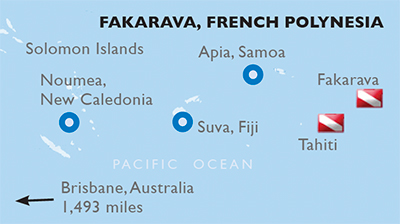 Top Dive offered two dives and day trips to South Fakarava but no night diving. They could handle up to 16 divers, but the 26-foot boat we used was crowded with us, three Czech divers, a divemaster, and a captain. After a 25-minute ride with lots of salt spray, we stopped and reviewed hand signals with our dive guide, who said we'd drift through the pass in the light current. One apprehensive Czech insisted he wanted to ascend with 70 bar (1000 psi); I had a bad feeling we were in for a short dive.
 My only complaint is that one of their boats
had no dive ladder. I had to kick onto the dive deck
and push myself up, boosted by waves in rough water.
Keep in mind these are isolated islands with tiny
populations; dive operations are basic, not unlike
the Caribbean forty years ago.
My only complaint is that one of their boats
had no dive ladder. I had to kick onto the dive deck
and push myself up, boosted by waves in rough water.
Keep in mind these are isolated islands with tiny
populations; dive operations are basic, not unlike
the Caribbean forty years ago.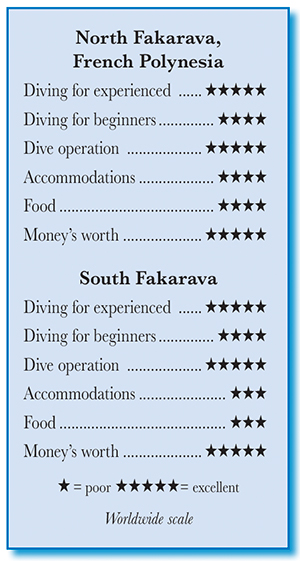 We slept with the door open, covered by a curtain, to get a cross breeze. Aito, one of the cats, took this as an invitation to join us in bed one morning, cuddling between us and trying to suckle my partner's nipple, then his ear lobe. When I mentioned this at breakfast, there was a lot of snickering and head nodding. Aito had been making the rounds.
 On my third diving day, our guide, Gregory, asked what I wanted to do for our
last dive. "How about starting with sharks, then moving into the coral gardens to
see lots of fish? And make it a long dive." Gregory took us to the coral ledge to
watch the sharks, but it soon became crowded with other divers arriving from North
Fakarava. To avoid them, we dropped to the bottom at 90 feet in the middle of big
shark territory, where several looked pregnant. Slowly crossing to the other side
of the channel, we followed the slope up, watching small fish dart in and out of
the vibrant corals. I ran into a wall of bluestriped snappers, who were reluctant
to give way. We ended by soaring over the coral garden 20 feet deep while
thousands of blue-green chromis flowed in the other direction. After 70 minutes,
we ascended over a half mile from where we had begun.
On my third diving day, our guide, Gregory, asked what I wanted to do for our
last dive. "How about starting with sharks, then moving into the coral gardens to
see lots of fish? And make it a long dive." Gregory took us to the coral ledge to
watch the sharks, but it soon became crowded with other divers arriving from North
Fakarava. To avoid them, we dropped to the bottom at 90 feet in the middle of big
shark territory, where several looked pregnant. Slowly crossing to the other side
of the channel, we followed the slope up, watching small fish dart in and out of
the vibrant corals. I ran into a wall of bluestriped snappers, who were reluctant
to give way. We ended by soaring over the coral garden 20 feet deep while
thousands of blue-green chromis flowed in the other direction. After 70 minutes,
we ascended over a half mile from where we had begun. DIVER'S COMPASS: For one person; Pension Vekeveke Village in North Fakarava with half board for four nights, $624 . . . Moto Aito Paradise in South Fakarava with full board for 3 nights, $1200,
I want to get all the stories! Tell me how I can become an Undercurrent Online Member and get online access to all the articles of Undercurrent as well as thousands of first hand reports on dive operations world-wide

| Home | Online Members Area | My Account |
Login
|
Join
|
| Travel Index |
Dive Resort & Liveaboard Reviews
|
Featured Reports
|
Recent
Issues
|
Back Issues
|
|
Dive Gear
Index
|
Health/Safety Index
|
Environment & Misc.
Index
|
Seasonal Planner
|
Blogs
|
Free Articles
|
Book Picks
|
News
|
|
Special Offers
|
RSS
|
FAQ
|
About Us
|
Contact Us
|
Links
|
3020 Bridgeway, Ste 102, Sausalito, Ca 94965
All rights reserved.