
 |

 Email Signup
|
Subscribe
|
Login
Email Signup
|
Subscribe
|
Login
For Divers since 1975 The Private, Exclusive Guide for Serious Divers Since 1975 |
"Best of the Web: scuba tips no other source dares to publish" -- Forbes |
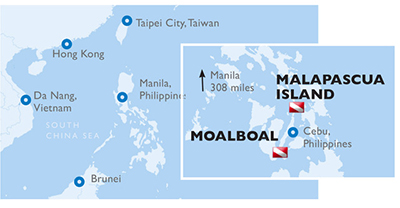
Malapascua, Moaboal, PhilippinesContents of this Issue: Malapascua, Moaboal, Philippines Mandarinfish at Lighthouse Reef Microplastics in the Ocean? It's Your Car Tires Passengers Board, but this Aggressor Doesn't Sail Cozumel, Mahahual, Roatan by Cruise Ship Florida Fish Spinning in Circles How Should We Tip the Dive Crew? Medical Examiner's Evaluation Form The Astounding Rate of Liveaboard Deaths More Details of the Sinking of MY Sea Legend Editorial Office: Ben Davison Publisher and Editor Undercurrent 3020 Bridgeway, Suite 102 Sausalito, CA 94965 undulating thresher sharks, swirling sardines from the April, 2024 issue of Undercurrent
Dear Fellow Diver,
But Malapascua is complicated to reach, so to make it worthwhile, I added a second stop, Moalboal, famous for its great schools of swirling sardines. After changing flights in Manila, I arrived at Mactan-Cebu International Airport and overnighted at the Reef Island Resort. The next morning, my partner, I, and two other divers were picked up for a five-hour van ride, weaving in and out of traffic, passing trikes, jitneys, trucks, and scooters with lots of horn honking, all made more difficult as we sat in the cramped van with our knees up to our chests. Then, it was a 45-minute ride aboard a 30-passenger ferry to Malapascua, an island half the size of Central Park. We pulled up to the Thresher Shark Divers Shop, where I dropped off my dive gear, and the staff carried my other belongings to Tepanee Beach Resort, a 5-minute walk. The island has no cars -- pushcarts and muscle move about everything. The next morning, we motored to Monad Shoal, once the threshers' home, until tiger sharks moved in. We dropped to a sandcovered plateau 50 feet deep, accented with small clumps of coral and rubble, where I watched damselfish, zigzag wrasses, schools of striped catfish, and colorful anthias. Our guide found a large-scaled dwarf flounder and a four-inch painted frogfish dangling its long lure. But no tiger sharks. Oh well. As the dive ended, I didn't have high hopes for seeing threshers at the next destination. But wow. How wrong I was. As soon as I descended at Kimud Shoal, our dive guide, Mark, pointed at two gray shadows in the distance, only a hint of what was to come. Soon, several threshers swam by, and then again, this time closer, and one swam back and forth between another diver and me as we took endless photos. It was 40 feet deep, the top of Kimud Shoal. The nondescript bottom with rubble, sand, and small coral heads drops off to a wall we explored, but the thresher encounters occurred at the top.
Rarely seen elsewhere by divers, threshers are drawn to Kimud Shoals to be cleaned, and I saw a few being tidied up by crescent wrasse. I never saw the threshers feed. My additional three dives with threshers were as exciting as the first. On our last dive, five threshers appeared simultaneously, their undulating tails gracefully, slowly propelling them. To reach the threshers it's a 40-minute boat ride. They ran two 40-foot, traditional wooden bangka boats, partially shaded, comfortable, and stable, with twin bamboo outriggers. The dozen divers aboard were assigned four to a divemaster. After a dive, I had to swim to the boat carefully to ensure rising and falling outriggers didn't hit my head. The divemaster handed up my camera, the crew pulled up my BCD, I removed my fins and then climbed a wooden ladder. The stern held the helm, a kitchen, and a primitive bathroom; to flush one poured salt water from a bucket.
They require advanced certification for shark diving because one needs good buoyancy control to keep from stirring up the bottom and spooking the sharks. The crew enforced stringent rules -- no strobes or video lights and no chasing or touching the sharks. Two idiots were chastised for blowing off the rules -- one used a large strobe, and the other jabbed his GoPro stick at a shark. Startled, it quickly fled. I watched in dismay as a woman from another boat swam upside-down under a thresher and reached out to grab its tail. On one dive, when tiger sharks didn't appear, I got permission from the divemaster to use my flash on frogfish.
My partner and I had a bungalow on the cliff's edge with blue-water views. The large room had tile floors, a small desk where we serviced our cameras, a closet, and a kettle with instant coffee and tea. An on-demand water heater in the bathroom provided endless hot water. Some evenings, we invited guests for cocktails on our roomy deck at sunset. One evening, a large spider crawled up the wall. Having a Buddhist mentality, I captured it in a glass. As I released it outside, the thankless guy jumped on my hand; I'm sure my neighbors heard me yell. Their upscale restaurant, Amihan, with million-dollar views, was open for breakfast for guests only, and to the public for dinner. The breakfast buffet provided fruits, vegetables, pastries, breads, cereal, yogurt, breakfast meats, and eggs any style. For lunch, Ristorante Angelina was right outside the gate to Tepanee, where there was great crispy pizza, pasta, and shish kabobs. Amihan dinners were mainly Italian dishes. One evening I ordered fried chicken, a plate-sized chicken schnitzel; I saved half for lunch the next day, accompanied by fruit from a local market. The bar was quite inviting, with beer about $2.10, a bottle of wine for $24, and a shot of Johnnie Walker Black for $4.
During our week, we explored other sites, such as Gato Island's swim-thrus and long tunnels, where I saw several large whitetip sharks and even a sea snake. In the darkest areas, schools of sweepers swam overhead. Outside the tunnels, our sharp-eyed dive guide, Mark, showed us several nudibranchs, cuttlefish, spiny seahorses, and three pygmy seahorses on a fan at 60 feet. At Monad Shoal, I spotted a small tiger shark 40 feet below during the safety stop. Other dives were a good mix of rubble and sand with high-profile reefs or wall dives, often with large turtles and small creatures like anemone shrimp and wire coral crabs. Quilano had two bright orange frogfish, an electric blue variable jawfish, and my newest obsession, the scarletfin flasher wrasse. Currents were mild everywhere except for one pinnacle where we were whisked away during our safety stop. No matter how much effort one puts into dive trip planning, it's impossible to nail the water conditions, and it turns out my trip coincided with colder, murkier water that comes for a few weeks in early March. Bottom temperatures ranged from 75 to 79°F, and visibility at Gato Island was less than 30 feet. I wished for my 5mm wetsuit. After a week at Malapascua, I was ready to head back to Cebu island to dive among the great sardine balls. After a private ferry dropped us at Maya Port, it was another 5-hour van ride -- Andrea saw that we had a more comfortable van -- to Cebu Seaview Dive Resort, which had several waterfront rooms and about a dozen in a two-story building. Ours had lots of shelves, a large desk to work on our cameras, tea and instant coffee, and an on-demand heater in the shower. A sliding door opened to a small back porch with two chairs and a table where we could dry wet gear. A nice infinity pool and bar, a large open-air restaurant with water views, and a small beach made for an attractive and comfortable resort.
On our first dive along a wall, I encountered great schools of swirling and spiraling sardines, creating magnificent artistic patterns that reminded me of Van Gogh's Starry Night. Free divers descended into the schools, creating round fissures in the ever-changing patterns, but no fish came to feed. Most dives were drifts along the wall, five minutes out. On the sandy bottom of Moalboal Bay, I found lots of shrimp gobies and pipefish, a starry blenny, and clownfish flitting about their anemone homes. During the safety stop near the top of the wall, I had plenty of fish and critters to shoot in the 40 to 60-foot visibility. Water was 75 to 79°F. At Pescador Island, I had a great ride, drifting along the entire length while enjoying colorful soft corals and abundant reef fish. We surfaced in seas so rough our guide nearly got crushed by the ladder when he tried to steady another woman as she climbed aboard. Rather than hand up my gear, I climbed the ladder with my gear on, which I think was safer for both me and the guide. They had no rinse tank, so after diving, I hosed down my gear (and myself) before storing it in the dive gear room. Using a hose was much more sanitary than a rinse tank with lots of wetsuits tossed together -- well, I can smell what happens in many of those wetsuits. We saw no large animals underwater except for a few green turtles. (While we approached a mooring by White Beach, a young whale shark swam within a few feet of shore, exciting several beachgoers.) While I found wide-angle invaluable diving with sardines, the rest of the time, I shot macro and close-up subjects like painted frogfish, sexy shrimp, and, in the overhangs, sea spiders, dragonets, and shrimp gobies. I became obsessed with fairy wrasses I had never seen before, such as the yellowback.
One late afternoon, our dive guide, Arvin, took my partner and me on a dusk dive to see mandarinfish. It was a long walk to dive depth, and Arvin pulled our tanks and BCDs while we carried cameras and fins. In chest-deep water, we geared up and headed to the mandarinfish, where we spent 45 minutes on a single coral head pursuing these magnificent little fish. I never saw any boom-chicka-wow-wow mating behavior I had hoped for, but I did get some excellent shots. The onsite restaurant was a bright side. For breakfast, they cook eggs to order and offer fruits, rice, toast, sausage, pork, beef, and more. One could eat other meals at the pool bar or restaurant, including Filipino, Asian, American, and Italian dishes. The food was very good -- except for incinerated chicken one night. My favorite meal was sweet and sour pork, followed closely by their ham and cheese on a fresh baguette. Our food and bar tab for two came to US$110 for 4.5 days of dining. For terra firma excitement, Thresher Shark Divers arranged a canyoneering trip on our last day. I ziplined in a Superman position down into a canyon and then hiked 20 minutes downhill to a river, where we continued hiking down the rocky river bed, another 20-minute hike out. After a couple of weeks of diving, which provides little exercise, I was sore for three days from all the rock scrambling. But it was an excellent excuse to get a massage at our next stop. Neither my partner nor I could make all the dives during this trip. At first, jet lag was the culprit, then sinus problems. Neither shop refunded any of the prepaid dive packages, which didn't surprise me. So, one tip I offer is to arrive a couple of days early to beat jet lag. The other is to come prepared with whatever you need to treat such things as sinus issues or any other problem you might expect, from acid reflux to coral cuts. You can't depend on getting the most simple medical supplies at isolated places. Still, I got plenty of excellent dives, swam with threshers and sardines, got tons of good photos, and certainly got my money's worth. -- F.L. Our undercover diver's bio: As a child, I poured over National Geographic underwater articles. I got certified in 1991 while stationed at Andersen AFB, Guam, and my first dive trips were to Palau and Truk. I have made more than 2,000 dives, mainly in Florida but also in the Philippines, Indonesia, the Revillagigedo Islands, the Sea of Cortez, and the Red Sea.
|


 I had a single reason to make the long, tiring journey
to Malapascua. Thresher Sharks. The animals average
about 10 feet or more, and more than half of that is
their magnificent arching tail, which they use to frighten
and chase their prey into schools so they can feed on
them.
I had a single reason to make the long, tiring journey
to Malapascua. Thresher Sharks. The animals average
about 10 feet or more, and more than half of that is
their magnificent arching tail, which they use to frighten
and chase their prey into schools so they can feed on
them.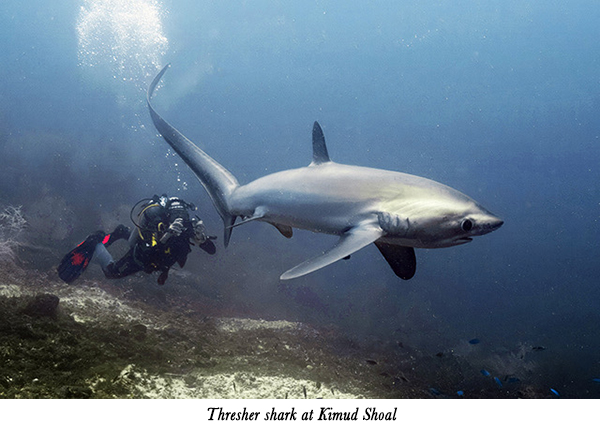
 While the diving was leisurely, having to
arrive at either 4:45 a.m. or 5:45 a.m. to board
for a shark trip was tough, especially after all
that travel. With the restaurant not yet open for
breakfast, I found sustenance at a 24-hour bakery
a short walk away, which I supplemented with whatever I had saved from the
previous day. The crew provided
boiled eggs and soft rolls when
we made three dives.
While the diving was leisurely, having to
arrive at either 4:45 a.m. or 5:45 a.m. to board
for a shark trip was tough, especially after all
that travel. With the restaurant not yet open for
breakfast, I found sustenance at a 24-hour bakery
a short walk away, which I supplemented with whatever I had saved from the
previous day. The crew provided
boiled eggs and soft rolls when
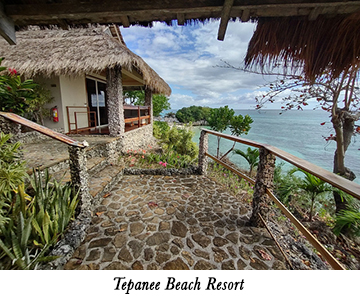
we made three dives.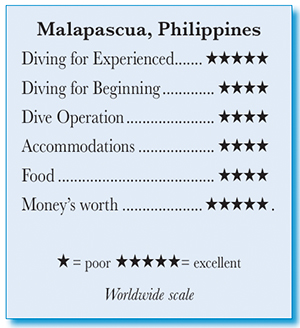 The modern Tepanee Beach Resort, built on a hill, was a lovely place to return
after diving. A small gym, a beach bar with shaded lounges for resort guests only,
and a small private beach added to the hotel's charm. But steep stone stairs and
paths down to the bungalows looked like landmines to me; I broke my foot on a
Bonaire dive trip, and I didn't want a
repeat.
The modern Tepanee Beach Resort, built on a hill, was a lovely place to return
after diving. A small gym, a beach bar with shaded lounges for resort guests only,
and a small private beach added to the hotel's charm. But steep stone stairs and
paths down to the bungalows looked like landmines to me; I broke my foot on a
Bonaire dive trip, and I didn't want a
repeat.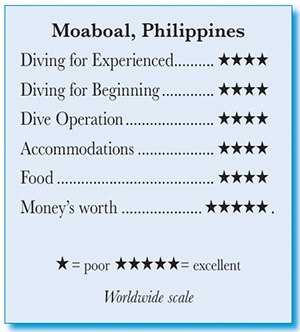 Tepanee owners Sylvia and Andrea,
Italian expats, live on the property.
They have three desalination systems
for fresh water and treat and recycle
water for other uses. They created a
marine preserve to protect the reef and
fish out front. Guests were mainly from
Europe, with a large group from Italy.
Tepanee owners Sylvia and Andrea,
Italian expats, live on the property.
They have three desalination systems
for fresh water and treat and recycle
water for other uses. They created a
marine preserve to protect the reef and
fish out front. Guests were mainly from
Europe, with a large group from Italy.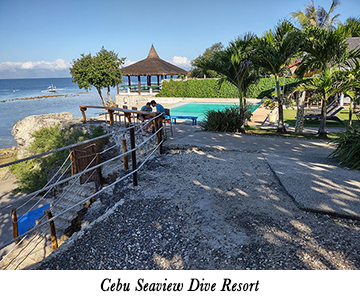 Cebu Fun Dive had two large bangkas with outriggers -- they required a backroll
with a five-foot drop -- and one small boat that together could handle about
30 divers for three dives a day plus a night dive; one could shore dive with a
guide.
Cebu Fun Dive had two large bangkas with outriggers -- they required a backroll
with a five-foot drop -- and one small boat that together could handle about
30 divers for three dives a day plus a night dive; one could shore dive with a
guide.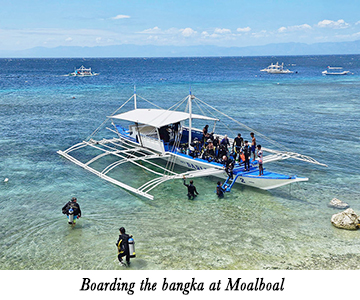 At low tide, it's a long walk out to the boat, so the staff carried major gear
to the water and then towed it out. My dive guide offered to carry our net bag with
weights, fins, and mask, either in deference to our carrying cameras as well, our
ages, or, if I'm not being too cynical, perhaps he just considered us Americans,
compared to the Europeans, good tippers.
At low tide, it's a long walk out to the boat, so the staff carried major gear
to the water and then towed it out. My dive guide offered to carry our net bag with
weights, fins, and mask, either in deference to our carrying cameras as well, our
ages, or, if I'm not being too cynical, perhaps he just considered us Americans,
compared to the Europeans, good tippers. Divers Compass: Seven nights at Tepanee Beach Resort in a Deluxe
Double room, breakfast included, $690 total for two . . . . 30
nitrox dives, $1020; they have good rental gear and night dives,
if enough divers join . . . . Spa services, including massages,
are available . . . . Five nights Cebu Seaview Resort garden
Deluxe room, breakfast included, $305 for two . . . . Cebu Fun
Dives 20-dive package, $680; five percent discount if you have
your own gear; their rental gear looked well-maintained . . .
. . Transfers from Cebu to Malapascua, to Moalboal, to Cebu,
including ferries, are $350; miscellaneous park and environmental fees, $115 . .
. . The chamber is at Cebu City, about seven hours away from Malapascua . . . .
Late February to May is supposed to be the calmest, clearest season, but it was
chilly, with lower visibility, and cold water blowing in . . . . Typhoon season
is from October to December . . . . . Thresher Shark Divers' hands-on owner,
Andrea, made all the travel arrangements for me: vans, ferries, hotels, diving,
and even a canyoneering, making a complex trip very easy. Thresher Shark Divers
Divers Compass: Seven nights at Tepanee Beach Resort in a Deluxe
Double room, breakfast included, $690 total for two . . . . 30
nitrox dives, $1020; they have good rental gear and night dives,
if enough divers join . . . . Spa services, including massages,
are available . . . . Five nights Cebu Seaview Resort garden
Deluxe room, breakfast included, $305 for two . . . . Cebu Fun
Dives 20-dive package, $680; five percent discount if you have
your own gear; their rental gear looked well-maintained . . .
. . Transfers from Cebu to Malapascua, to Moalboal, to Cebu,
including ferries, are $350; miscellaneous park and environmental fees, $115 . .
. . The chamber is at Cebu City, about seven hours away from Malapascua . . . .
Late February to May is supposed to be the calmest, clearest season, but it was
chilly, with lower visibility, and cold water blowing in . . . . Typhoon season
is from October to December . . . . . Thresher Shark Divers' hands-on owner,
Andrea, made all the travel arrangements for me: vans, ferries, hotels, diving,
and even a canyoneering, making a complex trip very easy. Thresher Shark Divers

I want to get all the stories! Tell me how I can become an Undercurrent Online Member and get online access to all the articles of Undercurrent as well as thousands of first hand reports on dive operations world-wide

| Home | Online Members Area | My Account |
Login
|
Join
|
| Travel Index |
Dive Resort & Liveaboard Reviews
|
Featured Reports
|
Recent
Issues
|
Back Issues
|
|
Dive Gear
Index
|
Health/Safety Index
|
Environment & Misc.
Index
|
Seasonal Planner
|
Blogs
|
Free Articles
|
Book Picks
|
News
|
|
Special Offers
|
RSS
|
FAQ
|
About Us
|
Contact Us
|
Links
|
3020 Bridgeway, Ste 102, Sausalito, Ca 94965
All rights reserved.