
 |

 Email Signup
|
Subscribe
|
Login
Email Signup
|
Subscribe
|
Login
For Divers since 1975 The Private, Exclusive Guide for Serious Divers Since 1975 |
"Best of the Web: scuba tips no other source dares to publish" -- Forbes |
Five Improperly Equipped Divers Die at 200 feetContents of this Issue: Conch Republic, Amoray; Upper Keys, Florida Sharks on Drugs in the Bahamas Crystal Blue Resort, Anilao, Philippines Five Improperly Equipped Divers Die at 200 feet Diving Into the Unknown, a Documentary The Diver Medical Form: Part 1 Divers Overestimate Their Skills and beat up reefs Editorial Office: Ben Davison Publisher and Editor Undercurrent 3020 Bridgeway, Suite 102 Sausalito, CA 94965 why did they undertake that dive? from the June, 2026 issue of Undercurrent
The death of four Italian sport divers and a dive guide in the Maldives on May 14 is perhaps the most serious sport diving tragedy ever. Using normal scuba gear, they dived deep into a cave off the island of Alimatha in Vaavu atoll, a popular diving spot, and never returned. Their deaths are fraught with error, a lesson for all of us.
The deceased included a 51-year-old marine biologist from the University of Genoa, Monica Montefalcone, her 22-year-old student daughter, Giorgia Sommacal, university researcher Muriel Oddenino (31), marine biology graduate Federico Gualtieri (30), and the dive guide, Gianluca Benedetti (44). They dived into a cave about 200 feet deep, where even a short time at that depth would require a greater gas supply (they used only air) and lengthy decompression stops. Benedetti's body was first recovered from an outer section of the cave (he is said to have navigated the ferocious currents of the Vaavu Atoll since 2017), while the others were found farther into the cave system. They were diving from the luxury liveaboard MY Duke of York, and, according to Orietta Stella, the legal representative of Albatros Top Boat (the boat's charterer), their diving was supposed to involve coral-sampling at standard recreational depths. The University of Genoa was quick to distance itself from the tragedy, saying that though researchers were on a scientific mission in the Maldives, they had taken the fatal dive on their own, while other tourists aboard MY Duke of York engaged in normal recreational diving. The Wrong Dive Kit Because "the group was using standard 80 cu. ft. cylinders, not suited to depth below 100 feet," Laura Marroni, CEO of DAN Europe, told La Repubblica, "they would have had little time to turn around [if they took a wrong turn]." The divers ran out of air. Monica Montefalcone, one of the five divers who drowned, had published multiple studies involving the collection of sediment from the bottom of the ocean floor on dives at depths of 260 feet, deepening the mystery on her funeral day about why she and her daughter decided to go down without appropriate equipment. Desperate not to attach blame to those who lost their lives, many "experts" who were buttonholed by reporters offered theoretical explanations with no evidence, a favorite being that the divers were helplessly drawn into the cave by a current caused by the site's unique entrance. This was dismissed by Sami Paakkarinen, one of the Finnish divers who retrieved the bodies. He told the Italian paper Corriere della Sera: "It's a huge cave. It's not possible they were sucked in. [The current is not strong and only derived from the rise and fall of the tide.] At 60 metres (197 feet) deep [in the Maldives] it's still daylight outside. When you enter a cave, you know it because it gets dark. You don't risk accidentally entering a cave." Shaff Naeem, a well-known Maldivian technical diver, confirmed Paakkarinen's view: "I have visited that cave countless times. There is no current [in the cave]. The Italian group swam into that last chamber. They chose to go in there."
Some news reports mention oxygen toxicity, but no knowledgeable diver would have planned to dive that deep with nitrox (oxygen-enriched air). But then, one might argue that no knowledgeable diver would have planned to go that deep with just air in a single 80 cu. ft. cylinder. Investigators examined the boat's compressor, but found no evidence that a poorly installed or maintained air filtration system allowed carbon monoxide (in exhaust fumes from the ship's engines) to bypass filters and enter the cylinders; only a small amount of CO would be fatal at such depth. So, Why Enter the Cave? The group may have intended only to visit the mouth of the cave (an exceptional depth for their gear), but once there, they decided to venture in just a little way to have a look. After all, how often are we divers tempted to investigate a cave or a swim-thru we stumble across, equipped only with a single tank and maybe no underwater light? We enter an overhead environment naively thinking we'll just take a quick look, but then something catches our eye, and with a few quick kicks, we investigate. How often do we follow other divers who appear confident into dark or confined spaces, and soon regret it? You and I have gotten away with it. Even though we know that cave training, adequate gas supplies, and appropriate equipment are essential to enter a cave. Even though we know a casual approach can lead to disaster. What were these experienced divers thinking? Or were they, at 200 feet, even capable of thinking? They surely knew that in caves, loss of vision through stirred-up silt is a killer. John Volanthen from the British Cave Rescue Council, one of the two British cave divers who in 2018 searched for and found the boy's football team trapped in a Thai cave, told CNN, "If the cave becomes silty, as is normal for this type of cave, finding the way out becomes much more difficult. Panic can also affect divers, with risks increasing on deeper dives due to nitrogen narcosis."
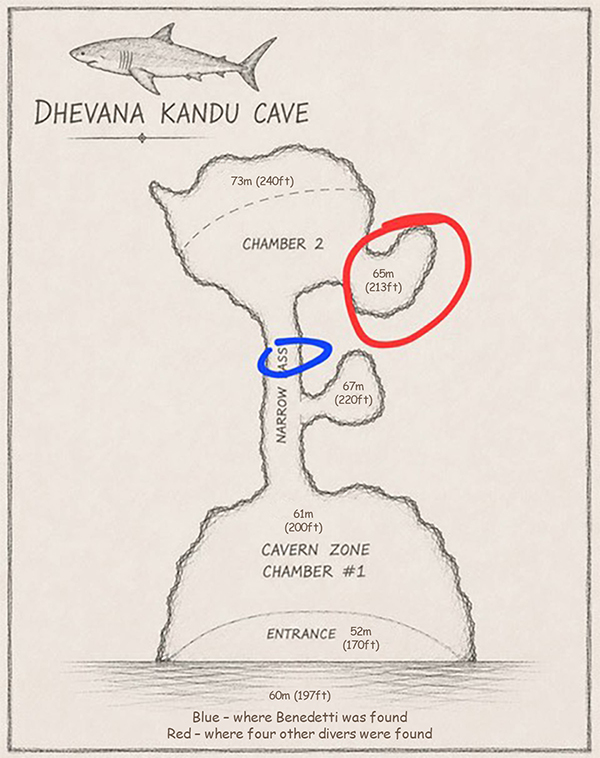
They surely knew that to enter a cave, where silt would be inevitable, it was essential to firmly attach a guideline to a fixed point at the cave entrance, then deploy it as they moved away from the light at the entrance. Like Theseus, of Greek legend, and his ball of string, you can find your way back out -- even if the cave is shallow. Of course, they knew this. Even a line laid by someone else can be deceptive, leading one the wrong way if no direction markers are attached. So, unless you are fully prepared for cave diving, you should never lose sight of the blue window of daylight formed by the cave entrance. Rob Palmer, the pioneering British cave diver who died deep reef diving in 1997, regularly espoused the mantra, "You lose the line -- you lose your life." One or all of these elements may be part of the mystery about how the tragic dive unfolded. The Sixth Victim After the cave divers were missing, the cave claimed a sixth victim: Maldivian National Defence Force diver, Sergeant Major Mohammed Mahudhee. Using ordinary air in a single tank -- inappropriate for a lengthy dive at that depth -- he lost his life to DCI during the initial search for the bodies in the outer part of the cave. Shaff Naeem, who had dived many times in the Devana Kandu cave in Vaavu Atoll and had originally trained Mahudhee, told the Maldives Independent, "Despite being one of the best divers in the Maldivian National Defense Force, he was not trained for the fatal mission . . . He went in with the wrong gas, with no recompression chamber on site and no specialist team -- 24 hours before the international cave-diving specialists were due to land." Naeem said Mahudhee was "the kind of diver every team wants beside them when things get difficult underwater. Calm, reliable, disciplined, and always ready to step forward when others hesitated." Military divers do what they are told to do, despite what diving rules might apply. The Questions Unanswered Why was the Italian group using just air for a dive of that depth? Did they go that deep on a lark or plan it? Why did they not realize they had insufficient air or that it was the wrong gas? Why did they not use multiple tanks or closed-circuit rebreathers? Why did they not take steps to ensure a safe egress from an overhead environment by using a guideline? Naeem told the New York Post, "Everyone knows the rules were broken. The entrance to the cave is more than 170 feet deep, and it extends some 330 feet inward. There is no third chamber [as reported by various media]. There are two main ones and a passageway connecting them." Naeem provided Undercurrent with a rough sketch of the cave to counter misinformation and AI-derived illustrations disseminated by non-diving-related media. There has been a limit on recreational diving below 100 feet in the Maldives since 2003. Hubris kills divers. Search and Recovery On May 17, acclaimed Finnish cave-rescue divers Sami Paakkarinen and Patrik Grönqvist (who became internationally known with the release of the 2016 documentary Diving Into The Unknown) and Jenni Westerlund, a mine rescue specialist, arrived in the Maldives equipped with closed-circuit rebreathers to search for and recover the remaining bodies.
The following day, they located the four bodies far inside the cave system, nearly 200 feet deep. They identified a side passage off the innermost chamber that indicated the deceased divers had lost their way, probably due to visibility obscured by silt. The body recovery was straightforward for such experts, and once the dead were taken out of the cave entrance, they were transferred to military divers. The Cause? So, what was the cause of the tragedy? For starters, insufficient and inappropriate gas for the depth of the dive, combined with an overhead environment and poor planning. With their inadequate dive-lights in a pitch-dark space with a silt bank (also described as a 'sandbank'), it would be difficult, if not impossible, to find the exit. With minds befuddled by narcosis, disorientation sparked by panic from dwindling air, and no marked guideline, they turned the wrong way and swam into the short side passage. It was a dead-end mistake. After speaking with the Finns, DAN Europe's communications manager, Cristian Pellegrini, said that a narrow passage beyond the first chamber led to the large second chamber. "I wouldn't call [the dead-end passage] a 'third chamber' . . . Its entrance closely resembled the passageway leading to the [outer] cavern and the exit, but it was much more obvious than the right exit when observing the scene from the second chamber." Evidently, only Benedetti found his way to the exit passage (though we don't know if he entered the last section), where his body was found. However, he did not have enough air to surface and drowned. It was a tragedy that need not have happened.
The Autopsy The bodies were repatriated to Italy on May 23, and post-mortem medical examinations found that "The direct cause of death for all five victims was asphyxiation due to gas depletion in an overhead environment . . . Tissue pressure data and forensic biological clocks indicate that the four victims -- Professor Monica Montefalcone, her 22-year-old daughter Giorgia Sommacal, researcher Muriel Oddenino, and research assistant Federico Gualtieri -- shared an almost identical time of death, diverging by a mere one to three minutes. Local instructor Gianluca Benedetti's time of death occurred approximately five to seven minutes prior to the rest of the group." Even the Best Can Get It Wrong Devastated by the loss of both wife and daughter, Carlo Sommacal, Montefalcone's husband, insisted, "My wife is among the best divers on earth, and she wouldn't have put anyone in the group in danger." But even the best can get it wrong. So, I conclude this mystery by saying there are old divers, and there are bold divers. But bold divers who are now old are quite rare. As Rob Palmer often said about cave-diving, "Get it wrong, and you're dead." In diving, that can apply to anyone on any dive. John Bantin P.S.: At the last minute, the sixth member of the Italian group decided not to dive and stayed on the boat. While it would be important to hear why she stayed on board and what the other divers were planning, for the time being she is not speaking to the press. (John Bantin was originally taught basic cave diving by Rob Palmer, who, ironically, died on a deep reef dive.) |

 = publicly available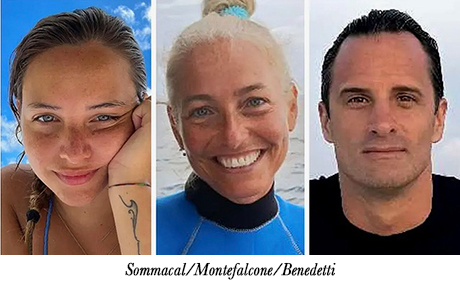

I want to get all the stories! Tell me how I can become an Undercurrent Online Member and get online access to all the articles of Undercurrent as well as thousands of first hand reports on dive operations world-wide

| Home | Online Members Area | My Account |
Login
|
Join
|
| Travel Index |
Dive Resort & Liveaboard Reviews
|
Featured Reports
|
Recent
Issues
|
Back Issues
|
|
Dive Gear
Index
|
Health/Safety Index
|
Environment & Misc.
Index
|
Seasonal Planner
|
Blogs
|
Free Articles
|
Book Picks
|
News
|
|
Special Offers
|
RSS
|
FAQ
|
About Us
|
Contact Us
|
Links
|
3020 Bridgeway, Ste 102, Sausalito, Ca 94965
All rights reserved.