
 |

 Email Signup
|
Subscribe
|
Login
Email Signup
|
Subscribe
|
Login
For Divers since 1975 The Private, Exclusive Guide for Serious Divers Since 1975 |
"Best of the Web: scuba tips no other source dares to publish" -- Forbes |
Crystal Blue Resort, Anilao, PhilippinesContents of this Issue: Conch Republic, Amoray; Upper Keys, Florida Sharks on Drugs in the Bahamas Crystal Blue Resort, Anilao, Philippines Five Improperly Equipped Divers Die at 200 feet Diving Into the Unknown, a Documentary The Diver Medical Form: Part 1 Divers Overestimate Their Skills and beat up reefs Editorial Office: Ben Davison Publisher and Editor Undercurrent 3020 Bridgeway, Suite 102 Sausalito, CA 94965 macro photography at its best from the June, 2026 issue of Undercurrent
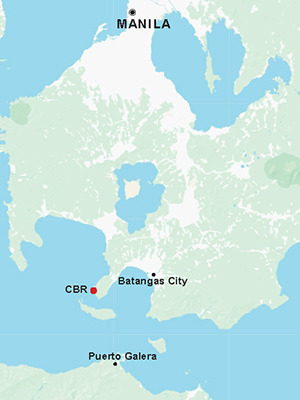
After a 5-minute boat ride from shore, I backrolled into the house reef at Crystal Blue Resort ("CBR"), a lovely and lush reef with healthy hard and soft corals showing no wear and tear from divers. It teemed with colorful fish, as well as anemones with their attendant clownfish. Anilao, on the island of Luzon, south of Manila, has other colorful dives; two standouts are Cathedral and Koala, where I saw blue ribbon and moray eels, mantis shrimp, octopuses, and an Ambon scorpion fish.
But then my eagle-eyed guide, Pong (who says his name is like Ping-Pong), pointed out a beautiful nudibranch on the sand. Being a photographer, I lay on the yucky sand and took all the time I needed to set up a shot. While most nudis are exotic and beautiful, the photographer's challenge is to take sharply focused images with the critter's horns (rhinophores) "crispy" sharp, and at the same time minimize the unattractive bottom. Secret Bay, Bubbles, and Red Rock were other sandy sites with innumerable species of nudibranchs, but also flamboyant cuttlefish, ornate ghost pipefish, frog fish, and the occasional highly poisonous, slow-moving, blue-ringed octopus, a unique creature, indeed. The purpose of my trip was to join a macro photo workshop organized by Backscatter. All the participants were American. The workshop was led by master photographer Mike Bartick, who lives at CBR. He's a well-prepared, articulate teacher who generously responded to questions. The classroom has large open windows that keep the temperature comfortable, and the large, built-in TV monitor was easy to see from anywhere in the classroom. Mike is a pioneer of "black water" diving; night diving in deep, open water next to a 75-foot down line with lights about every 15 feet. Divers, carrying no dive lights, float next to the line in the current and shoot subjects when they enter their focus light beam. It's an extension to the course, and not for the faint of heart.
With no shore diving at CBR, even the house reef required a trip in their traditional wooden Filipino bangkas, which look like large canoes with outriggers on both sides. About 35 feet long, with a maximum beam of roughly seven feet, they come to points at the bow and stern. CBR has no dock or pier, and the bangkas are simply run up on the beach, bow first. When I walked down the beach to my bangka, I had to be careful not to fall, as the rocky, uneven beach, with some trash here and there, made going treacherous. An elderly diver went arm-in-arm with a staff member. For the first dive, I walked in my thin-soled booties, which proved uncomfortable and unstable, so I switched to sandals. The crew members, often smaller than their guests, carried a tank on one shoulder and held a heavy, ungainly camera rig in the other hand, sauntering along the beach in flip-flops. Boarding the bangka was a bit of a challenge. Each bangka had a plank that's about seven feet long and six inches wide with blocks nailed to the plank's surface to help with footing. The staff made it look simple as they glided up the plank hauling heavy gear, but the divers typically needed the assistance of a boatman to ascend and descend the plank. Most often, the plank was set in about six inches of water that I had to step through before starting up the 30-degree incline. I was told, at least once every workshop, a diver falls off the plank into the water. It happened in ours too; it's not dangerous, but everyone saw and heard it, and a playful ribbing followed. Soaked, our companion took it well. A 25-minute ride took us across the bay to Maricaban Island and the wreck of the Darit Laut. The boatmen prepared my tank and BCD and helped me slip it on as I sat on the gunwales. After a backroll, I bobbed up to grasp my camera handed down by the boatman. I headed down to the Darit Laut, which, according to legend, was a money-losing, floating casino that the owner intentionally sunk about 50 years ago. It sits between 50 and 80 feet. It's an easy wreck to penetrate, but it has not been "sanitized" like some Caribbean wrecks, so divers need to watch for protrusions that could hurt. Visibility ran about 30 feet, and no junk floated past. Pong pointed out a large red frogfish nestled under a beam as well as a couple of nudibranchs, which I took plenty of time to shoot, since we had no restrictions on depth or time and could dive our own profiles. And we students never lined up waiting for another to finish. One of my fellow students told me he asked to see a pygmy seahorse, which lives in Anilao at 80-90 feet. The guide took him there, but divers from another operation were lined up, and with limited bottom time at that depth, he had to rise before it was his turn.
During the surface interval, with whiffs of burning garbage in the air, I got a closer look at the humble shanties lining the shore, flimsily constructed with bamboo and scrounged metal and wood to serve as walls. Often without running water and only one room, they can be homes for entire multigenerational families. A few hundred yards past a collection of shanties, I would sometimes see a spectacular house perched on a steep hillside, worthy of an Architectural Digest spread.
After lunch, I was ready for the third dive; later in the day one could take a dusk dive to photograph Mandarin fish or a night dive. After every dive, the boatmen took my gear to and from the bangka, rinsed and hung it (divers were only responsible for their wetsuits). They placed it carefully in one of the camera rinse tanks (the rinse tanks have the clearest rinse tank water I've ever seen). I'd transfer it out and place it on a nearby table to blow off the big drops with a compressed air gun, then take it to the camera room to let it dry more fully.
Like most Anilao resorts, CBR is built on a steep hillside, with 84 steps from the uppermost guest rooms to the dive deck. I spent a fair amount of time trekking up and down those steps, uneven pieces of slate set in concrete. The surface is not level, and the steps vary in height, depth, and shape. To navigate them safely, I had to concentrate, look down, and not carry on a conversation. (Undercurrent has reported about divers tripping on Anilao stairs, and I did not want to be a sidebar to my own story.) The most treacherous steps of all are from the dive deck to the beach. Narrow and uneven, at high tide they lead into ankle-deep water you must step into before stepping on and over some jagged rocks to reach the beach. The large concrete-floored service deck, covered with a roof, served the diver well. The tanks were neatly lined up, and each had a masking tape label with the diver's name. A staff member gauged the nitrox level while the diver observed, and after gauging, the O2 percentage was written on the masking tape. My tanks were consistently around 31percent. Each diver gets cubby with a large plastic basket that fits inside. After each dive, there's a dry beach towel in your cubby. The staff gave my gear a thorough rinse that included rinsing both the outside and the inside of my BCD. I used my cubby to hold dry clothing to change into after a post-dive rinse-off in the outdoor shower, which saved a many-step climb to my room.
There were a few solo photographers in our group, but nobody ever ate a meal alone. The common thread of underwater photography brought us together, and there was always plenty to talk about at meals. Since we were so consumed with shooting, I learned a great deal about everyone's photography interests and skills, but often little about their lives, especially their jobs or business, until the closing night cocktail party. Given the serious nature of the participants and long night sessions, there was not much drinking, but CBR hosted a cocktail party on that last night; it was fun to loosen up and chat with people I'd intensely dived and photographed with. I departed with increased photographic skills and some great macro photographs. I must admit that I did not stay for the blackwater extension to the workshop. I got some gentle pokes about wussing out, but for me, discretion is the better part of valor. I want to stay in good shape because I just might want to return for another course; it was that good. - G.P.T. Our undercover diver's bio: G.P.T. got certified in 1983 and is a PADI Advanced Open Water diver with more than 900 dives at resorts and on liveaboards throughout the Caribbean, the Philippines, Indonesia, California, Australia, and Hawaii. For the past 10 years, he's been keenly interested in underwater photography and has taken several organized underwater photography trips where instruction is an important feature of the trip.
|

 = publicly available
 Nonetheless, I found a startling counterpoint to these lush reefs. Octo Point surprised me with its utterly barren and desolate bottom, just endless brownish sand in all directions, and not even a piece of coral or fish in sight. A plastic bag floated by, reminding me that junk is not uncommon at some sites.
 For this workshop, there was one leader for each buddy team, and Pong was key for finding subjects for me to photograph, particularly in the barren, sandy sites where there appeared to be no subjects in sight. The best way to work with a leader was to have them search for a subject while you were photographing a different one. Mike told the class that he, too, relied upon the leaders to find subjects.
 When I rose from my dive, the strong, hardworking boatmen carefully moved
the boat ahead, and after handing up my gear, I grabbed the ladder on the
gunwales, removed my fins, and climbed up. Once aboard and organized, they offered
coffee or tea, made to order from a thermos of boiling water, and a snack, which
could be leftover desserts from last night's dinner or a packet of saltines.
When I rose from my dive, the strong, hardworking boatmen carefully moved
the boat ahead, and after handing up my gear, I grabbed the ladder on the
gunwales, removed my fins, and climbed up. Once aboard and organized, they offered
coffee or tea, made to order from a thermos of boiling water, and a snack, which
could be leftover desserts from last night's dinner or a packet of saltines.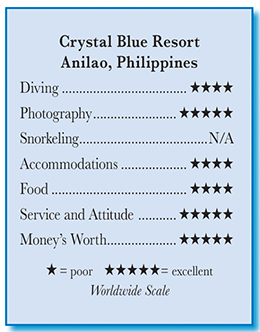 The visibility was usually a poor 20 feet, with occasional jumps to 40
feet, but with lows to 10 feet. With the February water temperature 78°F, it
dropped to 75 degrees when I hit a thermocline at 60 feet, definitely a 5mm
wetsuit environment. Spending 10-15 minutes on the sand setting up a shot
meant I was not moving around generating body heat, so I got chilly. During
surface intervals, with no protection from the wind, I got quite cold, and as
I waited for other divers to surface, I'd drop in the water for a time to warm
up. I should have bought one of their "boat coats," basically neoprene jackets
designed to be worn over a wetsuit, sold in the minuscule resort boutique. The
open bangkas provide no wind protection, so we four divers (that's the max) got
hit with sea spray on the way home.
The visibility was usually a poor 20 feet, with occasional jumps to 40
feet, but with lows to 10 feet. With the February water temperature 78°F, it
dropped to 75 degrees when I hit a thermocline at 60 feet, definitely a 5mm
wetsuit environment. Spending 10-15 minutes on the sand setting up a shot
meant I was not moving around generating body heat, so I got chilly. During
surface intervals, with no protection from the wind, I got quite cold, and as
I waited for other divers to surface, I'd drop in the water for a time to warm
up. I should have bought one of their "boat coats," basically neoprene jackets
designed to be worn over a wetsuit, sold in the minuscule resort boutique. The
open bangkas provide no wind protection, so we four divers (that's the max) got
hit with sea spray on the way home.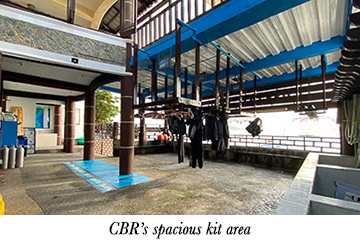 Even the most jaded photographer will be
delighted with the well-lit facility with plenty
of large workstations with tables, two shelves
above, and storage room below that can handle
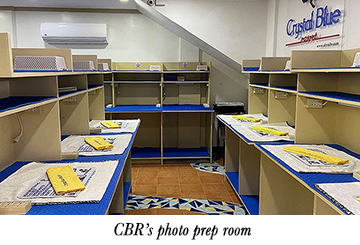
the largest of camera bags. There's a 4-plug, U.S.-compatible power strip for charging as well as an individual light over each table. I took advantage of the outdoor shower next to the rinse tanks to get the salt off before heading to my room.
Even the most jaded photographer will be
delighted with the well-lit facility with plenty
of large workstations with tables, two shelves
above, and storage room below that can handle
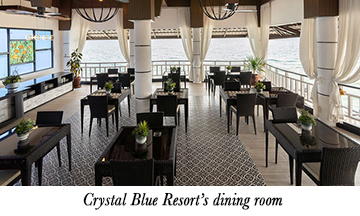
the largest of camera bags. There's a 4-plug, U.S.-compatible power strip for charging as well as an individual light over each table. I took advantage of the outdoor shower next to the rinse tanks to get the salt off before heading to my room.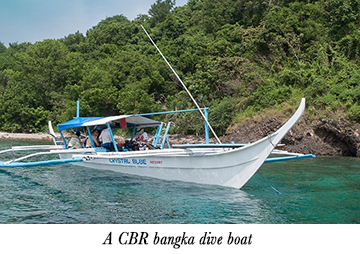 The spotless dining room, open on two sides, overlooked the water and made a pleasant setting for good meals. Served buffet style, the food was decidedly more American than Filipino. For breakfast, there were eggs made to order, and I was amazed at how the egg station chef made half-flipping an omelet look easy. There was always bacon, sausage, or ham, plus oatmeal, fresh fruit, and yogurt. Pancakes and French toast were also made to order. Good coffee was available from 6 a.m. onward. Lunch and dinner had a variety of meat, chicken, and fish options, plus pasta, rice, and vegetables. Salads, it was clearly stated, were washed in filtered water. There were always two delicious desserts at dinner. The bar charged about $3 for a local brew and $6-$10 for a cocktail. As a wine drinker, I was not surprised that the selection was very limited (e.g., no chardonnay), but I was surprised that I had to buy it by the bottle. The pleasant bartender stored it for the following day.
 DIVER'S COMPASS: I flew nonstop from Seattle, 14 hours in the air. My 10-night stay in late March cost $3,400 per person, double occupancy, and three meals per day, and 18 boat dives with nitrox, and round-trip van transportation to and from a hotel in Manila, 2 to 2.5 hours . . . A 10 percent tip is recommended and was actually a pleasure for me to leave after a week of watching the staff work so hard . . . there are no land excursions or off-site bars or restaurants . . . The Belmont Hotel at the Manila airport is basic but acceptable at about $100 per night. For a more upscale alternative, the Marriott near the airport is about $175 per night . . . The dive season at CBR runs from about mid-September to June, after which the winds make diving too difficult . . . The nearest chamber is in Batangas City, about a 1.5-hour drive.
I want to get all the stories! Tell me how I can become an Undercurrent Online Member and get online access to all the articles of Undercurrent as well as thousands of first hand reports on dive operations world-wide

| Home | Online Members Area | My Account |
Login
|
Join
|
| Travel Index |
Dive Resort & Liveaboard Reviews
|
Featured Reports
|
Recent
Issues
|
Back Issues
|
|
Dive Gear
Index
|
Health/Safety Index
|
Environment & Misc.
Index
|
Seasonal Planner
|
Blogs
|
Free Articles
|
Book Picks
|
News
|
|
Special Offers
|
RSS
|
FAQ
|
About Us
|
Contact Us
|
Links
|
3020 Bridgeway, Ste 102, Sausalito, Ca 94965
All rights reserved.