
 |

 Email Signup
|
Subscribe
|
Login
Email Signup
|
Subscribe
|
Login
For Divers since 1975 The Private, Exclusive Guide for Serious Divers Since 1975 |
"Best of the Web: scuba tips no other source dares to publish" -- Forbes |
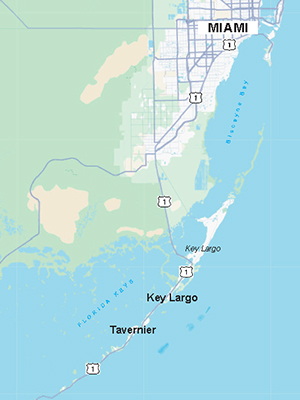
Conch Republic, Amoray; Upper Keys, FloridaContents of this Issue: Conch Republic, Amoray; Upper Keys, Florida Sharks on Drugs in the Bahamas Crystal Blue Resort, Anilao, Philippines Five Improperly Equipped Divers Die at 200 feet Diving Into the Unknown, a Documentary The Diver Medical Form: Part 1 Divers Overestimate Their Skills and beat up reefs Editorial Office: Ben Davison Publisher and Editor Undercurrent 3020 Bridgeway, Suite 102 Sausalito, CA 94965 wreck diving when you don't want to travel far from home from the June, 2026 issue of Undercurrent
Dear Fellow Diver,
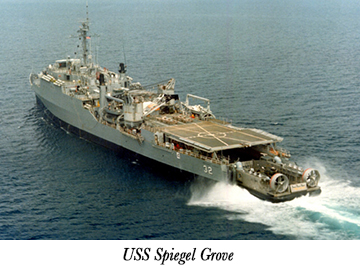
I planned to make four dives the first day with Amoray Dive Center, then have two more days of deep diving with Conch Republic, then on the fourth day, morning dives only, respecting my flight departure the following day. I have dived with both often, but Conch tends to go outside Pennekamp Park and dives the wrecks more often. My buddy for the first two days, an instructor at one of the shops, offered to dive with me on days off, and I was delighted. I often hire a guide from the shop if I don't have a dive buddy who has local knowledge. And I'm not interested in insta-buddies, having had to rescue a few. I enjoy having someone along who knows where the cool stuff is. I traveled in February -- unlike Thanksgiving or Christmas, when scads of parents and kids fill the hotels (meaning lots of snorkelers on dive boats) -- so the boats weren't jammed, and restaurants had tables. February's downside is that the wind may kick up the waves, and in the past, I've had many diving days rescheduled or canceled, especially on the renowned 500-foot-long Spiegel Grove. If conditions are too challenging, operators will call off the trip even when they're on site. This trip, I had glassy seas, no currents, and several repeat splendid dives on the Spiegel Grove. The former Navy ship, which was commissioned in 1956 to deploy amphibious landing craft, was sunk as an artificial reef in May 2002, but the descent didn't go as planned. It landed catawampus about 140 or so feet down. It didn't take long for fish to discover it. Three years later, Hurricane Dennis stirred the seas with so much power that the currents surprisingly pushed the ship upright, just as it was originally planned.
The captain ties off at one of eight permanent buoys rising from the ship, and which one he selects will largely decide which part of the ship you'll dive. Since the ship is outside the protected marine park, you may be competing with fishermen for the attention of the sharks and groupers who cruise through. And, with plenty of fire coral on the buoy line, in a current you'll need gloves to go down hand over hand (or at least stick close to that line). SMBs are required, but the boat has plenty for divers who don't bring one. We tied off at Buoy 4, toward the ship's stern, near the wreck's shallower part at about 70 feet. The keel rests at 134 feet. We planned to start by hanging out to see if the sharks or goliath groupers were around, and if they were sparse, we'd go into the ship. The shallower depth gave us plenty of time (it's a popular spot for tech divers who can maximize their bottom time with double tanks). I dived with a steel HP 100 to get both the extra weight and extra EAN 30. Everyone on this trip was diving Nitrox. To help me in the current, I used the anchor line for most of the descent. Visibility was easily more than 50 feet. At 60 feet, the current was essentially gone. A few bull sharks and barracuda greeted us as we reached the upper part of the ship's superstructure. Reef sharks, who often hang out there, joined the party, and I was happy to see a few large -- think XL pizza large -- goliath groupers in hiding. Some nice coral has grown on the ship, which attracts the usual damselfish, wrasses, and bar jacks. I spotted a hogfish, which always makes me ready for dinner. I stayed with the fish while other divers toured the Spiegel's interior. After a 3-minute safety stop at 15 feet, I rose to the tag lines off the stern platform, which made it easy to pull back to the large twin ladders. Crew members gave me a hand, and the hot fresh water shower took off both the salt and the chill of 74°F water. The Spiegel is a deep dive, but you don't have to hit the sand to see a lot. We stayed around 100 feet our first dive, and, after an hour's surface interval, a bit shallower on the second, keeping us comfortably out of deco. This kept us close to a large portion of the superstructure, where most of the fish action took place, and I could see big pelagics cruising through the Gulf Stream. And I had reasonable bottom times for the Eagle that afternoon. I really can't dive the Spiegel enough! I once told a friend I could dive it 100 times and not be bored. He laughed. "I've got more than 300 dives on it," he said, "and I'm never bored." There's still so much more to see.
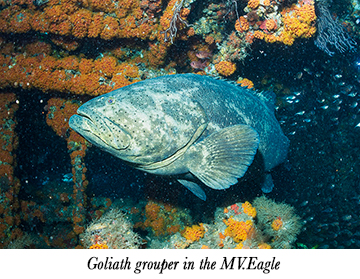
The Eagle, a 287-foot Dutch freighter named for one of the corporate sponsors who purchased it with the intention of making it an artificial reef, was sunk in 1985. In 1998, the destructive Hurricane Georges broke the ship apart near the superstructure, and part has since collapsed, but there are still ample coralencrusted swim-thrus. It is an advanced, deep wreck dive, a 30-to 40-minute ride from the marina. Conditions can be spotty, with tough currents, but we had calm seas, no current, and 50-footplus visibility. The fish population wasn't as large as at the Spiegel, but I noticed a couple of butter hamlets along with plenty of sergeant majors, jacks, blue tangs, and more big groupers. But one thing I had not expected was the wads of monofilament, fishing weights, and hooks around the superstructure, on the deck, and even hanging over the side! Some fishermen aren't happy seeing divers tie off on one of four permanent buoys and have been known to cut the buoys off the line when divers aren't there. Pack your cutting tools and your gloves.
Conch Republic requires a checkout dive if you have been out of the water for a year and may require you to hire an instructor for that dive. If you have been dry for two years, they may require a refresher course. You can work out those details before you arrive. I stayed at the Ocean Pointe Suites in Tavernier, about a 5-minute drive from Conch Republic -- but not next time. We had problems at check-in, and the freezer, bedroom ceiling fan, and light didn't work, and that's the short list. They comped us for two nights since they were fully booked and couldn't move us. Next time I'll try the Marriott Courtyard or Holiday Inn near the Key Largo oceanside marina, which are popular with divers.
Florida's reefs took a hit in the summer of 2023, when water temperatures approached triple digits; already stressed from sewage and agricultural runoff from the mainland, a vast majority of the coral was bleached, and much died. While the reefs look better each time I've dived since, they're still far from what they were when I started diving here 25 years ago. Amoray operates a 45-foot catamaran, the Amoray Diver, custom-built for diving. I rarely felt crowded, even in the past when the boat was filled with divers and snorkeling families. About half of the boat is covered; it has a marine head, a freshwater shower, a large dry box for personal items, and peanut butter pretzels, hard candy to cut the saltwater taste, and ginger chews to calm nausea. My crew was the locally renowned Captain G and mate Nick (also an Amoray captain). G, as he's known, is funny, engaging, safety-focused, and lots of fun to dive with. Nick was my guide last year when the plastic bolts connecting the jacket to the backplate on my Apeks Exotec broke during the dive, so I missed the last dive of the day. The BCD was barely a year old with 100 dives. I'm OCD on gear maintenance, so I was not happy. Nick offered me his, but it was too small. I reminded him of my adventure, and we shared a good laugh. Other Amoray staff were guiding other divers or enjoying a day of free diving, so plenty of help was available. They loaded standard AL-80 tanks along the rails (there's plenty of storage space beneath the bench seats), and I set up my kit as soon as it was on board. They have no dedicated camera workspace, but in the Keys, divers with big rigs are rare. Following a roll call at the dock, G provided a thorough safety and boat briefing, and we took off shortly after 8:30 a.m. for the Benwood wreck, which sits at about 45-50 feet.
After mooring the boat on a wreck buoy, G described the dive site and the best way to dive it. He gave the return time, and with a final, "Divers! Get off my boat!" we splashed in. My buddy and I have dived a 360-foot English freighter, the Benwood, several times, together and separately, so we went to the places where we hoped to find either unusual or small critters wanting to pose for a photo. My big find was a juvenile slender filefish blending into the coral. It was also pleasing to see a healthy fish population of grunts, snappers, surgeonfish, parrotfish, harlequin bass, and trumpetfish. Since diving there after the 2023 heat disaster, it's nice to see the coral a bit more vibrant and the fish population healthy. I'm always encouraged to see a good number of juveniles (wrasses, damselfish, butterflyfish, etc.) showing up and then seeing some of the bigger fish, like groupers, who are looking for a snack.
The Benwood is also a popular night dive, with lots of turtles, lobsters, rays, and sharks that aren't there during the day. In fact, it's so popular, I always book ahead, since night dives aren't offered every day, and during the busy season, groups may take most of the spots. Next, it was a short ride to the French Reef, a massive, nearly mile-long reef system with about two dozen dive buoys. The deepest I've dived on French is 35 feet, and usually for an hour with no current. I hunted for fish hidey holes for my macro setup. While a majority of the fish population is the same from reef to reef, a group of bobbing yellowhead jawfish brought a smile. I even found a proud papa with a mouthful of eggs. And the first XL-pizza-sized goliath grouper of several I would see on this trip. We returned to the dock around noon, leaving again at 1 p.m. for three hours. With so much diving, there's little time left for anything but meals. I live far from the ocean, so when I come to Florida, fresh seafood off the boat is a priority (and so is Key Lime pie), and that was the nightly meal. For us, it's Hobo's for shrimp or Seafood Hobo, and we always visit both locations of Mrs. Mac's, which has been around since the 1970s. We like "Little" Mrs. Mac's for breakfast and lunch, and "Big" Mrs. Mac's for lunch and dinner: straight-up home cooking and hearty conch chowder. Harriette's Restaurant is a good breakfast stop with huge biscuits and muffins. I make a point to stop at Pinecrest Bakery for a Café Cubano or Café con Leche; it's a South Florida chain and is open 24 hours. Your dive crew will also have lots of other suggestions. And while those dive crews and the boats I dive with are top-notch, we all know that Florida doesn't have the reefs of Bonaire, Cayman, or Cozumel. But those islands also don't have the wrecks and big fish of the Keys (or the vehicle traffic). With plenty of dive operations along the 100-mile stretch, they are close to home, with no passport required. It has big boats, skilled captains and crews, endless hotels and restaurants, and something for the non-divers. And it can be a long-weekend destination, at least for people east of the Mississippi. The shallow reefs are good for new divers. If you want to learn technical diving, there are a growing number of opportunities with skilled instructors and fine wrecks. The Keys have a lot to offer. - M.L. Our undercover diver's bio: My parents said my love for diving started as a small child when I would ask for "underwater sings" (that frontal "th" sound was complex!) at every opportunity. I began diving more than 30 years ago, with most of it spent working with students in freshwater lakes and quarries, along with trips throughout the Caribbean, Florida, and North Carolina. Many of my friends still don't understand why I swim toward sharks and barracudas.
|

 = publicly available
 I needed a break from local drysuit diving and wanted to stay in saltwater shape for an upcoming trip. So, I did what many experienced divers never consider and headed to the Florida Keys, where in the past I found interesting diving options, great food choices, and shops and art galleries for my non-water-sports spouse. While lodging and dining in the Upper Keys, specifically Key Largo and Tavernier, have become expensive, with a non-diving companion, I'm willing to spend more than I would on a divers-only trip.
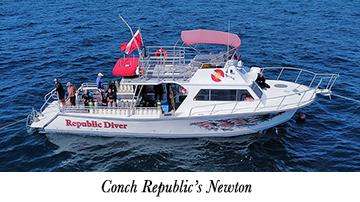
 We left Tavernier Creek Marina on my second diving day on the comfortable Republic Diver, a 46-foot Newton (with a marine head), for the 45-minute ride out. Co-owner Ashley Hudson brought some friends for their first Spiegel dive. She and her husband, Dave, purchased Conch Republic in 2022. Captain Jasen, whom I'd enjoyed diving with on previous Conch trips, has been with them since 2008. He and the crew know how to read the water and find the best buoy for that day's dive.
 We returned to the dock around noon. As we motored in, I called the Habanos
restaurant at the marina to order a Cuban sandwich, which was ready when I
arrived, leaving plenty of time for the 1 p.m. departure.
We returned to the dock around noon. As we motored in, I called the Habanos
restaurant at the marina to order a Cuban sandwich, which was ready when I
arrived, leaving plenty of time for the 1 p.m. departure.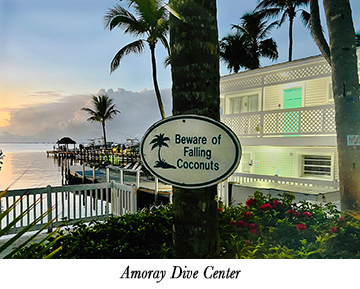 We planned to stay around 100 feet on each
dive, with 35 to 40 minutes of bottom time. My
focus would be photography and just enjoying my
first Eagle dive. But we shifted gears when we saw
so much monofilament and fishing tackle. My buddy
and I grabbed what we could on the first dive, and
on our second, we focused on clearing line where we
could. Jasen had a mesh bag, which we put to good
use, but there was still much more to do. In fact,
Conch and some other operators planned a cleanup
dive on the wreck.
We planned to stay around 100 feet on each
dive, with 35 to 40 minutes of bottom time. My
focus would be photography and just enjoying my
first Eagle dive. But we shifted gears when we saw
so much monofilament and fishing tackle. My buddy
and I grabbed what we could on the first dive, and
on our second, we focused on clearing line where we
could. Jasen had a mesh bag, which we put to good
use, but there was still much more to do. In fact,
Conch and some other operators planned a cleanup
dive on the wreck.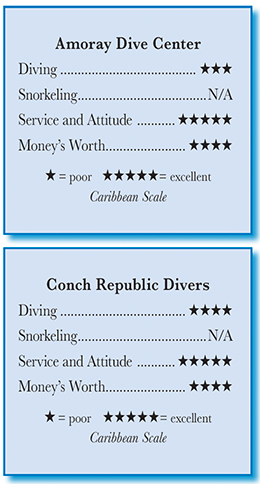 Many divers diving with Amoray stay at their nice hotel and take advantage
of the hotel/dive package. My diving with the Amoray Dive Center was to begin my
first day with two-tank shallow reef trip in the morning, followed by a doubledip
on the Spiegel Grove in the afternoon. But it didn't work out like that.
They didn't have enough divers (one must, at a minimum, be an Advanced Open Water
diver), so it was another two shallow reefs for the afternoon. While they gave
me advance notice and offered to arrange my joining another operator going to
Spiegel, the logistics of switching operators at midday or going to a different
operator for the whole day were more trouble than I wanted on a restful vacation.
Many divers diving with Amoray stay at their nice hotel and take advantage
of the hotel/dive package. My diving with the Amoray Dive Center was to begin my
first day with two-tank shallow reef trip in the morning, followed by a doubledip
on the Spiegel Grove in the afternoon. But it didn't work out like that.
They didn't have enough divers (one must, at a minimum, be an Advanced Open Water
diver), so it was another two shallow reefs for the afternoon. While they gave
me advance notice and offered to arrange my joining another operator going to
Spiegel, the logistics of switching operators at midday or going to a different
operator for the whole day were more trouble than I wanted on a restful vacation.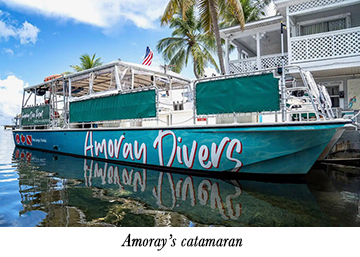 As we motored out from the bay side of Key Largo, Nick provided more information about dive procedures, while tapping into his endless supply of dad jokes. Trust me, it is endless (and mostly funny); he says he tries to have a new one daily and I haven't heard the same one twice. I enjoyed motoring through the mangroves, with usually a good selection of seabirds; I saw pelican chicks nesting with mom on one marine marker pole.
 We had calm seas, little current, and 40-foot visibility. It's a large wreck, so even with a full boat of divers, it was easy to leave the crowd for photos or exploration. Built in 1910, the Benwood sank in a collision in 1942 and is pretty broken up. There's nothing to penetrate, but lots to see, and many places for fish of all sizes to hide, so I had to search carefully. After nearly an hour of bottom time, we took a 3-minute safety stop as is our habit, then rose to the floating tag lines that had been set out. I pulled myself to the boat, removed my fins, and headed up one of two large ladders where a crew member was stationed to help.
 DIVER'S COMPASS: It's about a 60-mile drive from the Miami airport to Key Largo, another 100 down to Key West. Ft. Lauderdale/Hollywood airport is another option and adds about another 30 minutes to your drive . . . Full rental gear sets are available at nearly all dive operators . . . A two-tank dive with Amoray is $105 and $155 if you want a guide. Two-tank dives on the Conch Republic Diver are $110 and $150 for the smaller six-pack Mermaid Diver. Guides are also available ($65 1:1 or $35 2 divers or more) . . . Night dives (single tank, $105) are available if there's sufficient demand.
I want to get all the stories! Tell me how I can become an Undercurrent Online Member and get online access to all the articles of Undercurrent as well as thousands of first hand reports on dive operations world-wide

| Home | Online Members Area | My Account |
Login
|
Join
|
| Travel Index |
Dive Resort & Liveaboard Reviews
|
Featured Reports
|
Recent
Issues
|
Back Issues
|
|
Dive Gear
Index
|
Health/Safety Index
|
Environment & Misc.
Index
|
Seasonal Planner
|
Blogs
|
Free Articles
|
Book Picks
|
News
|
|
Special Offers
|
RSS
|
FAQ
|
About Us
|
Contact Us
|
Links
|
3020 Bridgeway, Ste 102, Sausalito, Ca 94965
All rights reserved.