
 |

 Email Signup
|
Subscribe
|
Login
Email Signup
|
Subscribe
|
Login
For Divers since 1975 The Private, Exclusive Guide for Serious Divers Since 1975 |
"Best of the Web: scuba tips no other source dares to publish" -- Forbes |
NECO Marine, Palau Royal Resort, MicronesiaContents of this Issue: NECO Marine, Palau Royal Resort, Micronesia The Depth-rating for Watches is a Myth Stingy Operators, Runny Noses, Credit Card Theft Your Travel Reports Are Important Sargassum Threatens Belize's Beaches A Free Ascent - the Last Resort? Part 1 New Technology to Track Divers Popular Cozumel Dive Guide Struck by Propeller Editorial Office: Ben Davison Publisher and Editor Undercurrent 3020 Bridgeway, Suite 102 Sausalito, CA 94965 still the wow factor for pristine diving from the August, 2025 issue of Undercurrent
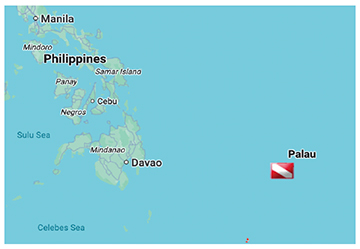
Dear Fellow Diver, I've been diving for 40 years, and I figured my first dive in the Republic of Palau would be one of the best of my life; instead, it was one of the worst.
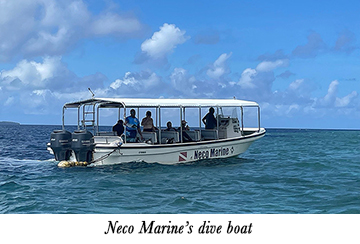
I cut the checkout short, climbed aboard the boat, swallowed my pride, took off my watch, and solved my problems. Having been too eager to begin my week underwater, I wasn't fully prepared. So, I slowed down, checked everything twice, and began again on a week of near-perfect diving. Palau is an island nation in Micronesia, comprising 340 limestone islands, islets, atolls . . . and swift currents, the result of the confluence of the Indian and Pacific Oceans. But those currents are precisely why it's home to at least 1,450 species of reef fish, over 135 shark species, and more than 700 varieties of reef-building hard corals and soft corals. Currents make fish life abundant and exciting, so most dives are drifts, and one needs a reef hook to stop and see the action at a couple of sites. It's no place for new divers. For example, after hooking into the reef at Ulong Channel to avoid being swept along, I watched hundreds, if not thousands, of reef fish, barracudas, sharks, triggerfish, and groupers swim by, and viewed the world's largest patch of cabbage coral, plus sea cucumbers the size of Subway Foot-Long Subs. As the dive ended, I made my mandatory safety stop at 15 feet for three minutes, then rose to the boat and grabbed the mooring line alongside two women, as the rough water slammed us against the hull. They had arrived ahead of me, but I was closest to the ladder. "After you," I said, as the waves again bounced us off the boat. Rightfully, one of the women yelled, "Just get on the f...ing boat." Apparently, being chivalrous in rough water is not the thing to do. I dived twice daily for eight days (with a day off after the fourth) with NECO Marine, a first-class PADI operation. Each morning, two of their six dive boats powered by twin Yamaha 250HP outboards would pick me up along with 11 other divers at our hotel. All the boats are equipped with sun covers, padded seats, dry storage areas, emergency oxygen kits, first aid kits, communication equipment, and, upon request, a rinse tank for photo equipment. While each boat could accommodate 13 divers, only six were on board for our 45 to 60-minute trip to our dive sites. After our first dive, we'd zip to the second site for our surface interval, get wet again, then make a short trip to Two Dogs Island for lunch before slaloming through the beautiful Rock Islands and returning to the dive shop between 2:00 and 3:00 p.m.
Each morning began with a huge buffet breakfast (included in my dive package). Keeping in mind the forthcoming speedy journey to the dive sites, I tried to go light on the fruit, pastries, omelets, waffles and pancakes, and an abundance of bacon to feed a small army, as well as Asian specialties such as bowls of congee, rice, pork buns, kimchi, and more (most resort guests were Chinese, Taiwanese, or Japanese). It was easy for me to skip the Tang, a Micronesian delicacy like SPAM that became a staple in WWII.
Jewel, our divemaster, was from Bangladesh and had lived in Palau for two years. He briefed us and knew the sites well. We started each dive with our buddies, convened at about 30 feet, spread out, then reconvened at 700 psi. He would raise his surface marker, we'd all do our safety stops near the line 15 feet below the surface, and the boat would be right there. Arson, the driver, and Jewel hauled up my BCD, and, unburdened, I climbed the sturdy aluminum ladder. The dives lasted between 50 and 60 minutes. My maximum depth was 100 feet. With only six divers in our group, there was no need for roll calls.
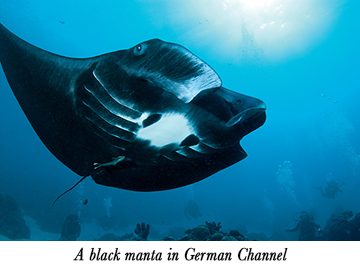
Another famous site, the German Channel, which was cut in 1908 to allow freighters to avoid going around the island during Germany's colonial rule of Palau, is a renowned dive site due to the frequency and size of the giant black manta rays. At 50 feet, I knelt on the sand behind about 40 divers in several rows. Within minutes, the magnificent mantas started arriving and lining up like they were being directed by air traffic control. Wave after wave fluttered toward and over me, just a few feet away, flapping their majestic pectoral fins, and dining on plankton. Remoras clung to their backs and stomachs, while cleaning wrasses went about their business at this cleaning station. A few reef sharks and hundreds of small fish provided a grand canvas of marine life. It was perhaps the best dive I've ever had.
However, a couple of divers in my group didn't know when enough was enough. The woman who had yelled at me earlier on accidentally bumped the top of her head into the chin of a fellow diver without looking up while ascending. The bumped diver apparently thought the other did it intentionally and retaliated by jabbing her coral pointer stick into her back. It turned into an underwater catfight, a sudden wrestling match, before I yelled "STOP IT" through my regulator. The "bumper" separated from the "bumpee" and swam away. But it wasn't over. Back on the boat, the bumper stomped toward bumpee and screamed, "If you ever do that again, I'll f...ing kill you!" By the way, I only knew one of my group, but I didn't know any of the other people in this travel group. It was indeed an odd lot. NECO Marine was founded in the 1980s by Shaluum Etpison, the son of Palau's President (NECO stands for Ngiratkel Etpison Companies). His Dutch wife, Mandy Thijssen Etpison, was once a NECO dive instructor and now manages it today. She wears multiple hats very stylishly -- as a businesswoman, museum owner, author, and photographer, whom I saw diving from another boat to take photos for her next book.
But there was one thing missing. Heads on their boats. Now, I've made hundreds of dives, and not once have I needed to pee underwater. Until this trip. A couple of times, I had to ask the captain if I could "check the current." He'd stop the boat, lower the ladder, and I'd climb down the steps to let it flow. Others might join for a pee party, one at a time. And, for the first time, I peed in my wetsuit, no big deal, of course. What I learned from my ENT when I got home is that for some people, Sudafed can increase their need to urinate. I guess I'm one of them.
I only had a few meals at the resort's Waves Restaurant - one dinner and one lunch. They offered fresh seafood, large salads, noodles, pasta, and U.S. beef. When I found the Drop Off Bar & Grill a block away, I dined there al fresco many times: fresh fish, grilled barracuda, burritos, burgers, pizzas, poké bowls, salads, and a full bar with island-brewed Red Rooster beer. Other restaurants I strolled to were Elilai Seafood Dining (Palauan and Pacific Rim fare; reservations highly recommended), Sakura (high-end Japanese), and Kramer's Café (run by a pretentious descendant of a man who dredged the German Channel). One night, I grabbed a taxi to The Taj for delicious Indian food. I had drinks one night at the nearby Breeze Bar, located at the water's edge, and was surprised that my fellow divers didn't want to gather there for Karaoke, but one had to have a clear head for those early morning current dives.
I had hoped for a dive in Jellyfish Lake on Eli Mak Island, which in the past has teemed with millions of harmless golden jellyfish. However, it's a delicate creature, and its population rises and falls with the lake's temperature. Its population was down to zero 10 years ago (jellyfish polyps were found on the lake's bottom, however). Still, it rebounded to the millions by 2020, only to drop down to roughly 5,000 today. NECO Marine canceled its planned excursion that week; I would have been less disappointed had they been truthful on their website about the barren lake. My group did charter a van for $10 each to visit Tebang Woodcarving Shop for beautiful artisan crafts, a glassblowing shop, a cultural museum, and a massive mall. Both of our boats also went to the Milky Way, a stinky, sulfuric-smelling, white limestone mud surrounded by bright blue water (and saltwater crocodiles nearby). I saw a group of Asian swimmers covered head to toe in this rancid goo. So, my friends. Palau has it all: world-class diving, a great hotel, good bars and restaurants, and fine people. But, unless one has had a few dives in strong currents, this is no place to get initiated. And for those who do come to dive, take a lesson from me. Before you jump into the water for the first dive, check all your gear once, and once again. And one more time, if it's rental gear. -- G.A. Our undercover diver's bio: The author is a PADI Open Water- and Nitrox-certified diver with 40 years of global experience. He has written more than 300 articles, blogs, and newsletters for dive magazines, websites, and dive clubs.
|


 On my checkout dive at 15 feet, I was having trouble clearing my ears; I saw the water rising under the crystal of my 10-year old Casio watch (am I the last diver on the planet to wear a watch underwater?); I had insufficient weight to maintain my buoyancy; and I was unable to reach the purge valve on my rented BCD. I felt like a brain-dead newbie.
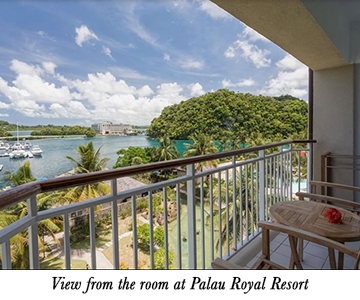
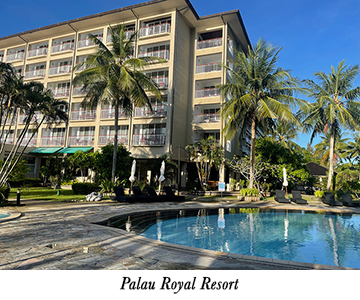
 I stayed at the Palau Royal Resort, a block away from NECO Marine. It's Koror's largest hotel, with 157 rooms and all the amenities you'd expect from a Nikko Hotel, including a huge pool and a private beach for snorkeling. My room had two double beds, a dresser, a roomy closet, air conditioning, a big-screen TV, free Internet, a coffee maker, a mini-bar, and a bathroom with a shower/tub and a separate room for the toilet.
 During WWII, Palau was a major battleground, and about 40 sunken ships and planes are scattered in its waters. Five miles from the harbor, at 90 feet, lies the Teshio Maru, a Japanese merchant marine ship that sank in 1944 in the western lagoon. It's over a football field long (321 feet), with a huge bomb hole in the hull. On my dive, two remoras circled this wreck, adding a touch of life to a serene setting. The rotting fuselage of a Japanese Jake Seaplane rests on its pontoons in the sand at 60 feet. Had it not been encrusted in coral, I could have climbed into the cockpit. I'm a casual photographer, and my Nikon Coolpix captured the moment nicely (strong currents, however, did affect the image's clarity).
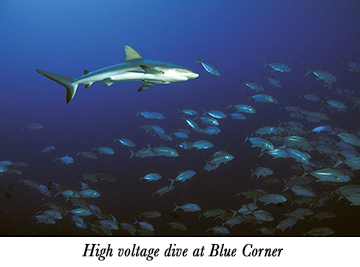 Blue Corner is generally considered one
of the best dives anywhere, and one member
of our group was on his fifth trip to Palau.
"It never disappoints," he said. And he was
right. We dived it twice, and on the second
dive, after drifting past a gorgeous wall, we
hooked in to watch a half-dozen thresher and
reef sharks eyeing us, plus too many fish to
count. With water temperatures ranging from
82°F to 87°F, my full 3 mm wetsuit and cap
kept me toasty.
Blue Corner is generally considered one
of the best dives anywhere, and one member
of our group was on his fifth trip to Palau.
"It never disappoints," he said. And he was
right. We dived it twice, and on the second
dive, after drifting past a gorgeous wall, we
hooked in to watch a half-dozen thresher and
reef sharks eyeing us, plus too many fish to
count. With water temperatures ranging from
82°F to 87°F, my full 3 mm wetsuit and cap
kept me toasty.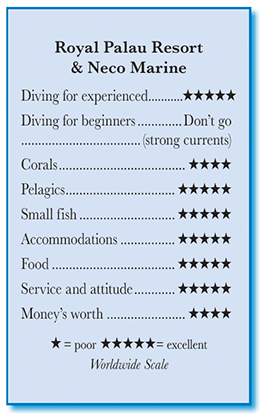 While forty divers seem like more than enough
at one site, they posed little problem. In fact,
I counted as many as 15 to 20 dive boats at most
sites, which meant up to 180 to 200 divers per
site. Only a few sites seemed crowded, but one must
wonder what effect this has on the animals. Most
of the reefs -- I estimated 60-70 percent -- were
vibrant, but the remainder were boneyards. One can
only hope that Palau, an environmentally conscious
republic, will know when enough is enough.
While forty divers seem like more than enough
at one site, they posed little problem. In fact,
I counted as many as 15 to 20 dive boats at most
sites, which meant up to 180 to 200 divers per
site. Only a few sites seemed crowded, but one must
wonder what effect this has on the animals. Most
of the reefs -- I estimated 60-70 percent -- were
vibrant, but the remainder were boneyards. One can
only hope that Palau, an environmentally conscious
republic, will know when enough is enough.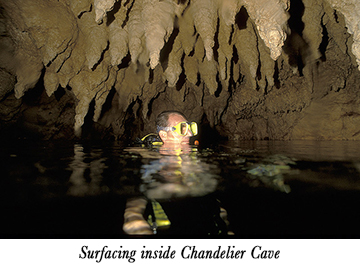 Her responsive crew of nearly 90, including three PADI divemasters and four PADI instructors, operated at peak efficiency. Their marina includes a Shell fuel station, the Drop Off Bar & Grill, and the island's only scuba training pool.
 Of course, when we stopped at the public beach for lunch, there were restrooms. The lunches, by the way, were terrific -- each day, the boat captain gave each diver a list of the hearty meal options from NECO Marine's Drop Off Bar & Grill for the following day, including huge sandwiches with grilled chicken, line-caught tuna, roast beef, chicken salad, or chips and fruit, as well as bento boxes of fish, chicken, beef, sushi, or vegetarian meals.
 The final dive of note was Chandelier Cave. At 40 feet, my divemaster said it
was easy and interesting, with five interconnected chambers filled with stalagmites and stalactites and interesting haloclines separating the fresh and saltwater. Four chambers had enough room for me to ascend to catch a few gulps of breathable air. Caution: If you're claustrophobic or didn't bring your flashlight, take a pass.
The final dive of note was Chandelier Cave. At 40 feet, my divemaster said it
was easy and interesting, with five interconnected chambers filled with stalagmites and stalactites and interesting haloclines separating the fresh and saltwater. Four chambers had enough room for me to ascend to catch a few gulps of breathable air. Caution: If you're claustrophobic or didn't bring your flashlight, take a pass. DIVER'S COMPASS: My Palau Royal Resort package (with double occupancy) was $3,940/person for 11 nights, including breakfast, 17 two-tank dives, lunch for eight days, and airport transfers . . . The package also included AL80 cylinders and a few AL100s, rental Aqua Lung regulators, and BCDs . . . Nitrox fills (include) were between 3,000 and 3,450 psi . . . they rinsed gear in fresh water nightly . . . Night dives were offered, but no one in my group raised their hands . . . Tips for the divemaster and boat driver set me back $300; bring cash, otherwise four percent is added to a credit card . . . Eleven dinners ran about $350 . . . All my expenses, including Air China flights, tallied $6,100 . . . Flights from America's West Coast on China Air or United arrive daily . . . A Palau entry form must be completed within 72 hours or less of arrival . . . Palau uses the U.S. dollar . . . Palau was the first country to ban environmentally harmful sunscreens, so only bring reef-safe products . . . The dry season is the best time for diving, between December and April. I wore a 3.2 mm wetsuit (others wore shorties or dive skins) and never felt cold . . . Many of my dive buddies raved about the massages at the resort's Mandara Spa . . . There is a hyperbaric chamber in the Belau National Hospital ... About the only downside is that many locals (and in other Pacific Island nations) chew betel nut, a narcotic that causes gum damage, and rots their teeth; they spit the red saliva onto the streets.
I want to get all the stories! Tell me how I can become an Undercurrent Online Member and get online access to all the articles of Undercurrent as well as thousands of first hand reports on dive operations world-wide

| Home | Online Members Area | My Account |
Login
|
Join
|
| Travel Index |
Dive Resort & Liveaboard Reviews
|
Featured Reports
|
Recent
Issues
|
Back Issues
|
|
Dive Gear
Index
|
Health/Safety Index
|
Environment & Misc.
Index
|
Seasonal Planner
|
Blogs
|
Free Articles
|
Book Picks
|
News
|
|
Special Offers
|
RSS
|
FAQ
|
About Us
|
Contact Us
|
Links
|
3020 Bridgeway, Ste 102, Sausalito, Ca 94965
All rights reserved.