
 |

 Email Signup
|
Subscribe
|
Login
Email Signup
|
Subscribe
|
Login
For Divers since 1975 The Private, Exclusive Guide for Serious Divers Since 1975 |
"Best of the Web: scuba tips no other source dares to publish" -- Forbes |
Flotsam & JetsamContents of this Issue: NECO Marine, Palau Royal Resort, Micronesia The Depth-rating for Watches is a Myth Stingy Operators, Runny Noses, Credit Card Theft Your Travel Reports Are Important Sargassum Threatens Belize's Beaches A Free Ascent - the Last Resort? Part 1 New Technology to Track Divers Popular Cozumel Dive Guide Struck by Propeller Editorial Office: Ben Davison Publisher and Editor Undercurrent 3020 Bridgeway, Suite 102 Sausalito, CA 94965 from the August, 2025 issue of Undercurrent
Papua New Guinea. Rob Van der Loos sold his popular liveaboard, the MV Chertan, a few months back, and it is no longer being used for diving. He says piracy at sea and violence on land made it impossible to run his business. "Most vessels carrying out trips there do so with armed security on board," he told Undercurrent. Honduras Steps Up Reef Protection. The Honduran government has issued a nationwide fishing ban to protect coral reefs, groupers, and other key marine species. This nationwide fishing ban prohibits the harvest of herbivorous fish such as parrotfish and surgeonfish, and key grouper species during their spawning season from November to April -- a period vital to reef reproduction and resilience. They also reinstated seasonal bans on spiny lobster and queen conch. Confrontation Leads to Arrest. After a Taiwanese client accidentally dropped an air tank on a 38-year-old Malaysian diving instructor's foot during a boat ride to a dive site at Pulau Timba-Timba, east of Semporna, on July 22, the injured man was treated in a Tawau hospital. He returned to the tour company's premises the following day and demanded the tourist pay him compensation. This precipitated an argument, resulting in the diving instructor striking the Taiwanese national and threatening further harm. The instructor was later arrested after his victim made a complaint to the police, who now seek witnesses. (Free Malaysia Today) The Arctic's Most Successful Apex Predator turns out not to be the polar bear, but the humble sea star, say researchers at Canada's Laval University. Their research, published in Ecology, reports that certain sea stars hunt and scavenge opportunistically, and play a crucial role in recycling nutrients from dead creatures that sink to the bottom, similar to how polar bears rely on whale carcasses to sustain them through harsh winters. The researchers found the Arctic's benthic food web to be just as complex as the pelagic food web. (BBC Wildlife Magazine) Using Your Regulator to Hijack an Airplane. While it happened two years ago, Karen Card of Mission Vallejo, CA, has a story to tell. Headed to Cabo Pulmo with eight divers, she and her group went from San Diego to the CBX Cross Border Terminal in Tijuana. "You go through passport and ticket check in the U.S. and walk through a long corridor into Tijuana to check luggage and go through security. We normally carry on our regulators, but Mexican security officers demanded that we all check them. They insisted our regulators were a weapon that could be used to harm others on the plane. Ridiculous. So, we switched a bunch of personal items, put all the regulators in one backpack, and ran back to check it in as baggage." (The flights to anywhere in Mexico are much less expensive from Tijuana.)
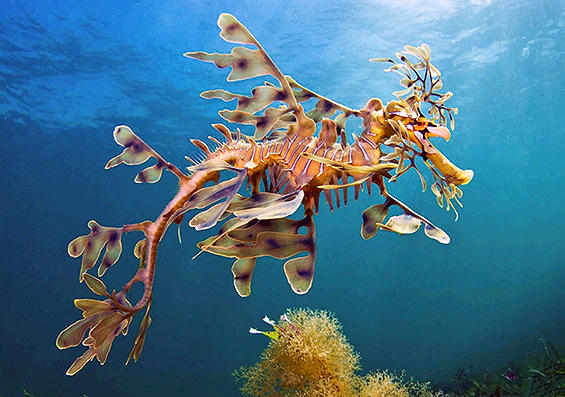
Leafy Seadragons are Dying. A toxic algal bloom has engulfed part of South Australia's coast, killing the iconic leafy and weedy seadragons. Thousands of bodies have washed up along hundreds of miles of the coast. According to marine biologists from the University of Technology Sydney, the algae are thought to produce reactive oxygen that damages fish gills, hindering their ability to breathe. The biologists worry that one of the world's most extraordinary creatures could be in danger of extinction. Baby Sea Turtles Dazzled in Georgia. They are struggling to find the ocean after hatching this season. According to Scott Coleman, ecological manager of Little St. Simons Island, the lights from the massive Interstate Highway 95 close to Exit 42 are to blame. Under normal conditions, the soft glow of moonlight guides newly hatched loggerhead sea turtles from the beaches of Little St. Simons Island to the ocean. But this summer, brighter and taller lights from the recently opened Buc-ee's gas station are disrupting that instinct. Instead of heading toward the sea, the hatchlings are being drawn miles inland with fatal consequences. (CNN) No Bright Lights Here. More than 13,000 turtle nests are being protected along the beaches of the Yucatan Peninsula, authorities say. 128 loggerhead and 229 green turtle nests were documented in Punta Sur Turtle Camp. Cozumel. The manager said, "The turtles released approximately 20 years ago are beginning to return to these beaches to continue their reproductive cycle." July Shark Bites. U.S. Marine veteran Michael Reich (West Palm Beach, FL) had spearfished a hogfish snapper in the waters off the Bahamas on July 15, when a 5-foot shark bit his left elbow. He dropped his spear and hoped the shark would chase after the snapper instead. But the shark, which Reich suspects was a bull or reef shark, shook his arm for a few seconds before letting go. Retired Palm Beach County Fire Rescue firefighter and underwater photographer Jeffrey Joel (69) from Hobe Sound endured a bite from a 5-foot lemon shark in Jupiter on July 19 while attempting to release it from a line. Both men were released from St. Mary's Medical Center after treatment to stitch the wounds. Dress Your Ears with Olive Oil. Seawater is full of pathogens, and although most of us can tolerate getting our outer-ear canals wet while diving, others can suffer regular, irritating infections if such pathogens make a home in their wet ears. A few drops of proprietary solutions, many containing isopropyl alcohol and glycerin, help dry ears after diving. But if you didn't carry any with you, then drop a few drops of olive oil (easily found in any kitchen or galley) into your ears before each dive. It will go a long way to keeping water away from your inner ear. Cownose Rays Herded in Florida. Vast schools of migrating rays were witnessed swimming along the Gulf Coast between Tampa and Clearwater in late July. The swimming of a school with as many as 10,000 stirred up sediment and left a trail of muddy water for miles. www.facebook.com/watch?v=613001981851306 |



I want to get all the stories! Tell me how I can become an Undercurrent Online Member and get online access to all the articles of Undercurrent as well as thousands of first hand reports on dive operations world-wide

| Home | Online Members Area | My Account |
Login
|
Join
|
| Travel Index |
Dive Resort & Liveaboard Reviews
|
Featured Reports
|
Recent
Issues
|
Back Issues
|
|
Dive Gear
Index
|
Health/Safety Index
|
Environment & Misc.
Index
|
Seasonal Planner
|
Blogs
|
Free Articles
|
Book Picks
|
News
|
|
Special Offers
|
RSS
|
FAQ
|
About Us
|
Contact Us
|
Links
|
3020 Bridgeway, Ste 102, Sausalito, Ca 94965
All rights reserved.