
 |

 Email Signup
|
Subscribe
|
Login
Email Signup
|
Subscribe
|
Login
For Divers since 1975 The Private, Exclusive Guide for Serious Divers Since 1975 |
"Best of the Web: scuba tips no other source dares to publish" -- Forbes |
Uepi Resort, Solomon Islands, South PacificContents of this Issue: Uepi Resort, Solomon Islands, South Pacific Investing in Digital Camera and Expensive Strobes? An Aging Liveaboard, a Dangerous Dive Deck Death and the Full-Face Snorkel Masks The Diver & The Cook, Fascinating Nonfiction DEMA Working Hard To Pass The Dive Boat Act Another Liveaboard Lost in the Red Sea Two More Liveaboards Lost to Fire Editorial Office: Ben Davison Publisher and Editor Undercurrent 3020 Bridgeway, Suite 102 Sausalito, CA 94965 a near-perfect, remote dive resort; and a word about the Bilikiki from the November, 2024 issue of Undercurrent
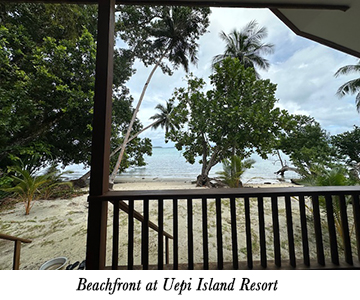
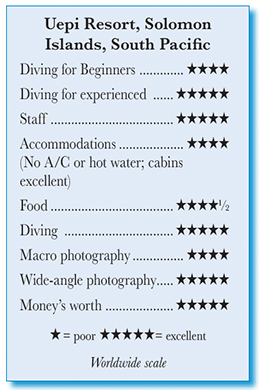
Dear Fellow Diver, The moment I landed at the Uepi Island dock, I had a good feeling. After a day or two, I knew I had discovered a hidden resort reminiscent of what diving was like decades ago, but with lovely cabins, high-quality food, and pristine diving, with plentiful fish, diverse corals, and warm and relaxing waters. Wanna see lots of sharks? You've got it. Like big schools of fish? Macro stuff? Enormous sea fans? Pristine, eye-popping hard corals? Uepi (pronounced ooo-pee) has it all and even activities for nondivers.
I arrived in mid-August, just four weeks after Jace Kelly, the co-owner/manager, and his crew at Uepi finished rebuilding their six exquisite guest cabins. (Jace's father, Grant, built and ran the resort until turning it over to Jace a few years back.) Despite no A/C or hot showers (the temperature was fine, but a shower can be bracing in the winter; it's how they manage their limited water supply, Jace explained), ceiling fans maintained pleasant temperatures in the lovely dining hall and in my well-appointed and spacious cabin, which had a comfortable bed, adequate storage, and many Aussie outlets (they have adaptors) that included USB-C plugs. All cabins sit on the water, with pleasant front porches and sheltered hammocks. My cabin was the farthest from the dining area, a semi-lighted 8-10 minute walk through the jungle. At night -- it stays light until 6:30 p.m. -- I used my phone light to keep from stubbing a toe. The comfortable common dining areas had a nice lagoon view and a comfortable sitting area in the bar. After my easy checkout dive among plenty of hard coral (85°F water, 100' viz) to get my buoyancy right, our next dive was at Charapoana Point, just three minutes away. I backrolled off the skiff and followed our guide along the wall, kicking easily in the mild current at 60-70 feet. Suddenly, I saw a flurry of big fish --sharks, a dozen or more, mainly grey reef sharks with a few black tips mixed in, and a hammerhead. Schools of hovering barracuda, trevallies, snappers, and cleaner fish abounded. I was reminded of Palau's Blue Corner but with a mild current, so I didn't need a reef hook; I just needed a simple handhold on dead coral. I turned the corner, and the dive turned into a small-stuff, hard-coral dive. Bright orange anemones, wild schools of grunts, and split-fin yellow-tailed snappers paid no mind to me as I swam through their swarms. I spotted a couple of nudibranchs, a pipefish, a small green eel peeking from his lair, and seven pink anemone fish cavorting about in their living nest. The dive was filled with life.
At 4:30, my third dive that day was Uepi Point, again with big stuff and swarms of large tropicals. Most divers only made two dives -- 8:30 a.m. and 11 a.m.-- but they willingly flexed the schedule for my group to 9 a.m. and 11 a.m. and offered a 4:30 p.m. dive or a night dive at 6:45 p.m. for four of us who wanted more (extra charge). Most guests are Australian, and Jace said that after two dives, they generally preferred to diversify in the afternoon and snorkel, kayak, or paddleboard, often with their spouse or kids. I traveled with five other Americans; the other guests were Aussie, Swiss, Polish, and Italian. Grant, the patriarch and founder of Uepi, told me that before he and his wife Jill built the resort in the '80s, Uepi was a coconut plantation. Jace, who grew up on Uepi and is now 30-something, took over the resort with his wife, Katie. Jace manages a staff of 25, helps with menus, and affably interacts with idiosyncratic guests, with lots of help from Jill (and Grant and Katie), who, along with Jace, is raising their three kids. He helped me solve a port-changing tool problem -- a real "McIver." In their YouTube video "The Island Life of Us," you can see how their rebuilding of Uepi during COVID involved ingenuity, hard work, and lots of help from resort employees. It's a well-oiled machine, a testament to creativity and perseverance. They are great hosts.
Photographers have to make do. There is no camera room, so I stored my rig on the dive shop platform's top shelf and charged batteries in my room. The crew handled cameras carefully, storing them on the bottom of the boat. It worked out fine since boat rides were only under five minutes (with one or two exceptions). On one wall dive, I was delighted with the diverse corals and critters -- an eagle ray, two fearless cuttlefish, and three species of anemone fish. Under the overhangs lurked electric clams, sexy shrimps, nudibranchs, and endless tiny tropicals darting in and out of the healthy staghorn and table corals. White tip sharks regularly cruised by. Something seemed familiar about this dive, and later, I remembered the fine China Wall in Alor, Indonesia. Two morning dives brought on a little hunger, and not long after returning to my cabin, a staff member brought lunches to each cabin, an excellent place to enjoy a meal, usually a protein, vegetables, rice/noodles, fruit, and a baked dessert. In the mornings, at 7 a.m., I made coffee in a French press, then walked to the lodge for 7:30 breakfast. Muesli, yogurt, toast, and tropical fruits were the mainstays, as well as eggs to one's liking, but no breakfast meats, mildly disappointing to me and others. Conversely, dinners were delicious fish, beef, chicken dishes, veggies, salads, lobster, crab, and ice cream/pie for dessert. On our welcome night, Jace briefed us, and dinner was trevally, chicken, crab, veggies, eggplant, rice, and birthday cake for an Aussie guest. Dining was buffet style, and a nearby bar and comfy chairs made for good after-dinner conversations. My only night dive was on the house reef near the dock, which had good visibility and no current. We went out at 7 p.m., but the creatures didn't. I saw a couple of crabs, a slipper lobster, a sleeping parrotfish, a pair of Peterson shrimp, and not much else. Oh well, you pays your money, and you takes your chances.
And I had a great visit with six pygmy mantas or, as most folks call them, mobula rays. We sat on the sandy bottom 20 feet from the cleaning station and waited for the show. And we got it; they weren't shy. Another time, we hoped to snorkel with resident giant mantas in 12 feet of water in the middle of Marovo Lagoon. Grant gave us a 50-50 chance they would show. Oh well, we lost; they didn't show. But overall, it was great diving. You may not get all the creature comforts at some upscale destinations or the massive soft corals of Raja Ampat. Uepi is a pristine hard coral destination with plenty of critters and swarms of fish that make photographers like me very happy. The diving, the staff/management, the resort, and the remote environment were truly magical. And a great prelude to my next 10 days, the Bilikiki. While Undercurrent carried a full undercover review of the Bilikiki in October 2023, editor Ben asked me for a brief update because of reports of problematic staff (who, it turns out, are no longer there). Cruise Directors Pato and Fernando, as well as divemasters Sean and Danny, were cordial, polite, helpful, and handled needy divers well. We had nearly total diving freedom. Preparing, then loading, and unloading divers onto their "Tinnies" was well organized for the 24 divers and guides. The dive deck was crowded, and not everyone had a place to sit to put on wetsuits, but everyone was thoughtful and helpful despite the close quarters. One glitch: Two of my dive buddies, admittedly poor on air consumption, had requested "fat boy" nitrox tanks in advance, but when they got on board, the request had been overlooked, and the guides could only rustle up two for one of my buddies, none for the other.
The bottom bunk was fine -- I'm 6'4" and couldn't fit my torso in the upper bunk. My 5'6" roomie drew the short straw! The Bilikiki is an older retrofitted cargo ship, so it has its quirks of steep stairs, step-over barriers between parts of the ship, a noisy engine, no shade on the sun deck, and no A/C in the lounge, only in the cabins. Still, its dives fit nicely into the history of the Solomons. An unguided dive at Bilikiki Bay was rich, diverse, and beautiful, with a couple of clown triggerfish leisurely nibbling at the wall. I spotted a bushtail tang, rare around here, and an inter-species clownfish nest. This bay has a unique beauty that is different from but equal to the best Raja Ampat dives. The Iwami Maru wreck had poor visibility, but it was still worth doing. It's a big ship in 85 feet of water, with the propeller mainly intact and lots of interesting fish about -- totally unafraid spadefish, grunts, glassies, and snappers. Cleaner shrimp gave me a cuticle manicure in a cubby on the wreck deck. White Beach was a cool treasure hunt of a WWII equipment dump that occurred when the Americans left and were not allowed to take anything with them. Camera facilities . . . one 6'x6' table in the lounge . . . are inadequate with no outlets. Eight big-rig photographers were on board and the first days were very crowded on the table. Cameras could not be kept at night on the table or on the dry table on the dive deck due to a rocking boat, so people kept them under the photo table in small baskets or in their rooms. In comparison, the diving at Uepi and off the Bilikiki was equally excellent, though a bit different. Plenty of big stuff at Uepi -- sharks, occasional giant mantas, mobula rays -- but few on Bilikiki dives. But the Bilikiki traveled to more variety -- caves, swim-thrus, and wrecks. Macro opportunities were abundant with both. If your goal on a trip is to dive, dive, dive, these two perfectly complement each other. P.S.: Little did I know that my editor, Ben Davison, had visited 37 years ago(you'll find the URL for his report below), and the diving today is just as good as then. Here's his report. D.S. Our undercover diver's bio: "I got the diving bug watching Sea Hunt as a kid, got certified in 1983, but didn't start diving the world until 1991. I've logged over 1,700 dives in the Caribbean, Indonesia, Australia, Tahiti, Palau, PNG, Maldives, and the Philippines. While I love the convenience of liveaboards, I enjoy resorts for their relaxing pace and beauty. My life goal is to dive on my 90th birthday. (Only 18 years to go!)"
|


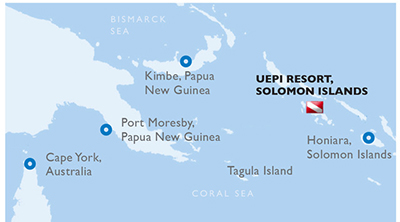
 The downside? Uepi Island is a long haul from the U.S., first requiring a plane change in either Fiji or Australia. After you arrive in Honiara, the capital, there's a 1-2 hour puddle jumper flight to Seghe, followed by a 40-minute boat ride to the resort. So one ought to devote at least two weeks to the journey -- make a side trip in Fiji or Australia, or, as I did, combine Uepi with 10 days on the venerable liveaboard, Bilikiki.
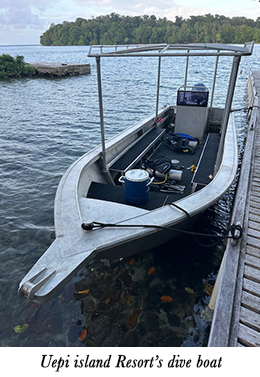
 With trips to the sites usually five minutes or less, the sturdy aluminum dive skiffs were uncovered, with overhead bars where the cover would be. The boat was a little crowded with seven divers, a divemaster, and a captain, but doable. To enter the water, we all backrolled simultaneously and finished climbing a sturdy ladder after slipping out of tanks/BCs Some climbed up fully loaded. Captain Silas and divemaster Joe, who had 30 years of guiding for Uepi, were competent indeed (though one day, an embarrassed Joe forgot his weights, so he hung above us for the dive; we all got a chuckle). Briefings were thorough, and Joe called attention to the big stuff (sharks, barracuda, trevallies, dolphins, and an occasional giant manta) he spotted in the blue, as well as those hidden and macro creatures on the walls and bommies (the Aussie word for a coral outcropping). Lots of diverse anemone nests populated shelves at 15-30 feet. The diving is flexible, and you can go at your own pace, but we generally stayed within sight of each other, and the guides pointed out small stuff for those interested. Dives lasted 60-70 minutes, never below 80 feet; most were 60 feet on average. After most divers surfaced, I'd occasionally linger a while longer.
 They dock alongside a wooden pier, and the
crew loaded our tanks/BCs into the skiff. Between
dives, Silas and Joe, if asked, lifted our tanks
with weighted BCs up to the dock and provided fresh
tanks; we attached our gear to the tanks, and then
either we or the crew lifted them back into the
boat. Afterward, we rinsed our gear and electronics
in separate containers or used the hose. The dive
shop is just a repair and storage area. They don't
sell anything, not even t-shirts. Valet diving
hasn't quite come to Uepi unless you ask for it.
They dock alongside a wooden pier, and the
crew loaded our tanks/BCs into the skiff. Between
dives, Silas and Joe, if asked, lifted our tanks
with weighted BCs up to the dock and provided fresh
tanks; we attached our gear to the tanks, and then
either we or the crew lifted them back into the
boat. Afterward, we rinsed our gear and electronics
in separate containers or used the hose. The dive
shop is just a repair and storage area. They don't
sell anything, not even t-shirts. Valet diving
hasn't quite come to Uepi unless you ask for it.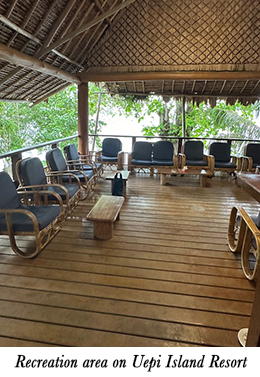 But chances were always great for day dives. I was stunned by the size of the sea fans on the Double D wall, the largest I've seen anywhere. A wide-angle photographer's dream, some were 20 feet in at the widest point and varied from brown to red, to purple and green , to off-white. I found a couple of hawkfish on them but no pygmy seahorses. And the barrel sponges are enormous as well. On this dive, I happened upon an anemone nest with two advanced guards 10 feet from the nest that warned me to stay away by pecking at my facemask. My photographer buddy got some pretty cool photos!
 Barracuda Point is a "wow" dive with hundreds of schooling jacks, dozens of schooling barracuda, and hunting sharks cruising the wall. Hooking in for 40 minutes, I watched the swarms get closer and closer, coming from overhead and against the current. And to top it off, there were loud, core-shaking rumblings of a nearby (50 nautical miles) active underwater volcano, Kavachi. I felt like I was in an IMAX theater.
 Divers Compass: I paid $3600 for eight nights at Uepi with two dives/day and US$70 per 3rd dive. (The 10-night stay on the Bilikiki cost me US$6600, plus $180 for nitrox) . . . Uepi has no nitrox due to a lack of demand from Aussies . . . One flies through either Fiji or Brisbane to get to Honiara; Solomons Air runs on "island time," with delays and unexpected stops, so give yourself 1-2 days' slack. . . .I came through Australia, and only 7kg were allowed in the overhead bins; I had to pay AU$45 for that, and AU$65 for my 41 kg dive gear . . . carry your batteries in your carry-on . . . Good-quality rental gear was available at the resort, and minor repairs were done expeditiously . . . Soft drinks were about US$4, beer $5, and wine $7 per glass; no hard liquor other than what divers brought . . . The nearest dive chamber is in Brisbane, a 3-hour flight from Honiara . . . The best time to dive is the dry season, April-November. We had a few showers, but nothing that got in the way of enjoying our stay.
I want to get all the stories! Tell me how I can become an Undercurrent Online Member and get online access to all the articles of Undercurrent as well as thousands of first hand reports on dive operations world-wide

| Home | Online Members Area | My Account |
Login
|
Join
|
| Travel Index |
Dive Resort & Liveaboard Reviews
|
Featured Reports
|
Recent
Issues
|
Back Issues
|
|
Dive Gear
Index
|
Health/Safety Index
|
Environment & Misc.
Index
|
Seasonal Planner
|
Blogs
|
Free Articles
|
Book Picks
|
News
|
|
Special Offers
|
RSS
|
FAQ
|
About Us
|
Contact Us
|
Links
|
3020 Bridgeway, Ste 102, Sausalito, Ca 94965
All rights reserved.