
 |

 Email Signup
|
Subscribe
|
Login
Email Signup
|
Subscribe
|
Login
For Divers since 1975 The Private, Exclusive Guide for Serious Divers Since 1975 |
"Best of the Web: scuba tips no other source dares to publish" -- Forbes |
Another Liveaboard Lost in the Red SeaContents of this Issue: Uepi Resort, Solomon Islands, South Pacific Investing in Digital Camera and Expensive Strobes? An Aging Liveaboard, a Dangerous Dive Deck Death and the Full-Face Snorkel Masks The Diver & The Cook, Fascinating Nonfiction DEMA Working Hard To Pass The Dive Boat Act Another Liveaboard Lost in the Red Sea Two More Liveaboards Lost to Fire Editorial Office: Ben Davison Publisher and Editor Undercurrent 3020 Bridgeway, Suite 102 Sausalito, CA 94965 from the November, 2024 issue of Undercurrent
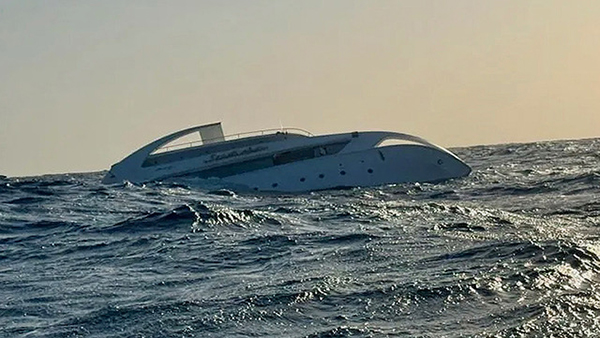
The 30-meter liveaboard Seaduction sank last month in the far southern Egyptian Red Sea after its captain apparently disregarded severe weather warnings. The 18 diving guests and crew escaped from the boat, but most had to abandon their possessions and subsequently spent some eight hours adrift in small boats. The incident occurred in the early hours of October 24, halfway through a charter trip out of Hamata. Most vessels, including liveaboards, were reported to have heeded warnings of stormy weather and high waves and stayed farther north in the more sheltered area of Sataya Reef. Seaduction, however, had sailed on to Elba Reef near the border with Sudan, where the timber-hulled vessel is thought to have sprung a leak. The boat had been chartered for the "deep south" trip by the Laval Subaqua Club in France. Two of the only four members who managed to save their passports returned to France and spoke about the incident to France Info. Philippe Galodé said he had been dozing around 3 a.m. when his friend asked if he thought the boat was lying at a strange angle. "I went upstairs to see what was going on," he said. "According to the captain, everything was under control." Other guests later said they noted the list as early as 2:00 a.m. "After half an hour, the boat started to shake very seriously," said ex-club president François Paillard. "We started to take out the life jackets, assuming that it was not going to get better, no matter what the captain said. Finally, we did what the captain did not do, which was to get ready to evacuate." By 3:30 a.m., water had risen in the cabin, said Paillard. "We were all saved at the last minute - the boat was listing hard and then completely capsized. It was panic; everyone jumped into the water." The divers managed to don life jackets, but few had time to get dressed and retrieve passports, phones, cash, or other personal property. Paillard commented that the 10 crew members had followed the captain's orders but were "not seasoned sailors." The liveaboard carried two 5m RIBs, but there had been time to launch only one RIB and one of two lifeboats. Amid the strong waves, they had to bail continually to stay afloat. The survivors spent eight hours adrift before a trawler spotted an orange lifeboat cover, brought the survivors on board, and provided them with clothes. They were later transferred to a naval patrol vessel that brought them ashore, where they were taken by bus to a hotel in Hurghada. The 14 divers who had lost their passports and belongings were left waiting for the French consulate in Cairo to make the necessary arrangements to allow them to travel. "The consul asked them to take steps immediately with their insurance companies, but they can't do anything," Nelly Leroux, speaking to France Bleu, said, "They have nothing left. My husband doesn't even have shoes on his feet. The trauma is still very significant - he just told me that he had flashbacks and that he couldn't sleep." Claire Penard, the president of the dive club, said that the levels of bureaucracy involved had made the process challenging. "It's extremely hard," she said, "and the evacuation was particularly traumatic because we really thought we were going to die." [divernet] |



I want to get all the stories! Tell me how I can become an Undercurrent Online Member and get online access to all the articles of Undercurrent as well as thousands of first hand reports on dive operations world-wide

| Home | Online Members Area | My Account |
Login
|
Join
|
| Travel Index |
Dive Resort & Liveaboard Reviews
|
Featured Reports
|
Recent
Issues
|
Back Issues
|
|
Dive Gear
Index
|
Health/Safety Index
|
Environment & Misc.
Index
|
Seasonal Planner
|
Blogs
|
Free Articles
|
Book Picks
|
News
|
|
Special Offers
|
RSS
|
FAQ
|
About Us
|
Contact Us
|
Links
|
3020 Bridgeway, Ste 102, Sausalito, Ca 94965
All rights reserved.