
 |

 Email Signup
|
Subscribe
|
Login
Email Signup
|
Subscribe
|
Login
For Divers since 1975 The Private, Exclusive Guide for Serious Divers Since 1975 |
"Best of the Web: scuba tips no other source dares to publish" -- Forbes |
The End of Coral Reef Diving?Contents of this Issue: Uepi Resort, Solomon Islands, South Pacific Investing in Digital Camera and Expensive Strobes? An Aging Liveaboard, a Dangerous Dive Deck Death and the Full-Face Snorkel Masks The Diver & The Cook, Fascinating Nonfiction DEMA Working Hard To Pass The Dive Boat Act Another Liveaboard Lost in the Red Sea Two More Liveaboards Lost to Fire Editorial Office: Ben Davison Publisher and Editor Undercurrent 3020 Bridgeway, Suite 102 Sausalito, CA 94965 from the November, 2024 issue of Undercurrent
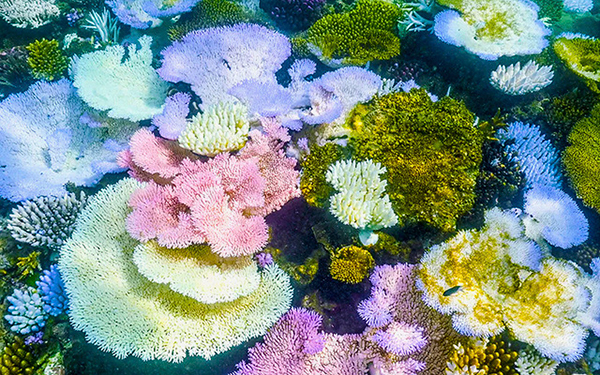
Have we Boomers seen the best of coral reef diving? Is there any hope? CNN reports that the mass bleaching of coral reefs worldwide since February 2023 has been the most extensive on record. Climate change is fueling record and near-record ocean temperatures throughout the world. In October, the National Oceanic and Atmospheric Administration (NOAA) said that, according to satellite data, a staggering 77 percent of the world's coral reef areas - from the Atlantic to the Pacific to the Indian oceans - have been subjected to bleaching-level heat stress. The NOAA Coral Reef Authority declared it a global bleaching event in April 2024, making it the fourth since 1998. From 2014 to 2017, mass bleaching affected about 66 percent of the world's reef area. Triggered by heat stress in warm oceans, coral bleaches when corals expel the colorful algae living in their tissues. Without these helpful algae, the corals become pale and are vulnerable to starvation and disease. A bleached coral is not dead, but ocean temperatures need to cool off for any hope of recovery. At least 14 percent of the world's remaining corals are estimated to have died in the previous two global bleaching events. Though this mass bleaching is already the most widespread, affecting reefs in 74 countries and territories, NOAA has stopped short of calling it the "worst" on record. In the coming months and years, scientists will conduct underwater assessments of dead corals to help tally up the severity of the damage. In response to the bleaching record, scientists, world leaders, and the global funding community met in Colombia at the end of October to discuss last-ditch strategies to avert the functional extinction of corals, including further protections and financing. They have a difficult job ahead. (CNN) |



I want to get all the stories! Tell me how I can become an Undercurrent Online Member and get online access to all the articles of Undercurrent as well as thousands of first hand reports on dive operations world-wide

| Home | Online Members Area | My Account |
Login
|
Join
|
| Travel Index |
Dive Resort & Liveaboard Reviews
|
Featured Reports
|
Recent
Issues
|
Back Issues
|
|
Dive Gear
Index
|
Health/Safety Index
|
Environment & Misc.
Index
|
Seasonal Planner
|
Blogs
|
Free Articles
|
Book Picks
|
News
|
|
Special Offers
|
RSS
|
FAQ
|
About Us
|
Contact Us
|
Links
|
3020 Bridgeway, Ste 102, Sausalito, Ca 94965
All rights reserved.