
 |

 Email Signup
|
Subscribe
|
Login
Email Signup
|
Subscribe
|
Login
For Divers since 1975 The Private, Exclusive Guide for Serious Divers Since 1975 |
"Best of the Web: scuba tips no other source dares to publish" -- Forbes |
MY Vita 2, Red Sea, EgyptContents of this Issue: Nature Island Divers, Jungle Bay Resort, Dominica, BWI Visiting Dominica's Sperm Whales Take Time to See Dominica's Rain Forests Miss a Connection and Arrive Four Days Later Travel with a UK Agency, and You Won't Lose Money Novel Emergency Treatment for Lionfish Envenomation Guadalupe Island Closing Cost Big Money When a Dive Guide is Wrong Make Sure Your Weight Belt is Not Impeded Apple Ultra Watch Running the Oceanic Dive Computer App Be Wary of Drug-Crazed Sharks? Editorial Office: Ben Davison Publisher and Editor Undercurrent 3020 Bridgeway, Suite 102 Sausalito, CA 94965 eight wrecks and reefs in a week from the August, 2023 issue of Undercurrent
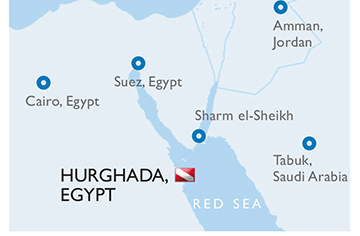
Dear Fellow Diver, Had the recent liveaboard accidents in the Red Sea, including the deadly June 11 fire aboard the Hurricane, occurred before I left for my May trip, I might have reconsidered. However, I've been to the Red Sea before and know how to pick a reputable dive agency and liveaboard. That's why my editor, Ben Davison, asked me to write an article because Europeans (I live in London) use boats hardly advertised in the U.S. and with lower prices (perhaps without a hot tub and a few other amenities). For $2000, my trip included a five-hour direct flight from London Gatwick to Hurghada and seven days of diving. In comparison, it's about $2700 for seven days aboard the Red Sea Aggressor, no flights included. And my booking had an ironclad financial guarantee if something goes wrong (see sidebar).
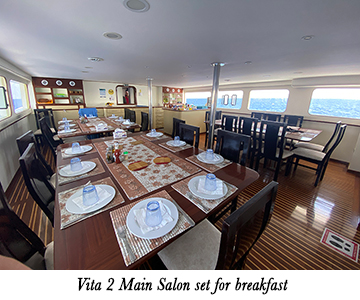
I've been to the Red Sea many times, and this time three friends booked the Vita Xplorer (aka the MY Vita 2). It's a sleek Egyptian 130-foot liveaboard accommodating up to 24 passengers in 12 cabins. I booked one of the four upper deck cabins for a modest $60 more. My cabin had two comfortable single beds and plenty of hot water for the shower, with limited storage space, but I know to pack light for liveaboards. After boarding late Saturday, the dive guides checked our logbooks or C-cards, we signed waivers, and were briefed on the boat, which included a look at the forward emergency exit past the two dive guides' cabins below decks. Early Sunday morning we departed and made our first check-out dive at Sha'ab el Erg, a not particularly auspicious reef as Red Sea reefs go, but it was only 40 feet deep, cluttered with lemon butterfly fish and crowds of bannerfish. It gave me a chance to get my weights right with the aluminum 80s that came equipped for both DIN and International A-clamp regulators. A couple of hours later we were at the great circular reef of Sha'ab Abu Nuhas, on the major shipping route between the Far East and the old European empires, where for centuries it was a scourge to ships until GPS came along. The Vita 2 anchored in the lee of the enormous reef, and it was a bumpy, spray-flecked 15-minute inflatable journey, tough with a heavy tank on my back, to where the wrecks lay. I was envious of those using side-mount tanks. Max, a British-born Sikh with a shaved head, was one. Sitting comfortably with his tank between his legs, he rambled on with humorous observations while we back-toters suffered. Our first of three dives at Sha'ab Abu Nuhas was on the MV Chrisoula K, a Cypriotregistered freighter that came to grief in 1981. Often called the Tile Wreck due to its cargo of Italian floor tiles, it lies at an angle, so you can choose how deep to go. I didn't pass 80 feet deep but peeped into the engine room and shined my torch on a milling machine in a workshop nearby, always in sight of the welcome blue of daylight. Divers, uninterested in rusty metal, puttered around outside on the reef among fish galore. The next morning, we dived the 1983 wreck of the MV Giannis D. It's what nondivers imagine a wreck to look like. With not a lot of coral growth, the stern is upright at 75 feet to the seabed and lies at an angle. My buddy and I made our way through the wreck, entering through a door at the stern, then moved on, scaring off an occasional grouper until we exited the wheelhouse. I got so used to the slight inclination of the wreck that when I exited, I was deeper than expected. My buddy and I then dropped through a skylight to visit the engine room filled with swarming glassfish. Some divers stayed outside, taking selfies by the funnel, while the more adventurous swam to the disconnected bow, about 200 feet away. I dived no deeper than 75 feet for an hour or so, and, although buddy diving was allowed, the guides were generally nearby. The rule was to dive as deep as one's certification and insurance allowed. (Uncertain divers could pay $500 for a dedicated guide for the week.)
The SS Carnatic was a 19th Century steam sailing ship that sank in 1869. In the 1980s, British divers plundered its brass work, but it's still a beautiful dive. With a transom reminiscent of "Pirates of the Caribbean," it lies on its side, where it slipped from the reef after running aground. Although the timber decking has gone, the iron hull and beams, covered in brightly colored soft corals, made for a wonderful dive. In the bow, clouds of glassfish are prey for lurking lionfish. Once we'd gotten our fill of the wreck, we made our way up to the reef top at 20 feet, then to our inflatable. Climbing back into the RIB was an art. After the boatman pulled up my gear, I grabbed the ropes with both hands, ducked down under the water, kicked hard, and executed a clean-and-jerk before toppling over the tubes into the boat. Then back to the mothership, where helping hands guided me safely onto the swim platform. While the crew put my rigged tank back in its place, ready to be refilled, I took a warm shower at the aft deck and slipped out of my wetsuit ready for lunch.
When I book a moderately priced liveaboard, I expect ordinary, basic, filling meals served buffet-style, and that's what I got: spaghetti Bolognese, chicken, fries, steaks, plenty of salads (some Middle Eastern), lots of baked vegetables, and freshly baked bread and pastries. Those with particular diets were well-served. One day, the chef was cutting pomegranates like he would an orange. Having been born in Iran, where pomegranates are revered, I volunteered to show him how to cut it so all the jewels stayed intact. Oh, oh. Thanks to typical Middle-Eastern male arrogance, he took offense to instruction from a woman and shunned me for the rest of the trip. While evenings were quiet, Adhams, the younger of the two guides, had taught himself to play the violin. Despite being modest about it, at times he serenaded us in the spacious salon, creating an unusually sophisticated atmosphere for a dive trip. During the day, many passengers sunbathed between dives on the top deck. After we had our fill of wrecks, we made a bumpy crossing over the Gulf of Suez to Ras Mohammed and some of the more famous reef dives in the Red Sea. I rolled back into the water at Shark Reef, a wall dive with water so clear one could easily stray beyond the limits of one's nitrox mix. Perhaps it's good that Nitrox never got beyond 29 or 30 percent, given the opportunity to go really deep here. I never went deeper than 80 feet all week.
We surfaced close to the reef to avoid the many liveaboard inflatables and day boats zipping about to pick up passengers. While a surface marker of some type is mandatory, I'm amazed at how the sharp-eyed inflatable drivers always manage to spot their own divers among so many waiting at the surface. Our midday dive was at Anemone City, where armies of officious yellow anemone fish and clusters of tiny black domino damsels guarded masses of anemones. And later in the afternoon, fun, fun, fun as we skimmed over Jackfish Alley's reef behind Vita 2 scooters. As Dr. Eugenie Clark once said, the proliferation of different coral varieties jammed together makes the northern Red Sea unique. There are whole guide books devoted to the different species. As we hummed along behind Mustafa with our DPVs, we certainly saw a lot of it.
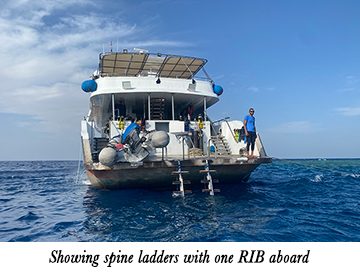
It's such a good dive that we moored overnight and dived it again early in the morning before scads of day boats arrived. Despite a strong current, we got to the stern, where an anti-aircraft gun and a bigger gun lay at a jaunty angle among masses of glassfish and their nemesis, lionfish. Because we were moored over the wreck, we climbed one of the liveaboard's twin ladders fully kitted, and after help doffing our tanks, showered and went for a breakfast of omelets and pita bread loaded with feta cheese and honey.
The last wreck we dived was the Barge at Bluff Point, home to some massive moray eels as well as the full magilla of Red Sea reef fish. An easy dive so fishy that divers on underwater photography trips spend their entire week shooting here. On our last reef dives on the way back to Hurghada on Friday, I passed a group of divers clad in swimming suits, without BCDs, and carrying their tanks under their arms. No one had an explanation other than divers in Egypt do crazy things. And our crew did too. After arriving in Hurghada late Friday and mooring stern-on to the jetty, the ladder between the boat and dockside fell into the water. I watched, amused, as the crew quibbled and scratched their heads to figure out how to retrieve it without getting wet. They got wet. So, I'd suggest my fellow divers in North America consider booking a Red Sea trip through an English agency. Then, before or after taking the five-and-a-half-hour flight to Hurghada, spend a few days in London or the countryside, enjoy a pint or two in an English pub, and see a few sights. -- F.M. Our Undercover Diver's Bio: A mother of two, I've been diving since 1979, but after a hiatus, I became enthusiastic in the mid-'90s, visiting cold-water sites such as Scapa Flow and the Outer Hebrides of Scotland, Iceland, and Vancouver Island, as well as the Caribbean, the Galapagos, Egypt, Yemen, and Chuuk. Nowadays, I travel with friends, leaving my long-suffering husband at home tending the garden.
|


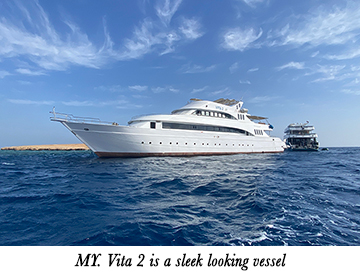 For the diving industry, nowhere is as busy as the Egyptian Red Sea, with more than 175 registered liveaboards and countless day boats. With so little plankton in the water, visibility consistently exceeds 100 feet. Deep thermal vents from below and desert sunshine from above provide warm water for fish and corals to thrive. On my late May trip, the water was 79°F.
 Aside from wrecks, I love the exceptional
variety of Red Sea fish. On most dives, I saw the
entire gamut: giant morays, masked butterfly fish,
bannerfish, chevron barracuda, batfish, bluefin
trevally, Napoleon wrasse, lionfish, titan triggerfish, Red Sea grouper, lyretail
anthias, hawkfish, surgeonfish, tangs, bluefin trevally, coral grouper, damselfish,
masked pufferfish, cornet fish, etc. With an experienced eye, I spotted giant
frogfish, scorpionfish, blue-spotted rays, and stonefish on the bottom. On this
itinerary, I saw no sharks or big fish; they're farther offshore, at destinations
like the Brothers Islands, which can be a rough ride out, and you might need your
sea legs. This itinerary was generally comfortable as we were usually in the lee
of the coast.
Aside from wrecks, I love the exceptional
variety of Red Sea fish. On most dives, I saw the
entire gamut: giant morays, masked butterfly fish,
bannerfish, chevron barracuda, batfish, bluefin
trevally, Napoleon wrasse, lionfish, titan triggerfish, Red Sea grouper, lyretail
anthias, hawkfish, surgeonfish, tangs, bluefin trevally, coral grouper, damselfish,
masked pufferfish, cornet fish, etc. With an experienced eye, I spotted giant
frogfish, scorpionfish, blue-spotted rays, and stonefish on the bottom. On this
itinerary, I saw no sharks or big fish; they're farther offshore, at destinations
like the Brothers Islands, which can be a rough ride out, and you might need your
sea legs. This itinerary was generally comfortable as we were usually in the lee
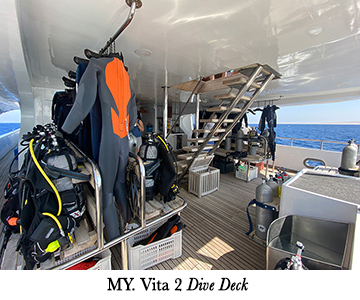
of the coast.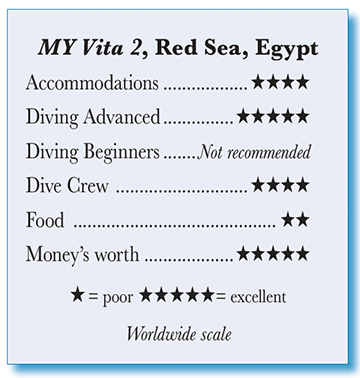 The Vita 2 has a spacious dive deck with two rows of benches, boxes for fins, masks, and other kit underneath, a large charging table for photographers, and a camera dunk tank near the platform. Those passengers who didn't speak English (we were equally divided between British and French) never seemed to get the idea they should not dunk their masks in the rinse tanks before diving, so the water became infused with spit gloop. I used the hose to rinse my mask.
 On our first dive, we followed the wall through hordes of large batfish, then ventured into the blue to meet a great swarm of chevron barracuda. Back at the reef, a saddle of sand was home to some huge morays, and the reef continued in a riot of reds, oranges, and yellows afforded by more than 200 species of soft and hard corals -- everything from gorgonia and fungia to acropora and tubastria. Finally we reached the former resting place of the wreck of the MV Jolanda, which had long ago slipped down to depths beyond diving. Its demise is marked by its spilled cargo -- masses of plumbing, toilets, and bathtubs, now adorned with fire coral, as if to warn divers against using them for their original purpose.
 The Red Sea's crown jewel is The SS Thistlegorm, a 415-foot armed British WWII freighter called one of the best wreck dives in the world. It matches any in Truk Lagoon. It's full of war materiel intended for unloading in Suez, Egypt, for the push against Rommel: trucks loaded with motorbikes, airplane wings, masses of artillery shells, and even the remains of two trains, with the steam engines lying nearby, blown off by bombs from German Heinkel bombers on a suicide mission because they were beyond their range from Crete. Until then, Sha'ab Ali was a safe anchorage for Allied supply ships. While our dive guides insisted the wreck was discovered in 1995, my buddy had dived it in 1992 when she was leading trips on an Israeli dive boat. And that was 40 years after Jacques Cousteau, after hearing about it from a local fisherman, salvaged a motorcycle, the captain's safe, and the ship's bell.
 Shag Rock is another huge reef in the middle of the gulf. After diving the 19th-century coral-smothered wreck of the SS Kingston, my buddy and I rode the current past spectacular coral and clouds of yellow goatfish for an exhilarating half-mile drift back to where our liveaboard was moored. A few divers took the inflatable taxi back, missing all the fun. At Beacon Rock we dived the SS Dunraven. At 100-feet deep to the seabed, it was the deepest wreck of the week and its upturned hull was so smothered with coral it was more reef than wreck.
 Diver's Compass: We booked a package through Regal Diving (
I want to get all the stories! Tell me how I can become an Undercurrent Online Member and get online access to all the articles of Undercurrent as well as thousands of first hand reports on dive operations world-wide

| Home | Online Members Area | My Account |
Login
|
Join
|
| Travel Index |
Dive Resort & Liveaboard Reviews
|
Featured Reports
|
Recent
Issues
|
Back Issues
|
|
Dive Gear
Index
|
Health/Safety Index
|
Environment & Misc.
Index
|
Seasonal Planner
|
Blogs
|
Free Articles
|
Book Picks
|
News
|
|
Special Offers
|
RSS
|
FAQ
|
About Us
|
Contact Us
|
Links
|
3020 Bridgeway, Ste 102, Sausalito, Ca 94965
All rights reserved.