
 |

 Email Signup
|
Subscribe
|
Login
Email Signup
|
Subscribe
|
Login
For Divers since 1975 The Private, Exclusive Guide for Serious Divers Since 1975 |
"Best of the Web: scuba tips no other source dares to publish" -- Forbes |
Flotsam & JetsamContents of this Issue: Nature Island Divers, Jungle Bay Resort, Dominica, BWI Visiting Dominica's Sperm Whales Take Time to See Dominica's Rain Forests Miss a Connection and Arrive Four Days Later Travel with a UK Agency, and You Won't Lose Money Novel Emergency Treatment for Lionfish Envenomation Guadalupe Island Closing Cost Big Money When a Dive Guide is Wrong Make Sure Your Weight Belt is Not Impeded Apple Ultra Watch Running the Oceanic Dive Computer App Be Wary of Drug-Crazed Sharks? Editorial Office: Ben Davison Publisher and Editor Undercurrent 3020 Bridgeway, Suite 102 Sausalito, CA 94965 from the August, 2023 issue of Undercurrent
The 100-Degree Ocean. In less than two weeks in late July, innumerable reefs in the Florida Keys have been bleached white and killed by the extraordinary water temperatures. And summer isn't even over. While scientists have predicted the results of global warming for decades unless governments act, endless politicians have denied it even exists and refuse to act for all sorts of imaginary reasons. The governor of Florida, where the leap in temperature is causing havoc, has said he rejects the "politicization of the weather." But by denying basic, established climate science, is he not politicizing it? And by the Way, Weather is Not Climate; Weather is what's happening today. Climate is what the weather is over a long period of time. This winter, Florida had some chilly days. That's weather. But Florida's average temperature is 2.5ºF higher than it was in 1970. That's today's climate. Of course, it's not just Florida's fault. The politicians of all the industrialized countries for the last 50 years are to blame. And the reefs die. What? A Ten-Year-Old Master Scuba Diver? Trent Ethridge, who lives in Maryland, became obsessed with scuba at a young age but had to wait until he reached the ripe old age of 10 before he could get certified as a Junior Open Water Diver. He then worked quickly to obtain more certifications, including night diving and nitrox diving, while logging 50 dives. So, he is now a certified Master Scuba Diver, though, at his age, he still must dive with a PADI professional or a certified parent or guardian and not exceed 40 feet. He has achieved the highest certification a sport diver can have. Do you think the label "Master Scuba Diver" is misleading? It's a Clam Dunk. Bleaching occurs when a stressed marine creature, most commonly a coral, expels its symbiotic algae and turns a ghostly white, often in response to a warming sea. But bleaching affects more than just corals. Scientists have recently discovered that giant clams, which can grow to four feet in diameter and weigh as much as 500 pounds, can bleach, too, which affects their nutrition and reproduction. (Hakai Magazine).
A Death-Defying Dive. Alexey Molchanov freedived to 442 feet deep on a single breath to set his 31st world record, this time in the constant weight with monofin category at the Bahamas Vertical Blue competition on July 22. His mother, Natalia Molchanov, who held multiple freediving records and remains possibly the world's greatest freediver, disappeared during a free dive in the Balearic Islands in 2015. Freediving record attempts are a dying sport. Only in America. While divers in inland waters in other developed countries come across discarded shopping carts, 60 feet deep in Lake Tahoe, CA, Christine Lewis and Sid Stimac retrieved a still-shiny gun carefully wrapped in padding and duct tape. The two women reported the discovery, and a sheriff's patrol boat arrived to take the weapon for forensic testing, figuring it had probably been used to commit a crime. Something Else to Worry About! In a rare case, a scuba diver who descended deep into an underwater cave developed a deadly blood syndrome in which fluid leaked from his blood vessels. Previously, he had dived to 100 feet for 40 minutes. As described in the British Medical Journal on June 5, systemic capillary leak syndrome (SCLS) is a strange complication of DCS. Thanks to prompt treatment, he survived. Dr. Jeffrey Cooper, an emergency medicine professor at the University of Nebraska, hopes the case will raise awareness of potential complications associated with deep diving. A Harbinger of Doom? The giant oarfish is a strange creature, often measuring up to 30 feet long. With bulging eyes, it swims perpendicular to the surface, with its head pointing upward. It's rare for a diver to see this deep-water fish with shimmering silver scales, and mythology says if one does, it foretells a coming natural disaster, as they are said to appear before tsunamis or earthquakes. Divers sighted an eight-footer off Taiwan in mid-July, and in 2022, divers saw one off the coast of Chile. Neither case led to a natural disaster, we must point out. Drifting Florida Diver Rescued. A diver left adrift six miles off the Florida Keys in early July was found by accident, when two off-duty cops mistook him for an injured seabird. Turns out the "bird" they saw a quarter of a mile away was a human, desperately waving his arms. The two men and their wives were fishing when they spotted him. "I thought I saw what might be a bird down on the water flapping its wing. Like it was injured," said one of the rescuers, Lt. David Woolf of the Marion County Sheriff's Office. Undercurrent will provide more information when it's available. The Oceans Are Getting Greener. Attributed to global warming, the ocean color is slowly changing from blue to green, especially near the equator. Scientists think this is likely due to the proliferation of phytoplankton and zooplankton, which are red, black, and green. Use A Surface Marker. On July 26, a surfacing diver was struck by a speeding boat off Boca Chita Key, about 10 miles south of Key Biscayne, FL. The vessel belonged to the Miami-Dade Police Department, and the victim was airlifted to Jackson South Medical Center for treatment of injuries sustained. It is unclear from news reports whether the diver was using a surface marker. But it is a reminder to all of us to use one, especially where there is boat traffic. |


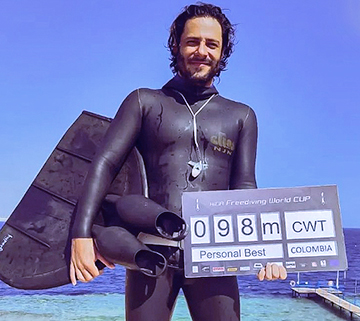 Shark Bites Freediver. On July 18, Colombian freediver Cristian Castaño Villa, a multiple record-holder, was bitten by a shark, reportedly an oceanic whitetip. He was at depth near the southern Caribbean archipelago of San Andrés, Providencia, and Santa Catalina. Remaining conscious, he was able to climb the ladder and pull himself onto the dive boat. He was taken to a hospital and stitched up without complications.
I want to get all the stories! Tell me how I can become an Undercurrent Online Member and get online access to all the articles of Undercurrent as well as thousands of first hand reports on dive operations world-wide

| Home | Online Members Area | My Account |
Login
|
Join
|
| Travel Index |
Dive Resort & Liveaboard Reviews
|
Featured Reports
|
Recent
Issues
|
Back Issues
|
|
Dive Gear
Index
|
Health/Safety Index
|
Environment & Misc.
Index
|
Seasonal Planner
|
Blogs
|
Free Articles
|
Book Picks
|
News
|
|
Special Offers
|
RSS
|
FAQ
|
About Us
|
Contact Us
|
Links
|
3020 Bridgeway, Ste 102, Sausalito, Ca 94965
All rights reserved.