
 |

 Email Signup
|
Subscribe
|
Login
Email Signup
|
Subscribe
|
Login
For Divers since 1975 The Private, Exclusive Guide for Serious Divers Since 1975 |
"Best of the Web: scuba tips no other source dares to publish" -- Forbes |
Whale Shark Research in the Mafia ChannelContents of this Issue: Whale Shark Research in the Mafia Channel Belize, Vanuatu, Costa Rica, and Beyond Is That Egyptian Liveaboard Safe? A Smoke Detector in Your Cabin? Unexplained Panic Can Kill a Diver The OUSPT Full-Face Snorkel Mask Crocodile Mauls Swimmer in Cozumel Diver Dragged to Surface: Line Caught in Propeller Editorial Office: Ben Davison Publisher and Editor Undercurrent 3020 Bridgeway, Suite 102 Sausalito, CA 94965 from the April, 2026 issue of Undercurrent
The Mafia Channel, formed between Mafia Island and mainland Tanzania, becomes a thick green soup at times, thanks to the plankton level. The plankton attracts large numbers of whale sharks that feed there. In 2007, I was lucky enough to join Matt Potenski, a shark researcher from the Shark Research Institute, funded by the Save Our Seas Foundation, and working from the research vessel MV. Kairos, radio-tagging whale sharks. Scientists have been studying the abundance and distribution patterns in the Indian Ocean by tagging whale sharks since 1993. Visual ID tags had been attached to over 200 whale sharks off South Africa, Mozambique, and the Seychelles. I joined Matt's expedition in the Mafia Channel to see how he worked. It wasn't easy since the visibility was so poor in the plankton-loaded water, but we'd spot a dorsal fin at the surface, slip from the Zodiac into the water, and swim as hard as we could to intercept the beast. After each plunge, we'd haul ourselves up over the tubes of the Zodiac around twenty times a day. Not for the less fit! They used two types of tags: a large visual tag with a number that can be clearly seen and reported by any opportunistic snorkeller or scuba diver, and a satellite radio tag that ultimately becomes unattached from the shark, bobs to the surface, and, via satellite, uploads all the data it has collected to SRI researchers' computers. These last cost around $9000 each, so they are used sparingly. Despite their grand scale, whale sharks feed on tiny plankton and small fish. They follow the plankton as they roam the ocean, mouths agape, filtering as they go. Because plankton growth is encouraged by bright daylight, it thrives in warm shallow seas, and so whale sharks feed near the surface and are often sighted by seafarers. Even so, it is remarkable that so little is known about them. https://tinyurl.com/4tdcahab John Bantin |

 = publicly available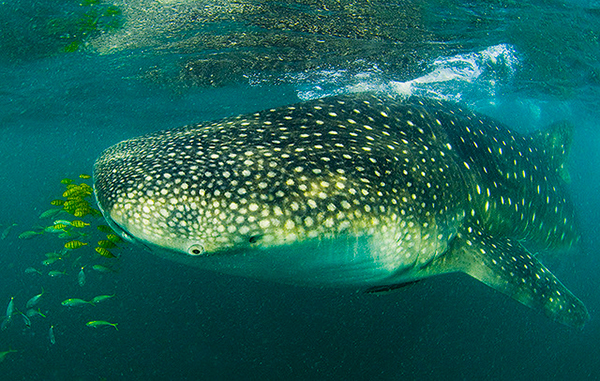

I want to get all the stories! Tell me how I can become an Undercurrent Online Member and get online access to all the articles of Undercurrent as well as thousands of first hand reports on dive operations world-wide

| Home | Online Members Area | My Account |
Login
|
Join
|
| Travel Index |
Dive Resort & Liveaboard Reviews
|
Featured Reports
|
Recent
Issues
|
Back Issues
|
|
Dive Gear
Index
|
Health/Safety Index
|
Environment & Misc.
Index
|
Seasonal Planner
|
Blogs
|
Free Articles
|
Book Picks
|
News
|
|
Special Offers
|
RSS
|
FAQ
|
About Us
|
Contact Us
|
Links
|
3020 Bridgeway, Ste 102, Sausalito, Ca 94965
All rights reserved.