
 |

 Email Signup
|
Subscribe
|
Login
Email Signup
|
Subscribe
|
Login
For Divers since 1975 The Private, Exclusive Guide for Serious Divers Since 1975 |
"Best of the Web: scuba tips no other source dares to publish" -- Forbes |
Mafia Island Diving, TanzaniaContents of this Issue: Whale Shark Research in the Mafia Channel Belize, Vanuatu, Costa Rica, and Beyond Is That Egyptian Liveaboard Safe? A Smoke Detector in Your Cabin? Unexplained Panic Can Kill a Diver The OUSPT Full-Face Snorkel Mask Crocodile Mauls Swimmer in Cozumel Diver Dragged to Surface: Line Caught in Propeller Editorial Office: Ben Davison Publisher and Editor Undercurrent 3020 Bridgeway, Suite 102 Sausalito, CA 94965 sailing back after great dives from the April, 2026 issue of Undercurrent
Dear Fellow Diver, Our dive guide, Sadiki, motioned me over and pointed to a small clump of greenery and entwined plant debris. A hidden poisonous ocellated octopus, yes, I see that. Baby lionfish, check. Oh, wait: an inch-long frogfish, perched between two leaves. The fifth one on this dive was very cool but no longer exhilarating. He pointed at a small green spot on a green leaf: a sap-sucking slug, a sacoglossam, maybe a quarter-inch long, a kleptoplast that eats tiny chloroplasts from algae to become a solar-powered slug. This was turning out to be a really great dive.
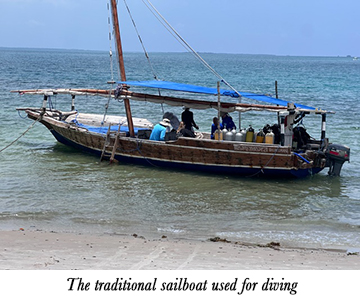
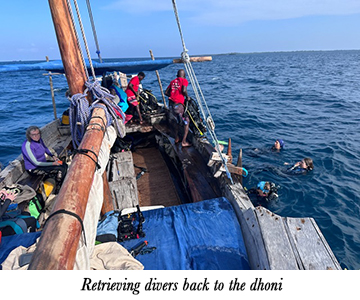
Before departing, I couldn't find reliable information to select a shop, so convenience drove my choice: Mafia Island Diving (MID) is next to the hotel Basecamp Mafia Island, about 100 meters away down a sand pathway. MID uses handcrafted local sailboats, traditional dhonis with outboards. One of the two other operators, Dive Planet, runs a modern fiberglass boat, which would have reduced the hour it took to outer dive sites -- but no one has Nitrox, so two dives a day was about all that my computer would let me do anyway. My first clue that diving wasn't typical was when I arrived in mid-February to check in. "The tides dictate our schedule," the shop manager began, "so here's what I recommend." (Protected diving is within Chole Bay, and venturing out to see larger and more diverse fish is tide- and weather-affected.) They recorded both my C card and DAN card, and they laid out a schedule to take advantage of the best conditions. They attached little tags with strings to each piece of my gear and checked it; my first stage needed adjustment, which they did on the spot, and without a charge. That is quite the service.
As we were newcomers, my buddy and I were assigned to our own divemaster for the checkout. We back-rolled in and descended with William, the divemaster, a friendly Frenchman with the unenviable job of qualifying the new divers and deciding whether we would be trouble. Apparently, we wouldn't, as we were handed off for the rest of the trip to Sadiki, Muhaji, and Hamsi. (On a later muck dive, we were paired with a "this is my 10th dive" diver, so the DM spent his time with her, and we got swapped to another DM as she got escorted back low on air.) These first dives were about 45 feet deep, visibility was 45 to 60 feet, with a slight current on the first dive. Announced as "60 minutes maximum" dives, I was down for 65 minutes on the first, 75 on the second. I descended past coral with nembrotha nudibranchs, leaf fish, and then anemones harboring anemonefish, mantis shrimp, hermit crabs, and moray and ribbon eels. The patches of hard coral and rock were home to schools of anthias, pairs of bannerfish and Moorish idols, parrotfish, flame dartfish, and sweetlips. We surfaced together with the DM shooting an SMB, followed by a short wait for the boat. I ungeared in the water, then climbed the wooden ladder into the boat. For beginning checkout dives, these were tops. Between dives, the guides and two boat captains handed out fresh coconut, flatbread, tea, and water. With a wide structure to protect us from the sun, the 45-minute surface interval was a great chance to compare notes with others. After the second dive, the captain put up the sail for an idyllic, peaceful, wind-driven trip back to the beach. After we reached shore, I climbed off into shallow water and waded a few feet to the shop, carrying only my fins, mask, and wetsuit. After a quick shower, I headed back to Basecamp.
The 27-room resort had a lot of nondivers -- a couple from Milan avoiding the Olympics, a Dutch family with three small children, and others there for the nice beach, a swimming pool, a pleasant bar, island tours, snorkeling with whale sharks, and walking/trekking. Basecamp's good service and comfort largely hit the mark. My large room had a comfortable bed, plenty of space to lay out my camera gear, a large bathroom, and a huge picture window looking out on a small private terrace and the crystalline Indian Ocean. Days were in the 70s and 80s, so I skipped the air conditioning. I had no screened window, so I couldn't open it to enjoy the cool sea breezes without inviting a few mosquitoes. Basecamp was definitely in Africa, though, amplified by their striking security guards: Maasai tribesmen in their distinctive red shuka robes. While I didn't see a need for security in the marine park on a small island, the tall Maasai were helpful in escorting guests around the property in the dark and keeping an eye on comings and goings.
There is a lunch and dinner menu for each day with four options: Swahili (a coconut-rich, seafood-heavy blend of African, Arab, and Indian influences), vegetarian, meat, and fish. A typical dinner consisted of a starter, main course (accompanied by bread), and then dessert. The Italian fish soup, with half a lobster and fish swimming in broth, was a winner, but other items were pretty forgettable. Beer was about $3 -- more for cocktails. While the food was fresh, the cooking wasn't especially inspiring, and the servings were small. Had there been a bottle of Tabasco, I would have used it.
My walk to Chef Pamela's was about all I saw of the island, other than the short ride from the airport in Kilindoni; I had come to dive and hadn't allocated time for touring. It's a quiet island, not a tourist and party magnet like Zanzibar, where Freddy Mercury was born, to the north. I figured we'd be the only Americans at the hotel, but a group from the U.S. State Department in Dar-es-Salaam showed up. Other guests were from Norway, Switzerland, France, and the UK, all experienced divers -- except for one young and very over-weighted diver who managed to hit everything she looked at with her fins as she turned to leave. By the second day, I had graduated to deeper dive sites outside the bay, exposed to ocean currents. The Indian Ocean fish coloration and behaviors kept me very interested. At Sarakasi and Secret Reef dive sites, I saw a sea of enormous Neptune's Cap corals, conical hard corals, not anchored to the seabed. I've seen one or two at a time, but this site had at least fifty specimens up to three feet in diameter. Large healthy coral fields were common. While levels of "fishiness" varied, I was impressed with the high biodiversity and healthy population. At busier sites, I saw schools of red-fang triggerfish and sweetlips finning in every direction, with groupers, surgeonfish, Napoleon wrasse, and tuna passing through the dive sites. For photographers looking for small, slow-moving critters, we also saw abundant flatworms and nudibranchs: phyllidia, nembrotha, and flabellina families. I had a hard time applying common names to the nudibranchs: my experience is mostly Caribbean and Pacific, and everything is just a little bit different here.
Mid-February water was 80-82°F (it can drop to 75°F in August to October). I had generally good visibility, ranging from 40 to 60 feet, which drops in the rainy season, mid-March to the end of May. We had torrential rainstorm that the staff shrugged off as not worth noting -- which means that the rainy season is really rainy. Although the guides were conscientious about checking my air, no one ever asked about my No Deco Limits. With dives dipping to 75 feet, I went to zero NDL on second dives every day and into a brief deco twice. But then again, my buddy and I have lots of dives (way more than 2000 between us) so we weren't concerned. We did all drift diving, and the ratio of diver-to-guide/DM was low (2 to 5 divers per DM, often just 2 or 3 per DM). It was decidedly casual. In the case where the DMs were aware of current, they went more into mother-hen mode to ensure we stayed close together. At Kasa, outside Chole Bay, the current was gentle when we dropped in, but turned into an E ticket ride and I spent the last 15 minutes steering with fins to follow the divemaster, We were blown off the dive site just as I saw a pair of stingrays, 8 and 5 feet tip-to-tip, hovering off the sand, enjoying the current, and, I'm sure, laughing at our awkward, un-streamlined bodies.
On my last day diving, we went to Mikadini and Kinasi Pass, both on the outer edge of Chole Bay. Dropping in, I immediately saw a spiny waspfish and then an enormous mantis shrimp peering out of its burrow. With nudibranchs everywhere, I almost ran into a lionfish; cleaner wrasses wanted to clean it, but unlike every other reef dweller, the lionfish wasn't interested, twitching and shaking to get the cleaner wrasses off before speeding away. (A new idea for lionfish control: annoy them until they leave.) Reminding me that I was in a new ocean were species I had never seen spotted: Meyer's, and black pyramid butterflyfish, powder-blue surgeonfish, and a carpet shark hiding under a ledge. While the diving is off the beaten path, it is certainly not primitive. I give all three guides top scores for fish and critter sighting, group safety, and underwater pace. On muck dives, Sadiki was far better than my own eyes; he pointed out critters 1-2 mm long, and I blindly took pictures without knowing what I was focusing on. I wouldn't rate Mafia Island diving with the best sites in the Indio Pacific's Coral Triangle, but I had a great variety of good diving, and I definitely wanted more when my week was up. MID's staff delivered an exceptional experience. The well-trained divemasters (two were European, the others Tanzanian) knew when to urge us to stay close -- current coming, so move to a different part of the site -- and when to let us do our own thing. As critter spotters, they were unparalleled, finding things I couldn't even see. Me. In my log, I called a muck dive a "four-star site with a five-star divemaster." In fact, every dive was at least a four-star dive with a five-star divemaster. And for a unique location, it was a five star trip all the way. - J.M.S. Our undercover diver's bio: A diver since 1990, JMS has a strict 3mm rule: no water colder than 77 degrees. Despite that limitation and thousands of logged dives, his to-dive list still has dozens of places to visit, with Africa and Indonesia coming up. Although he's changed his dive computer more times than he can remember, he's still using his original pair of Force Fins, bright yellow, so his buddy can always find him.
|

 = publicly available
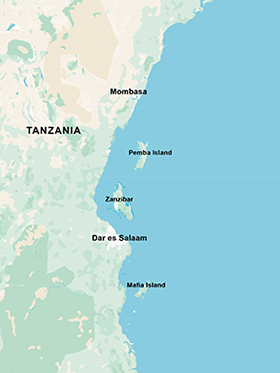
 Mafia (pronounced: Mah-FEE-ah) Island, about 30 miles long and 10 miles wide, with a population 66,000, is a few miles off Dares-Salaam, Tanzania's capital. The east side hosts the Mafia Island Marine Park, a protected Indian Ocean area of over 300 square miles, with broad biodiversity and both reef and muck diving. With just three dive shops in the Park and a handful of accommodations, it's a quiet island, predominantly populated largely by the Swahili coastal culture, with a large Arab and Persian influence, and largely Muslim.
 MID can handle about two dozen divers, but the most I dived with was 10, split into groups with three dive guides. On my first dive day, my buddy and I arrived 30 minutes before the departure; our gear had been rinsed and folded and put on a bench under our name, while our BCDs and regulators were attached to aluminum DIN-valve 11-liter (80 cu.ft.) or 12-liter tanks, ready for a quick check before being loaded onto the boat. We waded out -- no dive shop has a dock -- and hopped on for a 30-minute ride to two close sites inside the bay, Small Rock and Chole Reef, protected by Juani Island.
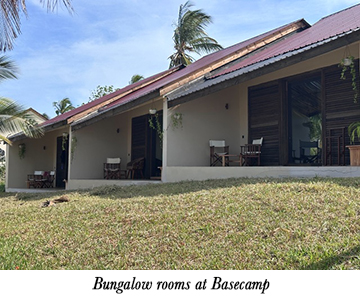 On the shores of the Marine Park, there
are few accommodations. Basecamp is the
largest; I didn't want to stay in a tent --
that's an option; I didn't want to spend a ton
of money on the room at the Pole Pole luxury
resort a few feet down the beach since I was
going to be diving; and I didn't want to drive
between the dive shop and my hotel. My package
included breakfast and either lunch or dinner,
so with the dive day lasting five hours, I
usually had dinner on my package. One evening,
I asked the restaurant to pack a cooler with
lunch to take on the boat, which I picked up
at breakfast the next day.
On the shores of the Marine Park, there
are few accommodations. Basecamp is the
largest; I didn't want to stay in a tent --
that's an option; I didn't want to spend a ton
of money on the room at the Pole Pole luxury
resort a few feet down the beach since I was
going to be diving; and I didn't want to drive
between the dive shop and my hotel. My package
included breakfast and either lunch or dinner,
so with the dive day lasting five hours, I
usually had dinner on my package. One evening,
I asked the restaurant to pack a cooler with
lunch to take on the boat, which I picked up
at breakfast the next day.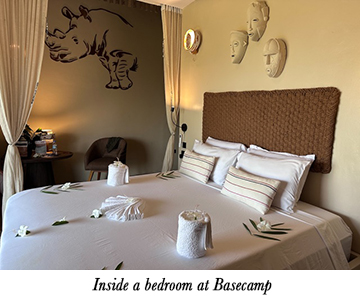 We had our meals on a large terrace, divided into a social/bar and restaurant
area. Breakfast buffets offered eggs, cereal, fresh local fruits, and breads, while
a Nespresso machine would make you an espresso for an extra fee. One morning,
an Austrian guest called the staff over to complain that the bread next to the
toaster was not fresh. How soft does bread need to be before it gets toasted? He
later accosted me while walking back to our rooms to warn me about cobras on the
property. He only repeated what I was told upon arrival; I never saw a snake.
We had our meals on a large terrace, divided into a social/bar and restaurant
area. Breakfast buffets offered eggs, cereal, fresh local fruits, and breads, while
a Nespresso machine would make you an espresso for an extra fee. One morning,
an Austrian guest called the staff over to complain that the bread next to the
toaster was not fresh. How soft does bread need to be before it gets toasted? He
later accosted me while walking back to our rooms to warn me about cobras on the
property. He only repeated what I was told upon arrival; I never saw a snake.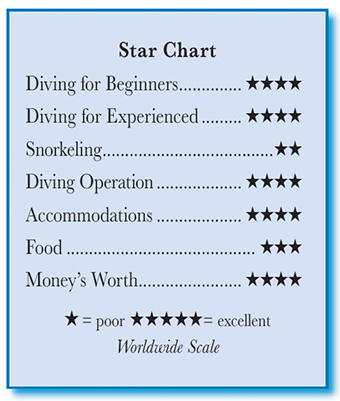 But within walking distance on the beach, Chef
Pamela's on the beach offered a more piquant menu.
I ate there two evenings and came away stuffed:
appetizer, main, dessert, beer, and water for $25.
One night she said "oh, they have good prawns in the
market" and since you have to reserve and order the day before, we said "OK, we'll take that, and the next night there were 8 or 10 big fresh prawns, sauce she had whipped up, rice and a salad, beginning with pumpkin soup, and ending with a small slice of sweet cake served with ice cream.
But within walking distance on the beach, Chef
Pamela's on the beach offered a more piquant menu.
I ate there two evenings and came away stuffed:
appetizer, main, dessert, beer, and water for $25.
One night she said "oh, they have good prawns in the
market" and since you have to reserve and order the day before, we said "OK, we'll take that, and the next night there were 8 or 10 big fresh prawns, sauce she had whipped up, rice and a salad, beginning with pumpkin soup, and ending with a small slice of sweet cake served with ice cream.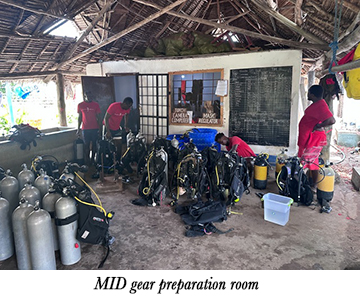 The sites all differed in current, depth, fish and reef life, coral and stone structures, making for an interesting week. For example, Dindini Wall didn't have much life on it, but I found plenty when I hit the bottom: big fat sassy lionfish, moray eels, spiny waspfish, razorfish, nurse sharks, and leopard rays.
 I made two beach dives in front of the MID shop. The shallow bottom starts out dull and sandy, but then explodes with life. Five different seahorses, two different types of pipefish, baby star puffers, mantis shrimp out of their burrows, and three different species of cuttlefish. That was just the first dive. Both were amazing 75-minute adventures right in front of the shop.
 DIVER'S COMPASS: Tanzania's capital, Dar-es-Salaam, is non-stop from Amsterdam (KLM) and others. From Dar-es-Salaam (DAR), Auric Air runs frequent 30-minute flights to Mafia Island. The planes are small: divers will need to arrange for excess baggage, preferably in advance . . . I booked everything through MID to ensure all the pieces would match, for $2000/person, double occupancy, two meals (10 dive package is $460), the $23/day marine park fee, flights from Dar-es-Salaam, transfers . . . South of the equator, but just barely, the best diving is October through February -- the rainy season ruins diving . . . I took a malaria prophylaxis, as wisely recommended by my doctor . . . Whale sharks are frequently sighted on the island's west side. Snorkel operators run trips to swim with them; divers reported that afternoons were the best time to see them . . . a lot of divers swing by after an African safari, so MID has a lot of rental equipment in good condition . . . A couple of staff members are equipment repair specialists . . . Prices are quoted in U.S. dollars; this includes taxis in DAR as well as any food or drink. Cash is accepted as well as credit cards . . . there is a hyperbaric chamber in Dar es Salaam and on Zanzibar, many hours away by boat.
I want to get all the stories! Tell me how I can become an Undercurrent Online Member and get online access to all the articles of Undercurrent as well as thousands of first hand reports on dive operations world-wide

| Home | Online Members Area | My Account |
Login
|
Join
|
| Travel Index |
Dive Resort & Liveaboard Reviews
|
Featured Reports
|
Recent
Issues
|
Back Issues
|
|
Dive Gear
Index
|
Health/Safety Index
|
Environment & Misc.
Index
|
Seasonal Planner
|
Blogs
|
Free Articles
|
Book Picks
|
News
|
|
Special Offers
|
RSS
|
FAQ
|
About Us
|
Contact Us
|
Links
|
3020 Bridgeway, Ste 102, Sausalito, Ca 94965
All rights reserved.