
 |

 Email Signup
|
Subscribe
|
Login
Email Signup
|
Subscribe
|
Login
For Divers since 1975 The Private, Exclusive Guide for Serious Divers Since 1975 |
"Best of the Web: scuba tips no other source dares to publish" -- Forbes |
Using AEDs in Small BoatsContents of this Issue: Southern Cross Club, Little Cayman Island Dolphins with Alzheimer's Disease? Surprising Safety Flaws in Lithium-ion Batteries Truk Lagoon -- Not for the Meek Should Divers with Head Colds be Quarantined? If the Water's Murky, Bull Sharks Thrive Garmin Wants to Save You at Sea A 12-Year-Old's Diving Death Brings a Lawsuit Editorial Office: Ben Davison Publisher and Editor Undercurrent 3020 Bridgeway, Suite 102 Sausalito, CA 94965 from the February, 2026 issue of Undercurrent
Last month, we wrote about a woman diver who died in the Azores while trying unsuccessfully to climb back into a rubber boat. One of our readers took issue with our saying, "Few small boats, if any, carry defibrillators, which might be dangerous to use in wet conditions." While applauding that we suggested an AED (automated external defibrillator) was essential life-saving equipment, she advocated the carrying of such devices in all boats, however small, citing the DAN article from August 2025, "Shocking Misconceptions About AEDs." The benefits of the timely application of an AED are undeniable. DAN states that survival rates can leap from between 5 and 9 percent to around 30 or 40 percent. Time is of the essence since a completely stopped heart is unlikely to be restarted. AEDs are now widely available in public places throughout the Western world, and come with step-by-step instructions that will allow an untrained person to use one. Any diver who has climbed back into an inflatable boat will know that the floor will be awash with the water that has drained from wetsuits and other diving gear. These boats also lack floor space and a steady surface, which means other divers will need to evacuate the vessel back to the water. So, using an AED might represent a danger to others on board. DAN seeks to assuage this worry of wet conditions: "Studies show that being in a wet environment is not a concern if the pads are well-adhered to the chest. Drying the chest before applying the pads results in better adhesion." It does mean a supply of dry towels should also be included with emergency equipment. "You can use an AED when the injured person is on a dock or boat if you make sure the pads are not touching the metal [or wet decking] when delivering a shock. The electrical shock can move further across the body rather than just across the chest, so be especially careful that no one is touching the injured person. The current travels between the pads along the path of least resistance; however, not to the ground." You can access the DAN article here. |

 = publicly available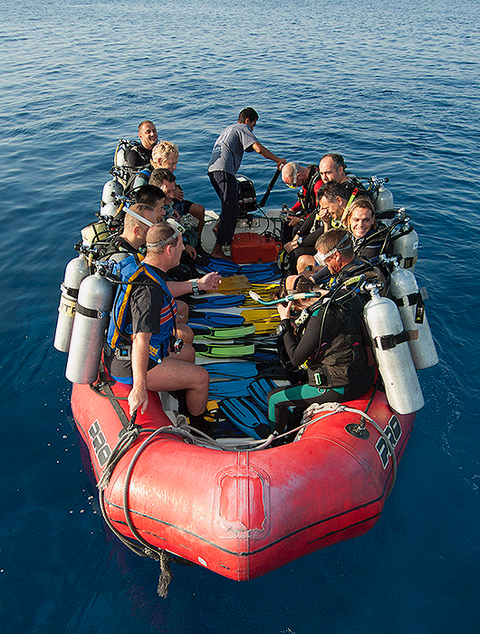

I want to get all the stories! Tell me how I can become an Undercurrent Online Member and get online access to all the articles of Undercurrent as well as thousands of first hand reports on dive operations world-wide

| Home | Online Members Area | My Account |
Login
|
Join
|
| Travel Index |
Dive Resort & Liveaboard Reviews
|
Featured Reports
|
Recent
Issues
|
Back Issues
|
|
Dive Gear
Index
|
Health/Safety Index
|
Environment & Misc.
Index
|
Seasonal Planner
|
Blogs
|
Free Articles
|
Book Picks
|
News
|
|
Special Offers
|
RSS
|
FAQ
|
About Us
|
Contact Us
|
Links
|
3020 Bridgeway, Ste 102, Sausalito, Ca 94965
All rights reserved.