
 |

 Email Signup
|
Subscribe
|
Login
Email Signup
|
Subscribe
|
Login
For Divers since 1975 The Private, Exclusive Guide for Serious Divers Since 1975 |
"Best of the Web: scuba tips no other source dares to publish" -- Forbes |
Tobago Dive Experience, Trinidad and TobagoContents of this Issue: Tobago Dive Experience, Trinidad and Tobago No Piece of Dive Gear is Worth Your Life Celebes Explorer 9, Sipadan Island, Malaysia When Lights Attract Unwanted Attention Use a Travel Agent or Book it Yourself? Part I Are Third World Scuba Tanks Safe? Protecting Our Oceans and Dive Sites The Genetic Adaptation of the Sea Women Editorial Office: Ben Davison Publisher and Editor Undercurrent 3020 Bridgeway, Suite 102 Sausalito, CA 94965 a throwback to a more casual age from the June, 2025 issue of Undercurrent
Dear Fellow Diver, On my first dive in Tobago, I backrolled into the water and the past. Black Jack Hole looked more like the Caribbean of 25 years ago than today's, with no evidence of SCTLD: it was filled with lush stony and soft corals, enormous sponges, and lots of fish, though few big ones. Squid, barracuda, Southern sennet, queen triggerfish, gray, French, and queen angelfish ... it was dazzling. While some hard corals I saw had black band disease, some algae, and evidence of bleaching, the reefs were nearly pristine. In 13 dives over six days, I saw fish I'd never seen in the Caribbean and rejoiced as I dived among pretty darn healthy reefs.
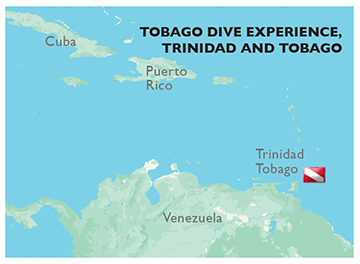
Tobago is more in the Atlantic than the Caribbean, as it lies 20 miles north of the country's main island, Trinidad, and 85 miles north of South America. Dive shop owner Sean Robinson, a native of T&T, has been diving forever (he says he has over 30,000 dives) and seems to know everyone in the industry and on the island. Setting a high bar for his staff, he runs his dive operation with sedulous attention to detail, particularly when it comes to teaching and training. Everyone working there is local, well-trained, professional, and helpful. Our guide, Ricardo, a passionate naturalist, did his best to find rare or endemic species. My only cavil was "island time." We showed up as asked -- 8:30 A.M. -- but sometimes waited around for an hour before getting underway. At least once, I think they held up the departure awaiting Sean, who ambled in late, sipping his coffee. Perhaps one should celebrate island time, a style of the old Caribbean, a time to slow down, which one does on the picturesque, curvy, hour-long mountain drive from the airport to the tiny village of Speyside. Touted as having more pristine diving than elsewhere off Tobago, sleepy Speyside has little going on. But for nature lovers, it is near a major forest reserve, with beach-to-mountain trails and innumerable beautiful and unique birds.
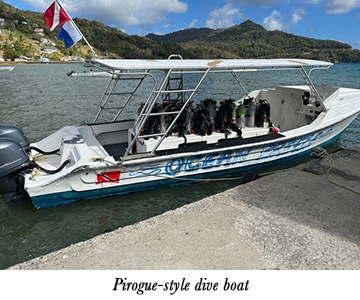
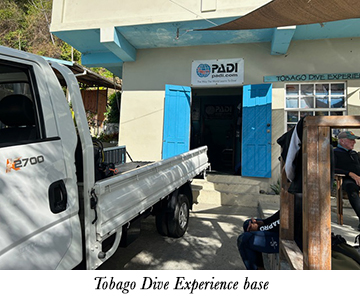
All our dives were drift dives, sometimes down to 100 feet and lasting 60-75 minutes. We wore wetsuits and hoods, with water temperatures from 77 to 81°F. Photography could be tricky. Cathedral challenged us with lots of current but excellent visibility and varied terrain: a sandy bottom, a reef slope covered with sponges, and a steep wall. A shoal of squid danced near the reef slope. In the sand, we found jawfish and giraffe garden eels (a new species for me). Anna told of once collecting a giraffe garden eel for the Smithsonian by making a slipknot noose from fishing line, putting it around the eel's hole with little rocks weighting the line, and waiting until the eel reappeared to capture it. The things you do for science! The small dive shop offers full rental gear, and a family diving there for the day took advantage of it. The shop is cramped, and it's easier to don rubber outside on the patio. The dive boats I saw could hold around 14 divers each. Both boats were basic open V-hulls with outboards, well-worn but functional, and short on amenities for photographers. The three photographers on board, each with a big rig, vied for space since there was no camera table, only benches or the deck. Because we were five experienced divers, we visited sites that boats with inexperienced divers may not see. We had contracted for two dives every morning, though Eric and I managed afternoon dives twice. Keeping with the island style, they had no firm times for dives, so scheduling was day-to-day. If four people want a night dive, they'll run one, but we passed. As old friends regrouping, we spent our evenings eating and relaxing!
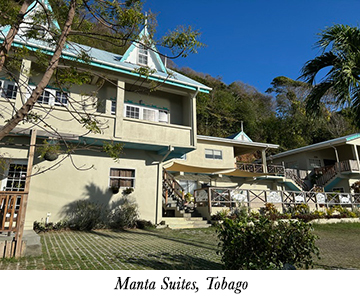
Our two-bedroom, two-bath villa (the top floor of one of the Manta Suites buildings) was self-catered and self-cleaned. Knowing this in advance, we picked up provisions for cocktail hour while en route from the Tobago airport, about an hour's drive. We did well to buy groceries, as the provisions available in Speyside are pretty basic, and I suggest you do the same. Our villa had abundant towels, local driftwood, and shell decorations, and we enjoyed our daily cocktails in its comfortable living room. It also had a full kitchen, an outside shower, and a drying rack. Sean and his wife Kathleen live in the Manta Suites. Kathleen manages the Suites and is also a chef at the property restaurant. Every morning, Sean moseyed around the property filling hummingbird feeders, and hummingbirds flocked to them all day, with mobs of them vying for sugar before sunset. Indeed, Tobago is a famed birding destination, and I know divers who meld their passion for fish with fowls, spending a week underwater and a week walking among the trees and birds.
Although a menu was chalked on the board, the servers also told us what was offered daily. We enjoyed lunches and most dinners at Finz -- fresh local kingfish baked with crunchy panko crust, a Trinidadian curry night, BLTs, grilled chicken, salads, potatoes, and lots of veggies. And don't miss "doubles," an East Indian Trinidadian treat of a soft, chewy bread filled with chickpeas and chutney or pepper. It's one of the messiest foods I've ever consumed and is traditionally eaten standing up. Our bill for a week of three meals a day plus adult beverages came to a measly $538 for two, about $13 a meal (and lodging and diving are among the least expensive in the Caribbean). There were a few small restaurants down the road, but we were content to stay with Finz and not walk in the heat.
A highlight of diving Tobago was seeing fish I'd never encountered in thousands of Caribbean dives, like the golden hamlet, saddled and reef parrotfish, and flame angels. Anna, Ned, and Eric were even happier as they pursued exotic blennies, often braving strong surge as they made close-up photos on walls. The only dive that disappointed me was Angel Reef, where Eric and I made an afternoon plunge. Corals were dead, and even the sea fans looked ill. We emerged a little dazed after seeing so much healthy coral at other sites.
Underwater, the landscape was equally interesting. London Bridge is a striking arched rock above the surface with a deep canyon beneath. As we descended in the low visibility, the booming of waves hitting the rocks was quite inimical. The low visibility added to the drama of an underwater landscape of steep walls and massive boulders, ejecta from the volcano that formed the island. And fish geek's delight: I saw my first-ever flameback angelfish at 90 feet after over 4200 dives! Our second dive was at Saint Giles, where a festival of fish greeted us: highhats, queen triggers, all phases of saddled parrotfish, and a trio of juvenile French angels in different stages of development. I could see the saddled parrotfish's gleaming red eyes, characteristic of the terminal adult -- quite demonic! A few weeks after I returned home, Anna and I talked about the trip. Would we return to Tobago? After all, we've been fortunate enough to dive endless spots far beyond the Caribbean. Even so, between the remarkably pristine diving, the excellent food, and the laid-back atmosphere, our answer was a resounding "yes." -- A.E.L PS: Many years ago, a diver got caught in these currents and went missing until the next day. She lived to tell her story. Read it here: https://tinyurl.com/4r2t2bcv Author's bio: A.E L. has written for Undercurrent for over twenty years and has dived all over the world.
|


 My spouse and I spent a March week in Tobago with old friends, famed naturalists Anna and Ned DeLoach and underwater photographer Eric Reisch. The DeLoaches often lead trips for REEF (the Reef Environmental Educational Foundation), which Ned and the late Paul Humann founded. But this trip was personal, a chance for friends to kick back and check out this far corner of the Caribbean. I know that diving with Anna and Ned made the staff of Tobago Dive Experience eager to please, but we took no favors, and they provided the same top-notch service to every diver.
 And underwater, plenty of unique fish. At Coral Garden, off Little Tobago
(247 square acres), the reef slope was covered with stony corals and sponges and
teeming with fish. Ricardo immediately found a cryptic, dark seahorse male. I
delighted in schools of cottonwick and reef butterflyfish, uncommon elsewhere in
the Caribbean. And here was a massive brain coral 30 feet across, of which I had
seen photos, but I was disappointed to discover black band disease had found it.
Otherwise, I enjoyed the good visibility, the varied currents, and the overall robust condition of the reef, thanks to Tobago's
small population 60,000, little industry or industrial
farming, and cruise ships confined to the southern end.
And underwater, plenty of unique fish. At Coral Garden, off Little Tobago
(247 square acres), the reef slope was covered with stony corals and sponges and
teeming with fish. Ricardo immediately found a cryptic, dark seahorse male. I
delighted in schools of cottonwick and reef butterflyfish, uncommon elsewhere in
the Caribbean. And here was a massive brain coral 30 feet across, of which I had
seen photos, but I was disappointed to discover black band disease had found it.
Otherwise, I enjoyed the good visibility, the varied currents, and the overall robust condition of the reef, thanks to Tobago's
small population 60,000, little industry or industrial
farming, and cruise ships confined to the southern end.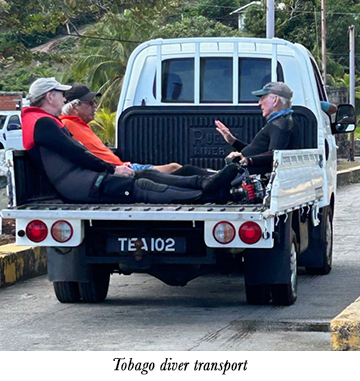 Anna remarked that Tobago Dive Experience was a throwback to a more casual,
earlier age when you hopped in the back of a truck to get to the dock. But unlike
yesteryear, the service from the dive staff was more akin to Indonesia than the
Caribbean. We handed over our dive gear at the start of the trip, and the crew
did the rest: it was ready on the boat when we arrived, set up, and after our
last dive, they washed gear and stored it securely for the next day. We just
showed up in our wetsuits, and the staff did the rest. Bless them.
Anna remarked that Tobago Dive Experience was a throwback to a more casual,
earlier age when you hopped in the back of a truck to get to the dock. But unlike
yesteryear, the service from the dive staff was more akin to Indonesia than the
Caribbean. We handed over our dive gear at the start of the trip, and the crew
did the rest: it was ready on the boat when we arrived, set up, and after our
last dive, they washed gear and stored it securely for the next day. We just
showed up in our wetsuits, and the staff did the rest. Bless them.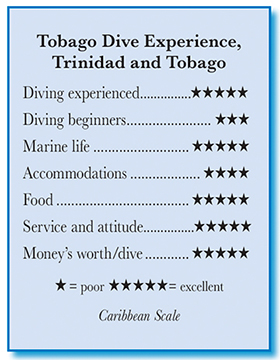 Breakfast was included daily, a 30-second walk to the nearby Finz By Da Sea restaurant, where Kathleen presided. The warm service from Isabella and Shaniqua was great, and the food was delicious. We started our dive days with French toast and bacon, eggs, savory swordfish with fried bread, yogurt and granola, and always fresh fruit.
 We dived at Special three times because it was, well, special. A sheer wall covered with small sponges and hidey holes descended from roiling water. The bottom was littered with huge boulders and funky barrel sponges shaped not like barrels but curved and bent, a testament to the lively currents that swept up, down, and sideways. On our three dives there, I saw sargassum triggerfish, tarpon, balloonfish, a huge hawksbill turtle, and saddled and reef parrotfish, more commonly found in Brazil. The lacy outlines of deepwater gorgonia jutted out from the wall. I loved hanging on my back near the wall and watching the water boil and foam white above me as it collided with the jutting rocks. Anna went nuts for a rare blenny that hid in holes in the wall, A. Johnsoni, named for the late Smithsonian ichthyologist Dave Johnson. You might find this critter in the fish ID book listed as the jagged head or the white jaw blenny.
 Sean pitched us two dives at the Saint Giles islands, just north of Tobago, and we were sold. For $45 extra per diver, the boat headed 40 minutes to this small uninhabited island chain off Tobago's northern tip. The water was rough, tossing us about, but the trip was worth it. The area is a bird sanctuary, and the government is careful to see no cats or rats introduced there. We saw nesting terns and brown noddies by the hundreds.
 DIVER'S COMPASS: A seven-night package at Manta Suites includes diving, breakfast, and airport transfers, and ranges from $1210 to $1400 per person, depending on which unit you occupy . . . . We flew on American into Port of Spain (POS) via Miami. JetBlue flies directly from JFK, United from Houston, and Caribbean Airlines flies directly from several U.S. and Caribbean gateways . . . . Airfare in coach ranges from around $350 to $600 . . . . The Caribbean Airlines flights between POS and Tobago (TAB) are frequent and inexpensive ($50-$67 RT), and the overweight baggage fee is cheap. A new airport on Tobago has opened, and locals believe direct flights from the U.S. are in the works . . . . It is easy to overnight near POS at the Holiday Inn Express, and a nearby Indian-Chinese restaurant has wonderful food . . . . The nearest recompression chamber is a 15-minute drive.
I want to get all the stories! Tell me how I can become an Undercurrent Online Member and get online access to all the articles of Undercurrent as well as thousands of first hand reports on dive operations world-wide

| Home | Online Members Area | My Account |
Login
|
Join
|
| Travel Index |
Dive Resort & Liveaboard Reviews
|
Featured Reports
|
Recent
Issues
|
Back Issues
|
|
Dive Gear
Index
|
Health/Safety Index
|
Environment & Misc.
Index
|
Seasonal Planner
|
Blogs
|
Free Articles
|
Book Picks
|
News
|
|
Special Offers
|
RSS
|
FAQ
|
About Us
|
Contact Us
|
Links
|
3020 Bridgeway, Ste 102, Sausalito, Ca 94965
All rights reserved.