
 |

 Email Signup
|
Subscribe
|
Login
Email Signup
|
Subscribe
|
Login
For Divers since 1975 The Private, Exclusive Guide for Serious Divers Since 1975 |
"Best of the Web: scuba tips no other source dares to publish" -- Forbes |
MV Fling, the Flower Gardens, TexasContents of this Issue: Pro Divers, St. Kitts, Caribbean MV Fling, the Flower Gardens, Texas What No Chase Boat? A Basic Safety Precaution Presumption is the Mother of Disasters Undercurrent Is More Than This Newsletter Closed Circuit Rebreathers are for Solo Divers No Gloves When Diving? A Senseless Rule Editorial Office: Ben Davison Publisher and Editor Undercurrent 3020 Bridgeway, Suite 102 Sausalito, CA 94965 coral gardens, oil rigs, and plenty of fish from the September, 2024 issue of Undercurrent
Several months ago, I asked one of our long-time correspondents to review the MV Fling, which makes two-night cruises into the Gulf of Mexico out of Freeport, Texas. "Yes," came the reply, but bad weather cancels, so it's never guaranteed. Early August weather was just fine, so we got our story. Of course, no one expected that three weeks previously, two Fling divers would get lost at sea for 39 hours. We covered that story in our July issue. While the search and successful rescue of the two experienced Oklahoma divers, Kim and Nathan Maker, was national news, the story was always about them and never the boat. So if you want to know what diving from the Fling in good weather is like, our anonymous reviewer has a story to tell. -- Ben Davison
I hit it lucky. While wind and seas can be rough, the offshore forecast looked good. I had signed up well in advance for a trip on one of those wonderful weekends when the Gulf of Mexico was calm. Just after lunch in early August, I tossed my bags into my car and prepared for a three-hour drive south, the scariest part of the trip.
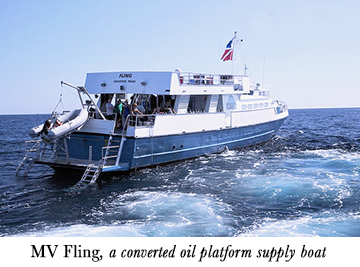
We piled into the Fling, a converted oil platform supply boat. Dive bags, wetsuits, and other stuff that could get wet stayed on the dive deck while we jammed the rest into spaces below the bunks. The Fling carries about 30 divers and a crew of 5 or 6. We were close to capacity, without much room to spare. Before we were out of the harbor, the crew provided an extensive safety briefing. If conditions were good, we would have five dives on Saturday, including a night dive, and two on Sunday. This is by no means a luxury liveaboard. The shared "staterooms" contain four bunks -- two upper and two lower -- with curtains to provide privacy. There are no ladders or handholds from the upper bunk, so passengers boost themselves up from the lower bunk. Having been on the Fling before, I reserved a bottom bunk. Bunks have a pillow, sheets,and a large blanket, but the mattress is relatively thin so I always bring a sleeping bag pad to put over my mattress and an extra pillow. Even so, when I was getting supplies from beneath my bottom bunk, the fat lady above me fell out of her bunk and crashed on my left foot. Nothing broke, but I had the mother of all bruises. The cabin is air-conditioned and it took a while for me to figure out how to change the chilly temperature. Some folks have a tough time adjusting to the ship's roll in transit. That's why everyone is given a large plastic bag to "deploy" for seasickness.
Saturday morning began with breakfast and a safety briefing before we hit the water at the West Flower Garden Bank at 7:00 A.M. Everyone was required to have an inflatable safety tube. It is easy to get lost underwater at the Flower Gardens. At or near the surface, there can be a stiff current, but not today. I took a giant stride off the side, grabbed the sideline, and flashed an OK signal to the crew. Visibility was close to 50 feet or more, water 86°F, and little current. Divers are told to use the lines, but some Smart Alecs make direct descents (or ascents), though in a current, which may appear quickly, it is easy to be carried away from the boat. One advises the crew as to whether he/she will us air or nitrox. You are assigned a tank at the start of the cruise and use it throughout--no switching from air to nitrox and back. The all male crew was very competent, always helpful, especially in readjusting my new BC straps. The guides do not enter with the divers or dive with them, but one had laid out a colored line for us to follow across the reef. Divers must buddy up (they try to match single divers with comparable buddies), be self-sufficient, and follow their computer profiles; most dives last 30-50 minutes, depending on depth. People with a solo diving certification can go independently, but most of us went with a buddy or a small group. Diver are given tags to hang on their BCs; when you climb back on board, the staff checks off your number to keep an accurate count. My buddy and I followed the line set out by a guide, a good idea because it is easy to get lost among the corals. I was snug in my 3 mm wetsuit as I soared over gigantic mounds of brain and star coral and a few small, branched corals (there are no staghorn or elkhorn corals). I saw no widespread bleaching, no signs of die-offs or overgrowing algae. Parrotfish, angelfish, and tiny wrasses darted into cracks or holes between corals. As usual, territorial fishes such as sergeant majors boldly displayed their colors and defended their turf -- or so they thought, I guess, because a fish smaller than your hand has little hope against a 6-foot diver.
Although I had no problems boarding the Fling this trip, with the potential of rough seas of currents that reverse from top to bottom or pick up gradually, it can be easy to run into trouble, especially if there is current. Some people breathe hard and run low on air; others have difficulty swimming into a surface current. Some people make their three-minute safety stop on the sideline and do not move, so others may have to remain below them until they move. Or ... there is a backup on the ladder lines. In July, the jumble of divers struggling to grab lines in a stiff current was the likely cause of Kim and Nathan Maker drifting away. I find it easiest to ascend by pulling myself hand over hand up the line instead of trying to swim. If somebody won't go up, I go into survival mode and go over the top of them, but I must hang on to the line somehow. I've been stuck in a crowd on a line as we tried to make a deco stop. If you can't hang on to the line, hang on to your buddy's tank. As they teach us in the First Aid and Rescue classes, you must consider your safety first. And one should not shoot to the surface. If the current is running, one could be swept away before anyone could deploy the dinghy or reach them with a safety line. In fact, I'm not sure the dinghy could cover much distance in high seas without being swamped. Our second dive was in the same spot, seeing Creole wrasse all over the place. We had 70-foot visibility and 86-degree water! After lunch, we headed toward the East Flower Gardens. A lot of us caught a snooze. I was tempted to go to the top deck to enjoy the sea breeze and look for flying fish, but with the hot sun above and reflected light below, but I decided not to risk a sunburn. On the reef, beams of afternoon light pierced the clear water above huge, healthy coral mounds, with patches of sand in between, and lots of small caves and overhangs. Some of the corals started feeding. It's odd to see a huge lump of tiny mouths! My buddy particularly wanted to see feather duster worms. No problem -- what color would you like? Then, off to an oil/gas platform in the late afternoon. Its beams and supports were encrusted with orange cup corals, red stinging sponges, and oysters, so I carefully watched where I was. You do not want to bump into them! Cute blennies hopped in and out of shells while sergeant majors defended their nests against hundreds of tiny damselfish. A school of crevalle -- they look as if they are made of metal -- cruised between beams, perfect framing for the photographers. My buddy and I agreed to go no more than 60 feet, so we, unfortunately, missed the shark divers saw who went down to 90 feet. Next time.
Thanks to a good meal or exhaustion, I slept well, waking up at Stetson Bank, a strange formation of cracked and layered sedimentary rock. The water was calm, with nothing but ripple marks, no current, 70-foot visibility! Underwater, my buddy and I sailed over ridges and flats, seeing cracks teeming with long-spined urchins and little fish that use them for cover. A stingray shot out beneath us, a school of snapper huddled deeper, and spotted morays lurked in the holes. Stetson Bank has never supported large corals, perhaps because it becomes colder in winter. All too soon, we were packed, had our lunch, and heading home. Most of us slept until we were past the marker buoy for the channel. Returning after such great diving was sad. What was far worse was seeing Freeport, with its brown water, surrounded by chemical plants and industrial shipping. Oh well -- time to buy a T-shirt or towel, exchange addresses with new friends, pack the car, and hit the road. And, in case you wonder -- oh, yes, I want to go back. We had great conditions, better than some Caribbean dives, and lots of interesting tropical fish -- trunkfish, queen and blue angels, rock beauties, spotted morays, redlip blennies, blue tang, Spanish hogfish, brown chromis schools, barracuda, scrawled filefish, orange spotted filefish, sharpnose puffers, rock hinds -- always the chance to see something different. And the new diver on board? He managed make all the dives, although perhaps with some trepidation! -- E.N. PS: Interestingly, I heard no discussion about the Oklahoma divers who, just three weeks previously, drifted away and spent a day-and-a-half floating miserably until they were rescued. At sea, I guess, some things are best left unsaid. Our undercover diver's bio: I started diving as a teenager just after single hose regulators were invented and dived in 54-degree Northern California water. I have dived both coasts of Mexico, on scientific expeditions to the offshore islands, and the Galapagos, central and south Pacific, and southern Australia. I keep up my diving skills in quarries and springs. I am happy to see the look on the faces of new divers when they see their first fish or an upside-down sea lion.
|


 Living as I do 150 miles inland from a sandy coast, I don't get much chance to
see reefs or even clear water. The coast of Texas is sand or mud. The best-known
diving site in the northern Gulf is the Flower Garden Banks,120 miles from the
northeast coast of Texas. And diving
there is tough to schedule. While
one must sign up for trips well in
advance, the Fling captain doesn't
say "go" until noon on the Friday
you leave. You see, they are watching
the weather, and if the seas are
high or a storm is on the horizon,
a trip may be canceled. The uncertainty
deters a lot of divers from
signing up, especially those who
fly to Houston and rent a car to
drive the 80 miles to the Freeport dock,only to find out that weather canceled their
trip.
Living as I do 150 miles inland from a sandy coast, I don't get much chance to
see reefs or even clear water. The coast of Texas is sand or mud. The best-known
diving site in the northern Gulf is the Flower Garden Banks,120 miles from the
northeast coast of Texas. And diving
there is tough to schedule. While
one must sign up for trips well in
advance, the Fling captain doesn't
say "go" until noon on the Friday
you leave. You see, they are watching
the weather, and if the seas are
high or a storm is on the horizon,
a trip may be canceled. The uncertainty
deters a lot of divers from
signing up, especially those who
fly to Houston and rent a car to
drive the 80 miles to the Freeport dock,only to find out that weather canceled their
trip.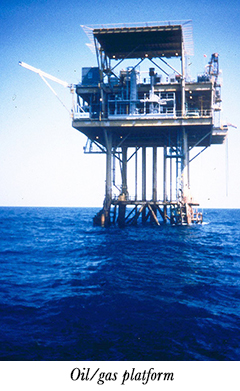 I arrived in plenty of time for the 7:00 P.M.
departure from Freeport, a small town southeast of
Galveston, where commercial shrimp boats and chemical
tankers dock. The contrast between the murky
brown water of Freeport and the sea out on the
reefs would be remarkable. I met other divers --
mostly people from Texas but one from Pittsburg --
either dive instructors, dedicated photographers,
or people like me who longed for beautiful reefs.
And one was a new diver, though it's not a wise
trip for beginners, people who have never dived in
salt water, or people who are really out of shape.
Some folks get out there, get frightened, and quit.
I arrived in plenty of time for the 7:00 P.M.
departure from Freeport, a small town southeast of
Galveston, where commercial shrimp boats and chemical
tankers dock. The contrast between the murky
brown water of Freeport and the sea out on the
reefs would be remarkable. I met other divers --
mostly people from Texas but one from Pittsburg --
either dive instructors, dedicated photographers,
or people like me who longed for beautiful reefs.
And one was a new diver, though it's not a wise
trip for beginners, people who have never dived in
salt water, or people who are really out of shape.
Some folks get out there, get frightened, and quit.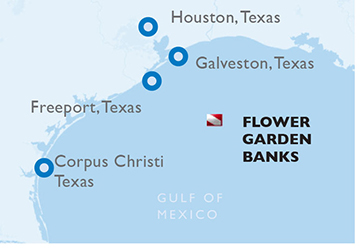 Meals are in the galley and "diner-style" -- breakfasts of waffles, scrambled
eggs, fruit, and cereal; lunches of burgers, tacos, etc., salads and some vegan
dishes on the side; the two dinners were mostly Tex-Mex" fusion; the cook always
had plenty to go around. You can eat at the tables inside, outside on the benches,
or on chairs and lounges on the top deck. Everyone gets his/her designated plastic
cup. Beer and wine are available, but there is no diving after your first drink.
Meals are in the galley and "diner-style" -- breakfasts of waffles, scrambled
eggs, fruit, and cereal; lunches of burgers, tacos, etc., salads and some vegan
dishes on the side; the two dinners were mostly Tex-Mex" fusion; the cook always
had plenty to go around. You can eat at the tables inside, outside on the benches,
or on chairs and lounges on the top deck. Everyone gets his/her designated plastic
cup. Beer and wine are available, but there is no diving after your first drink.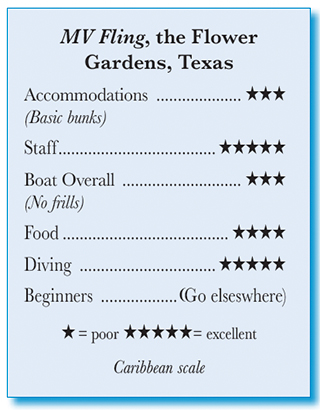 At the end of the dive, three large scrawled
filefish stationed themselves at the junction of the
sideline and the anchor rope, munching on something
too small for me to see. As on previous dive trips,
large barracuda stationed themselves beneath the
boat, as if they were fighter escorts. With my time
up, I went up along the line and grabbed a line from
a ladder, removed my fins, and swung up the metal
ladder to the deck with the crew's aid (they'll pull
you up the ladder to the deck if asked). The dive
deck is much higher than the water line.
At the end of the dive, three large scrawled
filefish stationed themselves at the junction of the
sideline and the anchor rope, munching on something
too small for me to see. As on previous dive trips,
large barracuda stationed themselves beneath the
boat, as if they were fighter escorts. With my time
up, I went up along the line and grabbed a line from
a ladder, removed my fins, and swung up the metal
ladder to the deck with the crew's aid (they'll pull
you up the ladder to the deck if asked). The dive
deck is much higher than the water line.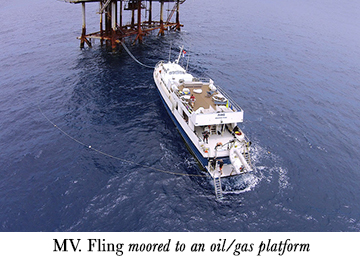 With the current and chop picking up in the early evening, diving at night
became more difficult than earlier. I stayed safely on the line just looking
around; while I saw an array of crabs, other divers were lucky enough to see a
large loggerhead turtle. Oh well. Anyone who made the night dive was rewarded with
a BIG fresh-baked brownie and ice cream.
With the current and chop picking up in the early evening, diving at night
became more difficult than earlier. I stayed safely on the line just looking
around; while I saw an array of crabs, other divers were lucky enough to see a
large loggerhead turtle. Oh well. Anyone who made the night dive was rewarded with
a BIG fresh-baked brownie and ice cream.
 Divers Compass: Weekend and three-day extended trips aboard the
MV Fling are $885 per diver in a standard bunk and $1085 in a
double bunk. An additional diver sharing a double bunk is an extra
$485; $1575 for a special coral spawning trip . . . No rebreathers
. . . Everyone needs a C-card and a Nitrox certification
card . . . They do not have rental gear or an onsite dive shop.
Divers Compass: Weekend and three-day extended trips aboard the
MV Fling are $885 per diver in a standard bunk and $1085 in a
double bunk. An additional diver sharing a double bunk is an extra
$485; $1575 for a special coral spawning trip . . . No rebreathers
. . . Everyone needs a C-card and a Nitrox certification
card . . . They do not have rental gear or an onsite dive shop.

I want to get all the stories! Tell me how I can become an Undercurrent Online Member and get online access to all the articles of Undercurrent as well as thousands of first hand reports on dive operations world-wide

| Home | Online Members Area | My Account |
Login
|
Join
|
| Travel Index |
Dive Resort & Liveaboard Reviews
|
Featured Reports
|
Recent
Issues
|
Back Issues
|
|
Dive Gear
Index
|
Health/Safety Index
|
Environment & Misc.
Index
|
Seasonal Planner
|
Blogs
|
Free Articles
|
Book Picks
|
News
|
|
Special Offers
|
RSS
|
FAQ
|
About Us
|
Contact Us
|
Links
|
3020 Bridgeway, Ste 102, Sausalito, Ca 94965
All rights reserved.