
 |

 Email Signup
|
Subscribe
|
Login
Email Signup
|
Subscribe
|
Login
For Divers since 1975 The Private, Exclusive Guide for Serious Divers Since 1975 |
"Best of the Web: scuba tips no other source dares to publish" -- Forbes |
Bonaire's Reefs This SummerContents of this Issue: Pro Divers, St. Kitts, Caribbean MV Fling, the Flower Gardens, Texas What No Chase Boat? A Basic Safety Precaution Presumption is the Mother of Disasters Undercurrent Is More Than This Newsletter Closed Circuit Rebreathers are for Solo Divers No Gloves When Diving? A Senseless Rule Editorial Office: Ben Davison Publisher and Editor Undercurrent 3020 Bridgeway, Suite 102 Sausalito, CA 94965 from the September, 2024 issue of Undercurrent
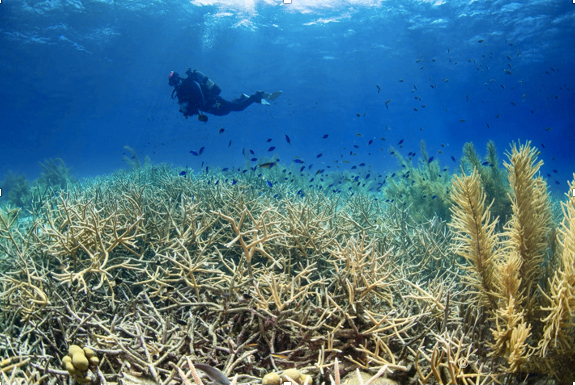
With most of our reader reports about Bonaire describing dead coral and disappointment, we wanted to get an opinion from someone who knows Bonaire reefs well. Here is what she has to say. * * * * * * * We spent eight weeks at our little house in Bonaire, from late May to late July, and our view of the reefs changed over time. Having institutional memory can be a curse, as we have been diving Bonaire since 1994. At first, I was shocked by the effects of SCTLD (stony coral tissue loss disease), a bacterial pathogen that has killed many stony corals. SCTLD seems to affect maze, brain, pillar, large star, and flower corals most seriously, perhaps because their polyps are relatively large and open. The reef in front of Captain Don's Habitat was studded with many large brain corals, for example, and most of them have died and are now covered with dark algal growth. As time went on, I think we got used to how the reef looked. I also rejoiced every time I saw a young, healthy brain coral, which suggested that despite the ravages of the disease, they were reproducing. Dive sites with a lot of soft corals also looked pretty good. The octocorallia (soft corals, sea fans, and gorgonians) seem unaffected, and when profuse, they disguise the presence of dead stony corals. I made four dives on the east coast and noted that though many large stony corals were dead, the soft corals and fans looked splendid. We had two houseguests who were new to Bonaire, and their enthusiasm and admiration for the reefs also helped me to see things through their eyes. But I do fear trouble ahead. The air and water temperatures were well above average even in May, and by the time we left in July, the water was 84-85°F, with Bonaire's hottest season coming in late August-October. If it's like last year, the stony corals will bleach. Recovering from bleaching requires water to cool down fairly soon so the symbiotic algae can return to their coral polyp hosts. As the world warms, that is incrementally less likely. On the hopeful side, Reef Renewal Bonaire are propagating nine species of stony coral and planting them with great success. I dived one site where they had transplanted a field of staghorn coral, and in Marsha Stamatakis's beautiful photograph, you can judge for yourself! - Mel McCombie |



I want to get all the stories! Tell me how I can become an Undercurrent Online Member and get online access to all the articles of Undercurrent as well as thousands of first hand reports on dive operations world-wide

| Home | Online Members Area | My Account |
Login
|
Join
|
| Travel Index |
Dive Resort & Liveaboard Reviews
|
Featured Reports
|
Recent
Issues
|
Back Issues
|
|
Dive Gear
Index
|
Health/Safety Index
|
Environment & Misc.
Index
|
Seasonal Planner
|
Blogs
|
Free Articles
|
Book Picks
|
News
|
|
Special Offers
|
RSS
|
FAQ
|
About Us
|
Contact Us
|
Links
|
3020 Bridgeway, Ste 102, Sausalito, Ca 94965
All rights reserved.