
 |

 Email Signup
|
Subscribe
|
Login
Email Signup
|
Subscribe
|
Login
For Divers since 1975 The Private, Exclusive Guide for Serious Divers Since 1975 |
"Best of the Web: scuba tips no other source dares to publish" -- Forbes |
MY. Infiniti, Tubbataha, the PhilippinesContents of this Issue: MY. Infiniti, Tubbataha, the Philippines Hanging Out in a Philippines Recompression Chamber Now, Cancun Has the Customs Banditos The Oceans are Getting Starved of Oxygen Selling Used Gear/Underwater Photo Classes - New Undercurrent Blogs Boylan Ordered to Pay Minimal Restitution Save the Travel Hassle and Rent Your Dive Gear? Treasures, Shipwrecks, and the Dawn of Red Sea Diving -- Howard Rosenstein Discarded Oil Platforms Increase Ocean Fish Populations Oklahoma Diving Couple Spends 39 Hours Adrift Editorial Office: Ben Davison Publisher and Editor Undercurrent 3020 Bridgeway, Suite 102 Sausalito, CA 94965 rough seas, and the big guys were on vacation from the August, 2024 issue of Undercurrent
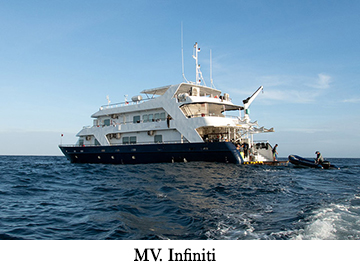
Dear Fellow Diver, Tubbataha National Marine Park is a 374-square-mile UNESCO World Heritage site in the Philippines' Sulu Sea. In good weather, the journey aboard the Infiniti takes 10 or 11 hours. As we departed the wharf at 2:00 p.m., a crew member exclaimed, "It's going to be rough out there," as he pointed at the distant whitecaps. It was, unfortunately, 17 hours on rough seas. Nic, our cheery guide, offered Bonine to prevent seasickness and to help passengers sleep.
Bonine got me through the rolling, bumpy night, but several divers were up all night praying to the porcelain god. Some tried sleeping on the open decks to avoid the confines of their cabins. Everyone still managed to complete the 8:00 a.m. checkout dive the next morning. The second night, the Infiniti, too large for the moorings, constantly ran its engine, nosing into the swells. Some passengers still had trouble sleeping, and some wished they knew the boat didn't moor at night before booking. On the third night, the seas calmed some, and most passengers slept well. By the fourth night, Infiniti's engines were finally silenced, and the ship drifted, leaving only the hum of a generator and the soft lapping of the sea against the hull. The remote marine park comprises fringing reefs; the south atoll has a lighthouse; the north atoll has a ranger station on stilts and a helicopter pad; and the Jessie Beazley Reef, a small sandbar visible at low tide. There is nowhere to hide from foul weather, so liveaboards make the 100-mile-plus trip from March through May when sea conditions are likely the best. I traveled in mid-March; I should have booked later. Regardless, I felt quite safe aboard the 128-foot Infiniti, an unrestricted navigation vessel with water-tight doors and extra-thick glass, built for scuba diving by a scuba diver. The outside entry to my berth had an additional water-tight door. Our cruise director, Nic, who briefed us the first night, said, with his dry humor, "If there is an emergency, wake me. If your toilet is overflowing, wake me. If the internet is out and you miss your mommy, don't wake me." An approachable guy, he encouraged us to raise any issues. The 22 guests were introduced to the 19 crew members, and one diver asked if there were night dives. "We don't night dive," Nic said. "There are a lot of big predators. We want your dives to end with a big smile and all your body parts." On our first diving day, after a 7 a.m. light breakfast of toast, fruit, Nutella, peanut butter, cereal, juice, coffee, and espresso, we were told the current would be light but changeable, so stay with our guide. If we got too far above or below him, the current could take us in a different direction. Rules were no gloves or pointer rods, drones only with a permit from the Ranger Station and not within 100 yards of the beach to protect birds and turtles, no touching or taking, and be a responsible diver.
Our second dive was similar, with a community of garden eels residing on the sandy slope; along the healthy coral wall, I shot colorful butterflyfish, beautiful square spot anthias, and a hawksbill turtle let me get close for a portrait. After lunch, it was time to see the striking sheer walls Tubbataha is known for. At Wall Street, it was a steep drop-off with no bottom in sight. In blue, a few gray reef sharks appeared in the distance. At times, the ever-present current did change, but it was easy to see the guides and other divers in the 80-foot visibility. Our guide, Kirvey, pointed out a tiny pygmy seahorse, so I again pocketed my wide-angle lens and looked for closeups, such as an orange and white comical coral blenny and a black-spotted puffer on a sea fan that looked stuck in its roost. We continued along the impossibly shear wall with no bottom in sight, then finished above on the reef.
That said, the Infiniti is a well-organized operation. Three days before we departed, they involved all guests on WhatsApp to disseminate information and schedule hotel pickups. When we boarded, I already felt I knew my new companions. Greeted with sweet tea and cucumber sandwiches, I signed paperwork, and the crew matched divers according to experiences. One bunch of friends debated about who would dive with their air hog buddy, who had yet to arrive. They resolved it, and the crew organized us into two groups of six and two of five and assigned guides. I headed to the top deck to chat with guests. One playfully flopped into a hammock, bottoming out on the hard deck, and then a woman hit the deck in the other hammock. But those proved to be about the only faults of the Infiniti; everything worked -- the outlets and lights, no leaky sinks or windows, good AC, and dependable outboards on the RIBs. My deluxe cabin had a large picture window, comfortable twin beds, a desk and chairs, and plenty of storage room; we were on the same level as the camera room and a shaded outdoor lounge. Four other deluxe cabins were on the main deck, four smaller rooms on a lower deck. All were equipped with on-demand showers, so I had endless hot water, never a shortage as on some liveaboards.
As slow-breathing divers, on following dives we boarded our tender first, so we ended our dive about the same time as those making shorter dives and we all ascended simultaneously to the RIBs. At the end of each dive, the crew hauled up my gear and gave me a hand climbing the ladder. Nic said that if we wished, we could leave our fins on and climb in "Navy Seals style so the other divers could get a laugh at you when you get stuck halfway." Our divemaster, Kirvey, was the only Navy Seal in our group. Meals were served buffet style in the pleasant dining room. After the first dive, a full breakfast of pre-cooked eggs (poached, fried, or scrambled), toast or pancakes, sautéed vegetables, rice, and fruit. Lunch was maybe a Filipino fish dish, curried pork, noodles, rice, and mushy sauteed vegetables. Dinners were Filipino-influenced, such as curried beef, noodles, a cucumber-based salad, and sinigang soup. Desserts were usually recently thawed store-bought cakes, which were unexceptional except for the moist and flavorful ube cake made with purple yams. By day three, I had tired of the food and told my partner I'd kill for tacos or a hamburger. To my surprise, they served tacos for the afternoon snack, and we divers devoured them. That evening, tempura-style shrimp and calamari were a hit, but the mixed vegetables were still cooked to mush. Food was not the Infiniti's strong suit.
After motoring most of the night before our last full day, we arrived at Jessie Beazley Reef, where I could see waves crashing over the entire reef. With Kirvey, we spent 15 minutes in the blue for our best blue dive -- five large dogtooth tuna, a school of white-tongue jacks, and sizeable blackfin barracudas, though the goal was to see hammerhead, which didn't appear. It was a long swim back to the reef, where I saw a couple of whitetip reef sharks, schools of jacks and scad, a gilded triggerfish, and a green-spotted toby. Before the second dive, the swells reached six feet. I anxiously watched our UK couple (I'll call them Peter and Elizabeth) climb into the tender. A wave pushed it onto the dive deck, lifting one side and flipping Elizabeth off the other side. Without her fins, the current quickly dragged her away from the RIB. She calmly grabbed her free-flowing regulator, put it in her mouth, inflated her BCD, and the RIB picked her up. Those rolling swells convinced her husband they needed to skip the last dive. As we headed home, the crew washed and dried our gear and told us we would arrive at Puerto Princess about 10:00 p.m., dock in the morning, and disembark in the morning. The seas were calmer, but the wine and beer busted loose again after dinner and rolled around the floor. They passed out invoices with onboard charges, and Nic brought out an oversized tip box, stating, "10-15 percent is a good tip. But $10 a tank is still a good tip." Not liking to carry a lot of cash around, I arranged with the office to tip via credit card, adding a 3.5 percent fee.
We made 15 dives on the Tubbataha Atolls and two at Beazley Reef. I saw plenty of grey reef sharks, but all kept their distance except for one that cruised over my head. I also saw several whitetip sharks and a few nurse sharks, a large school of trevallies, and white-tongue jacks. One coral mound looked like a day spa for green sea turtles; six lounged in the soft corals, getting spruced up by brushtail tangs while others swam about, waiting their turns. In reviewing a few Undercurrent reader reports, I am a bit jealous of those who had more exciting trips than I, with spawning bumphead parrotfish, sailfin snappers, many whale sharks, and close encounters with tuna and barracuda. For me, the abundance and kind of sea life didn't differ much from other trips I've taken and it didn't have the long overnight ride (and in rough seas). That said, certainly my trip was worthwhile -- one of my most exciting finds was a regal angelfish in an unusual aberrant color pattern -- but big animal encounters were few and far between. I've dived enough to know that divers might have seen swarms of big fish the week before or the week after my trip. It's all in the luck of the draw. Regardless, the Infiniiti is a fine craft with a good crew. Everything worked. The outboards on the three runabouts were flawless, and they stashed an extra on the sun deck, just in case. The compressor quickly filled tanks with 31% to 33% Nitrox. Oh, but then the Starlink Internet service was out for several hours one day. But 93 miles out to sea with some diving to do, who needs to read the news from back home? -- F.L. Our undercover diver's bio: As a child, I poured over National Geographic underwater articles. I got certified in 1991 while stationed at Andersen AFB, Guam, and my first dive trips were to Palau and Truk. I have made more than 2,000 dives, mainly in Florida but also in the Philippines, Indonesia, the Revillagigedo Islands, the Sea of Cortez, and the Red Sea.
|


 After dinner, we hit a vicious swell; cabinet doors
popped open, boxes of cookies and cans of beer and soda
flew out, as bottles of wine rolled around the floor. The
crew tied down the refrigerator doors and secured liquor
bottles set out for after-dinner drinks.
After dinner, we hit a vicious swell; cabinet doors
popped open, boxes of cookies and cans of beer and soda
flew out, as bottles of wine rolled around the floor. The
crew tied down the refrigerator doors and secured liquor
bottles set out for after-dinner drinks.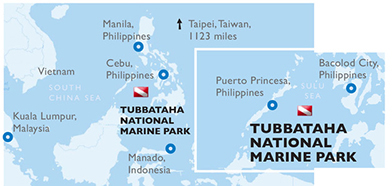 We made two checkout dives at the Ranger Station site, entering over a sandy
slope 35 feet below. Fish were few, so I took practice shots of my buddy to prepare
for big fish encounters. We slowly drifted to a vertical wall, where my hopes
were teased by a dogtooth tuna and two gray reef sharks, too distant to photograph.
I pocketed my wide-angle lens to concentrate on closeups of princess anthias,
blue-girdled angelfish, and ornate butterfly fish among the healthy corals.
Air flowed from one diver's inflator hose, even though his gear was serviced
before the trip. Too often, newly serviced gear fails; what's with repair people?
He solved the problem topside.
We made two checkout dives at the Ranger Station site, entering over a sandy
slope 35 feet below. Fish were few, so I took practice shots of my buddy to prepare
for big fish encounters. We slowly drifted to a vertical wall, where my hopes
were teased by a dogtooth tuna and two gray reef sharks, too distant to photograph.
I pocketed my wide-angle lens to concentrate on closeups of princess anthias,
blue-girdled angelfish, and ornate butterfly fish among the healthy corals.
Air flowed from one diver's inflator hose, even though his gear was serviced
before the trip. Too often, newly serviced gear fails; what's with repair people?
He solved the problem topside.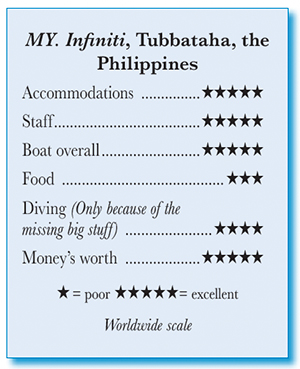 Despite the great visibility and colorful closeup subjects in 80F water,
after the second day, I realized this was not turning out to be the big-critter
trip I had hoped for after reading Undercurrent reports and watching videos of Tubbataha's whale sharks, scores of
gray reef sharks and schools of bumphead
parrotfish. I wondered again if I
had traveled too early in the season.
Despite the great visibility and colorful closeup subjects in 80F water,
after the second day, I realized this was not turning out to be the big-critter
trip I had hoped for after reading Undercurrent reports and watching videos of Tubbataha's whale sharks, scores of
gray reef sharks and schools of bumphead
parrotfish. I wondered again if I
had traveled too early in the season.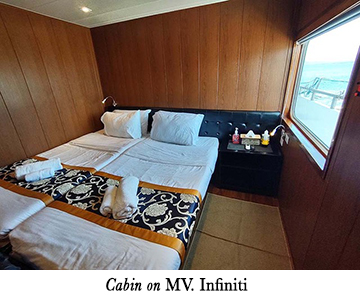 The dive deck had a couple of small camera rinse tanks and another for masks;
three showers were on the dive platform and another on the gear deck; compressed
air for cameras and a whiteboard listing the schedule. The first dive briefing
began at 7 a.m. The deck was crowded with 22 divers, so RIB loading was staggered;
groups were organized so two people sitting next to each other never geared up
simultaneously. On my first day, I watched divers perched on the edge of the dive
deck, waiting for a break in the 3-foot seas before stepping into an RIB. I wondered
how I would manage it, but the crew, with perfect timing between waves, gave
me a hand. My partner and I were well matched with two other mature, 1000 dive
couples, aged 54-67, one couple from the Isle of Man and the other from Germany.
We were compatible, preferring to drift leisurely rather than follow the divemaster
into the blue, hoping to find pelagics. When other divers asked to change
groups, my new German friend said, "We senior divers stay together."
The dive deck had a couple of small camera rinse tanks and another for masks;
three showers were on the dive platform and another on the gear deck; compressed
air for cameras and a whiteboard listing the schedule. The first dive briefing
began at 7 a.m. The deck was crowded with 22 divers, so RIB loading was staggered;
groups were organized so two people sitting next to each other never geared up
simultaneously. On my first day, I watched divers perched on the edge of the dive
deck, waiting for a break in the 3-foot seas before stepping into an RIB. I wondered
how I would manage it, but the crew, with perfect timing between waves, gave
me a hand. My partner and I were well matched with two other mature, 1000 dive
couples, aged 54-67, one couple from the Isle of Man and the other from Germany.
We were compatible, preferring to drift leisurely rather than follow the divemaster
into the blue, hoping to find pelagics. When other divers asked to change
groups, my new German friend said, "We senior divers stay together."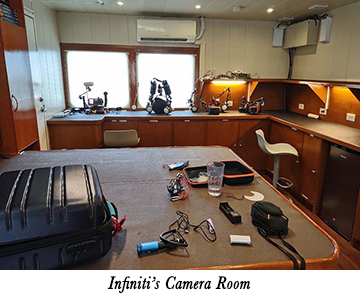 On the third day of diving, our group was whisked along by a one-knot current
with no bottom in sight. We worked our way to the reef's edge, where I flew past
a four-foot dogtooth tuna that remained perfectly still in the current and then
soared by a large mobula ray. I must have been traveling at least two knots when
I whizzed by a score of two-foot gray reef shark pups leisurely swimming against
the current. Soon, the current pulled us down, so Kirvey signaled us to follow him
to shelter from the current behind a large coral head. After a few minutes, the
current suddenly died, so we explored the reef top in 45 feet of water. My partner
stalked a nesting titan triggerfish with his wide-angle video while I pursued
rockmover wrasses. As the current slowly increased, we headed for a lovely hard
coral field with plenty of colorful fish darting about. While our dive lasted 60
minutes, one group aborted after 18 minutes. We seniors were not to be denied
diving time for something as simple as a two-knot current.
On the third day of diving, our group was whisked along by a one-knot current
with no bottom in sight. We worked our way to the reef's edge, where I flew past
a four-foot dogtooth tuna that remained perfectly still in the current and then
soared by a large mobula ray. I must have been traveling at least two knots when
I whizzed by a score of two-foot gray reef shark pups leisurely swimming against
the current. Soon, the current pulled us down, so Kirvey signaled us to follow him
to shelter from the current behind a large coral head. After a few minutes, the
current suddenly died, so we explored the reef top in 45 feet of water. My partner
stalked a nesting titan triggerfish with his wide-angle video while I pursued
rockmover wrasses. As the current slowly increased, we headed for a lovely hard
coral field with plenty of colorful fish darting about. While our dive lasted 60
minutes, one group aborted after 18 minutes. We seniors were not to be denied
diving time for something as simple as a two-knot current.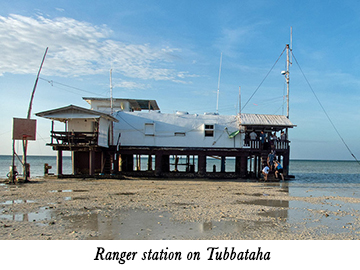 Early the following morning, a Cunard cruise ship blocked the Infiniti's spot
on the dock. Some of our divers had late-morning flights and were worried, so the staff decided to shuttle passengers
via the RIBs to a floating dock. But
then, a fisherman, whose boat was
blocking the dock we needed for boarding,
cast his net under our boat to
catch fish in our shadow and tangled
his net in the Infiniti's propeller.
Kirvey snorkeled down 10 feet to
release the fisherman's net. Soon, we
were all ashore, and no one missed a
flight home.
Early the following morning, a Cunard cruise ship blocked the Infiniti's spot
on the dock. Some of our divers had late-morning flights and were worried, so the staff decided to shuttle passengers
via the RIBs to a floating dock. But
then, a fisherman, whose boat was
blocking the dock we needed for boarding,
cast his net under our boat to
catch fish in our shadow and tangled
his net in the Infiniti's propeller.
Kirvey snorkeled down 10 feet to
release the fisherman's net. Soon, we
were all ashore, and no one missed a
flight home. Divers Compass: Most flights are via Manila and Cebu, with a few
from Taiwan and other islands . . . MY.Infiniti is $3299 for six
nights and offers 17 dives over four-and-a-half days . . . $110
fuel surcharge, and $100 for park fees to be paid onboard; credit
card payments get an added 3.5 percent fee . . . Larger tanks(12L
and 15L) are free . . . Aluminum tanks with DIN/INT adaptors available)
. . . Mixers for cocktails, liquors (don't expect top shelf),
local beer, wine, sodas, espresso, and ginger tea . . . They call
it a 7D/6N trip, but with everyone disembarking by 8:00 a.m. on the
last day, that's a stretch . . . divers must have logged 50 dives and be at least
an Advanced Open Water Diver . . . They booked us into the Ipil Suites for $35/
night; no elevator, but close to good restaurants.
Divers Compass: Most flights are via Manila and Cebu, with a few
from Taiwan and other islands . . . MY.Infiniti is $3299 for six
nights and offers 17 dives over four-and-a-half days . . . $110
fuel surcharge, and $100 for park fees to be paid onboard; credit
card payments get an added 3.5 percent fee . . . Larger tanks(12L
and 15L) are free . . . Aluminum tanks with DIN/INT adaptors available)
. . . Mixers for cocktails, liquors (don't expect top shelf),
local beer, wine, sodas, espresso, and ginger tea . . . They call
it a 7D/6N trip, but with everyone disembarking by 8:00 a.m. on the
last day, that's a stretch . . . divers must have logged 50 dives and be at least
an Advanced Open Water Diver . . . They booked us into the Ipil Suites for $35/
night; no elevator, but close to good restaurants.
I want to get all the stories! Tell me how I can become an Undercurrent Online Member and get online access to all the articles of Undercurrent as well as thousands of first hand reports on dive operations world-wide

| Home | Online Members Area | My Account |
Login
|
Join
|
| Travel Index |
Dive Resort & Liveaboard Reviews
|
Featured Reports
|
Recent
Issues
|
Back Issues
|
|
Dive Gear
Index
|
Health/Safety Index
|
Environment & Misc.
Index
|
Seasonal Planner
|
Blogs
|
Free Articles
|
Book Picks
|
News
|
|
Special Offers
|
RSS
|
FAQ
|
About Us
|
Contact Us
|
Links
|
3020 Bridgeway, Ste 102, Sausalito, Ca 94965
All rights reserved.