
 |

 Email Signup
|
Subscribe
|
Login
Email Signup
|
Subscribe
|
Login
For Divers since 1975 The Private, Exclusive Guide for Serious Divers Since 1975 |
"Best of the Web: scuba tips no other source dares to publish" -- Forbes |
Aqua Trek, Ring Gold, FijiContents of this Issue: MY. Infiniti, Tubbataha, the Philippines Hanging Out in a Philippines Recompression Chamber Now, Cancun Has the Customs Banditos The Oceans are Getting Starved of Oxygen Selling Used Gear/Underwater Photo Classes - New Undercurrent Blogs Boylan Ordered to Pay Minimal Restitution Save the Travel Hassle and Rent Your Dive Gear? Treasures, Shipwrecks, and the Dawn of Red Sea Diving -- Howard Rosenstein Discarded Oil Platforms Increase Ocean Fish Populations Oklahoma Diving Couple Spends 39 Hours Adrift Editorial Office: Ben Davison Publisher and Editor Undercurrent 3020 Bridgeway, Suite 102 Sausalito, CA 94965 home stays with big sharks, beautiful reefs, great people from the August, 2024 issue of Undercurrent
After a mid-April work-related stint in Australia, I sought a low-key, direct flight destination out of Brisbane for a few days of diving. Fiji's island of Viti Levu was a three-and-a-half-hour flight. I picked a six-day itinerary that hit the island's two diving hotspots -- Pacific Harbour for the Beqa Lagoon's bull shark dive and then the soft corals of the Bligh Waters on the island's northeast side.
Aqua Trek's two aluminum dive boats can accommodate at least 24 divers for the 15-minute ride to the Bistro, their feeding site. After a giant stride off the stern into the 84°F water, I kicked down 60 feet along the fixed mooring line to the rubble bottom, then the group made a short swim to the feeding area. A twofoot- high handmade rock wall arcs around the feeding station where a diver feeds fish by hand to the sharks. We divers kneeled behind the wall, facing the feeder; divemasters knelt with and behind us, aluminum looped poles in hand, to watch our backs. I was blown away by the sheer number and size of the bull sharks that came rushing in. Three, maybe even four meters long, they appeared, almost on cue, interspersed with toothy lemons, a few sizeable silky sharks, and long, slender nurse sharks sticking close to the rubble bottom while swarms of reef fish finned around them. The hand feeding was exhilarating. At first, it seemed chaotic and a touch disorienting, but once I settled in, I was mesmerized by the circling bulls. With their big, broad heads bearing straight down straight at us, they turned at the last second, showing their silvery gills, their thick, muscular torsos, and long pectoral fins. They came face to face with the calm feeder, snatching fish heads with a powerful snap of the jaw. The nurses and lemons churned up the sand and rubble to grab fallen morsels. I watched for 15 minutes until something entirely unexpected happened. All at once, the formidable bulls thinned out, disappearing into the distance. I glanced up to see a massive profile, nearly five meters long, I'd estimate, with the telltale striped flanks of a tiger shark. Nothing could prepare me for the sheer scale of it. The dive changed in a flash. The tiger bullied its way to the stationary bait box, ramming it with its nose, bulldozing it around, finally opening it, and eating everything. At one point, it passed over my head -- more like an airplane than a fish, its body a fuselage so large it seemed as if it could hold passengers. It was a 10-minute spectacle, and it even returned for our second dive. Back on deck, the divemasters were as gassed as we were: this was a first-time visitor, previously unknown.
While we had several nervous divers, the guides are in the business of ensuring we were safe and in the correct position to watch the show. They herded us out of necessity; there was no straying from the group. At the end of the dive, we swam to the mooring line against a hard current, ascended, took a safety stop, and climbed aboard. I had initially booked with Coral Coast Divers but switched to Aqua Trek because CCD does not allow strobes. In hindsight, I don't think this is significant, and I should have stayed a second day and dived with Coral Coast at their site farther offshore, which might offer even better visibility. They situate divers in front of a wall, a sort of natural amphitheater, making it virtually impossible for the sharks to sneak in behind them. But I felt safe enough with Aqua Trek. CCD booked my homestay, but I couldn't find the house on my GPS. Some locals tracked down the CCD's owner, who took me there. I expected an Airbnb, but here it seems an Airbnb is equivalent to a homestay, and my bedroom was part of the owner's house. I had a decent, reasonably priced meal at the Establishment, a local restaurant, good coffee and croissants at roadside bakeries, and tasty fish and chips at Uprising Beach Resort beach bar. Had I wished, I could have shopped at a small grocery store and made meals in the homestay owner's kitchen. Then, it was off to the Bligh Waters and Rakiraki, driving along the southern coast to Suva before turning inland, a worthy half-day endeavor. Once out of Suva, the traffic thinned, and the road ran along soaring ridges covered in tropical vegetation and hardwoods, then opening into lush valleys with quaint and frequent villages, where everyone waved and smiled. Fresh fruit stalls abound. The road followed a river before I reached the village of Rakiraki, home to Ring Gold Divers, where I had booked a five-night homestay and four days of diving.
They offer a 2-tank morning dive and add a third upon request, with lunch on the boat. The eldest sons, in their 30s, Tom and Jessie, were fun to hang out with, and were outstanding skippers and guides. Their 23-foot fiberglass open hull, partially shaded boat, has three seat rows and a single 60 hp Yamaha outboard. They only take four divers, and we never had more than three, so it was private, customized diving that was much to my liking. I took a lot of time with photos and sightings, so I got a lot of attention and personal service. It's a back-roll in and an exit up the portable ladder after they lift your gear. They set up the gear, changed tanks, washed and hung everything at the end of the day. I hate standing idly watching others work, so I helped load and unload the boat. Sharp-eyed Jessie knows the sites' fauna well and was excellent at spotting tiny critters, like flabellina nudibranchs, on the coral-adorned walls and interesting fish I would have missed. Most soft coral grew above 20 meters, so I had no need to go deeper and usually stayed down for an hour in the 83°F water. We generally stuck together, with no real need to buddy up. Unlike a resort stay, the homestay provided me with an authentic slice of village life. I presented kava, the slightly buzzy drink of choice in Fiji, to the Chief and formally asked permission to stay in the village. He told me 10 percent of the diving and lodging fees go directly to the village coffers.
Ring Gold provided plentiful homecooked food with fish, chicken, beef, and goat, as well as lots of fresh sautéed vegetables. Breakfasts included fresh fruit, baked goods, pancakes, and local honey -- $9 per meal. Had I wished, I could have gone to Volivoli or Tanoa resorts for meals, but I was satisfied with the homestay, which cost only $75/night. But back to the diving. The Bligh Channel is all about healthy soft corals adorning pinnacles, walls, and swim-thrus, with extensive soft coral coverage on the seabed and connecting ridges. Light rays filtered into the steep gullies, and the walls, often with overhangs, created an interplay of shadows and refracted light rays. Depending on the current, we often zigzagged along reef walls or corkscrewed around the pinnacles. I spent three days sampling sites closer to Rakiraki and one day inside the marine reserve. Most sites have visible bottoms, so our slow-paced, hour-long dives were between 15 and 25 meters. The sites were very fishy, with diverse species like humphead bannerfish, longnose butterflyfish, and regal angelfish. I saw several small aggregations of curious batfish, endless Moorish idols, and anemonefish mixed with juvenile dascsyllus. A larger species, A. barberi, the Fiji anemonefish, lived in bulbous anemones that presented deep red. Parades of fusiliers flew by, and goldies (Pseudanthias) hovered along the reef facing into the current. Away from the reef, a school pickhandle barracuda theatrically split off into two groups, passing on either side of me before disappearing into the blue. On several dives, I gazed at white-tip reef sharks patrolling the reefs.
One day, Joji's young son, about 11 years old, joined us to go spearfishing. When we arrived at the site, he leaped off the boat with wild abandon, speargun raised in triumph, a moment of pure jubilation. In my home country of Canada, 11-year-olds don't get turned loose in the ocean for hours on end with weapons and no adult supervision. In Fiji, it's just another day. Inside the marine park, more of the same but with better visibility. When the current picked up, the soft coral swelled and became more vibrant, greedy to consume the nutrients fast water delivers. Between the second and third dives, Joji and his wife, Alisi, arrived by boat. We tied up together for a picnic lunch of fish cooked in coconut milk, fried plantains, and pineapple cake dessert. The ocean surface was glass, and the wind was barely four knots. Not another boat in sight. What a privilege. Many reefs rise to 3 to 16 feet below the surface. Hard corals were bathed in shimmering light with a constant explosion of anthias, chromis, and damsels. Translucent jellyfish floated by aimlessly while jacks shot past in the blue. Bobbing beside the boat, I contemplated life while looking out over the vast expanse of water toward sunlit green mountains erupting out of the sea in the distance -- a view that caps off one great dive after another. Fiji diving can be spectacular, but with the added fun of living with the locals, it becomes a dive trip like no other. -- C.I. Our undercover author's bio: Our writer is an aspiring marine life photographer and dive journalist, based in Canada and fed up with dreary, cold winters. He is a fish nerd and enjoys observing fish behavior and learning about ocean ecology and conservation. He loves to escape to subtropical and tropical destinations to dive with his wife and teenage daughter, supporting her goals to become a divemaster at age 18, and study marine biology.
|


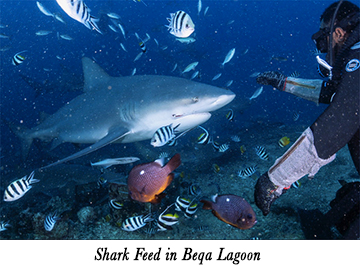 Unlike most divers who prefer dive hotel accommodations with other divers
around to talk diving, I wanted to hang with the residents and enjoy the culture.
What better place than friendly Fiji? At Nadi's airport, I rented a sedan to circumnavigate
Viti Levu and headed out on the Queen's Highway, twisting and turning
through several villages before arriving on the Coral Coast. Pacific Harbour has
a few resorts, but I booked a simple two-night homestay and a two-tank shark dive
with Aqua Trek, which, after running bull shark dives for 25 years, has it down
to a science. Local villagers give up their traditional village fishing rights for
a cut of the profits, which makes the sharks worth more to the islanders alive
than dead.
Unlike most divers who prefer dive hotel accommodations with other divers
around to talk diving, I wanted to hang with the residents and enjoy the culture.
What better place than friendly Fiji? At Nadi's airport, I rented a sedan to circumnavigate
Viti Levu and headed out on the Queen's Highway, twisting and turning
through several villages before arriving on the Coral Coast. Pacific Harbour has
a few resorts, but I booked a simple two-night homestay and a two-tank shark dive
with Aqua Trek, which, after running bull shark dives for 25 years, has it down
to a science. Local villagers give up their traditional village fishing rights for
a cut of the profits, which makes the sharks worth more to the islanders alive
than dead.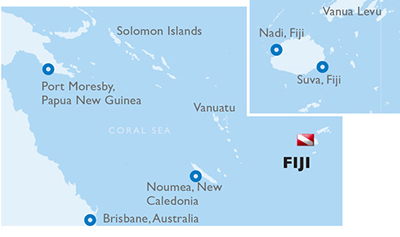 Afterward, I realized that, in one sense, the
famous Beqa Lagoon shark dive is about as safe as
it can be. But then, you never know what's going to
happen. I witnessed an apex predator's raw power and
elegance up close and almost personal. It exceeded
any wildlife encounter I have had or could even
imagine.
Afterward, I realized that, in one sense, the
famous Beqa Lagoon shark dive is about as safe as
it can be. But then, you never know what's going to
happen. I witnessed an apex predator's raw power and
elegance up close and almost personal. It exceeded
any wildlife encounter I have had or could even
imagine.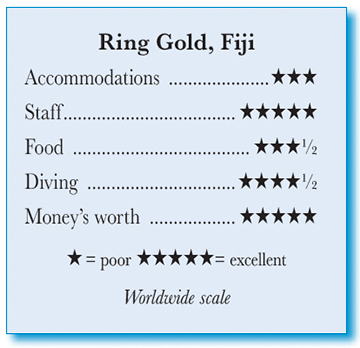 The owner, Joji, originally from Taveuni, has been in Rakiraki for 10 years.
He offers basic rooms with shared bathrooms in a three-bedroom house and three
more in his home where the dive center headquarters. I didn't have AC, but apparently,
the guestrooms inside his house do. Nearby, the well-regarded Volivoli
resort has an onsite dive shop, but I was looking forward to diving with the
family-operated Ring Gold. Their small boat launch area is just two minutes away
by car, and some sites are within 15 minutes. The 110-square-kilometer Vatu-i-Ra
marine park is about 45 minutes away, weather depending.
The owner, Joji, originally from Taveuni, has been in Rakiraki for 10 years.
He offers basic rooms with shared bathrooms in a three-bedroom house and three
more in his home where the dive center headquarters. I didn't have AC, but apparently,
the guestrooms inside his house do. Nearby, the well-regarded Volivoli
resort has an onsite dive shop, but I was looking forward to diving with the
family-operated Ring Gold. Their small boat launch area is just two minutes away
by car, and some sites are within 15 minutes. The 110-square-kilometer Vatu-i-Ra
marine park is about 45 minutes away, weather depending.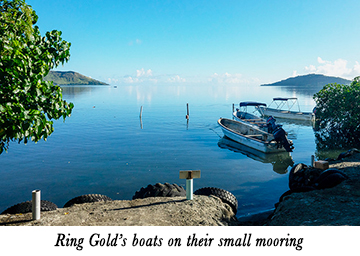 Ring Gold's lodging was a bit "rough around the edges" but still comfortable.
It was a pleasure to spend a few days living in the village, with comfortable
outdoor dining and space to relax with a book or edit photos. Children and
adults floated in and out of the scene -- talking, playing -- and the whole village
seemed to function at once with an air of polite formality and an endearing
laid-back approach to life. I enjoyed talking with them in the evening, inevitably
drinking kava, listening to their music, and eventually drifting off to sleep to
the sound of gentle guitars and soothing vocal harmonies. I passed one scorcher of
an afternoon at Volivoli, drinking fancy cocktails at the pool bar.
Ring Gold's lodging was a bit "rough around the edges" but still comfortable.
It was a pleasure to spend a few days living in the village, with comfortable
outdoor dining and space to relax with a book or edit photos. Children and
adults floated in and out of the scene -- talking, playing -- and the whole village
seemed to function at once with an air of polite formality and an endearing
laid-back approach to life. I enjoyed talking with them in the evening, inevitably
drinking kava, listening to their music, and eventually drifting off to sleep to
the sound of gentle guitars and soothing vocal harmonies. I passed one scorcher of
an afternoon at Volivoli, drinking fancy cocktails at the pool bar.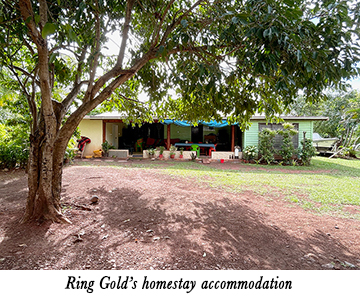 A site named "Fantastic" sported enormous sea fans and long spiraling devil's
sea whips. Dream Maker and Golden
Dreams were characterized by mazelike
topography with the corridors
of several swim-thrus splashed
in fuchsia, violet, or yellow
Dendronephthya, commonly called
carnation coral resembling cauliflower.
Orange sea fans, sea whips,
and rods waved in the current.
Dark-colored crinoids clung to deep
red gorgonians. Green fan coral and
leather corals filled the gaps.
A site named "Fantastic" sported enormous sea fans and long spiraling devil's
sea whips. Dream Maker and Golden
Dreams were characterized by mazelike
topography with the corridors
of several swim-thrus splashed
in fuchsia, violet, or yellow
Dendronephthya, commonly called
carnation coral resembling cauliflower.
Orange sea fans, sea whips,
and rods waved in the current.
Dark-colored crinoids clung to deep
red gorgonians. Green fan coral and
leather corals filled the gaps. Divers Compass: For Aqua Trek's shark dive, one must have an Open
Water Certification . . . Aqua Trek offers 2-tank morning shark
dives ($180) four days per week. On alternate days, it's a 2-tank
($145) soft coral reef dive . . . They sometimes offer a one-tank
afternoon dive, weather-dependent, and night reef diving (minimum
of 4) but no night shark night dive . . . They have plenty of
equipment to rent, but no dive computers . . . These homestays
range from $65-$90 per night. My mid-sized sedan ran $80 per day .
. . I visited in late April, a transitional time from the wet to
dry season. I had sunny skies, but heavy rains and swells are common . . . July-
August is the best time to dive Bligh Waters, but water can dip to 75°F. But clarity
is at its peak . . . Best months for the shark dive are from July to November
. . . At Ring Gold dives were $120 for a 2-tank dive and $135 with gear rental.
There was a selection of BCDs, regulators, wetsuits, masks, fins, and computers.
The condition of the gear looked to be OK . . . contact Ring Gold Divers through
its Facebook page or call +679 831 7365.
Divers Compass: For Aqua Trek's shark dive, one must have an Open
Water Certification . . . Aqua Trek offers 2-tank morning shark
dives ($180) four days per week. On alternate days, it's a 2-tank
($145) soft coral reef dive . . . They sometimes offer a one-tank
afternoon dive, weather-dependent, and night reef diving (minimum
of 4) but no night shark night dive . . . They have plenty of
equipment to rent, but no dive computers . . . These homestays
range from $65-$90 per night. My mid-sized sedan ran $80 per day .
. . I visited in late April, a transitional time from the wet to
dry season. I had sunny skies, but heavy rains and swells are common . . . July-
August is the best time to dive Bligh Waters, but water can dip to 75°F. But clarity
is at its peak . . . Best months for the shark dive are from July to November
. . . At Ring Gold dives were $120 for a 2-tank dive and $135 with gear rental.
There was a selection of BCDs, regulators, wetsuits, masks, fins, and computers.
The condition of the gear looked to be OK . . . contact Ring Gold Divers through
its Facebook page or call +679 831 7365.
I want to get all the stories! Tell me how I can become an Undercurrent Online Member and get online access to all the articles of Undercurrent as well as thousands of first hand reports on dive operations world-wide

| Home | Online Members Area | My Account |
Login
|
Join
|
| Travel Index |
Dive Resort & Liveaboard Reviews
|
Featured Reports
|
Recent
Issues
|
Back Issues
|
|
Dive Gear
Index
|
Health/Safety Index
|
Environment & Misc.
Index
|
Seasonal Planner
|
Blogs
|
Free Articles
|
Book Picks
|
News
|
|
Special Offers
|
RSS
|
FAQ
|
About Us
|
Contact Us
|
Links
|
3020 Bridgeway, Ste 102, Sausalito, Ca 94965
All rights reserved.