
 |

 Email Signup
|
Subscribe
|
Login
Email Signup
|
Subscribe
|
Login
For Divers since 1975 The Private, Exclusive Guide for Serious Divers Since 1975 |
"Best of the Web: scuba tips no other source dares to publish" -- Forbes |
Flotsam & JetsamContents of this Issue: Airlines Take Lithium-Ion Batteries Seriously Cozumel, the Philippines, the Caymans, Florida Diver Pulled into Boat's Propeller Having Fun with Artificial Intelligence Don't Hide Your Diving Mistakes Underwater GPS Will Tell You Where Your Boat Is Another Bad Accident Waiting to Happen? Belize Diving Death; Always Test Your Air Editorial Office: Ben Davison Publisher and Editor Undercurrent 3020 Bridgeway, Suite 102 Sausalito, CA 94965 from the July, 2024 issue of Undercurrent
Troublesome Monk Seal Nipping Divers. A five-year-old male Hawaiian monk seal has been captured and transferred from Hawaii's Big Island after it nipped one too many snorkelers and scuba divers. He first began nipping divers' fins in Makako Bay last year, but he enjoyed the sport so much that he began nipping other equipment and divers' limbs, and he even tried to mount a few divers. He has been relocated to the remote Laysan Island, where we hope he will find love among the other 200 monk seals living there. Long Haul Silky Shark. After scientists tagged a silky shark (Carcharhinus falciformis) with a fin-mounted satellite transmitter near Wolf Island in the Galápagos, they were stunned by the data received. The silky had swum an astounding 17,191 miles over 546 days, more than 30 miles a day, six times farther than any previously recorded silky. Despite being a heavily fished species, little is known about the movements of silkys, though we know this one was on the go daily. https://tinyurl.com/2znn2x8x Retiring Volunteer Diver Inspires Others. Carl Perkins' 42 years as a volunteer diver at the National Aquarium in Baltimore is three more than his 39 years as an educator. He has said his passion for ocean conservation and marine life keeps him coming back for more. Now retiring, he hopes his story, as one of the few Black scuba divers in the program, inspires others to follow. As a volunteer, Perkins gave educational talks to the public, helped clean the tanks, and fed the animals. Perkins says he's not done diving; he just wants to spend more time enjoying life and his family.
Not Another One? Some diving industry members were critical of Undercurrent for publishing our special report on the last decade's notable liveaboard dive boat losses. They told us it harmed business prospects, among other negative impacts on the industry. Then, another liveaboard, the MY Sea Sound (also known as the Exocet) left Sataya Reef in the Red Sea on June 26, only to drift to nearby Sha'ab Malahi during the night. The crew and all 24 French passengers were rescued before the vessel sank from sight completely. Note to the Dive Industry. In the last twelve years, at least 21 liveaboards have caught fire, capsized, hit an object, or run aground. We think it's scandalous. Don't you? Annual Great Shark Snapshot is planned for this month - July 20-28. Divers and snorkelers are invited to record and share data, photos, or videos of all the sharks and rays they see that week, which will be added to the Shark Trust Log. Scientists are building maps of species distribution and changes that occur among the sharks and rays. Sightings can be recorded at https://tinyurl.com/tzewu8e6
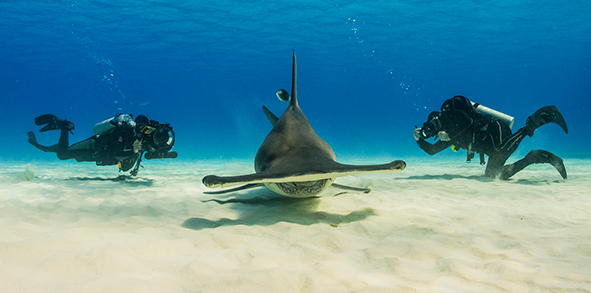
COVID After-effects. Malaysian Authorities have directed the owner of Layang Layang, a Malaysian scuba destination popular with Americans, to return deposits from travelers who were prevented from visiting in 2020 because of COVID lockdowns. According to SAYS, a Malaysian news outlet, more than 100 individuals made 50 percent deposits but were never refunded. The resort claimed that its operating license had not been renewed, so it could not open, and therefore, they would not be refunding deposits. Supersized Sharks at Norfolk Island. Norfolk Island, 1000 miles northeast of Sydney, Australia, is known for its supersized tiger sharks. People have believed that their size was due to a history of farmers habitually disposing of dead cows in the ocean, giving them an unusually high protein diet. Researchers from Australia's Flinders University and James Cook University went there to study why the remote island attracts so many tiger sharks, the highest-known concentration in the world. Could it be the dead cows? More than 20 sharks were caught and tagged in a few days and clearly exceeded size expectations. Large tiger sharks are rather lazy and opportunistic hunters, relying primarily on the element of surprise. Stable isotope analysis proved the majority of their diet were the seabirds that raft in tens of thousands on the ocean surface around Norfolk Island at night. (National Geographic) Hopeful Trash Talk. It's undeniable that our oceans are now full of plastic trash, and several enterprising persons are working to develop solutions. Dutch scientists have identified a fungus, Parengyodontium album, that is breaking down polyethylene waste in the marine environment of the North Pacific garbage patch. Previous research has discovered enzymes and bacteria that will munch through plastic waste. Polyethylene is a common form of plastic in packaging, grocery bags, bottles, toys, and housewares. Let's hope there's enough of the fungus, enzymes, and bacteria to have a positive effect. Pirates' Shark Attack Tragedy. Forty-nine-year-old Tamayo Perry, who played one of the buccaneers in Pirates of the Caribbean, died while surfing near Goat Island in a shark attack on June 23 - about 32 miles north of Honolulu. Local surfers reportedly found him with an arm and a leg missing. Lifeguards brought Mr. Perry to shore by jet ski, where he was pronounced dead by paramedics. |



I want to get all the stories! Tell me how I can become an Undercurrent Online Member and get online access to all the articles of Undercurrent as well as thousands of first hand reports on dive operations world-wide

| Home | Online Members Area | My Account |
Login
|
Join
|
| Travel Index |
Dive Resort & Liveaboard Reviews
|
Featured Reports
|
Recent
Issues
|
Back Issues
|
|
Dive Gear
Index
|
Health/Safety Index
|
Environment & Misc.
Index
|
Seasonal Planner
|
Blogs
|
Free Articles
|
Book Picks
|
News
|
|
Special Offers
|
RSS
|
FAQ
|
About Us
|
Contact Us
|
Links
|
3020 Bridgeway, Ste 102, Sausalito, Ca 94965
All rights reserved.