
 |

 Email Signup
|
Subscribe
|
Login
Email Signup
|
Subscribe
|
Login
For Divers since 1975 The Private, Exclusive Guide for Serious Divers Since 1975 |
"Best of the Web: scuba tips no other source dares to publish" -- Forbes |
Coco View, Roatan, HondurasContents of this Issue: Airlines Take Lithium-Ion Batteries Seriously Cozumel, the Philippines, the Caymans, Florida Diver Pulled into Boat's Propeller Having Fun with Artificial Intelligence Don't Hide Your Diving Mistakes Underwater GPS Will Tell You Where Your Boat Is Another Bad Accident Waiting to Happen? Belize Diving Death; Always Test Your Air Editorial Office: Ben Davison Publisher and Editor Undercurrent 3020 Bridgeway, Suite 102 Sausalito, CA 94965 why 2000 divers have visited five or more times from the July, 2024 issue of Undercurrent
Dear Fellow Diver,
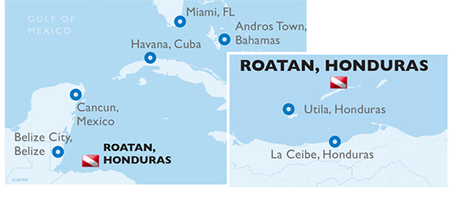
After other divers descended, the spadefish, shaped like the largest angelfish I'd ever seen, tagged along until we went over the wall and dropped to 75 feet. In visibility close to 100 feet, I noticed the south end of a northbound spotted eagle ray cruising into the blue while another soon passed within 15 feet. For half an hour, I followed Gringo (his real name) along the wall, spotting spiny lobsters in the dark crevasses (sometimes as many as a dozen), a huge channel crab, and tiny cryptic teardrop crabs, nearly invisible on branching corals. And, of course, the usual reef fish. Schools of horse-eyed jacks cruised off the wall, and an occasional solitary barracuda cast a wary eye. As we ascended to the sun-lit shallow reef, Gringo and Edgar, the other divemaster, pointed out interesting critters. Schools of Creole wrasse cascaded around the coral heads. Clouds of small fry were everywhere in coral crevasses. Cleaner wrasse crewed the cleaning stations for Nassau grouper, and a large hogfish and the spadefish returned for their mysterious encounters. Under the boat, Gringo pointed at a 4-inch-diameter hole disappearing into the sandy coral rubble bottom. With his tickle stick, he cautiously pushed a pebble down the hole. Up popped a scaly-tailed mantis shrimp clutching the pebble with its front claws. It threw it on the sand, glared at me with those weird eyes, and zipped back down the hole. We dropped in another pebble. The mantis emerged halfway, throwing the pebble farther. He was as round as a beer can and a few inches longer. The locals call them "thumb splitters," Gringo later told me, because they can cause quite a contusion or even break a finger. This was one of my top Caribbean dives; I've had hundreds. I met divers at CoCo View who have traveled all over the world and return again and again. I'm one. It's so popular and reasonably priced that while the resort itself can sleep 60 people, during my late March trip 90 people were registered. No problem: overflow is easily accommodated in adjacent beachfront condos and vacation homes. And the diving operation handled them all with ease. Return visitors can be in the water as quickly as an hour after their plane lands. Immigration is quick, and it's a short van ride to the shuttle ferry for the half-mile trip through a mangrove lagoon to the little island. My buddies and I told the dive shop manager we were returnees (we registered ahead by email), gave our bags to the "bellman," donned our gear without signing anything, and walked into the warm water at CoCo View's Backyard. On other days, one can easily make five dives a day. (First timers, after checking in, have a beach checkout dive, where a divemaster observes skills and orients you to the reef and nearby wrecks; there may be time for another beach dive before dinner.) And CoCo View has an excellent photo pro, Mickey Charteris, whose shop is 100 feet from the boats. He rents point-and-shoot cameras, offers photography courses, and lots of free advice. He's the go-to guy for anyone needing a computer cable or connector. With all this service, you can see why people return.
While Caribbean coral has been struck by bleaching and coral disease, leaving dead and dying coral in some spots, the sites chosen were less affected than those on the island's more heavily populated west end. CoCo View diving is fishy, and, in today's world of climate change, coral diseases, and overfishing, it has some of the best Caribbean diving. One reason is that the dive staff, supplemented by the guests, cleans out the lionfish. Historically, the best way to render a species extinct is to get humans interested in eating it, and plenty are served at CoCo View. I became a certified and licensed Honduran lionfish hunter ($60) under the tutelage of a Roatan marine parks supervisor, Nicholas Bach, who described their infestation, proliferation, eradication attempts, and lifecycle in his impressive British accent. After he showed the basics of a Hawaiian sling, I and five other students waded into the water and submerged to demonstrate we could spear half a dozen coconuts without poking our fins or anyone else. Our award: our own shiny new Hawaiian sling spear with a serial number matching our two-year Honduras hunting license. Since there weren't many lionfish near the resort due to regular hunting, we headed a few miles east the next day, where there were plenty of vermin.
I began each day at my locker by checking my nitrox percentage, and the staff loaded my gear on the boat and set it up. We reached sites in 15 minutes or less, dived for an hour in groups no larger than six -- go off with your buddy or stick with a divemaster -- then traveled to a second site and sat out our surface interval (or jumped in the water since the boats don't have heads) waiting for another hour dive. On the way back, I and anyone who wished would roll off the boat a few hundred yards from the resort and fin our way back among plenty of tropicals in the shallows above, where we would exit a short walk from the dive locker. An hour after lunch, a 1:00 p.m. boat departed, giving the divers the option to be returned to shore after the dive or kick in. After that, many divers grabbed another cylinder for a 4th dive, then took a fifth at night, following supper. It's like a big liveaboard in some ways.
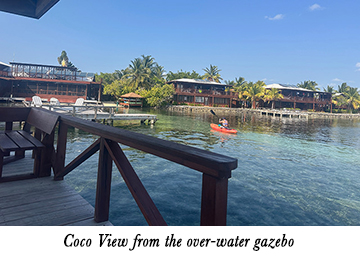
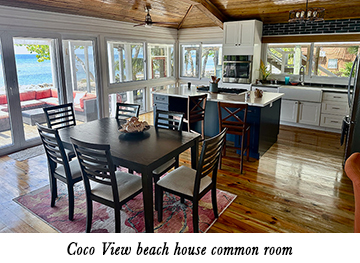
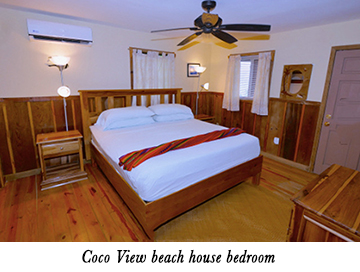
Returning from one morning dive, a few others and I were dropped off along the reef wall and instructed to "keep the wall on your right side until you get back to the home reef." We were just off Beach House number 12, where I was staying, a quarter of a mile east of the resort. With 75-plus-foot visibility, no current, and myriads of creatures, some divers went deep, traveling 75 to 90 feet along the wall. My buddy and I preferred the reef crest, which teemed with colorful reef fish at 10 to 20 feet and gradually transitioned into the natural hatchery of seagrass beds along the shoreline. The water was alive with fry too tiny to speciate. Schools of Creole wrasse streamed past; Bermuda chub, hogfish, and graysby hung between the coral heads. I stopped to watch a pair of hawksbill turtles flipper past, then spotted a green turtle munching on something, unbothered by my approach. I followed and photographed seven reef squid swimming in a big circle, their iridescent fins gleaming in the sunlight. As we neared the end of the dive, a five-foot tarpon followed us as if to ensure we safely exited. I didn't plan for a beach house, but the resort was full, so five others from my dive club and I were fortunate to get upgraded at no extra cost. I had signed up for a basic double occupancy room along the shore with a porch, hammocks and air-conditioning, decent WiFi, and daily maid service. Three 3-room over-the-water cabanas have similar amenities, and some have a back porch over the water. Several beautiful, spacious, privately owned beachfront condos and homes are reachable by a fleet of community bicycles or golf carts. My abode, about 2000 sq. ft., a modern two-story oceanfront three-bedroom home, had expansive ocean views. It had a 400 sq. ft. common area, two bedrooms with twin beds and baths adjacent, and a larger bedroom upstairs. If you wish, you can rent one for roughly $300 a night.
One reason divers return is the unlimited, cost-free shore diving, though intense diver traffic has taken its toll. I walked waist-deep on a sandy trail through the seagrass beds for maybe 60 yards to the edge of a sloping sandy wall. The area beyond has become a wasteland due to thousands of divers annually. Since this is the first dive for almost every new CoCo View diver, an experienced diver will be greatly disappointed with this dived-out area. However, continue to the reef walls and it gets better quickly. Due south is the Prince Albert shipwreck, a 160-foot bulk carrier intentionally sunk 60 feet of water in 1985. One hundred feet beyond is the wreckage of an old airplane, reportedly a C-46 of WWII vintage. Both are covered with thick growths, and tarpons and morays thrive. At night, octopuses and large crabs were common. Easy diving, no guide required.
During a huddle at the bar one night, we talked about the high density of small reef fish at CoCo View and other sites within a mile of the resort. Regular lionfish hunting protects that population, but a divemaster noted that the lionfish are plentiful below sport diver depths. One diver said he had seen far fewer fish a couple of miles east or west, where lionfish were not regularly speared. If dive operators in the Caribbean are going to be able to show their customers reef fish, they must get their tourists involved in culling lionfish at their dive sites. It's heartbreaking to think about, but in the future, 10 miles of reef may have a mile protected by spearfishermen, while lionfish own the rest. For non-divers, CoCo View can arrange many activities, including a baited shark dive -- we created our own -- environmental tours, cultural tours, and even zip-line adventures. And divers, too, ought to get out and about. Too many never leave a resort, ignoring they are in a foreign country from which there is a lot to learn and going home ignorant of the culture. CoCo View is a top-notch Caribbean destination for divers, but if you replace a dive or two or with a guided tour of Roatan or other activities, you'll have much more than just parrotfish memories. --D.D. Our undercover author's bio: . Our undercover author's bio: The author is a master diver and has been diving for more than 30 years, making 1600 dives around the world. Retired from rebreather and technical diving, he is a DAN undersea referral physician and has written several pieces for Undercurrent.
|


 After a backward step off the dive boat CoCo Nut 1 on my first dive of the week, I dropped to 15-feet. I was the first diver in and was startled when something bumped me hard on the back of my leg and shoulder. Then, a grayish-striped fish nearly three feet long slipped in front of my mask, one eye staring at my eye a few inches away. Ah, yes. Our divemaster Gringo Gomez had told us to be on the lookout for a school of curious Atlantic spadefish. And here I was surrounded by 20, some in my face, others nibbling on my wetsuit as if it had to be cleaned of cooties.
 On your fifth visit, you officially become a CoCo Nut (there are 2000 of
these folks!), which provides a few small perks. Make nine visits, and your 10th
is free!
On your fifth visit, you officially become a CoCo Nut (there are 2000 of
these folks!), which provides a few small perks. Make nine visits, and your 10th
is free!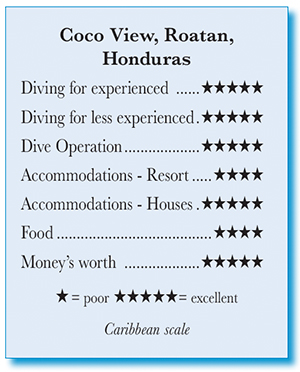 After our first dive in the 84° water, two other hunters and I returned with 37 lionfish. We motored to Pidgeon Cayes for lunch, where Edgar sat on the stern, cleaning the lionfish and icing the fillets in plastic bags for the afternoon's ceviche back at the bar. He tossed the entrails into the current, and a nurse shark came up for the scraps, and then a lemon shark and a grey reef shark appeared. One brave young lady donned her snorkel gear, grabbed her point-and-shoot, and jumped in. Whoa! We all gasped. But she said she was having a great time and invited us to join in. I watched for a few minutes and didn't see the gray reef shark or lemon shark anymore, just nurse sharks. As shark bait girl squealed with delight swimming with the nurse sharks, I couldn't stand to watch anymore, so I jumped in. Edgar kept throwing more lionfish parts into the water and the nurse shark hoovered them up in milliseconds. After about 10 minutes, we all exited the water when the reef shark returned.
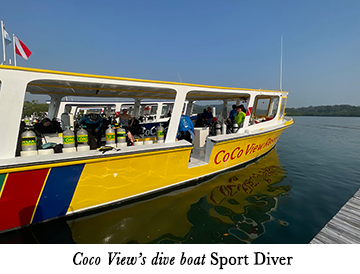
 Four of CoCo View's dive boats are unique 56-foot U.S. Navy surplus dive boats, with inboard diesels and central open wells with ladders that divers can easily climb from beneath the boat, especially in rocky seas. The exterior dive platforms, with ladders, are excellent, and the boats have large, well-designed camera tables with compressed air.
 Given all the diving, I looked forward to meals. The buffet was powered by an excellent couple of chefs and an efficient serving line crew offered several selections emphasizing Central American specialties. Dive resort buffets are never gourmet, but this was a cut above. One night all-you-can-eat lobster tail and shrimp; another night, surf and turf -- excellent lobster, fairly good steaks -- served in a large combination cafeteria, bar, and ocean-view clubhouse, with indoor or outdoor dining, with tables for couples or groups. Specialty menus were available. With a nod to environmentalists, they offer no soft drinks or bottled water but have pitchers of fruit punch, iced tea, and other beverages, and five-gallon bottles of potable water were handy. The 7:00 a.m. breakfast featured an omelet station and fresh-baked muffins or biscuits), lunch choreographed between morning and afternoon boat dives, and dinner, perhaps at 5:00 p.m., suitably timed for midwestern families but far too early for New Yorkers. It means a short cocktail hour, which often resumed after dinner with good local music. One night, a talented guitarist playing both a six and twelve-string guitar skillfully handled any request tossed at him. Several divers, tired after a long day underwater, came alive on the dance floor and had a ball.
 To take a break from diving, one can hop on a free paddle board or free kayak and paddle across the harbor to the Fantasy Island resort or simply stick around the shallow seagrass beds. They're perfect for snorkelers, with plenty of macro life and reef fish. I encountered barracuda, octopus, myriads of small colorful reef fish, and even octopus in water where I could stand up.
 Divers Compass: Several airlines fly nonstop to Roatan on weekends, and one can always change planes in La Ceiba . . . . January to September: $1764 peak for a peak season; Ocean View vs $1564 non-peak. My cost for seven nights was $1950 for room, board, diving, and nitrox (which is strongly encouraged; courses are offered . . . . Beer and wine were $4, liquor $5-6 and up . . . . A gear rental package is $175 per week with an EAN air-integrated computer, shorty wetsuit, fins, and BCD. They also handle equipment repairs . . . . The hyperbaric chamber is a 20-minute drive, near Anthony's Key Resort . . . . CoCo View has a small medical clinic staffed by a nurse . . . . To take your Hawaiian sling home, check it as baggage and attach a copy of your license.
I want to get all the stories! Tell me how I can become an Undercurrent Online Member and get online access to all the articles of Undercurrent as well as thousands of first hand reports on dive operations world-wide

| Home | Online Members Area | My Account |
Login
|
Join
|
| Travel Index |
Dive Resort & Liveaboard Reviews
|
Featured Reports
|
Recent
Issues
|
Back Issues
|
|
Dive Gear
Index
|
Health/Safety Index
|
Environment & Misc.
Index
|
Seasonal Planner
|
Blogs
|
Free Articles
|
Book Picks
|
News
|
|
Special Offers
|
RSS
|
FAQ
|
About Us
|
Contact Us
|
Links
|
3020 Bridgeway, Ste 102, Sausalito, Ca 94965
All rights reserved.