
 |

 Email Signup
|
Subscribe
|
Login
Email Signup
|
Subscribe
|
Login
For Divers since 1975 The Private, Exclusive Guide for Serious Divers Since 1975 |
"Best of the Web: scuba tips no other source dares to publish" -- Forbes |
Rocio Del Mar, Southern Sea of Cortez, MexicoContents of this Issue: Rocio Del Mar, Southern Sea of Cortez, Mexico Great Diving While Saving Fish Rocio del Mar, Midriff Islands, Mexico Liveaboards: Fertile Ground for COVID King Crabs to Rescue Florida's Reefs? Another Red Sea Liveaboard Damaged Humpbacks Whales, Shark Rodeos, Monk Seals, Giant Octopuses Our Subscribers Depend Upon Your Reports A Journey to the Depths of the Ocean Conception Captain Found Guilty Conception Fire Appears To Have Started in a Plastic Trash Can Editorial Office: Ben Davison Publisher and Editor Undercurrent 3020 Bridgeway, Suite 102 Sausalito, CA 94965 counting fish with REEF from the November, 2023 issue of Undercurrent
Dear Fellow Diver, The Reef Environmental Education Foundation -- REEF -- was founded 30 years ago to train sport divers to identify and count fish species to aid scientists, much like birders help the Audubon Society. In October, I joined a REEF trip to the southern Sea of Cortez, led by REEF's communications manager and all-around fish geek, badass tech diver, and dive gearhead Amy Lee. I'm no slouch when it comes to fish identification, but boy, did I learn a lot.
Unlike a conventional dive trip, we divers had work to do. REEF gave each diver a slate with a preprinted underwater survey paper listing the fish we might see. We were to record what we saw and estimate their abundance (a single fish, few, many, or abundant). After the trip, we were to enter our information into REEF's database. Each morning included an entertaining fish identification class. Amy, speaking with grace and humor, showed photos from the early morning dive, reviewing fish we had seen and adding new ones to look for and identify. By the end of the trip, I had mastered a surprising number. Armed with REEF's fish identification slates and papers, we surveyors were passionate and informed. We all recognized and counted the abundant spot tail grunts, coral hawkfish, flag cabrillas, Mexican hogfish, amarillo snapper, and Pacific creole fish. Several surveyors sought rare or cryptic blennies and gobies. Rather than four short dives, Amy had arranged three 75-minute dives every day, and I loved the dives' slow pace so we could seek out fish and identify and record them. Though some stony and soft corals exist in the Sea of Cortez, the substrate is mainly rocky, with a lot of orange cup coral -- tubastrea -- studding the rocks. Mollusk shells litter the bottom, a testament to the fecundity of the waters that Jacques Cousteau called "the world's aquarium." I saw a lot of orange cup coral -- tubastrea -- studding the rocks as well. The Sea of Cortez is seriously fishy, with large schools of jacks, snappers, and Pacific creole fish. No wonder marine mammals like dolphins and sea lions thrive there. There is a lot for them to eat! Sometimes, the sheer number of fish left me agog. I saw schools of graybar grunts and yellowtail surgeonfish at El Perdido, near Isla San Francisco. Bicolor, bumphead, and blue chin parrotfish cruised by. And while the week's visibility averaged about 30 feet or less, here the sun sparkled in the water, lighting up the colors of king and Cortez angelfishes. Loads of scissortail chromis provided a constant background.
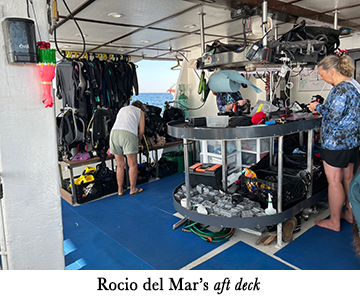
Rocio del Mars's small dive deck can seem cramped, so we divers were divided into groups with departures staggered about 10 minutes apart. Each tank setup has a basket beneath it, with plenty of storage, but overall, it's a compact area. The camera table in the middle had many outlets and secure flame-proof bags for charging batteries and seemed just big enough for this group's many portable cameras.
At El Morro, near Isla las Animas, my group went to 90 feet hoping to see a hammerhead (no joy there). Instead, we were rewarded by two dozen dolphins that cruised around, gracing us for about 20 minutes -- and even accompanying the panga as we cruised back to the boat! At Los Islotes, near Isla Espiritu Santo, sea lions were the stars of the dives, with fish a distant second. I rolled around with two of them and laughed into my regulator as they peered into my eyes and blew bubbles. The sea lions were acrobatic and fun, but they do have fearsome teeth. One nibbled on my fins repeatedly, and I saw others nipping cameras and the first stages on tanks. They may have faces like puppies, but the wise diver respects those jaws. As we chilled in the salon on the deck upstairs after diving, everyone gathered to drink beer, fill in logs, and exchange stories. One diver brought "fairy hair" extensions, iridescent synthetic silk strands in a rainbow of colors. She set up a chair in the salon, and almost all the divers got fairy hair extensions, including the divemasters! I have short hair, but she managed to knot in a few highlights that added a little dazzle to my crop. Amy's very long dark hair glowed with purple and blue extensions, a real head-turner. It felt like a band of buddies.
But, back to the diving. Divemaster Victor promised a lot of panamic green morays at La Reyna, near Isla Serralvo, and he was not kidding. I stopped counting at 50. The rocks and bits of an old wreck provided a perfect hideout for the large morays, with some ledges and crevices holding four or five. And, saw a lovely zebra moray out hunting, its graphic body undulating through the rocks, accompanied surreptitiously by a shadow-hunting flag cabrillo.
Our last dives, done en route to Los Cabos, were in bays along the coast. Visibility was the absolute pits, maybe a few feet. My group managed to stay together, but several divers aborted early because conditions were so inimical. I've dived that area before, and visibility was never good, but this was particularly bad. Being with divers who love to learn about fish and marine life was great. REEF trips are open to anyone eager to learn, as well as hardcore fish nerds. I've been on trips where the divers only wanted to see big stuff, so they ignored the abundant smaller life around them and groused if the big guys failed to show. Some of the divers were highly knowledgeable, and some were new to fish identification -- but we learned from each other and from class, and it really enhanced my pleasure. Full disclosure: I am a longtime supporter of REEF, so of course, I was eager to represent this trip positively. It was a great trip, so I don't feel conflicted about writing this. If there were problems, I would have reported them. -- A.E.L PS: If you want to read REEF's detailed process for fish surveying, it's outlined on REEF's website, at https://www.reef.org/programs/volunteer-fish-survey-project. Author's Bio: AEL has written for Undercurrent for over 20 years, most recently about the Solomon Islands on the Bilikiki.
|


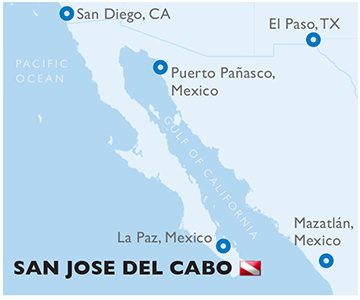
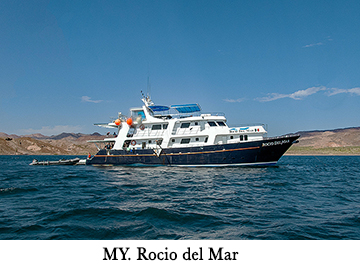 I boarded the 110-foot Rocio del Mar around 5.00 PM at the San Jose del Cabo Marina to be welcomed aboard by Captain Nestor and divemasters Victor, José, and Mauro. I unpacked, stowed my gear, and showed my certifications, then helped myself to the tray of snacks that preceded our first dinner. Twenty divers can be housed in the ten compact cabins, mostly outfitted with twin bunks set at right angles, ensuite bathrooms, and limited storage, so I packed light.
 I've dived the Sea of Cortez
several times, always during
summer and early fall, and the
water had rarely exceeded 80°.
But on this trip, it ranged from
84°F to 87°F. Visibility was often
low 20-30 ft, sometimes more,
sometimes less. I knew El Niño
would warm the water, but this
surprised and concerned me.
I've dived the Sea of Cortez
several times, always during
summer and early fall, and the
water had rarely exceeded 80°.
But on this trip, it ranged from
84°F to 87°F. Visibility was often
low 20-30 ft, sometimes more,
sometimes less. I knew El Niño
would warm the water, but this
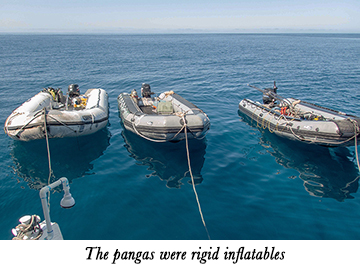
surprised and concerned me.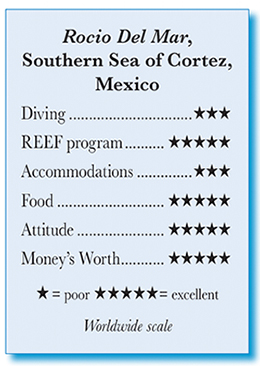 We dived from rigid bottom inflatables, or pangas, driven right up onto the transom. I geared up, walked down a few steps to the transom, and swung my leg over the panga's gunnels while a crew member held my arm to steady me. It's tricky. For those divers who preferred to gear up on the panga, the crew brought them their kit. Our trip had 16 divers, so we dived in groups of five, with Amy accompanying a different group each day. Each group was assigned a divemaster, and we stayed together, and if a diver needed to surface early, they did so in buddy teams.
 I have dived from the Rocio before, as well as its sibling vessel, Quino El Guardian, and I knew the food and service would be superb. After our arrival briefing, we were invited to the lower deck salon for dinner, the first of many great meals. Roast salmon with a savory herb sauce, exquisitely plated with roast veggies and whipped potatoes, took the edge off a long travel day. Chef Joshua and his mate Cinco made every meal special, with flourishes of carved fruit and herb garnishes dressing up each plate. During the week, I enjoyed lasagna, grilled shrimp, tacos, chicken, a variety of salads, and desserts like cheesecake and key lime pie. Eggs to order at every breakfast were complemented by sides like chilaquiles (crunchy tortillas with red or green sauce), bacon, pancakes, and waffles. Wine and beer are available at no cost. I hold Joshua responsible for my snug swimsuit by week's end. My only cavil is the dining area on the lower deck in the bow. Getting there means climbing down a steep ladder, and the sloping walls make it much too noisy.
 The one night dive at a sheltered bay near Isla Espiritu Santo had to be canceled; lights were lowered to attract mobulae rays, but they failed to show up. Those darn wild animals just won't take direction. Four years ago, I did dive with them at night there, and it was a lot of fun, with hundreds, maybe thousands, of food-crazed rays streaking around gobbling plankton attracted by powerful lanterns the crew had placed on the bottom. Perhaps they were stuffed from previous visits and stayed home.
 Divers Compass: San Jose del Cabo (SJD), 722 air miles south of Phoenix, is easily reachable by many airlines . . . . . The trip was $2994, and nitrox adds $140. . . . Limited rental gear is available, including 100 cubic foot tanks at $50 for the voyage. . . . Since we boarded the boat at 5 PM, and I arrived around noon, I got a day room at the Hotel El Ganzo, right next to the marina; the La Marina Inn is also nearby. Rooms around $130 and up.
I want to get all the stories! Tell me how I can become an Undercurrent Online Member and get online access to all the articles of Undercurrent as well as thousands of first hand reports on dive operations world-wide

| Home | Online Members Area | My Account |
Login
|
Join
|
| Travel Index |
Dive Resort & Liveaboard Reviews
|
Featured Reports
|
Recent
Issues
|
Back Issues
|
|
Dive Gear
Index
|
Health/Safety Index
|
Environment & Misc.
Index
|
Seasonal Planner
|
Blogs
|
Free Articles
|
Book Picks
|
News
|
|
Special Offers
|
RSS
|
FAQ
|
About Us
|
Contact Us
|
Links
|
3020 Bridgeway, Ste 102, Sausalito, Ca 94965
All rights reserved.