
 |

 Email Signup
|
Subscribe
|
Login
Email Signup
|
Subscribe
|
Login
For Divers since 1975 The Private, Exclusive Guide for Serious Divers Since 1975 |
"Best of the Web: scuba tips no other source dares to publish" -- Forbes |
Rocio del Mar, Midriff Islands, MexicoContents of this Issue: Rocio Del Mar, Southern Sea of Cortez, Mexico Great Diving While Saving Fish Rocio del Mar, Midriff Islands, Mexico Liveaboards: Fertile Ground for COVID King Crabs to Rescue Florida's Reefs? Another Red Sea Liveaboard Damaged Humpbacks Whales, Shark Rodeos, Monk Seals, Giant Octopuses Our Subscribers Depend Upon Your Reports A Journey to the Depths of the Ocean Conception Captain Found Guilty Conception Fire Appears To Have Started in a Plastic Trash Can Editorial Office: Ben Davison Publisher and Editor Undercurrent 3020 Bridgeway, Suite 102 Sausalito, CA 94965 serving science in the Sea of Cortez from the November, 2023 issue of Undercurrent
Dear Fellow Diver, Ever since the Rocio del Mar made its maiden voyage exploring the Sea of Cortez in 2009, it has been on my bucket list, so I was delighted to be invited to join a group of photographers and biologists on a scientific expedition to the Midriff Islands. The trip was organized by digital nomads and citizen scientists Carlos and Allison Estape, major contributors to the fish identification page hosted by the Smithsonian Tropical Research Institute (STRI). The expedition included six male and two female marine biologists from seven scientific and educational institutions in Mexico and the U.S., 11 passionate photographers, and a fish-spotting spouse.
To do our daily work, we made two 90-minute dives and one 75-minute dive (265 minutes), giving the biologists more time between dives to process specimens and the photographers more time to recharge batteries and look at photos. We started at depth and worked our way up, sometimes to the surface, to photograph Cortez clingfishes and worm blennies that looked more like tiny eels than blennies. Visibility ranged from 10 feet when caught in schools of mysida shrimp to 80 feet. Water temperatures were in the low 80s but dipped to 75 when I reached 100 feet. The first evening, our divemaster, Bob, provided a thorough safety briefing, explaining emergency procedures, followed by a surprise fire drill. They divided us into three groups: seven marine biologists on the largest panga, seven photographers on another panga, and six photographers and a senior marine biologist on my panga. Each morning, we received a thorough dive briefing tailored to our group. With the photographers spread out underwater, our excellent guide, Marco, hovered above, tracking us with our faces buried in our viewfinders. More than once, I looked up and didn't see my buddy, but I could see Marco above me, and he would point toward my buddy. I imagine Mauro, the dive guide with the biologists, had a more difficult time as his divers scattered, some after tiny creatures along the shore while others targeted seabass and wrasses to collect with a spear. As a photographer, it didn't matter if you had the latest and greatest equipment. Five of us shot with a $500 Olympus Tough TG-6 camera, which takes great macro images. Everyone got excited about their unique discoveries and loved showing each other. I saw fish I would have never found on my own, such as an elusive gecko goby. After taking photos of an unusual blenny hiding on an algae-covered rock, I pointed out the well-camouflaged fish to another diver, who took several photos and then skillfully maneuvered the fish into a dipnet. I felt a little guilty helping secure it in a bag, but I forgot about it when I discovered an unusual flap-scaled blenny. A later internet search revealed I may have taken some of the first photos of this fish in its natural environment!
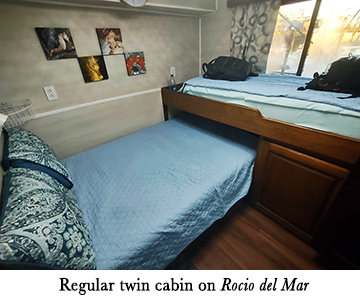
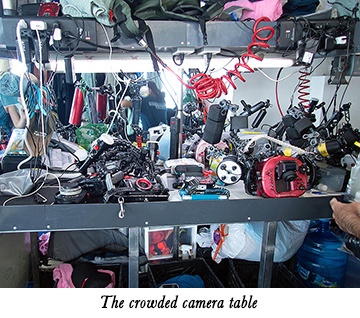
The staff of the Rocio del Mar is outstanding, and the accommodations are comfortable. When the steward, Carlos, heard I preferred iced tea at lunch rather than the usual Gatorade, he provided a pitcher every day. He ensured the cabins were made up during our first dive. (Oddly, sheets on many beds were too small or too large, and many of us struggled to keep them covering the mattress; fitted sheets would solve the problem). The lower deck has a spacious galley and dining area that comfortably seats 20 divers in three booths. On the deck with the pilot house, there is an indoor TV and computer room. While the sun deck on top was usually available for lounging, the marine biologists also processed the collected specimens there. Each had to be carefully cataloged, photographed, and preserved. Many fish were brought in alive and placed in a thin tank to be photographed against different backgrounds to make their fins stand out. When I captured a juvenile jawfish, I excitedly ran upstairs to show the marine biologist and add it to the collection. Later, I provided the photos I took before collecting it. Not only did we deal with wildlife below the surface, we were bugged from above. One morning, a prominent note on the bulletin board shouted: "Lots of bugs on dive gear. Clear regs before putting in mouth!" The boat was covered in large stink bugs -- I purged my regulator more than once. Another day, a swarm of bees kept us alert on the stern of the boat.
Each morning, a cold breakfast was spread out with breads, yogurt, cereal, and fresh fruit. Then, a hot breakfast was offered each morning, including eggs, omelets, French toast, bacon, sausage, and even huevos rancheros. Lunch began with a delicious soup followed by excellently prepared fajitas, cheeseburgers, and tacos. On our fourth day, we awoke next to the tiny Isla San Pedro Martir, the southernmost location on our trip. In clear blue water, I descend to a gravel bottom at 50 feet next to a wall. While my assignment was to photograph juvenile wrasses, I soon found myself surrounded by dozens of playful sea lions. I tried concentrating on a small, erratic wrasse, only to be startled by a large sea lion swooping in from behind me. After several failed attempts to capture a wrasse, I gave up and enjoyed some time with the playful sea lions. Our last dive site, Isla Angel de la Guarda, was a macro photographer's delight. At 110 feet, Ross grunted at me to photograph a longnose hawkfish in the yellow-green black coral draping over the wall like a forest of weeping willows. I missed the shot, but luckily, Allison got a photograph of one, a rare sighting in the Sea of Cortez. The current was powerful, so I began heading up to shallower waters called the "Blenny Field," known for gulf coast signal blennies. I was surprised by a giant electric ray as it swam slowly below me. At 45 feet, Marco pointed out the head of a tiny black fish peering from a fist-sized rock: a gulf coast signal blenny. I quickly pulled a 5x7 inch plastic shaving mirror out of the cargo pocket of my dive shorts and propped it up on some nearby rocks about four inches from the blenny so I could shoot him from the side without getting the mirror in the shot. As I lay on the gravelly bottom at 45 feet, it didn't take long for him to notice his reflection and begin an impressive territorial display. The full fin flare happened very fast, but after a while, I could anticipate his movements. Orange-throat pikeblennies and blue-spotted jawfish also popped out of their burrows and flared their fins at potential mates. As I learned later, the BBC was coming here to film a special on the signal blennies. During the trip, our group sighted but one manta ray, a single sea turtle, and no sharks. Two of our most boring dives were exploratory. But on a third exploratory dive, I was surrounded by small barracuda and a huge school of large halfbeaks. They schooled all around me, sometimes swirling in a circle. The Rocio del Mar and its sister ship, the Quino El Guardian, host a range of science trips, some focusing on big fish, photographing, identifying, and tagging, while others focus on fish/animal counts and census monitoring. On most citizen science trips, divers can participate as much or as little as they wish. My Rocio del Mar trip was by invitation. Most scientists paid their way through research grants; photographers paid their own way at a slightly reduced cost. As a diver who loves to contribute photos to marine biologists, this trip was especially fun. Would a regular diver enjoy it? Probably, but it wouldn't be for everyone due to the lack of large marine life and colorful coral gardens. But it is a chance to help scientists better understand the underwater world and help it survive. We all need to pitch in. -- F.L. Our undercover diver's bio: As a child, I poured over National Geographic underwater articles. I got certified in 1991 while stationed at Andersen AFB, Guam, and my first dive trips were to Palau and Truk. I have made more than 2,000 dives, mainly in Florida but also in the Philippines, Indonesia, the Revillagigedo Islands, the Sea of Cortez, and the Red Sea.
|


 The Midriff Islands, 55 islands, islets, and pinnacles in the northcentral Sea of Cortez, rise from the sea floor with swirling colors of volcanic rock, reminding me of Death Valley. The underwater topography was similar, mostly rocky slopes tumbling to a cobblestone bottom 30 to 100 feet deep. The expedition's goal was to catalog as many fish species as possible through photography and collection. The STRI would use our photos to extend the known range of some species and hopefully get images of fish never photographed in their natural habitats. While some fish would be collected for DNA samples and fin counts, they wanted photographs of the fish in their natural environment before they were preserved and the colors faded.
 The trip's patriarch was Dr. Ross Robertson, a member of the STRI staff since 1975 and currently in his 70s. If he saw an interesting fish, he would grunt at the closest photographer to get their attention and point at the fish, wanting them to take photos.Sometimes, he would try to collect it, and sometimes he would let it be. For a fish that was a known resident of the Sea of Cortez but not this far north, he only needed a good photo as a "voucher" of the more northern location; everyone was happy to oblige. After all, if you heard a really excited grunt, your photo might be the first live photo of the species in the wild. I found a Barnacle Bill blenny on a snorkel dive, and my photos may provide evidence of an extended range.
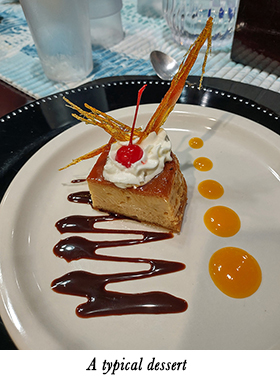 The meals Chef Joshua prepared set the bar for my future liveaboard trips. When the dinner menu said shrimp, I never expected an Instagram-worthy bundle of shrimp elaborately wrapped in bacon to resemble a lobster tail in its shell, covered generously with remoulade sauce. It was a feast for the taste buds and the eyes. The ribeye steak was so large some guests requested leftovers be served with their eggs in the morning. The menu was posted each morning, and the chef kindly replaced my salmon with chicken when I requested it. He accommodated vegan and gluten-free diets also.
 Divers Compass: Rocio del Mar $2995 per person, double occupancy. Prices include all taxes, port fees, meals, beverages, tanks, weights, and complimentary beer and wine. Plus National Park Fee -- $6 per day of diving, Nitrox Fee $140, crew gratuity (typically 10 - 15 percent of the fare) . . . From Phoenix, it's a 4-hour trip to Puerto Peñasco, Mexico, where we boarded the boat. The van service, by Head Out to Rocky Point, included a border inspection with no hassles -- $150 round trip.
I want to get all the stories! Tell me how I can become an Undercurrent Online Member and get online access to all the articles of Undercurrent as well as thousands of first hand reports on dive operations world-wide

| Home | Online Members Area | My Account |
Login
|
Join
|
| Travel Index |
Dive Resort & Liveaboard Reviews
|
Featured Reports
|
Recent
Issues
|
Back Issues
|
|
Dive Gear
Index
|
Health/Safety Index
|
Environment & Misc.
Index
|
Seasonal Planner
|
Blogs
|
Free Articles
|
Book Picks
|
News
|
|
Special Offers
|
RSS
|
FAQ
|
About Us
|
Contact Us
|
Links
|
3020 Bridgeway, Ste 102, Sausalito, Ca 94965
All rights reserved.