
 |

 Email Signup
|
Subscribe
|
Login
Email Signup
|
Subscribe
|
Login
For Divers since 1975 The Private, Exclusive Guide for Serious Divers Since 1975 |
"Best of the Web: scuba tips no other source dares to publish" -- Forbes |
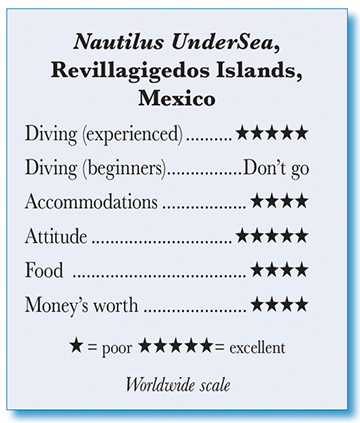
Nautilus UnderSea, Revillagigedos Islands, MexicoContents of this Issue: Nautilus UnderSea, Revillagigedos Islands, Mexico When Good Intentions are Ill-founded Banning Fishing at Revillagigedo National Park Works Rangiroa, BVI, Guanaja, Bermuda, Maui and More Reflections on the Philippines Capsizing. Carrying Four Divers to the Depths Fancy Your Own Dive Center in the Sun? Carlton Queen Capsizes in the Red Sea A Serious Shark Bite After the Dive Ended Legal Remedies for Overseas Injuries Unlikely Another Killer on Caribbean Reefs Lend A Hand On Your Next Dive Vacation: Part II Volunteering for Maldives Whale Shark Research Editorial Office: Ben Davison Publisher and Editor Undercurrent 3020 Bridgeway, Suite 102 Sausalito, CA 94965 when not astonishing, it's still really good from the July, 2023 issue of Undercurrent
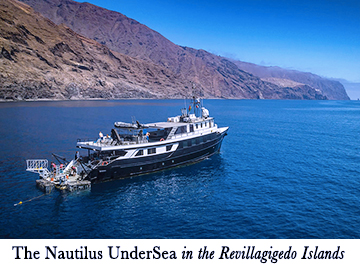
Dear Fellow Diver, My first foray back into the water after being fully vaccinated for COVID was an April 2021 trip aboard the Nautilus UnderSea, plying the remote Pacific waters of the Revillagigedos Islands, better known as Socorro, about 300 miles south of Cabo San Lucas. In reviewing my 2021 dive log from Roca Partida: "This dive was a one-with-the-universe experience. We entered through clouds of jacks and trevallies as whitetips cut through -- two massive yellowfin tuna streaked by. Silvertip and Galapagos sharks cruised by ... and then a massive school of bonito flowed over us, the size of a five-story building made of fish. The whale shark was icing on the cake!" No wonder I returned this April, and while diving was not as astonishing as in 2021, it was still good.
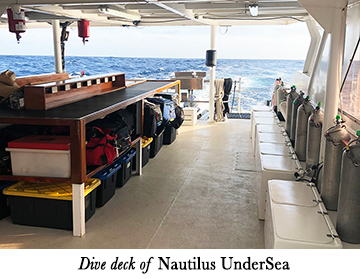
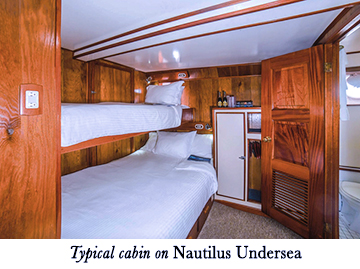
I felt a certain déja-vu boarding the 105-foot Nautilus UnderSea. My spouse and I traveled on the then Undersea Hunter for our first trip to Cocos 30 years ago. It was swanked up in 2017 with an expanded dive deck, a roomy suite on the top deck, an ADAaccessible cabin on the main deck, a hot tub, and improvements throughout. Built for exploration, its bones remain sound. Like every vessel plying this route, the Nautilus UnderSea moves with the ocean, and even some folks inured to motion sickness felt green around the gills. Before boarding, I loaded up on overthe- counter Bonine (meclizine) and took it throughout the trip. One diver, on her first-ever liveaboard, hesitated to use her scopolamine patch, and it took days before she was comfortable. Count on about 80 hours of open ocean crossings, 30 hours each way between Cabo and the islands and another 8-10 hours between the islands. Socorro's appeal lures divers from around the world. Our 15 guests were from the U.S., Canada, Holland, Switzerland, and France (the boat can hold 19), and we quickly knit together. The staff, too, was international. Captain Rey was from Costa Rica, divemasters Pablo, Dani, and Nico from Mexico, Spain, and France, respectively, and host Laura hailed from Spain. Chef Gerardo, mate Einar, engineers Aurelio and Javier, and deckhand Geronimo were all Mexican. English was the lingua franca, though Spanish was the crew's common language. We boarded around 7:30 p.m., and the crew welcomed us with champagne and a light sushi dinner. The captain briefed us as we got underway, staged a life-vest drill, and reminded us that while the chamber on Socorro Island was as much as eight hours away, it would be a 30-hour trip to a hospital (which is why liveaboard divers should carry medical air evacuation insurance). As a seasoned traveler knows, lower deck cabins have the least apparent motion -- the Nautilus UnderSea really rocks and rolls when underway -- but get the most engine noise. Main deck cabins have less apparent motion than the upper deck, which is quieter. I needed earplugs in my lower deck cabin where the engine noise was louder than on most liveaboards I've been on. Here's a short video of the noise in my cabin when the boat is underway: Our first dive was on day three at 7:30 a.m., and we dived again at 11, 2 p.m., and 4:45. Night diving is not possible, so leave your big torches at home. On both my trips, the divers were experienced and self-reliant, which one must be because several dives are challenging and unsuitable for inexperienced divers. Nautilus also equipped each of us with their proprietary Lifeline, an emergency transponder, a DiveAlert horn, and an SMB. The big dive deck has plenty of space for gear; the bar for hanging wetsuits is high up, tough for vertically challenged people. The huge camera table has a station for every diver. The crew will assist if you need help gearing up, but they expect self-reliance.
Our first dive was in the lee of San Benedicto island, our only dive from the mothership and our chance to check our gear. It's a quiet site of volcanic boulders and dark sand, plenty of trevallies and whitetip sharks, morays, and lobsters. We made our remaining dives from three 15-foot rigid-bottomed uncrowded inflatables or pangas. I felt awkward entering the panga as the captain drives its bow onto the Nautilus UnderSea's transom. After gearing up on the spacious dive deck and walking down the ladder sans fins to the transom, I slung one leg over the edge, then the othher, earning no style points! Once full, the panga backed off the transom.
After a couple of dives at the Boiler, some divers became blasé -- "Oh, another giant manta (stifled yawn)!" Even so, my log from 2021 notes I saw even more mantas and sharks than this time. We stayed at San Benedicto to dive a second day at El Cañon and its massive volcanic rocks, a testament to the volcano ejecta. A shark cleaning station featured magnificent scalloped hammerheads and a few silvertips enjoying the grooming services of Clarion angels and barberfish. I watched rainbow runners brushing against the sides of whitetip sharks, using their rough hides to scrape off parasites. As the day passed, the visibility dropped, making it harder to see the big sharks in the gloom. My 2021 log noted much better visibility and a pod of dolphins that showed up to play, followed by a hypnotic school of hammerheads that circled us. No such joy on this trip, but it's nature. Big fish don't stay in one place long, so anything is possible. We then crossed to Socorro Island and checked in with the Mexican naval base, something every liveaboard must do, making it a three-dive day. At Punta Tosca, the massive architectonic wall of rock was so clean-edged that it looked artificial. I saw a big school of bicolor parrotfish, amberstripe scad, and a single hammerhead. My group missed an encounter with a pod of friendly dolphins, and I could only envy the other two groups, who frolicked with them. Regardless, I was transported by the distant song of humpback whales; in the quiet between my breaths, the eerie whale arias enhanced the vast deep in which I floated. On our second day at Socorro Island, we dived Cabo Pearce, which, the staff said, had been loaded with life the past few weeks. But, the force was not with us, as we had few big sightings in the low visibility, which was about the distance of two sharks, end to end. I guess I'm spoiled -- I complained in my log, I am ashamed to say, that one dive at Cabo Pearce was "not as good as 2021: only a few mantas, one silvertip, and one Galapagos shark." Most places, this would be enough to merit five-plus stars! Unlike liveaboard trips, say, in Indonesia or the Caribbean, where one can have a couple of land trips, our only chance to get off the boat was when Geronimo took us on an interesting panga tour of Socorro Island, motoring under a natural stone arch while pointing out the roosting brown boobies. From the surface, I could see several feeding mantas below, with a wing tip occasionally breaking through the surface.
The compact salon and dining area hold long meal tables and some cushioned seating. It is not expansive, so it did encourage folks to mingle and get to know each other, especially during cocktail hour, when Laura offered a daily cocktail special (I loved her margaritas). They sell several wines by the bottle or glass. Of course, there is good Mexican beer. Next stop, Roca Partida (Split Rock). In 2021, while the pandemic restricted travel, we had the site to ourselves in unusually calm conditions. It's the tip of a massive, sheer-sided underwater volcano, where the water is usually rough, with no lee or shelter. Like an iceberg, Roca Partida exists mainly beneath the surface, attracting animals like it's the only bar in a dry county. In 2021, my dives were among the best of my life. Whale sharks, hammerheads, Galapagos, silvertip, and whitetip sharks competed for my attention; schools of bonito and yellowfin tuna cruised by while clouds of trevallies and jacks hung out. This trip was good, but nothing like my one-with-the-universe experience in 2021. Visibility was fine on my first dive, which featured silvertip sharks and yellowfin tuna. As the day progressed, the visibility dropped considerably, so I saw less. But on my last dive of our trip, I was intrigued watching a pompano brushing against a silvertip shark, using its cartilaginous exoskeleton to brush off parasites. We left that evening and began the long trip back. While my ride out was filled with expectation, I filled the long ride back by exchanging photos, reminiscing, and bunk dives.
Socorro diving demands buoyancy control because a mistake can be fatal given the distance to medical facilities. Safety stops mean hanging in the blue, and often the current pushes you along. You need to be comfortable deploying an SMB. While most dives don't require kicking into the current, you should be in good shape and comfortable kicking against it. And, one must prepare for cool Pacific water year-round. On both trips, I recorded water temperatures between 71-75°F. I wore my 7mm steamer, a hooded vest, and a Venture heated vest underneath, and even then, I felt cold on a few dives. One diver came quite unprepared and was grateful when I had an extra neoprene hooded vest to loan. Gloves are prohibited in the marine park (though the boat did not enforce this), and I sure wished I had brought mine as my hands got cold. In my younger days, my excitement was enough to keep me warm. No more. Now I need to layer and layer again. Overall, this was a good diving trip, but it paled compared to my once-in-a-lifetime trip in 2021 -- but that's nature for you. I respect the Nautilus' commitment to safety and environmental awareness, and I like the food and the boat (except for the engine noise). I will carry the memory of schools of scalloped hammerheads, graceful oceanic mantas, and schools of yellowfin tuna forever. There is nothing like Socorro diving. -- A.E.L. Our undercover diver's bio:: Among AEL's nearly 4000 logged dives all around the world, those at Socorro are among the best. This was the third trip there for AEL, who has written for Undercurrent for over 20 years.
|


 Whenever I take a liveaboard trip, I plan to arrive at least a day before departure in case I miss a connection, or my luggage has to catch up. I stayed at the charming Casabella Boutique Hotel, next door to the Nautilus operation at See Creatures, a short walk to many restaurants and the marina. I traveled solo, so security mattered to me, and the small, family-run Casabella made me feel very comfortable, psychologically and physically. To tune up before the hard-core diving at Socorro, I made a local dive
with See Creatures. The sites (like
Pelican Rock) had low visibility and
66F water, but lots of fish.
Whenever I take a liveaboard trip, I plan to arrive at least a day before departure in case I miss a connection, or my luggage has to catch up. I stayed at the charming Casabella Boutique Hotel, next door to the Nautilus operation at See Creatures, a short walk to many restaurants and the marina. I traveled solo, so security mattered to me, and the small, family-run Casabella made me feel very comfortable, psychologically and physically. To tune up before the hard-core diving at Socorro, I made a local dive
with See Creatures. The sites (like
Pelican Rock) had low visibility and
66F water, but lots of fish.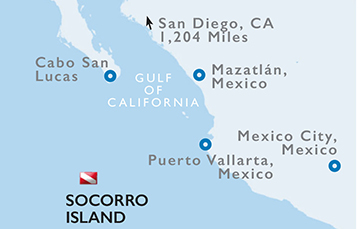 As we traveled, Nico, a manta enthusiast, gave an excellent presentation on Socorro's mantas. Did you know that the poor females carry their young for 13 months before birth? No wonder they only have pups every three to five years!
 Underwater, we were to stick with our assigned group and divemaster, but those who wished to surface earlier than 60 minutes were quickly picked up by a panga. After the dive, the crew hauled up my weights and BCD, and I climbed up the short ladder. Back on the mother ship, Laura offered hot chocolate or hot tea.San Benedicto is home to a signature dive, El Boiler, famous for giant Pacific mantas that come to socialize and to be groomed. After a five-minute ride in the windy open water, we backrolled in together and descended quickly. Six huge mantas slowly circled, stopping to be groomed by the orange and brown Clarion angelfish. Thanks to Nico's talk on mantas, I could distinguish the chevron from the black variations of Mobula birostris (the oceanic manta). With wingspans from 10-18 feet, they seemed genuinely curious as they swam close to us. I saw dozens of hammerheads on one dive and schools of yellowfin tuna, which look like brilliant steel torpedoes, compact yet lethal, as they power through the water. The tuna had competition. A meaty wahoo sliced through the water, scattering the redtail triggerfish. At the 55-minute mark, our divemaster deployed his SMB from 20 feet, and we hung together for a safety stop with the panga nearby.
 Every crew member played an important role, but from my point of view, the most important person on a liveaboard is the chef, and Gerardo fed us well. Continental breakfasts were out at 6 a.m., and after the first dive, he served eggs to order, omelets, eggs Benedict or Florentine, and French toast. My one cavil about breakfast: bacon and sausage are turkey-based, lacking the umami and unction that make pork so delicious. Daily, lunch began with hot soup, usually vegetarian or vegan; the carrot-ginger was my favorite. Pizza, sandwiches, pasta, and curried chicken were on the menu, and always a salad. Dinners alternated between buffets and plated meals: roast beef with sweet potatoes, roast fish with mango salsa, a robust lasagna, and always a salad. Taco night, served on the top deck, offered beef, chicken, and vegetable tortillas, guacamole, pico de gallo, and frijoles. The Dinners included roast beef with sweet potatoes, roast fish with mango salsa, a robust lasagna, and always a salad kitchen ensured that vegetarian divers left the table satisfied. I blame Chef Gerardo for making my swimsuit a little tighter. His baked goods were addictive, and I indulged in chocolate chip espresso cookies, shortbreads, and moist coconut and lemon cakes.
 While one dives Socorro for the big guys, the smaller creatures are certainly worth noting. I admired the ubiquitous red-tailed triggerfish on virtually every dive. Panamic green moray eels abounded, as did spiny and spotted lobsters. On several dives, I watched octopuses foraging or glaring balefully from a hole. While hanging in the blue doing my safety stop, wahoo and tuna frequently swam past. In 2021, I saw a rare larval oarfish (adults can reach 20 feet long or even more) on my safety stop at Roca Partida.
 Divers compass: it's easy to fly into San Jose del Cabo, which is served by Mexican, U.S., and Canadian airlines . . . A taxi or car service between the airport and Cabo San Lucas runs about $90 for two . . . My trip was eight days, nine nights, with five dive days. Cost ranges between $2300 to around $5000 per person, depending on the stateroom; with my business class fare and hotel, tips, taxis, meals, and booze, I spent more than $10K, a lot for five dive days . . . The $35 port fee must be paid in cash, and the crew prefers tips in cash over credit . . . Nitrox, always a good idea, adds $100 to the trip . . . Rental gear is available at the See Creatures headquarters. I rented a steel tank for $65; its negative buoyancy let me wear only one pound of weight . . . The crew is not permitted to repair equipment but will loan you gear if something breaks . . . Unlike many liveaboard companies, Nautilus charges for alcohol and asks that you not bring your own bottle . . . At the hotel, I paid cash and got 20 percent off the rack rate
I want to get all the stories! Tell me how I can become an Undercurrent Online Member and get online access to all the articles of Undercurrent as well as thousands of first hand reports on dive operations world-wide

| Home | Online Members Area | My Account |
Login
|
Join
|
| Travel Index |
Dive Resort & Liveaboard Reviews
|
Featured Reports
|
Recent
Issues
|
Back Issues
|
|
Dive Gear
Index
|
Health/Safety Index
|
Environment & Misc.
Index
|
Seasonal Planner
|
Blogs
|
Free Articles
|
Book Picks
|
News
|
|
Special Offers
|
RSS
|
FAQ
|
About Us
|
Contact Us
|
Links
|
3020 Bridgeway, Ste 102, Sausalito, Ca 94965
All rights reserved.