
 |

 Email Signup
|
Subscribe
|
Login
Email Signup
|
Subscribe
|
Login
For Divers since 1975 The Private, Exclusive Guide for Serious Divers Since 1975 |
"Best of the Web: scuba tips no other source dares to publish" -- Forbes |
Golden Rock Resort, St. EustatiusContents of this Issue: Golden Rock Resort, St. Eustatius Sharks Thrive in the Remote MPAs Travel Insurance Might Not Cover Your Cancelation Belize, Thailand, Fakarava, Grand Cayman It's Cheaper to Jump from the Bow of Your Liveaboard Cuts and Grazes Sustained from Coral Medical Questionnaires, Training Rules ... Fire at Fantasy Island, Honduras That California Swimmer Killed by a Shark Editorial Office: Ben Davison Publisher and Editor Undercurrent 3020 Bridgeway, Suite 102 Sausalito, CA 94965 lovely resort, easy Caribbean diving from the March, 2026 issue of Undercurrent
Dear Fellow Diver,
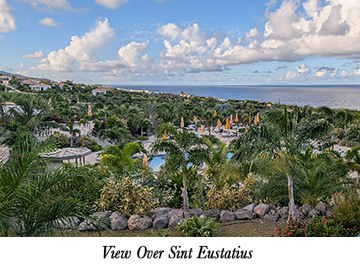
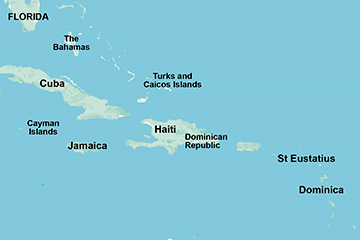
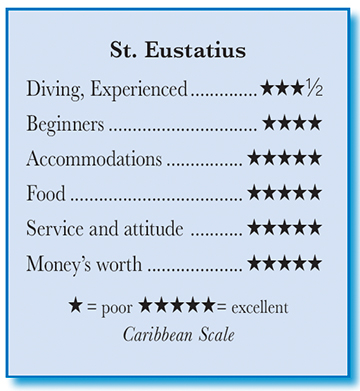
The overcast day and a fair amount of particulates in the water made for a dark dive, a challenge for photography. I dropped to the bow, surrounded by black-eyed jacks, sergeant majors, and yellow goatfish; a lone puffer fish hovered nearby. Descending to the bottom, I spotted a green turtle near the midships smokestack (I later learned that the smokestack is its personal resting perch nearly every day). Unfazed by my presence, it lay with its beak resting on a soft yellow tube sponge. At the stern, a school of jacks circled, then more arrived, and hundreds of brown chromis came whizzing by. It was a spectacular way to end the dive. In nearly 50 trips to the Caribbean, I had never ventured to the small Dutch island of Sint Eustatius, or Statia as it's called, a volcanic island nestled between St. Barths, St. Martin, and St. Kitts. Measuring about five miles by two miles, it was a major trading hub in the 18th century, resulting in hundreds of wrecks, the bones of which are occasionally spotted. Today, its population is around 3,700 with an oil terminal and a small tourism industry. On November 16 each year, they celebrate Statia Day in honor of being the first foreign government to recognize the U.S. in 1776. During the second week of January, I lodged at the Golden Rock Dive and Nature Resort, Statia's only luxury resort. Post New Year's, it was indeed quiet, with only a few guests, mostly from the U.S., a few from Scandinavia. The five-year-old resort sits on 40 acres below the dormant 1972-foot Quill volcano. As I strolled through the lush grounds with over 140,000 plants, flowers, and trees, I was impressed with the tropical beauty. The 72-room property has and two- story luxury hotel building with ocean view rooms and suites, private one or two bedroom cottages, and, where my wife and I stayed, charming villa suites in quad buildings, with two units down, two units up. One can stay busy in the well-equipped gym, on the tennis or paddleball courts, or in one of the two swimming pools, and even hike from the resort to the volcano summit -- it's not an easy climb.
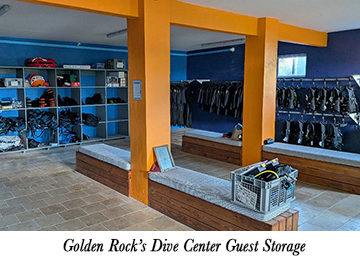
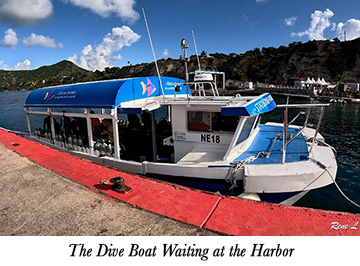
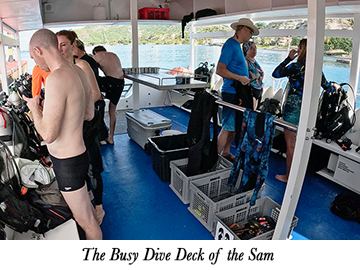
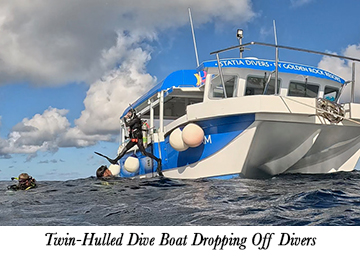
The first morning, I placed my gear outside the door and headed for breakfast -- most everything one might expect was on the menu -- then at 8.00 a.m., I took the short five-minute walk downhill to the dive shop overlooking the ocean, which has a dedicated camera room with ample workspace and power plugs. After meeting and chitchatting with the other five divers, we hopped in their van for the 15-minute ride to the harbor, a bumpy drive down roads of dirt or broken pavement. Sitting in the back meant I'd get launched now and then, so for the next trips, I would board quickly to grab a seat up front. Each day at the harbor, we walked through the immigration/customs gate, where a guard had a list of our names, then down the dock to board the boat. I set up my gear (which they'll do if you wish), analyzed my tanks -- the free nitrox was consistently 31-32 percent and always 3000 psi -- and away we'd go for the 7-to-15-minute rides. They have two boats; I dived from a covered 30-foot twin-hulled twin diesel custom dive boat named "Sam" with a 25-diver capacity and a camera table and camera rinse bin. The first day's briefing, maybe 30 seconds, consisted of Killean, our French guide, just kinda pointing in the general direction of where things were: marine head, a DAN kit (I found it under an overloaded crate), water jug, and a cooler of snacks (no mention of life vests or where they were). He pointed out things on the laminated drawings of dive sites and described the plan." . . . we will drop here, move to the right, blah blah blah . . . then look for (whatever fish species), then blah blah blah, we will turn this way . . ." Blah blah blah dominated the briefings.
We were at STENAPA Reef, inside the harbor, in an area littered with purposely sunk wrecks. There are several other wrecks, including a small upright tugboat, generally covered with soft corals; I swam with stingrays, yellow goatfish, schools of blackbar soldierfish, a couple of barracuda, and a green sea turtle, as well as smaller reef fishes. Though it was January, the water was a comfortable 80-82°F and visibility ranged from 30 to 60 feet. After the dive, we moved a short distance, gabbed for an hour, then dropped in at The Aquarium, a small coral area at around 60 feet, and so small, it took only about 15 very slow minutes to circumvent the entire patch. I found a couple of turtles riding atop a swaying bunch of seagrass while munching on it. Here and there, I spotted an assortment of coneys, groupers, yellow goatfish, blue tangs, chromis, sergeant majors, and even a couple of octopuses, and at the end of the dive, a turtle finned between the dive guide and me, giving me one of the cleanest shots I took all week. We then motored back to the dock, placed our gear in the gear bags, and were shuttled back to the hotel. The staff brought the gear back to the shop, rinsed it, and stored it to dry. And they returned it to the boat each morning.
The Beach Club is near the dive shop and lagoon. It was open three days for dinner only (I'm sure that changes in high season), with a more eclectic menu: sushi and sashimi items for $12-$28, pizzas for $22, and from the grill were several seafood, chicken, steak, and ribs options from $30-$65. I stuck with the sushi and was very pleased. What makes the food particularly appetizing is that they grow their vegetables and herbs in their 20,000-square-foot greenhouse using captured rainwater for irrigation, and their own solar farm for electricity. But with all that 21st Century technology, the restaurant service operates on 18th Century Caribbean time; it's a long wait for the first glass of water, and even longer to receive a menu, and on occasion, I went searching for a server. Perhaps it was a post-holiday staff vacation.
To attract people who want to learn to dive, they excavated a 30-foot-deep artificial saltwater lagoon on the cliff's edge far above the ocean. For dive training, they sunk a school bus, added life-sized mannequins and a concrete garden seating set. Or so I was told, because the pumps were not working and the lagoon was closed. With such a significant training facility, one might expect plenty of divers to come for training. On a couple of my dives, an instructor was conducting open water training, so we certified divers went deeper and elsewhere.
I kept away from them at Mushroom Garden, a small patchy coral reef, with lots of sea fans, barrel sponges, trunkfish, queen angels, a couple of lionfish, and endless lobsters. Nursing Station, a coral-encrusted volcanic lava flow, was relatively flat, with a 6-foot-high wall, and I spent most of the dive at 50-55 feet, among the same reef fish I saw in other places, and a barracuda and green turtle. The name may be meant to suggest lots of nurse sharks; I saw none. But I did see one at Anchor Point North (the only shark I saw all week), and there was more sea life than at the other dive sites. French grunts, jacks, schools of yellow goatfish, a large barracuda, but the star of the show was the large anchor wedged into the coral.
The 372-foot Charles Brown wreck, formerly an AT&T Transatlantic cable-laying vessel, was sunk in 2003 as an artificial reef, landing on its starboard side at 100 feet. As soon as I plunged in, I could see the wreck. With barely any current, few fish were hanging around, so the four of us -- including the guide and my underwater nemeses, Joe and Judy -- had the ship to ourselves. We moved to the stern, where I watched them take photos of the prop, while I hovered about 20 feet away. After they had moved away, I moved in, framed my shot, and, with the camera at my eye, the record button pressed, Judy passed directly in front of me! What the . . . I reframed my shot, and WHAM, "Joe" crashed into me from below and somehow wrapped a hose around me; I freed myself and pushed away. He finned past, never looking around or acknowledging bumping into me. That was their last dive, so the next day I didn't have to worry about bumper car diving.
All in all, it was a relaxing week of diving at an excellent resort, with beautiful weather. It was so enjoyable that, as divers tend to do, we failed to tour the island. To many, even diving here may seem secondary as the hotel offers many amenities, and, at least at the sites this operator picks, you won't be wowed by the sea life. But you would be hard pressed to find such a splendid hotel in the Caribbean with comparable easy diving. - V.A. Our undercover diver's bio: I got certified 35 years ago, and since retiring a few years ago, I've ramped up the frequency of traveling to new places. I dive and hike worldwide, passionate about capturing those moments in pictures and videos and sharing my experiences with others. Hiker, diver, adventurer, amateur photographer, that's me.
|

 = publicly available
 I took a giant stride off the twin-hulled dive boat and descended to the Chien Tong, a 170-foot wreck sitting upright at 85 feet on the sandy bottom. It's a Taiwanese fishing trawler that was scuttled in 2004 after encountering damage and failing an insurance survey.
 Before arrival, I emailed my c-cards
and forms, medical and otherwise, leading to
some back-and-forth regarding their required
"doctor's note." One form stated that if a
diver is over 45 AND has certain medical
conditions, then they are required to obtain a doctor's approval. Elsewhere, it
states that it's recommended for divers over 65 to obtain a doctor's approval.
The final document states that anyone "45 or older with medical conditions OR
anyone over 65" must have a doctor's approval. With such inconsistencies, I
doubted anyone in their dive shop had read the documents. Being fit, in my late
60s, and with no listed medical conditions, I took issue with these conflicting
requirements. After a few email exchanges with Fabio, the Italian manager at
Statia Divers, he said I could skip the doctor's approval.
Before arrival, I emailed my c-cards
and forms, medical and otherwise, leading to
some back-and-forth regarding their required
"doctor's note." One form stated that if a
diver is over 45 AND has certain medical
conditions, then they are required to obtain a doctor's approval. Elsewhere, it
states that it's recommended for divers over 65 to obtain a doctor's approval.
The final document states that anyone "45 or older with medical conditions OR
anyone over 65" must have a doctor's approval. With such inconsistencies, I
doubted anyone in their dive shop had read the documents. Being fit, in my late
60s, and with no listed medical conditions, I took issue with these conflicting
requirements. After a few email exchanges with Fabio, the Italian manager at
Statia Divers, he said I could skip the doctor's approval.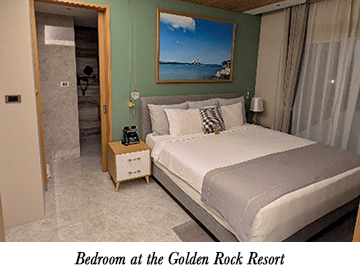 And he did say dives were limited to 45 minutes . . . WHAT? Diving nitrox in 60 feet of water for 45 minutes. Well, that "limit" would be relaxed once they got to know the divers, and generally became closer to 60 minutes, but still . . .
 The resort has two restaurants, the more upscale Breeze Restaurant and the more casual Bobby's Beach Club, and both were excellent. Situated near the top of the property, the Breeze has an unobstructed view of St. Barts and even St. Maarten. The lunch menu had everything from soups for $8, salads $14, burgers $22, pasta $16, steak $38, and other options. Dinners added main courses like beef lasagna $28, seafood risotto $38, seared salmon $36, filet mignon $48, and whole lobster $65; with other mains and side dishes. Before dinner, we had drinks in the chairs overlooking the ocean at the outer edge of the restaurant.
 While the meal prices can add up, I should add that a full breakfast -- two eggs, bacon and sausage, potatoes, some fruit, and toast -- is included in the room price . . . well, not quite. One morning, I went for simpler fare -- French toast and bacon -- and afterwards was handed a bill for the bacon, $4, I guess because I went off menu. There was a day I would have complained -- and explained how silly it was to charge me for eating less of their food -- but I just shook my head and signed it.
 With such benign ocean waters, one can presume a lot of divers who enjoy easy dives will seek out Statia, some perhaps ignorant of diving etiquette, like "Joe" and "Judy," a well-traveled couple who told everyone about all the exotic places they had dived. Underwater, both would rush to some coral head and hang out to take pictures -- lots of pictures; everyone else had to hover and wait many minutes for them to leave. But they had another quirk, maybe caused by poor eyesight or dirty masks. If other divers were looking at something or taking photos, they swam right in with no regard for the other divers, whether they were shooting the critters, hovering, or swimming past. It didn't matter; they seemed to see no other divers at all.
 Lots of the sea fans at Mushroom Garden were damaged. I thought perhaps my disappointment might be ameliorated on land at the botanical gardens, which we found on our All Trails app. So, my wife and I took the half-mile walk down the road from the resort, only to find that the property was long abandoned and completely overgrown. An old sign at an ocean overlook with views of St. Kitts noted that humpback whales sometimes pass by . . . and moments later, my wife yelled "WHALE!" In the distance, three surfacing humpbacks were blowing. After a short while, we headed back to the resort, where several staff members said they had never seen whales; we looked out and spotted them again, amazing everyone.
 Triple Wreck is a coral patch surrounded by sand. A barracuda came by, surrounded by a massive school of small silver boga, but we came to see artifacts, not fish. Embedded in the sand under a coral protrusion was an old anchor shaft, and nearby a coral-encrusted canon, presumed to be nearly 300 years old; I also found what seemed to be yellow ballast bricks and pottery shards. We were to respect the archeological sites, but if we found blue beads, they were ours. They had been used as currency in colonial times, and legend has it that when the enslaved people were liberated in 1863, the beads were gathered and thrown into the ocean. Of course, I didn't find any.
 DIVER'S COMPASS: We flew to SXM (St. Martin) and then caught a short 25-minute flight ($550) with WINAIR to Statia; the hotel is 15 minutes from the airport . . . 7 nights Suite for 2 including breakfast $4771 (including taxes) . . . 5-day dive pack of 2 morning dives with free nitrox $900; after lunch at the hotel, there's a third afternoon dive, also night dives if enough sign up . . . wine by the glass around $10, bottles $50 . . . Rental gear is ScubaPro, computers are Suunto Zoops . . . They have 63 cu. ft., 80 cu. ft., and 100 cu. ft. cylinders . . . Statia has a hyperbaric chamber, and there is an emergency helicopter service to St. Maarten.
I want to get all the stories! Tell me how I can become an Undercurrent Online Member and get online access to all the articles of Undercurrent as well as thousands of first hand reports on dive operations world-wide

| Home | Online Members Area | My Account |
Login
|
Join
|
| Travel Index |
Dive Resort & Liveaboard Reviews
|
Featured Reports
|
Recent
Issues
|
Back Issues
|
|
Dive Gear
Index
|
Health/Safety Index
|
Environment & Misc.
Index
|
Seasonal Planner
|
Blogs
|
Free Articles
|
Book Picks
|
News
|
|
Special Offers
|
RSS
|
FAQ
|
About Us
|
Contact Us
|
Links
|
3020 Bridgeway, Ste 102, Sausalito, Ca 94965
All rights reserved.