
 |

 Email Signup
|
Subscribe
|
Login
Email Signup
|
Subscribe
|
Login
For Divers since 1975 The Private, Exclusive Guide for Serious Divers Since 1975 |
"Best of the Web: scuba tips no other source dares to publish" -- Forbes |
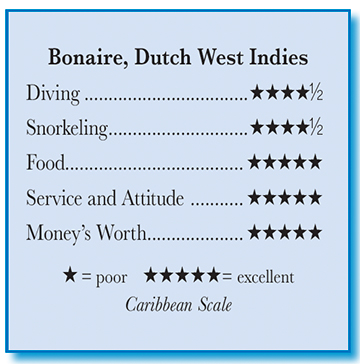
Bonaire, Dutch West IndiesContents of this Issue: Portofino, Cozumel, Roatan, Indonesia Getting Fleeced after Falling? going to the courts in Indonesia Captain Could Not Control His Boat When the MY Coralia Couldn't Sail Editorial Office: Ben Davison Publisher and Editor Undercurrent 3020 Bridgeway, Suite 102 Sausalito, CA 94965 living and diving like a local from the August, 2026 issue of Undercurrent
Dear Fellow Diver, With more than 50 accessible shore diving sites, Bonaire is a serious diver's mecca. No need to join a dozen rookie divers on a crowded boat to sites that have been dived daily for half a century. Get a car, get a shore diving map, rent tanks, and do what the hundreds of diving expats do who live on Bonaire -- dive at your leisure, as this long-time Undercurrent travel writer has been doing each summer for three decades. - Ben Davison * * * * * * * * * * * * * * * *
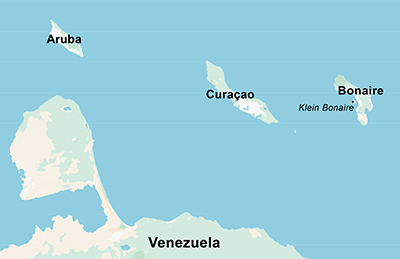
After 33 years, I still love diving in Bonaire. Most of my diving is with Captain Don's Habitat, a dive operation I love. But divers I know tell me good things about Divi Flamingo, Buddy Dive, Carib Inn, VIP Divers, Dive Friends, and Bonaire East Coast diving. When lionfish first appeared in Bonaire around 2010, it looked to me like the general fish population went down. Now that lionfish are popular menu items, there seem to be fewer, a blessing since a single lionfish can eat 60 juvenile fishes per day. Be prepared for some real variation in seasonal water temperatures. November-March can be chilly, as low as 74°F. When I arrived in mid-May, the water was 78°F, and I broke out an extra jacket and hooded vest to wear with my wetsuit; now it is late June, and it's 81°F. High summer into October usually sees the warmest waters, from 83-86°F. It is often cooler than you might expect for someplace so close to the equator.
I spend a lot of time diving off the dock at Capt. Don's Habitat. It offers a combination of sloping reef, sand shallows with mooring blocks, a small wall (known as Cliff), and two small wrecks, La Machaca in 35-50 feet, and a small wreck at 130. Shy flame lobsters lurk under the deep wreck's hull, and sometimes I see a black brotula, green moray, or nurse shark. Lately, a three-foot-long Goliath Grouper has been cruising by, sometimes hanging near La Machaca, sometimes resting in the sand by the deep wreck. Over the years, I have watched seahorses and frogfish grow, mate, and die off; seen a manta cruise by, as well as eagle rays and stingrays; watched tarpon and cubera snapper patrol the reef; seen shoals of squid dot the shallows while yellowheaded jawfish and sailfin blennies pop up and down from their holes; and reef and common octopuses hunt and display. And I can enter from a dock and exit up a sturdy ladder, so easy-peasy. Night diving is best from a resort's dock because it is simple to access and navigate. You are likely to see lots of basket stars and active crustaceans, and don't be surprised when tarpon and greater soapfish use your underwater torch to hunt!
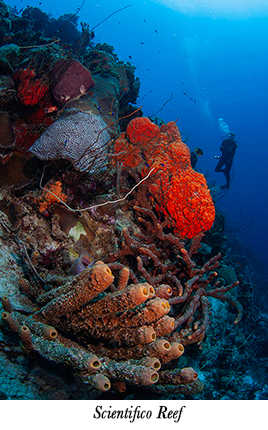
Though Salt Pier is a favorite, I have a longer list of sites I love. Karpata's dramatic high-profile stony reefs, next door to the off-limits marine reserve, often have big fish, and I just saw a small school of robust rainbow parrotfish there. The shallows around 1000 Steps, Jeff Davis, and Country Garden in the north offer both lush soft coral gardens and fields of successfully transplanted staghorn coral teeming with fish life. Southern sites like Angel City and Alice in Wonderland have very different topography, a double reef system with a deep reef (where you commonly see turtles and bigger fish), a sand channel, and a shallower reef along the shore. I often see schools of tarpon over the sand channel, just milling about (42 is my record), and the shallows at Angel City have Reef Renewal coral trees and a resident school of schoolmaster snappers.
Recently, divers reported small nurse and whitetip sharks off Klein, though I didn't see them. One lucky diver filmed a mola-mola in mid-June. When diving the east coast, you will see so many turtles, green, hawksbill, and occasionally loggerheads, that you stop counting. The astonishingly pristine coral reefs that fringed Bonaire in the 1990s have taken a lot of hits -- from storms (the backwash of Hurricane Lenny in November 1999 was brutal); from disease (SCTLD, or stony coral tissue disease, burned through the reefs between 2023 and 2025); and from pollution, bleaching, and over-use. I've had to adjust to a new normal too often. But thankfully, the reefs endure, though with more algae and fewer species of stony corals. SCTLD still exists but is well-controlled now after heavy mitigation measures. I'm seeing a lot of new stony coral recruits, little knobs of brain and star coral that tell me that between natural reproduction and the assistance offered by Reef Renewal Bonaire, the reefs have a chance.
Of course, divers get hungry. My spouse and I are enthusiastic cooks and are grateful for the improved access to groceries. In 1993, there were few grocery stores, and their stocks could be pitifully thin -- canned goods, expired cereal, perhaps hardy root vegetables like carrots and cabbage. Now, I mosey over to Warehouse or Van Den Tweel on Kaya Industria for organic produce and everything you expect from a grocery store. A gourmet grocer, Canarbo, has opened a storefront up the street and sells great meats, Belgian butter, specialty cheeses, and charcuterie. Boutique bakeries offer all-natural sourdough bread or elegant desserts. Big upgrade for those of us who cook!
During the pandemic, developers began some massive building projects, many controversial and even illegal. New resorts and condos popped up like toadstools after rain, especially in the southern neighborhood of Belnem. The Dutch vacation company, Tui, built an ugly resort just north of the marina encompassing eight massive four-story concrete buildings that look more like a prison than a resort (I call the buildings the "cell blocks"). If full, the Tui resort can accommodate over 900 hard-partying guests who never leave its value-priced all-inclusive confines. New high-end houses were built on spec in the upscale neighborhood of Sabadeco. One realtor on the island told me that his sales skyrocketed in 2020 and 2021, with many sales based solely on a video tour. In October of 2010, Bonaire became a curious legal fiction, a part of Holland, though the official currency became the U.S. dollar. Island residents get Dutch EU passports. Many white Dutch government workers moved to Bonaire, and the influx of the Dutch has not set well with many Bonaireans, who chafe at the legacy of slavery, colonial occupation, and racial animus associated with the Dutch. So many local people don't like the Dutch that when I am checking out at the supermarket, I make a point of speaking American English to signal that I'm not Dutch. A much-commented-upon sign on the main road just north of town protests "Dutch Apartheid."
The population has doubled, from around 13,000 when I first arrived to over 26,000 today. It seems everyone has a car, truck, or electric bike. There are no traffic lights, but around 5 P.M., the roads are lined with vehicles waiting turns to merge into the traffic circles. During the winter, two and even three cruise ships dock almost every day, disgorging thousands of day trippers. The boom in cruise ship arrivals is also controversial. Some locals make money renting golf carts or conducting island tours or booze cruises, but most people loathe the influx of cruisers. The coconut telegraph claims that members of the government have taken bribes from the cruise ship companies. What has not changed in Bonaire is the spirit of its residents. People remain warm, and the island is a safe and happy place to bring extended family. Our son grew up here on and off; my parents loved the island, and I see many families making their own Bonaire traditions. LGBTQ+ visitors find it welcoming with a small, proud local community. The many shore dive sites, in addition to 86 dive site moorings, mean no crowds in the water even during high season. Activities like cave snorkeling, a donkey sanctuary, a goat farm, mangrove kayaking, and wind and kite surfing offer plenty for nature-loving non-divers. And the food gets better and better. Despite a lot of change, Bonaire remains my happy place. - A.E.L. Our Undercurrent Diver's Bio: AEL, who dives all over the world and has more than 4600 dives, has been a part-time resident of Bonaire since 1997 and returns to Bonaire three months a year and loves it.
|

 = publicly available
 The places to which we travel are always changing, but one hopes that beloved places retain the qualities that make them special. Bali, for example, has become crowded and touristy, but parts of the island remain quintessentially Balinese. The same is true of Bonaire, where I have a second home. The island has transformed, but its laid-back charm abides if you know where to look.
 In addition to the usual suspects -- parrotfish, trumpetfish, Creole wrasse,
tarpon -- there are plenty of the weird and wonderful. In the past few weeks,
I have found a pair of striated, or hairy, frogfish (Antennarius striatus) at
a shore dive site north of town (kept a secret by locals), as well as a few
longlure frogfish. My dives at Joanna's Sunchi on Klein Bonaire, reached only by
boat, seemed to have it all: huge sponges, large soft corals and sea fans waving
in the surge, and an interesting array of Reef Renewal's "planted" aluminum
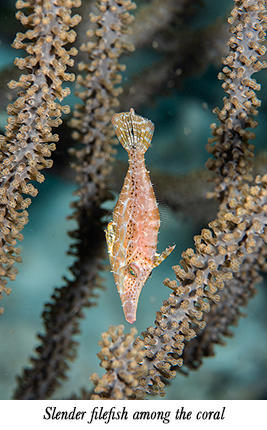
trees growing elkhorn and staghorn corals in 20 feet. I watched slender filefish
migrate from one soft coral to another as their colors changed to match the hues
of their host. A tiny peacock flounder, snowy white save for its faint blue
markings, eyed me from the sand. A visibly pregnant male seahorse curled its
tail around a sponge, swaying back and forth. When a loggerhead turtle, encrusted
with barnacles, swam by, I thought I had seen
it all. But then my buddy signaled that she
had found a red-lipped batfish hiding beneath
a soft coral at 16 feet! Its triangular body
blended perfectly with the sand, but its red
lips and bright eyes gave it away. A small
orange mantis shrimp glared at me from another
coral head, not bothering to hide (in my log,
I deemed it "saucy"), and nearby a pair of
web burrfish nestled in a convex coral head,
cuddled up like a pair of lovers.
In addition to the usual suspects -- parrotfish, trumpetfish, Creole wrasse,
tarpon -- there are plenty of the weird and wonderful. In the past few weeks,
I have found a pair of striated, or hairy, frogfish (Antennarius striatus) at
a shore dive site north of town (kept a secret by locals), as well as a few
longlure frogfish. My dives at Joanna's Sunchi on Klein Bonaire, reached only by
boat, seemed to have it all: huge sponges, large soft corals and sea fans waving
in the surge, and an interesting array of Reef Renewal's "planted" aluminum
trees growing elkhorn and staghorn corals in 20 feet. I watched slender filefish
migrate from one soft coral to another as their colors changed to match the hues
of their host. A tiny peacock flounder, snowy white save for its faint blue
markings, eyed me from the sand. A visibly pregnant male seahorse curled its
tail around a sponge, swaying back and forth. When a loggerhead turtle, encrusted
with barnacles, swam by, I thought I had seen
it all. But then my buddy signaled that she
had found a red-lipped batfish hiding beneath
a soft coral at 16 feet! Its triangular body
blended perfectly with the sand, but its red
lips and bright eyes gave it away. A small
orange mantis shrimp glared at me from another
coral head, not bothering to hide (in my log,
I deemed it "saucy"), and nearby a pair of
web burrfish nestled in a convex coral head,
cuddled up like a pair of lovers.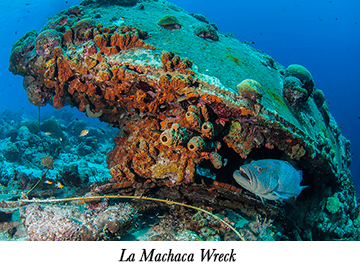 When pressed by some to reveal my favorite dive site, my Jeopardy answer is Salt Pier in the afternoon, when the sun slants through the angled pilings covered with massive sponges and schools of grunts are eyed by barracuda and bar jacks. If you go to Salt Pier, be sure to enter just south of the pier, not north. The southern entrance is rubbly sand, whereas the northern entrance (where most tourists inexplicably enter) is ironshore covered with urchins and slippery algae.
 From my experience, the easiest shore dives are from resorts such as Habitat, Buddy Dive, Divi, etc., because of docks and ladders to exit. (Anyone can dive from resorts for a fee of up to $15. You can rent tanks at Buddy, if you have a car or even hire a guide to dive with you at any shore dive). Oil Slick Leap also has a ladder for exiting, and there are steps at ChaChaCha Beach and Parke Tului. Shore dives at most sites require some agility (or a Sherpa to help) as you navigate the rocks and waves. When I shore dive, I tuck my car keys and $20 into my swimsuit, roll down the windows, and leave nothing in my car that could tempt a thief. There is some annoying property crime on the island, and the police blotter shows that on sites like 1000 Steps and Karpata, where cars are shielded from the view of divers, cars are often stripped of valuables. It's easier to have nothing to steal than to come back from a dive to a vandalized vehicle. In the unlikely chance you are stopped by police and asked for a license, saying that you were shore diving and your license is at your hotel or house works fine.
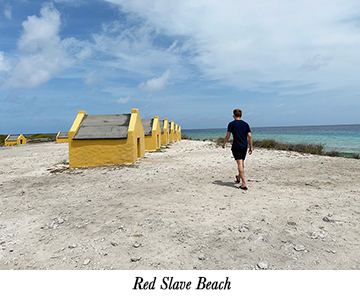 Though most divers come to enjoy Bonaire's easy shallow dives, tech diving thrives. I took my tech courses with Technical Diving Services, located at Captain Don's Habitat. Owner Zack Richardson sponsors Choptima Week every year for divers who love their chest-mounted closed-circuit rebreathers and offers trimix, custom blends, and an array of courses. X-Pro Divers, run by tech specialist Hens Silva, also offers total tech support, equipment, and repairs (Hens services all my Atomic regulators). I read that VIP Diving now offers tech courses and gear as well. Popular deep sites with the techies include Red Slave, the remains of the Windjammer and Cooper's Barge, and Karpata below 150 feet.
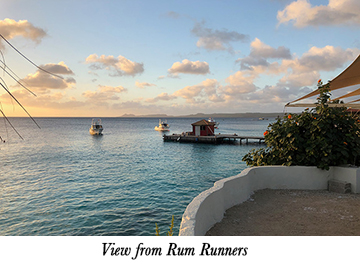
 Dining out is also a lively scene, much more competitive and professional than in the 1990s. Chefs Bonaire offers astonishing five-course meals that change every week (be sure to reserve many months in advance, as they only have 21 seats per night). We eat at Capriccio once a week and buy all our wine there as well; they serve great Italian food and offer an award-winning wine list. I've enjoyed meals at Wines and More and Mona Lisa as well. Chef Floris of Rum Runners caters all our parties, and his food is creative and delicious. Though Bonaire has only 26,000 residents, its culinary Olympic team wins silver and gold almost every year, competing against big islands like Jamaica, Grand Cayman, and Barbados, punching far above its weight.
 Yet being part of Holland has brought some important advantages to Bonaire as well. Medical care and schools are much improved. Regular air service with Amsterdam brings in fresh produce and creature comforts. During the pandemic, Holland made sure that people's needs were met.
 DIVER'S COMPASS: On a practical front, before you visit, be sure to pay the mandatory Bonaire tourism tax of $75 per head and print or download the QR code. Don't pay it via resellers but use the official site:
I want to get all the stories! Tell me how I can become an Undercurrent Online Member and get online access to all the articles of Undercurrent as well as thousands of first hand reports on dive operations world-wide

| Home | Online Members Area | My Account |
Login
|
Join
|
| Travel Index |
Dive Resort & Liveaboard Reviews
|
Featured Reports
|
Recent
Issues
|
Back Issues
|
|
Dive Gear
Index
|
Health/Safety Index
|
Environment & Misc.
Index
|
Seasonal Planner
|
Blogs
|
Free Articles
|
Book Picks
|
News
|
|
Special Offers
|
RSS
|
FAQ
|
About Us
|
Contact Us
|
Links
|
3020 Bridgeway, Ste 102, Sausalito, Ca 94965
All rights reserved.