
 |

 Email Signup
|
Subscribe
|
Login
Email Signup
|
Subscribe
|
Login
For Divers since 1975 The Private, Exclusive Guide for Serious Divers Since 1975 |
"Best of the Web: scuba tips no other source dares to publish" -- Forbes |
Double Heroism and a MiracleContents of this Issue: Lembeh Resort, Sulawesi, Indonesia Parrotfish Are Essential to the Health of Coral Reefs Full-face Snorkel Masks ... Specifications Getty Has Not Requested My Images The Red Sea Sea Story Liveaboard Disaster 52 Assignments - Underwater Photography by Alex Mustard Discovered - The World's Largest Coral Never Know What You'll Find On A Leisurely Dive Editorial Office: Ben Davison Publisher and Editor Undercurrent 3020 Bridgeway, Suite 102 Sausalito, CA 94965 from the January, 2025 issue of Undercurrent
When the vessel capsized, some passengers were trapped in their cabins. The vessel's diving instructor, 23-year-old Youssef al-Faramawy attempted to help them as the vessel went over and got trapped too.
It was fortunate that all were practiced scuba divers who had no problem using the alternate air sources of those divers who rescued them. Rescuer Khattab al-Faramawy told that it was a complex mission, exploring the partially sunk liveaboard by the light of their underwater flashlights. They needed to dive 40-feet deep to enter the vessel. Some of the cabin doors were jammed shut. One of the (Belgian) survivors told the BBC, "We appreciated the meal on board [the rescue boat] and the warm shower. We were shaking with cold before being rescued." It has been assumed that the shallow depth at which the five survivors were found means there will be no ill-effects from decompression but they were kept in hospital under observation. In fact, one of those survivors reported opening a window [porthole?] in the upturned vessel, to get more air and signal to any possible rescuers, so that part must have been above the sea surface. Meanwhile, the Egyptian authorities kept them excluded from journalists reporting the disaster. No doubt there will be more information forthcoming in the following months. |


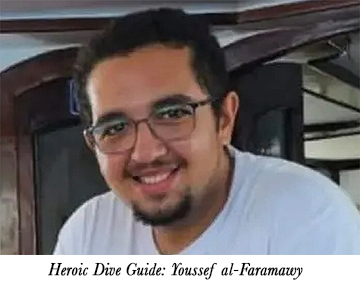 More than a whole day later, his uncle,
Khattab al-Faramawy, with other divers
searching inside the wreckage in darkness,
found him and four other passengers trapped
and cold, yet alive and breathing from an
eight-inch-deep air pocket, in complete
darkness, in a cabin. It was a miracle. They
were recovered to the surface and taken to
a hospital in Marsa Alam.
More than a whole day later, his uncle,
Khattab al-Faramawy, with other divers
searching inside the wreckage in darkness,
found him and four other passengers trapped
and cold, yet alive and breathing from an
eight-inch-deep air pocket, in complete
darkness, in a cabin. It was a miracle. They
were recovered to the surface and taken to
a hospital in Marsa Alam.
I want to get all the stories! Tell me how I can become an Undercurrent Online Member and get online access to all the articles of Undercurrent as well as thousands of first hand reports on dive operations world-wide

| Home | Online Members Area | My Account |
Login
|
Join
|
| Travel Index |
Dive Resort & Liveaboard Reviews
|
Featured Reports
|
Recent
Issues
|
Back Issues
|
|
Dive Gear
Index
|
Health/Safety Index
|
Environment & Misc.
Index
|
Seasonal Planner
|
Blogs
|
Free Articles
|
Book Picks
|
News
|
|
Special Offers
|
RSS
|
FAQ
|
About Us
|
Contact Us
|
Links
|
3020 Bridgeway, Ste 102, Sausalito, Ca 94965
All rights reserved.