
 |

 Email Signup
|
Subscribe
|
Login
Email Signup
|
Subscribe
|
Login
For Divers since 1975 The Private, Exclusive Guide for Serious Divers Since 1975 |
"Best of the Web: scuba tips no other source dares to publish" -- Forbes |
Belize Aggressor IV, BelizeContents of this Issue: Panama, Misool, Caye Caulker, Rapa Nui The Tragedy of the Liveaboard Industry The Call for Regulation of Liveaboards Thailand Bans Cameras for New Divers Editorial Office: Ben Davison Publisher and Editor Undercurrent 3020 Bridgeway, Suite 102 Sausalito, CA 94965 as the temperatures rise from the May, 2025 issue of Undercurrent
Dear Fellow Diver, In late October, I was aboard the roomy Belize Aggressor IV as it departed Belize City on a windy, rainy Saturday evening, sailing past mangrove keys that shield Belize's coast. We 18 divers, from beginners to instructors, organized by our Midwest dive store, had dinner and a quiet evening of socializing over a few drinks. Our time was intertwined with multiple boat briefings identical to those on the Roatan Aggressor, on which I was aboard just a few weeks previous (I reviewed it in the March issue). The crew covered boat policy, dive deck routine, nitrox routine, boat and fire safety, battery charging, diving routine (no decompression diving), and boat safety recall, and introduced the dedicated night watchman. I'm sure they presented everything their lawyers and risk managers wanted, a bit too much to digest for these tired travelers.
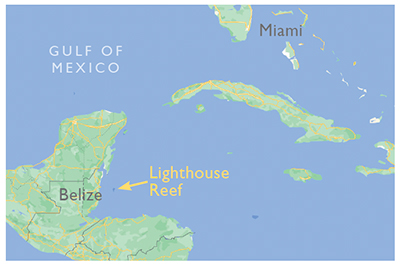
In Honduras, we traveled about 100 miles south, off the beaten path, where the Roatan Aggressor visits healthy reefs with plenty of fish. Having been to Belize several times, I knew there was good diving, though the summer of 2024 brought hot weather and unusually warm waters. As I dozed off, I dreamed of a bright morning with clear blue skies, sunlight piercing the ocean's surface, and vibrant reefs. It wouldn't happen. Our captain, Dennis Gautau, a good old Cajun boy, motored out 55 miles to moor for an early morning dive in the marine park at Half Moon Caye in the Lighthouse Reef system. Grumbling about the overcast day, I had a coffee and bagel during our thorough dive briefing and soon stepped off the huge dive platform into the choppy 87-degree water with 100-foot visibility. First in the water, my buddy and I followed the mooring line down 60 feet to an enormous sand patch that gradually slopes to 70 feet and a coral ridge before the wall drops into the abyss. While waiting for others, I caught something at the edge of visibility. A big eagle ray -- maybe eight feet across -- gradually flapped within 15 feet of me. After making two lazy passes, it eased back into the blue. That's why I always do my darndest to be the first diver in the water, especially in the morning.
After 20 minutes, we rose to a coral ridge and headed off to investigate the sand flats, with small coral heads housing arrow crabs, Pederson cleaner shrimp, and even a colony of sailfin blennies. Pink-tipped and purple-tipped anemones housed banded coral crabs and tiny squat anemone shrimp. Wary garden eels kept an eye on us, as did yellow-headed jawfish. I watched a sizeable southern stingray root in the sand while a queen triggerfish followed under the ray's butt gobbling up any disturbed morsels. An occasional floating lionfish kept an eye out for clueless passersby. As my time neared an hour, I spotted a vast bait ball of countless tiny silversides in a crack in the coral ridge. I coasted in. Lying on the sand were several large Nassau and black groupers, about as fat and lazy as a fish could be, piscine versions of couch potatoes. Slowly opening their mouths while remaining motionless, they would inhale a scoop of silversides, then relax quietly for a moment or two before drawing in another mouthful. We visited many sites during the week but almost skipped Long Caye's Aquarium due to wind and waves. However, in the 86-degree water, there was no current and 100-foot visibility. On the 30-foot sandy bottom, a field of garden eels bobbed and weaved among clouds of blennies and silversides as Creole wrasse cruised the relatively barren coral heads. Only green, purple, and yellow tube corals add much contrast. Along the coral ridges, razorfish scooted back and forth among Sergeant majors. While Bermuda chubs schooled farther out, the only large animal I spotted was a hawksbill turtle finning past. I found a tiny shortfin pipefish on the sand; some say it's rare, but those divers might just be impatient. If I take my time, I can often track one down. And the divemasters were sharp-eyed spotters. Besides the captain, Alex and Roque provided a nice combination of enthusiasm and calm, as well as slow guidance while pointing out critters. One site we didn't visit was the Blue Hole. The BA-IV is too large a boat to go there without perfect wind and tides. Since Aggressor trips are filled with experienced divers, many onboard have probably visited the Blue Hole and are in no hurry to return, so it might be skipped altogether unless some divers speak up. Long Caye was once a top Belize site, maybe for the entire Caribbean, as the crew claimed. But most of the hard corals were dead, and many were covered with algae. Rather than my usual hour, I surfaced after 50 minutes for the welcome warm towel they offered after every dive. While it was one of the better dives of the week, I knew this reef and others had changed, and I was no longer hoping for more.
The tall coral walls of the Cathedral rise meters above a sandy floor, looking like a large building's interior when the sunlight streams through, but on this trip, the gray skies lent no character. Still, it was a nice dive in calm water, devoid of lionfish, with a good population of grouper, as well as hogfish, mutton snappers, yellowtail snappers, and French and blue striped grunts, with neon wrasses occasionally streaming by. Under the overhangs, I spotted scores of lobsters. The healthy encrusting and tube sponges added color to the otherwise dead or dying hard corals, with no sunlight to bring out even a sparkle. Regardless, I saw either reef sharks or blacktips on every dive. The crew speculated that the weather created the multiple shark encounters. Is that possible? Only the sharks know. One of our three-night dives was at Chain Wall, a flat reef with hundreds of small coral hummocks in 30 feet of water, then dropping abruptly into the abyss. Entering shortly after dark, I found reef squid out in force and easy to photograph. I saw schools of small reef fish, clouds of tiny mysid shrimp (sea lice), and jellyfish near the surface, but try as I might, I couldn't spot an octopus. Down the wall, a few reef sharks cruised.
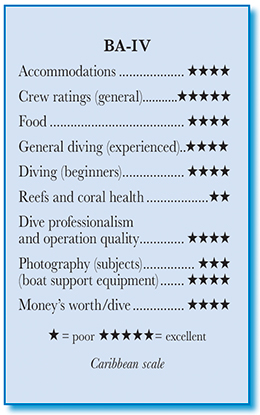
The dive deck offered plenty of room and convenience for each diver, with personal lockers and racks for gear and suits. Between dives, the crew quickly filled tanks; just disconnect your first stage, and they fill it with the whip at your station. Nitrox divers (only one diver stayed organic with air) were told they could skip analyzing the gas daily because the divemaster (ship's engineer) would post the oxygen percentage. I was a bit skeptical, so I occasionally checked my gas but was pleased with the consistency, a mere 0.2 percent variation daily. On each side of the ship were two camera tables with compressed air, rinse tanks, and the camera battery charging station nearby. Battery charging in your rooms was forbidden; if housekeeping found batteries charging in a room, the transgressor would be severely reprimanded and removed from the ship for a second offense. I don't think they were joking.
Small schools of blue chromis, yellow cleaner chromis, Creole wrasse, and a variety of parrotfish surrounded the coral heads, as did Spanish hogfish, French and gray angelfish, peacock flounders, green and reticulated moray eels, black and Nassau groupers, and a hawksbill turtle paddled by. Out in the blue, I marveled at the panorama with reef sharks and schooling horse-eyed jacks. There was no current, and the water temperature was 87 degrees with 75- to 100-foot visibility. After Friday's dives, we returned to Belize City, passing a huge construction project on a small mangrove cay. It's the new Carnival cruise tourism island, Port Coral, projected to dock four giant cruise ships simultaneously, meaning up to 30,000 cruisers can attack 40 acres of beaches, pools, cabanas, bars, shopping, and an "authentic" Belizean village, whatever that is. They plan to build a 4-mile causeway to the mainland. I can't imagine what the ships and their cruisers will do to the already over-stressed mangroves, cays, and reefs. Apparently, the project has come under a cloud of problems, and some predict it will never open. Let's hope so. When we docked in Belize City Friday night, we were advised not to wander out alone. Belize City has become a drug processing mecca run by expatriate U.S. gangs, the Bloods and Crips, who were deported from the USA. The violence of warring factions sometimes spills into the streets, so beware. Don't expect the Belizean media to highlight it; Belize thrives on tourists and investors. Here's a source: https://tinyurl.com/2dz5vfnc After we docked, the Belize Aggressor III arrived following their week at Glover's Reef, the other major Belizean reef system 50 miles farther south. A few divers told me they had similar weather but remarkably better coral health, and they were shocked when I described the state of the coral we dived. My takeaway is that the farther south you go, first Glover's, then Roatan, the healthier the coral. Oddly, while we had seen sharks on every dive, they had seen none. That kills the weather theory.
The Roatan reefs we visited were certainly healthier. The remote Honduras Seamount had the best Caribbean coral and reef life I've seen in years, similar to Fiji in coral density and color (of course, different species of coral). The Roatan Aggressor's sites were quite distant from the heavily dived sites along Roatan Island's north and south coasts, which were in poorer condition due to effluent, diver damage, and coral diseases. Of course, the weather may have detracted from my assessment of Belize's reefs. Having dived Belize half a dozen times in the last two decades, the lack of sunlight to bring out the bright and beautiful coral and fish colors led to dull, monochromatic dives. Adding to my sour mood, the dead hard corals, the staghorn patches covered with algae, and the lack of live elkhorn or pillar corals depressed me. When I returned home, I checked many Undercurrent reader reports, and many fellow readers reported the same significant deterioration of reef health in just a few years. I reviewed my old photos to confirm my memories of wonderful corals from just a few years ago. I now worry more about the state of our oceans than ever. One can only hope that future Caribbean temperatures won't rise any higher, that SCLTD will cease to spread, and that the reefs will return to their splendor. But for now, it seems little more than hope. -- D.D. Our undercover diver's bio: The author is a master diver who has been diving for over 30 years, making nearly 2000 dives worldwide. Retired from rebreather and technical diving, as well as being a dive instructor, he is a DAN undersea referral physician and has reviewed several destinations for Undercurrent.
|


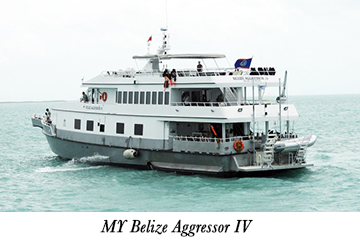 I headed down for a good night's sleep in my spacious twin bed in my roomy cabin, a good-sized closet, and a separate head with a full shower, sink, and toilet. AC was perfect; the hot water was unending. Clearly, this was a more comfortable craft than the Roatan Aggressor, but would the diving measure up?
 My buddy and I usually went off on our own, but for this dive, we followed Dennis, the captain, who led us over the almost vertical wall to 75 feet. Small patches of colorful encrusting hard corals were interspersed with algae-covered, mostly dormant or dead hard corals, victims of either Stony Coral Tissue Loss Disease (SCLTD) or bleaching. But encrusting sponges, soft corals, and long, colorful tube sponges were surviving. Stands of black coral stood out, a testimony to better times. Two gray reef sharks swam back and forth, sometimes coming within spittin' distance. Schooled horse-eyed jacks cruised back and forth, keeping their distance.
 Over dinner, our discussion turned to, well, food. Almost everyone liked
everything on the menu, and picky eaters tried and liked food they'd ignored
at home. Food was abundant: light fare before the early dive, afterward a full
breakfast, then a large lunch, an extensive dinner, often a feast, and afterward
nighttime snacks (oh, day-time snacks as well), all nicely prepared, tasty, and
abundant. Chef Jerry, Elia, the stewardess, and the sous chef, Zandon, worked
tirelessly and catered to special diets. (You ever heard of Alpha-gal? No? I'm not
surprised.) With 4-5 dives daily, our metabolism required more calories; several
folks said they consumed twice as much as they usually would. Some pondered
whether the food was that good or if we just needed more calories and would eat
anything they served. What did it matter? The
kitchen crew received well-deserved accolades.
Over dinner, our discussion turned to, well, food. Almost everyone liked
everything on the menu, and picky eaters tried and liked food they'd ignored
at home. Food was abundant: light fare before the early dive, afterward a full
breakfast, then a large lunch, an extensive dinner, often a feast, and afterward
nighttime snacks (oh, day-time snacks as well), all nicely prepared, tasty, and
abundant. Chef Jerry, Elia, the stewardess, and the sous chef, Zandon, worked
tirelessly and catered to special diets. (You ever heard of Alpha-gal? No? I'm not
surprised.) With 4-5 dives daily, our metabolism required more calories; several
folks said they consumed twice as much as they usually would. Some pondered
whether the food was that good or if we just needed more calories and would eat
anything they served. What did it matter? The
kitchen crew received well-deserved accolades.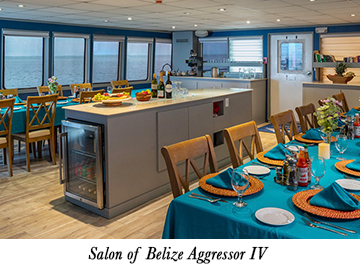 Aside from the disappointment about the dying hard coral, the only other grumbles were about the weather: "It was a lot sunnier last time I was here." From July through November, especially September to November, it's hurricane season in the Caribbean, and continuous cloudy skies can be the norm. Before my departure, my anxiety climbed as I visited the NOAA tropical storm forecast website daily (I hope this helpful website doesn't get bludgeoned before next season). Several tropical depressions had formed off Belize and clobbered Florida and the Southeast U.S. As I boarded the plane, the last NOAA prediction was "less than a 40 percent chance of a hurricane in the western Caribbean for the next five days." Only showers and thunderstorms were expected. NOAA was spot on. It was a week of clouds, winds, and waves, and Dennis kept us well-informed of the wind's strength and the waves' size. His seafaring judgment was sound as he picked sites with safe diving.
 The Quebrada dive site consists of ravines through the coral ridge separating the sandflats from the deeper wall. These broad sand chutes have hundreds of smaller coral heads, but the pillar corals were dead and algae-covered. The encrusting hard corals were surviving, with most coral heads festooned with soft coral, sea fans, and sea plumes. Several barracuda eyed us divers, and deeper, a couple of nurse sharks scouted for buried morsels. We were told to look for the rare white-lined toadfish, so I peered under every coral head I swam past and never saw one.
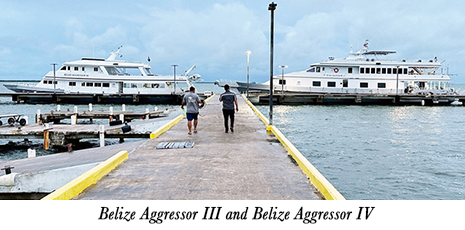
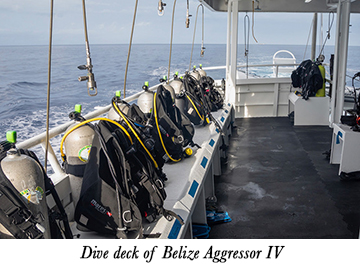 So, after plying the MesoAmerican Great Barrier Reef, less than 100 miles apart on two different Aggressor craft, it's clear that the BA-IV, once the Sun Dancer II in the Pacific, is hands down far more roomy and comfortable. And those Roatan Aggressor top bunks are hell to sleep in. Thirty feet longer and eight feet wider than the Roatan Aggressor, it has about 50 percent more deck space, making diving and relaxing less crowded. The BA-IV itself seemed safer because of the location and size of the emergency exits. Nonetheless, diving policies are identical, the crews were equally competent and friendly, and the meals abundant and satisfying. Both Aggressors' travel assistance and travel security were excellent. Like Roatan, an Aggressor representative in Belize met us outside airport customs, taking us directly to the ship's dock. We were dropped off next to the guardhouse at the foot of the pier, where both the Belize Aggressor III and BA-IV were moored and escorted to our ship.
 DIVER'S COMPASS: Seven-night trips with 27 scheduled dives on the Belize Aggressor IV start about $3500/person double occupancy; if you can travel on short notice, the Aggressor Fleet begins to cut prices sharply several weeks ahead of departure . . . Unlimited wine and beer were gratis at the end of your diving day . . . It was informally suggested we tip about $10/dive and put it in the communal the tip box, which includes the kitchen crew, ship's engineer, and night watchman. When I tipped a divemaster additionally, he promptly placed it in the communal box . . . If you arrive a day early or don't want to depart on your final day, the Fort George Hotel, at the foot of the pier where the ships dock, is safe and has a nice spa.
I want to get all the stories! Tell me how I can become an Undercurrent Online Member and get online access to all the articles of Undercurrent as well as thousands of first hand reports on dive operations world-wide

| Home | Online Members Area | My Account |
Login
|
Join
|
| Travel Index |
Dive Resort & Liveaboard Reviews
|
Featured Reports
|
Recent
Issues
|
Back Issues
|
|
Dive Gear
Index
|
Health/Safety Index
|
Environment & Misc.
Index
|
Seasonal Planner
|
Blogs
|
Free Articles
|
Book Picks
|
News
|
|
Special Offers
|
RSS
|
FAQ
|
About Us
|
Contact Us
|
Links
|
3020 Bridgeway, Ste 102, Sausalito, Ca 94965
All rights reserved.