
 |

 Email Signup
|
Subscribe
|
Login
Email Signup
|
Subscribe
|
Login
For Divers since 1975 The Private, Exclusive Guide for Serious Divers Since 1975 |
"Best of the Web: scuba tips no other source dares to publish" -- Forbes |
It's All About the AlgorithmContents of this Issue: Tiger Beach, Grand Bahama Island Tiger Beach Dives Can Go Wrong Chest Compressions Can Save a Diver's Life Emperor Explorer, The Maldive Islands The Risks of Diving in Remote Places The Value of Using a Dive Travel Agent The Shark Whisperer on Netflix Take Clive Cussler on Your Deco Stop Orcas Have Been Trying to Feed People Editorial Office: Ben Davison Publisher and Editor Undercurrent 3020 Bridgeway, Suite 102 Sausalito, CA 94965 from the July, 2025 issue of Undercurrent
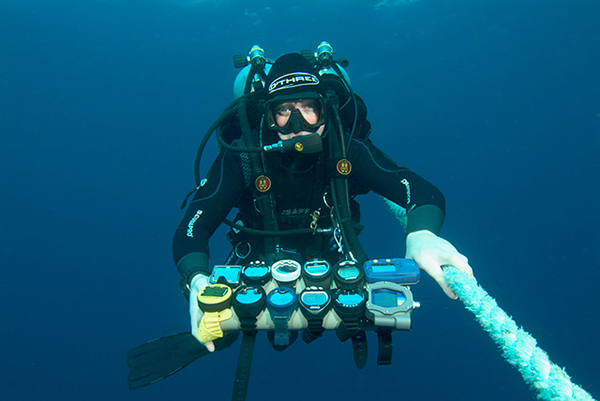
Diving computers use an algorithm -- a mathematical calculation, a process, or set of rules -- to be followed to compute real-time decompression status during a dive. This century, no physicists have taken it upon themselves to write a new algorithm for dive computers. Manufacturers have merely tweaked the algorithms. Most use an algorithm based on the work of Swiss physicist Albert Buhlmann (died 1994), some with additional Reduced Bubble Gradient Model (RGBM) modifications by Los Alamos atomic physicist Bruce Wienke (died 2020). Others use the Pelagic DSAT algorithm, developed earlier by Rogers and Powell, a Haldanebased algorithm loosely based on data similar to the PADI Recreational Dive Planner, and more liberal (less cautious) than the Buhlmann derivatives. It allows a diver to stay down longer and come up faster, though it was intended for no-deco-stop dives to less than 100 feet deep, not the kind of profiles many sport divers use. Once a diver got into deco-stop diving, the stops tended to be punitive. During the late 1990s and early 2000s, as Technical Editor of the UK's Diver Magazine, I regularly made side-byside comparison tests of dive computers, photographing all the displays at suitable intervals for later analysis, often on deco dives beyond 165-feet. While most computers produced similar results, it became apparent to me that the Pelagic DSAT algorithm employed in Oceanic computers and clones thereof was not suitable for the type of deeper diving Europeans and more adventurous Americans did. As you can imagine, this made me less than popular with dive industry personnel, such as Bob Hollis, or the rest of Oceanic's management, but eventually they caved in and supplied Oceanic computers with a dual algorithm mode. Today, users can switch between the Pelagic DSAT algorithm and the Buhlmann-type algorithm, Pelagic Z+. In many dive stores, customers are often not advised of this when they purchase their computers, and certainly not if they buy them online. And if they don't read their manuals, as many don't, they never discover this critical feature. Were you told about the choice of algorithms when you bought an Oceanic computer, or did you simply use it in DSAT default mode straight out of the box? When I dived in Truk lagoon, many fellow divers had a second computer to back up their first, as they should. And many complained that their (Pelagic DSAT) Oceanic computers gave very different results than their Buhlmann RGBM Suunto computers. I showed them how to switch their dual algorithm Oceanic to the Pelagic Z+ (Buhlmann) algorithm, and all came into line. It was a case, shall we say, of no RTFM or, more delicately, Not Reading the Manual. -- John Bantin |



I want to get all the stories! Tell me how I can become an Undercurrent Online Member and get online access to all the articles of Undercurrent as well as thousands of first hand reports on dive operations world-wide

| Home | Online Members Area | My Account |
Login
|
Join
|
| Travel Index |
Dive Resort & Liveaboard Reviews
|
Featured Reports
|
Recent
Issues
|
Back Issues
|
|
Dive Gear
Index
|
Health/Safety Index
|
Environment & Misc.
Index
|
Seasonal Planner
|
Blogs
|
Free Articles
|
Book Picks
|
News
|
|
Special Offers
|
RSS
|
FAQ
|
About Us
|
Contact Us
|
Links
|
3020 Bridgeway, Ste 102, Sausalito, Ca 94965
All rights reserved.