
 |

 Email Signup
|
Subscribe
|
Login
Email Signup
|
Subscribe
|
Login
For Divers since 1975 The Private, Exclusive Guide for Serious Divers Since 1975 |
"Best of the Web: scuba tips no other source dares to publish" -- Forbes |
Walindi; M.V. Oceania; Papua New GuineaContents of this Issue: Walindi; M.V. Oceania; Papua New Guinea Texas Coral Reefs - Among the Healthiest in the World? PNG: Getting There and Staying Safe Liquid Blue; Living Underwater, Cozumel, Mexico San Diego, A Hotbed of Diving Casualties The Ocean Art 2023 Competition What's Happening with Liveaboards? The Most Dangerous Thing You Will Meet is Your Boat Pity the Poor PADI Professional Pointer Sticks - Something You Should Do Without? Editorial Office: Ben Davison Publisher and Editor Undercurrent 3020 Bridgeway, Suite 102 Sausalito, CA 94965 by land and by sea from the February, 2024 issue of Undercurrent
Dear Fellow Diver, PNG is in the far reaches of the Indo-Pacific, difficult for Americans to reach because you first have to go to Australia, Hong Kong or Singapore to get there. However, it's a sparsely dived gem with great rewards for divers and underwater photographers willing to make the journey. I scheduled four days at Walindi Plantation Resort, then boarded the Oceania for an eight-day liveaboard diving cruise, and it was some of the fishiest diving I have ever done.
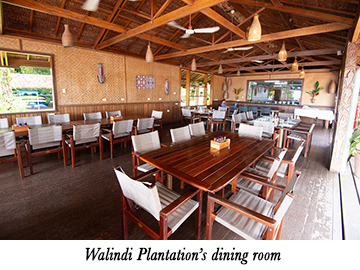
Much of PNG diving is on seamounts, where the tops may be as shallow as 30 feet, with the sides dropping sharply into deep water. Many attract schools with hundreds of fish, often barracuda, big eye jacks, and fusiliers. I was awed just hovering and watching schools move and change shapes, sometimes spiraling upward, other times making dense, lateral moves. If I moved slowly and carefully, breathing softly, I could get surprisingly close, and, at times, so close that the school engulfed me. Walindi Plantation Resort has been PNG's go-to resort for 40 years. It's on New Britain Island, just south of the equator in the eastern half of the coral triangle, with enormous biodiversity that produces some incredible diving. It's on Kimbe Bay, where there's little development, so the sea doesn't suffer from dumping, sewage, or other human activity that defiles the ecosystem and kills coral and fish. Walindi is a basic yet comfortable retreat with rooms in the Plantation house and cottages with large, comfortable beds. With no room air-conditioning, I had to rely on the large ceiling fan for tolerable temperatures, but the high humidity made everything feel slightly clammy. My room had a large can of insect spray I was instructed to use only when I left the room, so I guess it might kill the insects and me if I breathed it at full strength (bring personal insect repellant). The only airconditioned space at Walindi is the library, next to the open-air lobby, the only place to connect to the Internet. Walindi's three 26-to-36-foot outboardpowered aluminum vessels hold 6-8 divers, the captain, and one or two dive leaders. After two morning dives, onboard the crew spread out a surprisingly good buffet of meats, salads, and bread. After our surface interval was complete, we'd take our third dive, returning about 3.00 p.m., in time to relax, have a drink, and head to the buffet dinner, with main courses of beef, chicken, or fish (you pick), vegetables, salads, and homemade soup and bread followed typically by vanilla ice cream and homemade cake. Breakfasts were eggs prepared any way, as well as breakfast meats, toast, and cold cereals. With great sites, all the dives were excellent. Vanessa's Reef, one of the closest sites, was a 30-to-40-minute trip. After a giant stride, I could see a massive barrel sponge and several large orange sponges 65 feet down. A couple of six-foot-tall sea fans gently swayed in the mild current. Photographers framed the pinkish whip corals against the clear water above. Finning around, I saw a lovely dark pink anemone, home to a family of skunk anemone fish. Joelle's Reef boasted large sea fans, barrel sponges, and several species of anemone fish. The Inglis Shoals seamount, surrounded by deep water, is a magnet for fish such as barracuda and batfish. The seamount at Bradford Shoals begins at 65 feet and is memorable for its huge, healthy plate corals and massive schools of fish. Almost everywhere, I saw golden damsels, long-snout butterflies, bumphead parrots, bi-color angels, Moorish idols, and regal Queen angels.
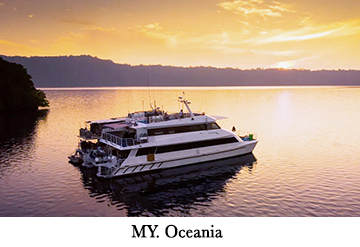
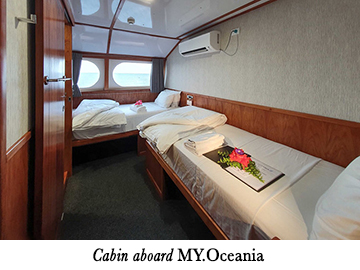
While one could spend weeks diving Kimbe Bay, it was time to board the Oceania and head out to the Bismark Sea, where we generally found more current, which carries the nutrients that attract fish. Oceania, an all-aluminum 88-foot catamaran, is a comfortable craft, fully refurbished as a liveaboard in 2018. With eight double occupancy air-conditioned cabins on the main deck, there are no stairs to climb to reach the dive deck or, more importantly, exit in an emergency. Rather than tiny portholes, large cabin windows let in plenty of natural light. Some cabins have two twin beds, and others have queen-sized beds with thick and comfortable mattresses and luggage space under the beds. All have a large ensuite bathroom with potable water and plenty of hot water.
On the dive deck, divers have their own tank station (80 cu ft aluminum only) with under-seat storage. After gearing up (a 3 mm wetsuit, even a shorty, was sufficient), I took a few steps to the stern, where a crew member helped me put on my fins so I wasn't tempted to duck walk wearing fins. From the dive platform, it's a simple giant stride entry. Upon return, a well-designed exit ladder made it easy for me to climb up with all my gear after handing up my fins. There were two morning dives, an afternoon dive, and a dusk dive. Capt. Dan is an enthusiastic leader who displays great pride in his boat as well as in the spherical metal stud just below his lower lip. An experienced diver, he hails from London but now considers himself an Aussie. He handled most of the briefings, while Lucas, the senior dive leader, gave others. He, the other dive leaders, Michael and Andrew, and the remainder of the crew are from PNG. They did not speak English well, so we couldn't have a detailed conversation. Like many PNG men, all male crew members chewed betel nuts for the stimulant and euphoric effect they produce; their blackened teeth and reddish mouths are a bit off-putting when first glimpsed. (The ingredients of betel nuts are not controlled in the U.S.) One evening, a diver who had one too many beers loudly proclaimed he wanted to try betel nuts, which made the rest of us cringe and prompted his wife to proclaim she'd never again kiss him.
Besides supplying a spray bottle of defog and a mask rinse bucket, there's a ladle by the bucket for filling one's mask for rinsing, so divers don't dip their masks in the rinse tank and foul the water. But of course, there was one diver on mental autopilot who dunked his mask in the tank despite the ladle hanging front and center. There's no camera room on Oceania, but there's a camera table on the dive deck. Every diver was given a numbered towel on the dive deck, which was dried and folded after every dive.
The only deep dive was Archway, where we swam shoulder to shoulder through the large arch at 100 feet. It's draped with some lovely, colorful soft corals, which are not that abundant in PNG. It's the abundant and healthy hard corals that make the diving spectacular. The clarity of the water and mildness of the current allowed for a fairly long but safe separation between my buddy and me, and we were often 40-50 feet apart but still in view of one another. Divers were not herded along (either at the resort or liveaboard) and could set their own depth and dive time. When I wanted to return to the boat, I usually had to search for a leader and hand signal him for the boat's location. They often just pointed in the boat's direction rather than leading me back to where I could see it. I'm an experienced diver and could easily find my way, but a less experienced diver might be quite anxious having to find the boat by themselves in the open ocean.
Dinner is one plate of the night's offering with no seconds, but the kitchen staff is amenable to meeting dietary requirements. Standard dinner fare was meat, chicken, or fish, a vegetable or two, rice or potatoes, and vanilla ice cream afterward. For breakfast, eggs and bacon were made to order, and cornflakes and Cocoa Puffs were available. The buffet lunch had a few offerings, including salad and a delicious homemade soup. Aside from a few hardships, like no room AC, a wine substitute, or no seconds at dinner, PNG is a remarkable place to dive. And not only does the Oceania operate from Walindi, but so also does the FeBrina, with the venerable Alan Raabe at the helm. Make the trip to Walindi, dive from land and by sea, add a long layover in Australia, and you'll have a trip of a lifetime. -- G.P.T. Our undercover diver's bio: Certified in 1983, I am a PADI Advanced Open Water diver with more than 1,000 dives from resorts and liveaboards in the Caribbean, Indonesia, Maldives, Red Sea, Mexico, Florida, California, and Hawaii.
|


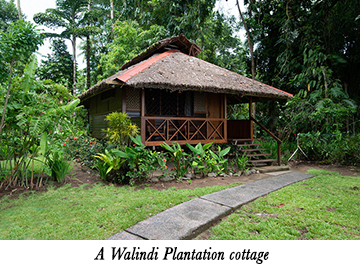 For the first three days, I took day boats from Walindi into Kimbe Bay, more than 1100 square miles, with endless sites reachable by their 25-to-36-foot aluminum vessels with powerful outboards. When I first hit the water, I was struck by the warm water (85°F), the mild current, and the 70-foot visibility. (Except for one shallow dive close to shore, we never had visibility less than 40-50 feet.) And then there's the fish. They're everywhere.
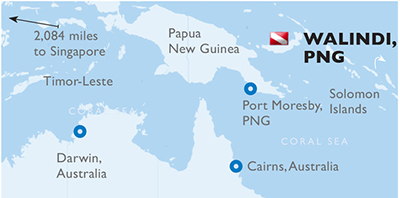 Katherine's Reef, farther out in Kimbe Bay, is dived by both day boats and the liveaboard. Sheer walls on two sides of the seamount plateau plunge far beyond recreational limits. Though soft corals were sparse, an abundance of anemones sported several species of anemone fish, including the orange fin, which counterintuitively does not necessarily have orange fins. On the other hand, the Clark's anemone fish, also known as the yellowtail clown fish, indeed has a yellow tail. I'm a well-traveled diver and still get a kick out of the star of the movie Nemo, the spined-cheek anemone fish, also called a maroon clown fish.
 While she cruises at a respectable 13 knots, the distances are so vast that once we sailed for 12 hours straight and another time for eight hours. It got a bit rough in open water, but Dramamine or Bonine worked fine for those who needed it.
 They divided us into groups of four or five divers, each with a leader who switched groups after every dive. They gauged each nitrox tank before every dive, logged the oxygen level, and the diver initialed it. After each dive, divers report their time and depth, which was recorded and initialed. They say that if there is a medical emergency, the first question from medical personnel will be about the diver's recent dives. And one doesn't want a medical emergency because it could easily take 12 hours for the boat to reach Walindi, followed by an hour's drive to the airport, where there are few scheduled daily flights (with a cabin pressurized at probably 7000 feet) to Port Moresby and then a drive to the chamber.
 The dives were uniformly excellent. It's nearly impossible for me to overstate the size and prevalence of schools of fish. Seventy feet down at Krakafat, a seamount with immense schools of barracuda and jacks, my buddy and I looked at one another wide-eyed and nodded, "Wow." Within our field of view were a massive school of barracuda and an immense school of big-eyed jacks. A veritable forest of black coral trees sprouted from the seamount, and there were beautiful sponges and a few sea whips.
 Although Oceania is a fine boat, the food could be better, at least up to Walindi standards. The fresh bread and rolls at lunch were good but served only with margarine. They advertise that a glass of wine is included with dinner, but the label discloses it is a "wine-based beverage with a 9.5 percent alcohol content and includes both preservatives and milk products" (they're used in many less expensive wines for fining). I think it's cheap and misleading to serve this bogus concoction. Many opted for a bottle of good wine for about $25.
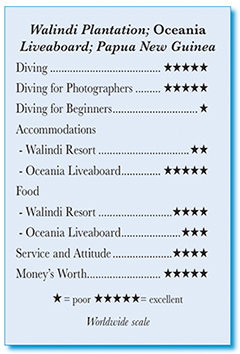
 Diver's Compass: A peak-season, seven-night stay at Walindi is $1,645 per person, double occupancy, which includes meals . . . . Airport transfers are $90/person; a 10-dive package is $790 with nitrox an additional $10 per tank . . . . There's a $9 per diver per day environmental fee . . . . An 9-day cruise on Oceania is $5,400/person, double occupancy, in a twin bed or queen cabin. Additional costs are a $72/person environmental fee, and nitrox is $210 . . . . Peak diving season is September through November, and April through June is also good . . . . Both Walindi and Oceania accept major credit cards for settling the bill as well as for tipping staff . . . . . At both Walindi and onboard Oceania, there is free, same-day laundry service. C-cards were verified, but no minimum number of dives or logbooks required . . . . Local beer is about $3. The boat serves no spirits, but bringing your own is fine, and soft drinks cost about $1.50 per can . . . . Occasionally Oceania takes exploratory cruises to find new dive sites. Contact Oceania directly for more information at
I want to get all the stories! Tell me how I can become an Undercurrent Online Member and get online access to all the articles of Undercurrent as well as thousands of first hand reports on dive operations world-wide

| Home | Online Members Area | My Account |
Login
|
Join
|
| Travel Index |
Dive Resort & Liveaboard Reviews
|
Featured Reports
|
Recent
Issues
|
Back Issues
|
|
Dive Gear
Index
|
Health/Safety Index
|
Environment & Misc.
Index
|
Seasonal Planner
|
Blogs
|
Free Articles
|
Book Picks
|
News
|
|
Special Offers
|
RSS
|
FAQ
|
About Us
|
Contact Us
|
Links
|
3020 Bridgeway, Ste 102, Sausalito, Ca 94965
All rights reserved.