
 |

 Email Signup
|
Subscribe
|
Login
Email Signup
|
Subscribe
|
Login
For Divers since 1975 The Private, Exclusive Guide for Serious Divers Since 1975 |
"Best of the Web: scuba tips no other source dares to publish" -- Forbes |
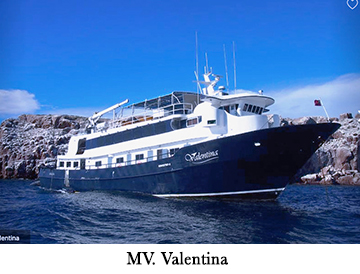
MV Valentina, Sea of CortezContents of this Issue: Bonaire, Belize, Rangiroa, Fiji, Indonesia Independent Reader's Reports Are Invaluable The 2024 Travelin' Diver's Chapbook is in Print! An Unpleasant Experience for a Novice Diver In California, Bring Hammers on Your Dive Should I Insure Old Scuba Gear? Editorial Office: Ben Davison Publisher and Editor Undercurrent 3020 Bridgeway, Suite 102 Sausalito, CA 94965 sea lion games and orca hunts from the March, 2024 issue of Undercurrent
Dear Fellow Diver, While divers travel to the Galapagos, Australia, or Indonesia in search of diving adventure, in Mexico's Sea of Cortez anything can happen.
Suddenly, several orca dorsal fins broke the surface. It was an orchestrated orca hunting party. We scrambled into the two 25-foot RIBs with cameras ready and motored slowly on the calm sea to where the action had been. Again, several orca dorsal fins broke the surface as the orcas seemed to be going in circles. Everywhere, dolphins jumped clear of the water and scattered, with the breaching orcas in pursuit. One 20-foot orca even brushed the side of an RIB. Later, one diver showed a video of his shadow across the animal's back while it spouted and sprayed everyone in the RIB, creating a rainbow. The money shots came from two people holding GoPros on selfie sticks under our RIB. One recorded an orca with a dolphin in its mouth 50 feet below. While we followed the orcas, one woman diver asked, "Can we stop the boat so I can swim with an orca"? For a few seconds, we had absolute silence. One diver said they had been disabling sailboats in the Mediterranean by breaking off their rudders. I said there is no documented evidence of an orca killing a human . . . or maybe there are no survivors to tell their story. Another said they're apex predators, and she would be putting herself at their mercy or whim. She did get into the water as she tried "to hear the whales." She didn't stay long. It was an hour before we awe-struck observers returned to the Valentina. I had arrived at the Valentina in La Paz a few days earlier after a 2.5-hour shuttle ride from the Cabo San Lucas airport. I left my gear on board and strolled to the Casa del Mar restaurant on the park-like Malecon boulevard to meet up with other divers, many of whom I had dived with previously. The boulevard was closed to vehicles to host a 10 km race for hundreds of runners while families with children sauntered along the sidewalk. After too many cervezas and a few too many dive stories over several hours, I said good night and ambled back to the ship. After an eight-hour trip north on the deadcalm Sea of Cortez, the crew dropped anchor, our wake-up call just before sunrise. There were no lights as far as the eye could see, and soon, the barren and beautiful mountains emerging from the Baja desert glowed with the sunrise. We were about 80 miles from La Paz and definitely off the grid.
No current, 100-foot visibility and 84-degree water made it a perfect start. Dozens of great hammerheads, 8 to 12 feet long, were 50 feet down, just above the bottom. I followed them for a while, staying at 100 feet, observing the maximum allowable depth. When a diver eventually signaled low on air, we ascended for a safety stop at 15 feet and, after 40 minutes, surfaced to hear barking sea lions and squawking seabirds on the nearby rocks. I can't imagine a better checkout dive, perfect for a group of mainly experienced divers with thousands of hours of bottom time. (Don't expect this kind of checkout with an unknown group.) Back to the boat for a breakfast of scrambled eggs, pancakes, home-fried potatoes, tortillas, and taco fixings, including sauces, fruit juices, coffee, biscuits, and pastries, served in a comfortable dining room by the boat staff and divemasters. About 9 a.m., we were off for a second hammerhead dive. The steel-hulled 135-foot Valentina, refitted in 2013, has about twice the deck space of most liveaboards. It has 10 spacious staterooms, eight with two bunks and two that can bed three, for a capacity of 22. They have private showers, adequate storage, and daily room service. All open directly to an outside walkway on the port and starboard sides so fire would trap no one in a cabin. On deck 2, a large, well-appointed, airconditioned common room also holds the kitchen, video center, and fish book library. I often hung out on the huge upper deck, which is partially covered by a canopy, to take in the night sky in t-shirt weather.
Divers board their RIBs by climbing down stairways on the port or starboard sides to their assigned boat, then stepping onto the side of their RIB and into it with the crew's help. The crew had loaded my cylinder and dive toys on the RIB, where I donned my gear. Some divers climbed down the steps wearing their full rigs and hopped into the RIB. With frequent swells and bouncing RIBs, that macho technique made no sense to me. DAN reports that the primary cause of dive trip injuries is clambering around boats or docks while geared up. Why tempt fate? The ship's sizeable stern platform looks easy to dive from, but it sits about a foot above the water, and waves and swells have pushed divers and RIBs under it, so they no longer use it. Upon return, I was able to get on and off an RIB with crewmembers giving a firm handhold without injury during three-foot swells. On the afternoon of the first day at Las Animas, sea lion encounters were the game plan. With divemaster Cesar, six of us dropped to 60 feet, encountering thousands of Pacific bigeye barracuda stretching 30 feet from top to bottom and passing in an unending stream. Small trails of bubbles occasionally rose from the school, but why would fish blow bubbles? Watching for a while, I realized they were not blowing bubbles but instead passing gas. I laughed into my regulator, which made my dive buddy laugh as well. About every 100th fish was farting! Near the sloping rock bottom with occasional cup corals, the sea lions came to play. This herd is not as socialized as one we interacted with later in Los Islotes, preferring to keep their distance -- except for three adolescents. They wanted to train us to play a game with them, which I called "Catch the Fish," a game of "keep away." One carried a dead fish in its mouth and its buddies tried to grab it. At least a dozen times, he -- or she -- dropped it on the rocks in front of us; when we tried to grab it, one would zoom in and get it before we could. Once, I did grab what was apparently a large headless damselfish, but the sea lion grabbed it out of my hand instantly.
That evening, we dined on baconwrapped filet mignon with mashed potatoes, mixed vegetables, and a choice of wine served by grinning boat staff and divemasters, the tremendous dives on everyone's tongue. Few divers will ever see anything like the orca vs. dolphin action. Less than five feet long with a small stout dorsal fin, they were not bottlenosed dolphins or a subtype, spinner dolphins perhaps, but they did no spinning. Every evening, Chef Luigi and his helper produced impressive and abundant meals for the 22 hungry divers. The second evening's meal was a jumbo shrimp and rice pilaf entre. Another evening dinner was a delicious Cajun-style seafood medley in a large bowl for everyone to dig into. The Mexican taco dinner came with a demonstration of the correct way to build, hold, and eat a taco. Having eaten tacos all my life, I was amazed to learn what I didn't know about taco history and etiquette. Four dives a day (none at night) was the plan, but we were disappointed to hear that a powerful cold front with several days of high winds was scheduled to hit by the afternoon of day 2, and it sure did, modifying our schedule.
There's a huge camera table with compressed air on the dive deck. Every diver has a semi-dry storage box under the table. Dive stations are supplied with air or Nitrox via a whip. And there is a wet storage box underneath everyone's dive station. An excellent camera tank and hot water showers are on the back of the dive deck. Los Islotes, about 20 miles from La Paz, is regularly visited by day boats that bring dozens upon dozens of divers. To avoid the masses, we overnighted nearby and were in the water just after daybreak to play with the pups and juveniles. The large sea lion colony is more socialized and interactive than their kin to the north. We had endless funfilled interactions, which included getting our fins nibbled or tugged on, snorkels grabbed and even stolen. I ended up with more video time of sea lions with whiskers in my camera lens than I'll ever need. Here, we also swam with schools of bigeye scad, yellowtail surgeonfish, Cortez barracuda, mackerel sergeant majors, black or dusky damselfish, blue parrotfish in their colorful variations, and an occasional Moorish idol. Schools of scad were a mesmerizing, shining mass in the clear, sunlit water. Throughout the week, we saw several green turtles and one giant jawfish in the sand off Los Islotes.
Several sites we visited were a compromise to avoid the wind and high seas. The Fang Ming wreck and the nearby wreck of a Mexican Navy patrol boat C-59 were sunk on the 75-foot sand bottom for divers. Both are open for hull penetration but are not very exciting. The Fang Ming was festooned with lots of hydroids and sponges, with small critters living in them, and I got a rare shot of the usually shy longnose hawkfish. Here, visibility decreased to about 20 feet. Like the rest of the ocean, the Sea of Cortez is not what it was 30 years ago when I first dived it. The hammerhead schools that were at El Bajo are gone. There seem to be fewer whale sharks. I've always seen huge schools mobula rays in this area, but locals say they have vanished. Overfishing is a significant cause. I'm sure poorly treated sewage from La Paz, a city of 500,000, which is dumped directly into the Sea of Cortez, also affects sea life. And climate change is having its effect everywhere. That said, the diving is unique, exciting, and fun. Don't put it on your bucket list far into the future. Go now while it still has its magical qualities. Visit mid-August to early November, when the water is a comfortable 82 to 84 near the surface and the mid-70s at depth. Winter and spring temperatures are in the high 60s. And if you want to see the orcas hunting dolphins, go to Facebook and search: "Diventures Valentina Sea of Cortez Liveaboard November 2023." --D.D. Our undercover author's bio: The author is a master diver who has been diving for more than 30 years, making 1600 dives worldwide. Retired from rebreather and technical diving, he is a DAN undersea referral physician and has written many articles for Undercurrent.
|


 As I and a gang of other divers were off-gassing
between dives on the MV Valentina in late October, I
watched a large school of small dolphins a few hundred
yards away. One of my sharp-eyed dive buddies yelled,
"Whale!" Soon, an orca appeared, and at least a hundred
dolphins leaped from the water. I was breathless.
As I and a gang of other divers were off-gassing
between dives on the MV Valentina in late October, I
watched a large school of small dolphins a few hundred
yards away. One of my sharp-eyed dive buddies yelled,
"Whale!" Soon, an orca appeared, and at least a hundred
dolphins leaped from the water. I was breathless.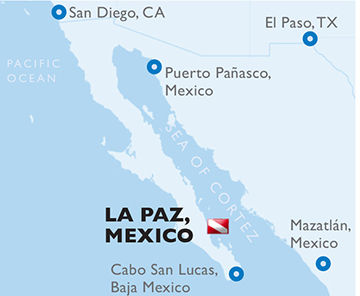 Lorenzo, the head divemaster with whom I have
dived many times over 30 years, gave a thorough
boat safety and dive briefing. We were an experienced
dive group, so Lorenzo wasted no time with
a boring checkout dive. The plan was to head down
90-100 feet to visit the great hammerheads of Las
Animas. The crew had loaded the two RIBs with our
gear, so I only had to slip into mine and backroll
off. At the edge of a drop-off at 40 feet,
the divemasters verified everyone was OK. Several
curious California sea lions inspected us as we
kicked down through schools of bigeye scad and vast schools of Pacific barracuda.
Lorenzo, the head divemaster with whom I have
dived many times over 30 years, gave a thorough
boat safety and dive briefing. We were an experienced
dive group, so Lorenzo wasted no time with
a boring checkout dive. The plan was to head down
90-100 feet to visit the great hammerheads of Las
Animas. The crew had loaded the two RIBs with our
gear, so I only had to slip into mine and backroll
off. At the edge of a drop-off at 40 feet,
the divemasters verified everyone was OK. Several
curious California sea lions inspected us as we
kicked down through schools of bigeye scad and vast schools of Pacific barracuda.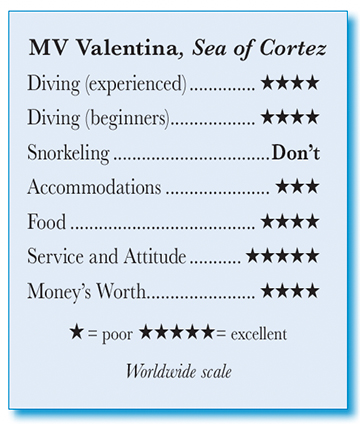 By email, Valentina's staff had verified my certifications before departure.
On board, some were asked to show C-cards, but Lorenzo just asked how I'd been
doing and why I'd been away so long. Dive rules are common sense: Stick with your
buddy; stay within sight of the divemaster; touch nothing other than sea lions
(they'll be touching you); notify the divemaster when your psi is in the 700s;
be on the surface with 500 psi. The dives were 40 minutes to an hour or so, and
afterward, both the divemaster and RIB driver counted the divers. You must have a
computer and an SMB and make a 3-minute safety stop. Dive insurance is necessary.
If you're not Nitrox-certified, you would be wise to enroll in their course -- you
won't miss any dives.
By email, Valentina's staff had verified my certifications before departure.
On board, some were asked to show C-cards, but Lorenzo just asked how I'd been
doing and why I'd been away so long. Dive rules are common sense: Stick with your
buddy; stay within sight of the divemaster; touch nothing other than sea lions
(they'll be touching you); notify the divemaster when your psi is in the 700s;
be on the surface with 500 psi. The dives were 40 minutes to an hour or so, and
afterward, both the divemaster and RIB driver counted the divers. You must have a
computer and an SMB and make a 3-minute safety stop. Dive insurance is necessary.
If you're not Nitrox-certified, you would be wise to enroll in their course -- you
won't miss any dives. Rafts of sea lions hung out on the
surface 60 feet above, watching the
game. Off in the blue, clouds of bigeye
scad swam with huge schools of scissortail
chromis. Yellowtail surgeonfish
seemed to be everywhere. A large green
moray swam by, and that endless school
of Pacific barracuda was still passing
an hour later, apparently swimming in
a huge circle. We ascended as a group,
and the divemaster's SMB alerted our RIB
driver for a quick pickup.
Rafts of sea lions hung out on the
surface 60 feet above, watching the
game. Off in the blue, clouds of bigeye
scad swam with huge schools of scissortail
chromis. Yellowtail surgeonfish
seemed to be everywhere. A large green
moray swam by, and that endless school
of Pacific barracuda was still passing
an hour later, apparently swimming in
a huge circle. We ascended as a group,
and the divemaster's SMB alerted our RIB
driver for a quick pickup.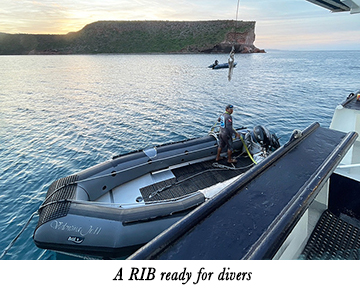 The following morning, we made two more great sea lion dives among lots of
small marine life: nudibranchs, gobies, and other critters. The water was calm,
the visibility 70 feet or more. After lunch, the winds picked up to a constant 30
to 40 miles per hour, creating 3- to 4-foot waves with whitecaps. Rolling off the
RIBs was still easy, but surface recovery had become a tricky wrestling match.
We dived the next day under these conditions with only a few bruises and mild
strains. The boat crew avoided any real problems, although we had to skip some
good dive sites. We retreated 40 miles south to a sheltered cove on the northwest
end of Espiritu Santo island and made alternative plans for the rest of the week.
The following morning, we made two more great sea lion dives among lots of
small marine life: nudibranchs, gobies, and other critters. The water was calm,
the visibility 70 feet or more. After lunch, the winds picked up to a constant 30
to 40 miles per hour, creating 3- to 4-foot waves with whitecaps. Rolling off the
RIBs was still easy, but surface recovery had become a tricky wrestling match.
We dived the next day under these conditions with only a few bruises and mild
strains. The boat crew avoided any real problems, although we had to skip some
good dive sites. We retreated 40 miles south to a sheltered cove on the northwest
end of Espiritu Santo island and made alternative plans for the rest of the week.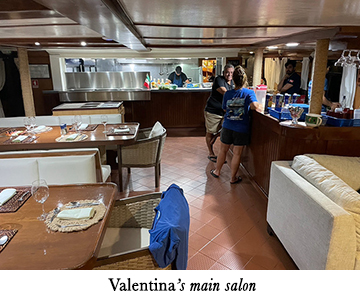 My one-hour dives around Los Islotes were less than 60 feet deep, with about
100 feet of visibility and no current. I shot several sea lions lying on the sand
bottom in front of divemaster Lorenzo as if he were organizing a class of little
children, intermittently pointing to each and trying to get them to follow commands.
They occasionally did in their sea lion way. We did not feed them, although,
at times, the dayboats do.
My one-hour dives around Los Islotes were less than 60 feet deep, with about
100 feet of visibility and no current. I shot several sea lions lying on the sand
bottom in front of divemaster Lorenzo as if he were organizing a class of little
children, intermittently pointing to each and trying to get them to follow commands.
They occasionally did in their sea lion way. We did not feed them, although,
at times, the dayboats do. Divers Compass: Southwest Airlines flies to La Paz from Phoenix;
Aeromexico from LA . . . . Cabo San Lucas, served by many airlines
with cheaper flights, is about 90 miles south . . . .
Valentina staff will arrange a shuttle for the picturesque ride
to La Paz from the San Juan del Cabo airport . . . . My trip was
approximately $3000 for six days/seven nights, plus airfare . .
. Tanks are aluminum 80s or 60s . . . . rental gear is available
. . . . Nitrox is about $8 a cylinder . . . . beer was free
anytime after diving, as was a glass of wine with dinner; liquor
was about $8 a drink, additional wine $8 . . . . WiFi cost $50 for the week . .
. . Tipping is directed to a "kitty" for all crew to share. (I gave my divemaster
an additional $10 per dive) . . . . Tourist rules say that after you disembark
a ship, you must overnight at a Mexican hotel before flying out, but some in our
group ignored it . . . . The Valentina dives the Revillagigedos during the winter
season . . . .
Divers Compass: Southwest Airlines flies to La Paz from Phoenix;
Aeromexico from LA . . . . Cabo San Lucas, served by many airlines
with cheaper flights, is about 90 miles south . . . .
Valentina staff will arrange a shuttle for the picturesque ride
to La Paz from the San Juan del Cabo airport . . . . My trip was
approximately $3000 for six days/seven nights, plus airfare . .
. Tanks are aluminum 80s or 60s . . . . rental gear is available
. . . . Nitrox is about $8 a cylinder . . . . beer was free
anytime after diving, as was a glass of wine with dinner; liquor
was about $8 a drink, additional wine $8 . . . . WiFi cost $50 for the week . .
. . Tipping is directed to a "kitty" for all crew to share. (I gave my divemaster
an additional $10 per dive) . . . . Tourist rules say that after you disembark
a ship, you must overnight at a Mexican hotel before flying out, but some in our
group ignored it . . . . The Valentina dives the Revillagigedos during the winter
season . . . . 
I want to get all the stories! Tell me how I can become an Undercurrent Online Member and get online access to all the articles of Undercurrent as well as thousands of first hand reports on dive operations world-wide

| Home | Online Members Area | My Account |
Login
|
Join
|
| Travel Index |
Dive Resort & Liveaboard Reviews
|
Featured Reports
|
Recent
Issues
|
Back Issues
|
|
Dive Gear
Index
|
Health/Safety Index
|
Environment & Misc.
Index
|
Seasonal Planner
|
Blogs
|
Free Articles
|
Book Picks
|
News
|
|
Special Offers
|
RSS
|
FAQ
|
About Us
|
Contact Us
|
Links
|
3020 Bridgeway, Ste 102, Sausalito, Ca 94965
All rights reserved.