
 |

 Email Signup
|
Subscribe
|
Login
Email Signup
|
Subscribe
|
Login
For Divers since 1975 The Private, Exclusive Guide for Serious Divers Since 1975 |
"Best of the Web: scuba tips no other source dares to publish" -- Forbes |
Avalon IV, Jardines de la Reina, CubaContents of this Issue: Technology Used to Find Lost Guam Divers Avalon IV, Jardines de la Reina, Cuba For Americans Traveling to Cuba Great News for Florida Turtles The 2023 New Orleans DEMA Show Scorkl: Why Divers See Its Potential Danger A Stroke While Diving is Serious and Often Preventable The Adventures of Gilliam and Garth Belize Aggressor IV Grounds on Reef 118 Countries and More to Come Liveaboard Capsizes in Thailand Editorial Office: Ben Davison Publisher and Editor Undercurrent 3020 Bridgeway, Suite 102 Sausalito, CA 94965 plenty of sharks in water too warm from the January, 2024 issue of Undercurrent
Dear Fellow Diver, Sharks, sharks, and more sharks! When a Bluewater Dive Travel photography workshop in Cuba appeared on my radar, it piqued my interest. I've made 43 dive trips to the Caribbean to nearly all the best places -- and some not-so-great places -- but I had never dived Cuba's isolated and reportedly pristine reefs. Little did I know that I would swim with several reef sharks and friendly goliath groupers on nearly every dive.
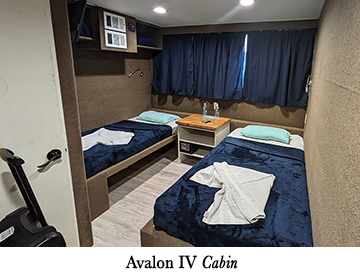
While this would be my 14th liveaboard trip, it didn't turn out to be a "typical" liveaboard cruise, but only a short sailing trip to the national park where the ship tied off for the week. From our floating hotel, we would dive from large tenders, with 20- to 30-minute rides to similar dive sites throughout a small area of the archipelago. I had expected to travel along the archipelago, mooring at different places and exploring a large swath of it, so I was a little disappointed. That said, had I studied the Avalon section of the Bluewater website, I might have known more about what to expect. After overnighting in Miami, I took a one-hour American Airlines flight to Santa Clara, where I quickly passed through immigration and customs. Outside, I spotted a taxi driver holding a sign with my name; he loaded my bags into his taxi, and off we went on our memorable drive. I hadn't planned well for the three-hour trip. It was hot -- the taxi's air conditioning didn't work well -- and I hadn't purchased a bottle of water in the terminal. My driver had none. I don't speak Spanish, and my driver didn't speak English. We dodged a lot of potholes along the way, passing more horse-drawn carriages than the few cars on the road. Some carriages sported solid rubber wheels, with much of the rubber missing, mounted on wooden wheels. Halfway into our drive, I noticed our speed decreasing. We pulled over -- the engine had overheated. We weren't going anywhere, but a half hour later, another taxi arrived to pick me up, and we were off again to the harbor, where the Avalon crew helped me with my bags. By liveaboard standards, the Avalon IV, the fleet's largest ship, is huge: 190 feet long by 42 feet wide, with a massive lounge area, 20 cabins (all with ensuite bathrooms), and a sun deck with two hot tubs. Four suites on the helm deck directly access the balcony/walkway. The upper and main decks each have eight roomy standard cabins with single beds. The ship is supported by a crew of about 20, including the dive staff. After boarding, a staff member checked C-cards. We left the harbor in the late afternoon for a calm sailing to the Gardens of the Queens, less than six hours away. The following morning, after breakfast, we headed out in sizeable dive tenders to our checkout dive at a site called Anclitis. If first impressions mean anything, I was going to be really disappointed in this trip. The water was greenish, a hot 88°F, and had no memorable fish life. It was early October, and the warm waters had severely affected the reefs; I saw lots of coral bleaching throughout the week. Most pillar corals had visible signs of thermal stress. A couple who had taken the same cruise eight months earlier said it was now a completely different ecosystem from what they had experienced. They were shocked at the bleaching and lesser aquatic life present. After the checkout, we returned to the Avalon IV, which had moved to a protected area surrounded by mangroves, our home base for a week. "Hot towels, hot towels!" After boarding the mothercraft, I walked over to one of the two lower platform showers and did a quick rinse in nice hot water before climbing a few stairs to the dive deck. The staff member nearest the ladder yelled "Hot towel," and other crew members repeated it as they tossed hot towels from the laundry room to another crew member and then on to others nearest the divers, who would wrap a nice warm towel around our shoulders. In between towel tosses, some crew members danced to Cuban music ... such fun.
During the second day of diving, I began to feel better about the underwater life, and my first dive on the third day was terrific -- visibility had improved considerably, the corals were colorful, and more fish showed up -- angel fish, schools of jacks and grunts -- and five reef sharks and a nurse shark hung with us for most of the dive. The real treat was when a goliath grouper finned from diver to diver to say "hello"! When he came to me, I pointed down quickly with my hand, and he followed it down; I pointed elsewhere and off it went in that direction. Back on the ship, my fellow divers started calling me the "grouper whisperer." I repeated this pointing action on other dives with similar behavior from the groupers. I guess a grouper sees something similar in my pointing to a diver spearing a lionfish for him. I was reminded of diving in Little Cayman, where divers spear lionfish; a grouper accompanying me finned over to a swath of coral and seemed to point its nose at a hole. I looked in, and there was a lionfish.
The four-dive package included an early afternoon dive and a late afternoon or night dive, which I skipped to edit my photography. The photo pros leading the group -- Shane Reynolds and Romona Robbins Reynolds -- were superb. He, a video expert, and she, a photography expert, offered lots of tips about what to shoot before a dive, and at day's end, discussed topics such as composition, lighting, and software while providing suggestions for each individual's work. It was a real treat to get their advice on my videography techniques, including better ways to use Adobe Premiere Pro.
After a full day of diving, we had lots of room to work on photography, hang out at the bar, or chill in our cabins. And chill it was because the air conditioning worked too well, and I had to sleep with a wool hat on. My cabin was large enough, with two twin beds (I paid the single supplement, so I had the room to myself) and ample space under the beds to store luggage. My large shower had plenty of hot water. The tap water was fine for brushing teeth but unsuitable for foreign stomachs, but there was plenty of potable water elsewhere.
After a full breakfast -- cereals, eggs, bacon, sometimes pancakes -- at 7:30, then an 8 a.m. dive briefing, we'd head out for a two-tank dive, with a surface interval in between dives on a small island beach -- once in a chilling rain. We were greeted by iguanas and several rodent creatures, an endangered rodent (Demarest's hutia) that can weigh up to 15 pounds. Now, why divers would try to feed little wild critters by hand is beyond me, but several did, and several had their fingers nipped ... go figure. One advertised attraction is to see Cuba's saltwater crocodiles, and three times near the end of our surface interval, they took us to where the local crocodile supposedly hangs out. They called, yelled, hooted, and made every imaginable sound to get it to show up, but a croc never made an appearance. I understand they do, but not for us. Our fifth diving day was the best. We motored 20 minutes to the first dive site. With my large video rig on my lap and tether attached, I rolled back and quickly descended to 50 feet, where I began filming the other divers plunging in. The visibility was excellent, and I could clearly see the dive tender 50 feet above as the divers splashed in. As we made our way along the corals, several reef sharks weaved in and out of our group, sometimes coming within a few inches of my camera. Shane carried a new 360-degree camera on a 10-foot pole. The sharks seemed interested in it, probably thinking he was about to spear lionfish. For a while, I filmed Shane filming sharks, doing what I do.
At 50 minutes, I started my safety stop. The sharks had followed many divers who had exited and now circled under the tender. I hung and filmed them weaving in and out; it was almost bumper-to-bumper traffic near the ladders. I watched the action for 10 minutes and then surfaced. We could stay down a full hour if we had the air and NDL. Handing up my camera and fins, I pulled myself to the ladder at the stern and boarded. This dive had more action than several other dives combined. It was a quality dive. Overall, it was a worthwhile trip, though pricey for six days of Caribbean diving. I learned more videography techniques, and the plentiful sharks and friendly groupers were a treat. The high water temperatures and negative impact on the reefs were saddening, but that's not just a Cuba issue; the Caribbean has been hit hard in 2023. Still, the crew and dive staff were excellent and friendly, the ship was large and spacious, and everyone had fun, which matters to me. -- V.A. Author's Bio: I got dive certified 35 years ago, and since retiring a few years ago, I've ramped up the frequency of traveling to new places. I dive and hike worldwide, passionate about capturing those moments in pictures and videos and sharing my experiences with others. Hiker, diver, adventurer, amateur photographer, that's me.
|


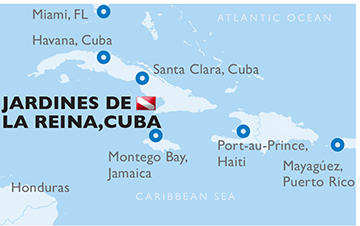
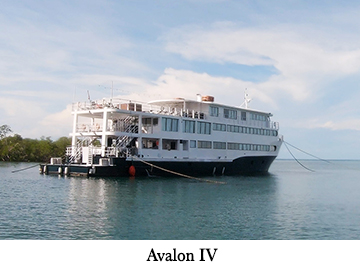 Bluewater has partnered with Avalon Outdoors, a Cuban Company, and this trip fell under the "Sustainable Marine Conservation Humanitarian Project" category, qualifying U.S. citizens for legal travel into Cuba. Avalon has a fleet of seven ships, and I signed up for a mid-October liveaboard trip to dive the Jardines de la Reina (the Gardens of the Queen), a marine park 60 miles off Cuba's southern coast.
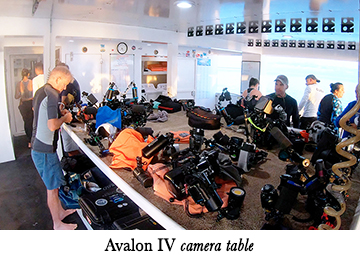
 With a spacious dive deck, we had plenty of room
to dress. At the center is a large camera table,
an essential when so many divers are photographers.
Each morning, the crew loaded our BCDs and tanks
onto the tenders. Nitrox fills were consistent at
31%-32%. The shade-covered dive tenders sport dual
150 hp outboards, shade covers, room for more than a
dozen divers, two dive guides, and the driver (but
no head). Our guides for the week, two pleasant local
dive guides, Ciro and Alejandro, spoke English well
enough to meet our needs. At the dive site, the crew
helped us don our equipment, and we plunged in one at
a time by sliding along the bench to the center of the dive tender and then rolling
back in the water. To get back onboard, we handed up our fins, then worked our
way to the ladders at the stern and climbed up. Some divers removed their BCDs and
weights before climbing the ladder, and the crew would lift their tank onto the
tender.
With a spacious dive deck, we had plenty of room
to dress. At the center is a large camera table,
an essential when so many divers are photographers.
Each morning, the crew loaded our BCDs and tanks
onto the tenders. Nitrox fills were consistent at
31%-32%. The shade-covered dive tenders sport dual
150 hp outboards, shade covers, room for more than a
dozen divers, two dive guides, and the driver (but
no head). Our guides for the week, two pleasant local
dive guides, Ciro and Alejandro, spoke English well
enough to meet our needs. At the dive site, the crew
helped us don our equipment, and we plunged in one at
a time by sliding along the bench to the center of the dive tender and then rolling
back in the water. To get back onboard, we handed up our fins, then worked our
way to the ladders at the stern and climbed up. Some divers removed their BCDs and
weights before climbing the ladder, and the crew would lift their tank onto the
tender.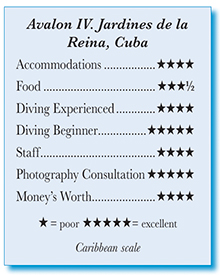 The 24 guests on board included divers who weren't with Bluewater, Americans and some Canadians, and six fishermen (one was a fisherman's wife, who went out on the fishing boat with her husband). Fishermen on a liveaboard? Yes, it seemed quite odd to share the craft with catch-and-release fly fishermen, but we got along, and they generally socialized together. They fished from their own small boats and generally did not affect diving, though one morning, their boats blocked our dive tenders from loading, delaying our dive half an hour as they were not yet ready to leave.
 Even though we were a bunch of photography nerds, the guides pointed out things our less experienced eyes missed, especially a few nudibranchs where we didn't know where to look, and if we did, they were nearly invisible. They never rushed us, so we could wander about to make our own discoveries; it was a relaxing, non-rushed experience. Our dives were generally limited to 60 minutes, with 60-70 feet the usual max, but going deep was never an issue. I once dropped to 102 feet to film a shark.
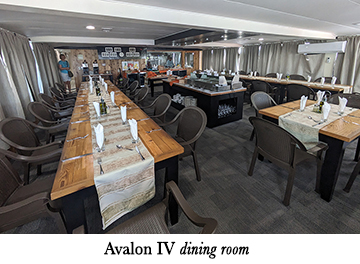
 The buffet lunches and dinners were plentiful; there were vegetarian options, fish, pork, and chicken for most meals -- and lobster on three nights. The dinner presentations were elaborate, more so than the food, which was simple and a little redundant, other than meals at Cuban night and lobster night. The only detractors were bugs -- they looked like cockroaches to me, though the staff tried to convince us otherwise -- and would sometimes crawl on the food. I tried to ignore them.
 At 40 minutes, I started to the mooring, filming a school of bigeye yellow snapper along the way. I encountered lots of angelfish and a dozen tarpons hanging out under a coral ledge. The sharks had stayed with us much of the dive, and Shane was doing his best to get them close to his pole camera; he even threw it to see what the sharks would do, and at least one gave the weird object a very close inspection ... the video played that night was rather entertaining.
 Divers Compass: Standard cabin on the Avalon IV is about $4,400 for double occupancy for the seven-night cruise, plus around $480 in fees; if you opt for a single supplement, it is about $2100 more . . . . The dive package included up to six daily beverages: beer, wine, or soda . . . . There was rental equipment available . . . . I use DIN, and plenty of tanks had removable inserts . . . . Cuba has six hyperbaric chambers, I was told . . . . Bluewater Dive Travel,
I want to get all the stories! Tell me how I can become an Undercurrent Online Member and get online access to all the articles of Undercurrent as well as thousands of first hand reports on dive operations world-wide

| Home | Online Members Area | My Account |
Login
|
Join
|
| Travel Index |
Dive Resort & Liveaboard Reviews
|
Featured Reports
|
Recent
Issues
|
Back Issues
|
|
Dive Gear
Index
|
Health/Safety Index
|
Environment & Misc.
Index
|
Seasonal Planner
|
Blogs
|
Free Articles
|
Book Picks
|
News
|
|
Special Offers
|
RSS
|
FAQ
|
About Us
|
Contact Us
|
Links
|
3020 Bridgeway, Ste 102, Sausalito, Ca 94965
All rights reserved.