
 |

 Email Signup
|
Subscribe
|
Login
Email Signup
|
Subscribe
|
Login
For Divers since 1975 The Private, Exclusive Guide for Serious Divers Since 1975 |
"Best of the Web: scuba tips no other source dares to publish" -- Forbes |
MV Ferox, Malpelo Island, ColombiaContents of this Issue: MV Ferox, Malpelo Island, Colombia Little Cayman, Maui, Raja Ampat, Texas Oil Rigs Key West Dive Instructor Disappears Four Divers in North Carolina Rescued Far at Sea The Dive - 90 Minutes on Amazon with 22 Minutes of Air Divers of a Certain Age: Part I Underjungle: An Underwater Fantasy Editorial Office: Ben Davison Publisher and Editor Undercurrent 3020 Bridgeway, Suite 102 Sausalito, CA 94965 where the big fish are from the September, 2023 issue of Undercurrent
Dear Fellow Diver, One way to demonstrate how well divers like a trip is whether they return. I've made 10 liveaboard trips to destinations such as the Red Sea, Cocos Island, the Galapagos, and the Revillagigedos, and a July 2021 trip to Malpelo Island, over 300 miles off the coast of Colombia. The day after I got home from that trip, I began planning a return for late July 2023. That's how much I like it.
Much of the underwater topography resembles Malpelo Island, with huge expanses of volcanic rock, cracks and crevices of all sizes, large boulders, and smaller rocks. Off Malpelo, there are some steep walls. Our first dive at El Arrecife was easy, and I swam with fine spotted morays, leather bass off on a hunt, a large school of pelican barracuda, and several sizeable Galapagos sharks. Surprisingly, I came across an expanse of dense coral coverage (coral appears at a few other sites). The next dive at D'Artagnan had more Galapagos sharks, barberfish, a rainbow chub cleaning station, and such a massive school of bigeye trevally that I could get lost in it. At La Gringa, I kicked through a beautiful swim-thru filled with whipper snapper and came across several Galapagos sharks, a couple of hammerheads, two eagle rays, and lots of bluefin trevally. Really, that's quite an array. At the end of the day, I had high hopes for sure. My trip leader and guide was Sten Johansson (he's called the "Viking," and for good reason), with whom I had dived on my 2021 visit (three others also had dived with Sten before). An experienced Eastern Pacific guide, he worked for Nautilus for many years in the Revillagigedos and Guadalupe Island. He's been a guide at Malpelo for more than a decade. For this trip, he chartered half the boat, taking only divers with 200 or more dives. In fact, to dive Malpelo on the Ferox, one must have an Advanced Open Water certification and 50 dives, proof of which is submitted to the Colombian National Park Service before the trip.
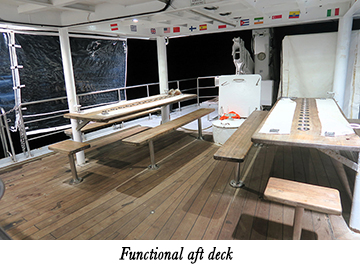
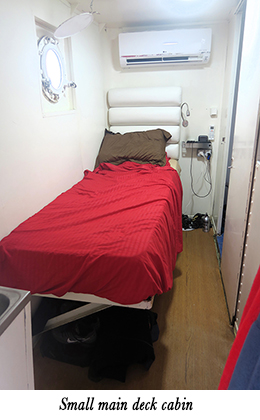
While the Ferox is without a hot tub or mints for your pillow, it's a 105-foot steel-hulled former Swedish Navy mine layer, indeed a stable and safe platform to tackle Malpelo's waters. On the main deck is the galley and an open dining area (plastic sheets can be rolled down for wind and rain protection) with two large, fixed tables and bench seats. It also doubles as the diving dressing area. (We did have a couple of rainy evenings and mornings.) The upper deck has a lounge and a sun deck. For the most part, we hung out on the main deck stern if we weren't in our cabins or in the water. Ten cabins accommodated 12 divers, which on my trip included couples from Australia and Switzerland and eight guys -- a Canadian and seven Americans. Below decks, there's a standard and an emergency exit for the eight cabins: two with queen beds, two with full-size single beds, and four with single beds. As I was recovering from a leg fracture, I had one of two small but comfortable main deck single cabins so I wouldn't have to negotiate the ladder down to a cabin. All cabins have bathrooms with showers (I often used one of the three central deck showers) and AC with superb temperature control. The steel-walled cabins limit the amount of flammable material, and each has a hardwired smoke detector, a batteryoperated backup smoke detector, and emergency lighting. The staff serviced the cabins each morning while we were diving.
The dives varied from just good to dazzling. On one dive at La Nevera, I saw several five-to-seven feet Galapagos sharks, some close up, a few distant hammerheads, schooling king angelfish, an eagle ray, and three dolphins. A whale shark turned up, and another, with which we had a great interaction, came by with a large school of bigeye trevally while, on the way back from a dive, we stopped to snorkel from our RIB at D'Artagnan. Two dives at La Ferreteria rewarded us with scores of fine spotted morays, large scorpionfish, almaco jacks, cubera snapper, and a large school of whipper snapper. Twice after the last dive of the day, we took RIBs around rocky Malpelo and its islets to observe the birds, lizards, and land crabs that call it home. My average maximum depth was about 100 feet (76-114°F), and the median was 59 feet (49-68°F). I averaged about 66 minutes, while one dive lasted 75. When diving Malpelo, it's helpful to use the average depth and dive time along with average gas consumption to estimate gas consumption to decide whether to use an AL80 or AL100 tank. Surface intervals between dives averaged just under three hours for extra safety. Ferox diving is all about safety. Their two rigid inflatables, the most rugged RIBs I have dived from, are former North Sea rescue boats -- 20 feet long with twin 60 HP Yamaha outboards, a sturdy dive ladder, GPS, an automatic identification system (AIS) for tracking the diver's personal locator beacons (PLBS), and VHF radio. Each diver was given a PLB and taught how to use it. We six divers and our guide rode the same RIB all week. Remote waters like these are no place to go off alone, so we backrolled in together, immediately descended, generally stayed together, ascended together, and then handed up our cameras, weights, tanks, BCs, and fins. It would be nearly impossible to go missing.
Diving is so electric that some folks take back-to-back trips, as did one of our boatmates. A skilled diver with an impressive professional camera rig, he knew much about Malpelo's marine environment, and we had several interesting conversations. It was not until midweek that another diver told me he was a highly regarded marine photographer and writer, Brandon Cole, the co-author of "Reef Life: A Guide to Tropical Marine Life," and whose work has appeared in the "National Geographic", the "Scientific American", among scores of other publications, as well as on 255 magazine covers. A self-effacing guy, he was great to chat with and was always pleased to share his vast knowledge and photos. In fact, it was one of those rare cruises where everyone was compatible. When writing an Undercurrent piece, I usually comment on the quirky people on board, the screw-up someone makes, and maybe a little conflict. But this trip was devoid of drama. My companions were excellent divers who were not prone to missteps and were friendly and engaging. All went quite smoothly for such an adventure into the Pacific. And that goes for the crew. Soft-spoken Popeye is one strong and solid Colombian sailor man. When I saw him yank BCs and tanks from the water with one arm and then place them gently on the RIB, I understood why everyone called him Popeye. The knowledgeable guide on the other RIB, jolly Jaime Orlando Lopez, had been working Malpelo for 20 years. His great dive maps clearly showed us the way. The gregarious young Valentina ensured everything on board was handled efficiently.
On the fifth day of diving, after a delicious breakfast of an omelet, pancakes, and toast, I donned my wetsuit for the 11 a.m. dive and climbed down the ladder to the RIB to be greeted by our friendly driver, Popeye. It was a short ride to Los Tres Mosqueteros (The Three Musketeers). Three. Two. One, and we all backrolled in and quickly descended to La Catedral (The Cathedral), a swim-thru in the middle islet of Porthos. Before we made the entrance, three beautiful eagle rays leisurely swam past. As we entered La Catedral, gorgeous shafts of light streamed down from the ceiling and a large, triangular exit lit by the bright sun. It was filled with whipper snappers, the sun glinting off their scales. As I exited at 85 feet, a large, fine spotted moray swam past with an entourage of king angelfish. A few 5-7 foot Galapagos sharks paid a brief visit before we started our ascent, only to encounter a dazzling school of bigeye trevally before ending our 71-minute dive. When I surfaced, only the RIB was in sight. Only one dive boat at a time is allowed to visit Malpelo.
Compared to my 2021 trip, I saw fewer Galapagos sharks, hammerheads, and whale sharks and had fewer close encounters. Perhaps these higher water temperatures had something to do with it; I'll never know. (This is a World Heritage site, and fishing is prohibited; it's enforced by a military post on the island, the only residents). Still, it was quite fishy: I saw many eagle rays, large schools of bigeye trevally, clouds of cardinal fish, whipper snapper, mullet snapper, leather bass, and bluefin trevally. Fine spotted morays were everywhere, as well as the usual reef fish: barberfish, guineafowl puffers, king angels, scorpionfish, giant hawkfish, Mexican hogfish, Moorish idols, surgeonfish, and triggerfish. This was a great trip; each one is different. So, I wonder what Malpelo is like during the dry season of January through April when the water is colder. The owner of the Ferox, Tony Cruzveragara, who usually is on his trips, was in Sweden to acquire another boat similar to the Ferox. He may have another itinerary that perhaps includes Gorgona Island, only 17 miles off the Colombian coast. I'd be up for that. I've dived the four main Pacific sites -- the Galapagos is the most diverse, the Revillagigedos probably has the most big animals, but Cocos Island is close. Malpelo? I think it's is the wildest, with all kinds of stuff, big and small. If you're an excellent, experienced diver, give it a go next summer. But sign up soon. The Ferox fills up fast. PS: Rather than wonder what Malpelo is like during the dry season when the water is colder, I'll find out. I'm returning for my third visit in March 2025. -- W.D. Author bio: I was certified at age 16 and dived for 10 years in Southern California before a 17-year hiatus. Since 1997, I have been diving steadily and have just under 2,300 dives.
|


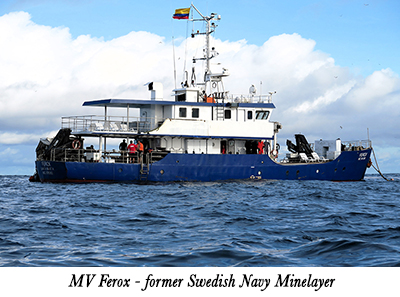 I chose an 11-day charter with seven days of diving rather than the usual six. I had high expectations, but you can never expect to see the same animals or have the same visibility at a dive site the next day, let alone two years later. Yet, my first day of diving got off to a great start.
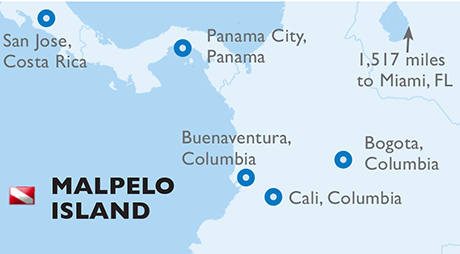 It's a journey itself to get to the MV Ferox. After arriving in Cali,
Colombia, on a nonstop flight from Miami and overnighting, the next afternoon, a
Colombia Dive Adventures bus picked up me and the other divers for a 3.5-hour ride
to the coastal port of Buenaventura, where an RIB took us to the Ferox. After
welcoming snacks and drinks, we received a thorough
safety briefing, were shown to our cabins, and
got underway for the nearly day-and-a-half trip to
Malpelo, a smoother journey than two years previously.
For those making this trip, your kit should
include a transdermal scopolamine patch or another
mal-de-mer preventative.
It's a journey itself to get to the MV Ferox. After arriving in Cali,
Colombia, on a nonstop flight from Miami and overnighting, the next afternoon, a
Colombia Dive Adventures bus picked up me and the other divers for a 3.5-hour ride
to the coastal port of Buenaventura, where an RIB took us to the Ferox. After
welcoming snacks and drinks, we received a thorough
safety briefing, were shown to our cabins, and
got underway for the nearly day-and-a-half trip to
Malpelo, a smoother journey than two years previously.
For those making this trip, your kit should
include a transdermal scopolamine patch or another
mal-de-mer preventative.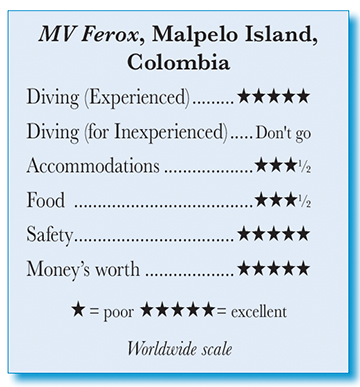 The diving day started early with fruit, breads, and coffee. After the first
dive, it was a full breakfast with eggs cooked to order and pancakes. After the
second dive, a plated lunch was served. I don't eat red meat, so chicken or fish
were my main courses, which I always enjoyed. The server described the meal and took requests. Some folks skipped one item and doubled up on another. I liked the food and had plenty, often too much, to eat. Prepared differently each day, it featured unique sauces, perhaps Colombian in origin. A tasty soup often kicked off the meal, followed by the main course, typically served with rice, vegetables, and a small salad. One can buy wine aboard, and gratis Colombian beer was available after the third dive when the snacks appeared.
The diving day started early with fruit, breads, and coffee. After the first
dive, it was a full breakfast with eggs cooked to order and pancakes. After the
second dive, a plated lunch was served. I don't eat red meat, so chicken or fish
were my main courses, which I always enjoyed. The server described the meal and took requests. Some folks skipped one item and doubled up on another. I liked the food and had plenty, often too much, to eat. Prepared differently each day, it featured unique sauces, perhaps Colombian in origin. A tasty soup often kicked off the meal, followed by the main course, typically served with rice, vegetables, and a small salad. One can buy wine aboard, and gratis Colombian beer was available after the third dive when the snacks appeared.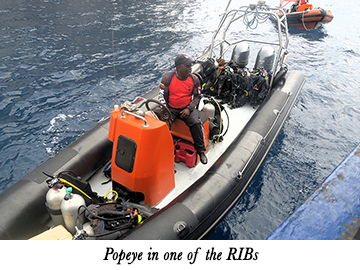 Surge is common at Malpelo, and the current is variable. In a protected area, one might find little current, but swim around the islet or pinnacle, and you could find a strong current you have to swim against, often ripping near the bottom but letting up if one ascends. Swimming against the current could be intense at times, so a diver needs to be in good physical condition and confident they can handle it. Malpelo can be wild, and one needs to adapt to changing conditions.
 When we returned from a dive, Popeye and other crew members carefully handled the cameras and gently placed them in a rinse tub. Afterward, I blew mine off with compressed air at the modest camera table. Cylinders, BCs, and fins stayed on the RIB, and tanks were filled in place. With a primary compressor, a backup compressor, a nitrox generator, and a 14-cylinder cascade, you can rest assured your trip won't be canceled because you can't get gas. My 32 percent nitrox fills averaged 3100 psi.
 The seas were calmer than in 2021, and we dived several southeastern sites we couldn't reach on the previous trip. La Gringa, which has a beautiful swim-thru, Bajon, David, Saul, and Sahara have different topography than other dives and currents and surge that comes and goes. Based on the water temperatures from my last visit (72-82°F), I took my full 5 mm wetsuit and a 5/3 mm hooded vest, but the water ranged between 77°F and 82°F this time. I never wore my hood, but I was still warm.
 Divers Compass: The 11-day trip, with seven days of diving, cost $5,500 plus $245 for park fees; besides airfare, it was about $700 for a night in the Miami airport hotel and two nights in the InterContinental Hotel Cali . . . And don't forget tips . . . . You can rent all your gear, including wetsuits, by the piece; the complete package was $200 for the trip. Colombia Dive Adventures
I want to get all the stories! Tell me how I can become an Undercurrent Online Member and get online access to all the articles of Undercurrent as well as thousands of first hand reports on dive operations world-wide

| Home | Online Members Area | My Account |
Login
|
Join
|
| Travel Index |
Dive Resort & Liveaboard Reviews
|
Featured Reports
|
Recent
Issues
|
Back Issues
|
|
Dive Gear
Index
|
Health/Safety Index
|
Environment & Misc.
Index
|
Seasonal Planner
|
Blogs
|
Free Articles
|
Book Picks
|
News
|
|
Special Offers
|
RSS
|
FAQ
|
About Us
|
Contact Us
|
Links
|
3020 Bridgeway, Ste 102, Sausalito, Ca 94965
All rights reserved.