
 |

 Email Signup
|
Subscribe
|
Login
Email Signup
|
Subscribe
|
Login
For Divers since 1975 The Private, Exclusive Guide for Serious Divers Since 1975 |
"Best of the Web: scuba tips no other source dares to publish" -- Forbes |
Komodo Resort; Kalimaya Resort; IndonesiaContents of this Issue: Komodo Resort; Kalimaya Resort; Indonesia What? No PADI Solo Diving Certification Accepted? Bahamas, Turks and Caicos, Raja Ampat, Belize Surviving a Liveaboard Emergency Insurance and the Traveling Diver; Part I Why Does Your Regulator Let You Down After Servicing? Golden Tides Threaten Mexico's and Florida's Reefs and Beaches PADI Pays Up After a Training Death Thieves? Maybe, and We Need More Like Them Insurance Claim Denied, But I'm a New Person Editorial Office: Ben Davison Publisher and Editor Undercurrent 3020 Bridgeway, Suite 102 Sausalito, CA 94965 from very good to great, two hours apart from the March, 2023 issue of Undercurrent
Dear Fellow Diver:
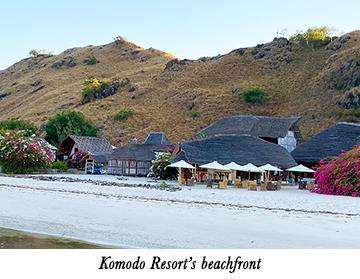
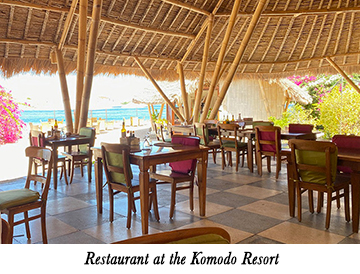
But during my checkout dive at Komodo, my heart sank when I jumped into the lousy visibility. Although the fish were schooling and plentiful, as a photographer, would the muck mean I had traveled halfway around the world for this? After landing at Labuan Bajo from Bali, the starting point for these destinations, my van driver drove me to the old wooden dive boat for the 90-minute ride to Komodo Resort. Once there, the friendly staff gave me a cold facecloth, tamarind juice, and a sandwich in the bougainvillea-covered dining area. Dive director Britta from Stuttgart and the Spanish and Italian guides briefed my group of 10 divers, and then the staff carried my stuff along the sandy path to my bungalow, with a million-dollar beach/mountain view. The 20 ocean-front air-conditioned cabins had lounge chairs and umbrellas steps away from the water's edge. Mine had plenty of storage and a nice outdoor bathroom -- but no hot water, not a great hardship in the warm climate. I had enough electrical outlets for charging my batteries and a small fridge to keep my chocolate stash cool. With no camera room at the resort, I had to schlep my rig daily on the long walk to my room.
But we had our problems. My first stage started leaking, so they moved my hoses and transmitter onto one of their first stages. Problem solved (it had just been serviced, and when I returned home, I discovered the technician had used the wrong tiny O-ring). For the first couple of dives, the nitrox mix was 10-15 percent below 32. The dive director got that corrected. On one second dive, several tanks had only been filled to 1600 psi, and while we divers got full tanks, one guide had to hover above his three charges because he didn't have a full tank. While the boat was to depart by 8 am, disorganization meant late departures and returns -- 1:30 or 2:00 pm -- and late afternoon dives didn't start until 3-3:30 pm and returned about 5:00. With the night dives beginning 5:45, I skipped them, showered up, and headed to the outdoor commons by the bar to share dive stories. Besides my group, which included an 85-year-old woman with more than 3,000 dives, there were a few Europeans and a group of snorkelers from the U.S. As they discovered, snorkeling off the house reef was tricky -- it usually had a ripping current so that one couldn't go out far and risk being swept away.
The large Indonesian-built dive boat had a spacious dive deck with two stern platforms for giant-stride entries. Before climbing back on board, the crew took my BCD, tank, and fins. Once onboard, I'd head up the steep ladder, bang my head too often on the low-hanging tarp on the top deck (which had no guard rails), then relax for an hour in a bean bag chair while enjoying fresh fruit and tea. The days were in the 80s, with intense sun.
Some dives had gentle currents, where I could easily shoot wide angle or macro. One dive was a "superman" 20-minute drift at three knots, ending with a leisurely swim over beautiful table corals with few signs of bleaching. Sweetlips hid under the tables, and thousands of chromis, surgeon, butterflyfish, Moorish idols, and bannerfish filled the 81°F water. When the current was strong, I did a couple of excellent "hook-in" dives to watch white tips, trevallies, tunas, and hundreds of smaller tropicals. I had to struggle to unhook and gain access to shelter once the show was over, and as I kicked to the safety stop, my guide, for some reason, grabbed my BCD and towed me. During my second dive at Manta point, I saw but one manta during a 60-minute drift--a disappointment. I was told that plankton blooms for a few days around the full moon, cutting visibility considerably.
For downtime, I enjoyed an excellent massage (U.S. $28 for an hour). One morning, the guests took an hour's boat ride to Rinca Island to see the Komodo dragons, an experience not to be missed. While the diving at Komodo had been good, I remembered it was better years ago; the dozens of dive boats visiting are taking their toll. So, when my week was up, I looked forward to diving Kalimaya, but I would not get there as quickly as I had hoped. The boat coming to pick us up lost an engine, so after a five-hour wait, we departed on an alternate craft for our two-hour fast and bumpy journey for a late afternoon arrival at the island of Sumbawa and Kalimaya Resort. Kalimaya: Diving in east Sumbawa is like diving in Komodo National Park was 15 years ago," said Aji, the always smiling and helpful manager of the small, lovely Kalimaya Resort. He was right. Once an IT systems administrator who chucked it all to run the resort, Aji is also a divemaster and knew what he was talking about. The reefs were more dense and pristine than Komodo -- like Raja Ampat or Alor. They looked as if no one had ever dived them. In fact, we never saw another dive boat and no evidence of diver damage, unlike at Komodo National Park, where hordes of inexperienced divers from mainland Asia are wreaking havoc on the fragile reefs.
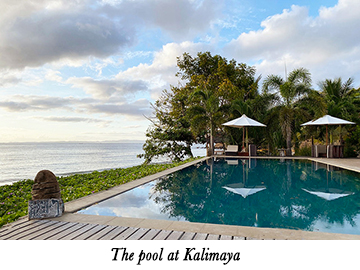
Our dive boat, a modern fiberglass runabout with two outboards, had a head and a covered area. To board it, we had to motor out from shore in a small skiff. Once on board, we had occasional equipment mixups, but the local guides sorted out the problems and had great eyes for spotting critters. Divers back-rolled in, and then exited up two solid ladders. Night dives were only offered off the house reef, guided for a fee or unguided for free. Our dive guides -- three, including Aji, for a group of 10 -- kept us loosely together, as the visibility was at least 100 ft. BamBam, who was always telling stories, asking for selfies, and laughing at his own jokes, was particularly good at finding mantas. We typically stayed down for 60 minutes, drifting slowly along in what little current there was, with the dive boat keeping close track of our bubbles. Between dives, we had cookies, snakefruit, mangos, oranges, apples, and tea. During the COVID hiatus, Kalimaya's 130-meter-long jetty fell into disrepair with lots of crooked and loose boards, as did the walkways to the nice but smallish cabins. Still, the ten cabins were well-maintained with an outside bathroom but were cramped with two twin beds and a small desk. A pool and open-air dining hall were on the lovely grounds, where they served delicious, primarily Indonesian, two-course meals. For breakfast, one had a choice of American or Indonesian egg dishes (with rice or noodles and a fried egg). And they made an expresso for $2.50. But they won't sell you a cocktail on this dry Muslim island of Sumbawa. So, with the help of one unnamed staff member, a couple of our creative group members slipped in a couple of cases of local Bintang beer. Not only did our staffer keep them cold, but he helped a couple of others get forbidden spirits, as well as hard-to-find club soda, in town. Now, that's service.
While enjoying one of my best dives ever, a 14 ft. giant manta ray appeared. Throughout my stay, mantas often appeared out of the blue, cruising for a cleaning station. Each time, I sucked in and held my breath, surprised and ecstatic.
One of our group had to leave a couple of days early and encountered price gouging on luggage at the Bima airport. For the rest of us, Aji greased the skids before we departed, and we had no problems. So, while both resorts are comfortable, air-conditioned, and clean, the diving sets them apart. Kalimaya's house reef was filled with critters galore, beautiful coral, and no current, unlike Komodo's, which I didn't dive because the currents were ripping. The best time to dive the area is summer through November, but be aware of full and new moon times -- they have a pattern of poor viz and rapid currents. Having done eastern Komodo twice now, once by live aboard and now at Komodo Resort, I wouldn't return. But I would return to Kalimaya for its pristine reefs, big and small stuff, and authentic Indonesian food and hospitality.
If you go, get a few days in Bali. While west coasters usually fly to Bali from SFO or LAX, East coasters often fly aboard Emirates or Qatar and head the other way. For sure, build in an extra day in Bali in case a flight goes wrong or baggage needs to catch up. Savvy travelers take several days in one of many fine resorts to raft rivers, visit waterfalls, temples, or coffee plantations, take an elephant ride, or explore the charming little town of Ubud, which hundreds of ex-pats call home. --D.S. Our undercover diver's bio: "I got the diving bug watching Sea Hunt as a kid, got certified in 1983, but didn't start diving the world until 1991. I've logged more than 1,700 dives in the Caribbean, Indonesia, Australia, Tahiti, Palau, PNG, Maldives, and the Philippines. While I love the convenience of liveaboards, I enjoy resorts for their relaxing pace and beauty. My life goal is to dive on my 90th birthday. (Only 19 years to go!)"
|


 If I were going to spend endless hours flying to and from Indonesia, I would want world-class diving with variety. Liveaboards can provide that, but too many Undercurrent readers have reported how the COVID petri-dish environment aboard a liveaboard affected their trips. Having dived this area by liveaboards before, my solution was to visit two land-based resorts, the Komodo Resort, followed by the less-dived Kalimaya Resort.
 On my second day, my concerns about
the visibility lessened (eventually,
we had about 60 feet) with the stellar
diving -- giant mantas on the first dive
and rich coral gardens on the second. I
saw massive schools of fish wherever I
went -- trevallies, surgeonfish, durgons,
bannerfish, Moorish idols, fusiliers
(lots of blue and yellow); occasionally,
a black-tip shark cruised by. I slowly coasted along the main attraction,
the healthy reef, snapping wide-angle pictures of beautiful floral "bouquets,"
sea fans, and multi-colored brittle stars, angelfish, butterflyfish, surgeonfish,
chromis, and an occasional turtle. Having arrived
the day after a full moon, I had to work around the
strong current swings and stay alert, although the
captain was careful about where he dropped us. We
stuck with our guides in a ratio of 4 to 1.
On my second day, my concerns about
the visibility lessened (eventually,
we had about 60 feet) with the stellar
diving -- giant mantas on the first dive
and rich coral gardens on the second. I
saw massive schools of fish wherever I
went -- trevallies, surgeonfish, durgons,
bannerfish, Moorish idols, fusiliers
(lots of blue and yellow); occasionally,
a black-tip shark cruised by. I slowly coasted along the main attraction,
the healthy reef, snapping wide-angle pictures of beautiful floral "bouquets,"
sea fans, and multi-colored brittle stars, angelfish, butterflyfish, surgeonfish,
chromis, and an occasional turtle. Having arrived
the day after a full moon, I had to work around the
strong current swings and stay alert, although the
captain was careful about where he dropped us. We
stuck with our guides in a ratio of 4 to 1.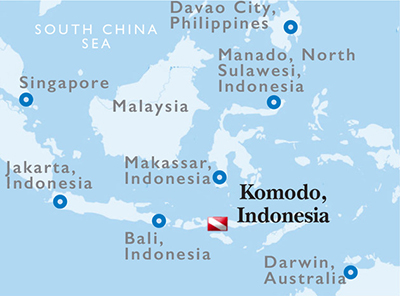 My day began at 6:30 am in the dining room for coffee, soon followed by an
excellent breakfast of omelets/eggs, croissants, homemade bread/toast, bacon, and
sausages, along with a traditional Indonesian breakfast of nasi goreng, a fried
rice dish with an egg, and veggies. Lunch buffets were good soups, sandwiches,
hamburgers, stir-fried dishes, and more. Our five-course dinners began with
sashimi. Indonesian wontons, soups, and salads, followed by choices of several
fish dishes, pork ribs, chicken parmesan, pizza, pasta, Indonesian veggies, French
fries, and various desserts. While the variety was surprising and delicious, it
got a bit repetitive. They offered Australian wines by the bottle or glass at U.S.
prices and local Bintang beer.
My day began at 6:30 am in the dining room for coffee, soon followed by an
excellent breakfast of omelets/eggs, croissants, homemade bread/toast, bacon, and
sausages, along with a traditional Indonesian breakfast of nasi goreng, a fried
rice dish with an egg, and veggies. Lunch buffets were good soups, sandwiches,
hamburgers, stir-fried dishes, and more. Our five-course dinners began with
sashimi. Indonesian wontons, soups, and salads, followed by choices of several
fish dishes, pork ribs, chicken parmesan, pizza, pasta, Indonesian veggies, French
fries, and various desserts. While the variety was surprising and delicious, it
got a bit repetitive. They offered Australian wines by the bottle or glass at U.S.
prices and local Bintang beer.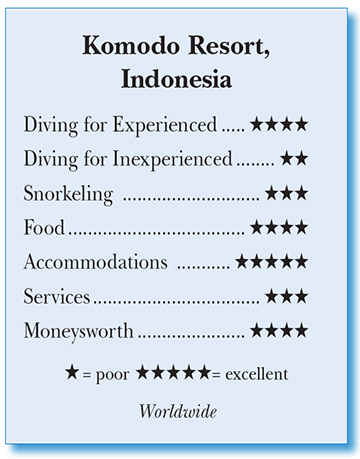 It seems like there's always one sh*t show dive on a trip. At Little Sebayur island, our guide inadvertently dropped his fin off the boat. Fifteen minutes later, another guide searching the bottom found a slimy slip-on snorkeling fin, which he combined with another slip-on fin on the boat. At last ready to dive, I asked a buddy to ensure my air was on, but for some reason, he grabbed my Shearwater transmitter and turned it hard, blowing the O-ring. I replace it on board. When I finally got into the current in 25 ft. visibility, our guide rocketed off without looking back. WTF? We didn't want to lose him, so I kicked hard and grabbed him by the fin to urge him to slow down. Fortunately, the dive shop was able to replace my transmitter O-ring, so I was good to go for the next dive.
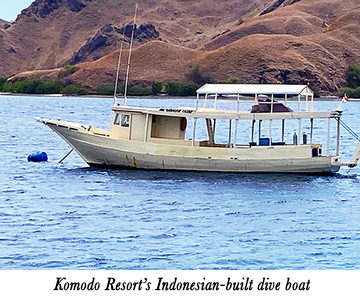 When I arrived at Komodo Resort in September, they had only been taking guests for three months due to the COVID hiatus. While the manager and staff
handled most guest problems, the dive
staff was new -- several dive guides for
my group were stringers from Labuan Bajo
-- and a bit disorganized. They worked
hard and helped people on and off the
boat. They always tossed a line to returning
divers and lifted the tanks and BCDs
before we could climb up a sturdy wooden
ladder. I would by now expect they're
fine-tuned.
When I arrived at Komodo Resort in September, they had only been taking guests for three months due to the COVID hiatus. While the manager and staff
handled most guest problems, the dive
staff was new -- several dive guides for
my group were stringers from Labuan Bajo
-- and a bit disorganized. They worked
hard and helped people on and off the
boat. They always tossed a line to returning
divers and lifted the tanks and BCDs
before we could climb up a sturdy wooden
ladder. I would by now expect they're
fine-tuned.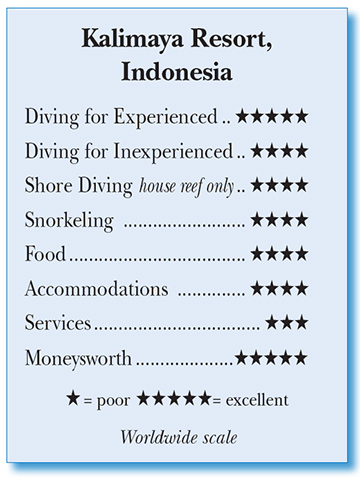 My first dive was spectacular, as the reef was
populated with healthy coral heads teeming with
life: giant frogfish, clownfish darting around their
anemone nests, crabs, and dancing shrimp. When I
inadvertently spooked a blue spotted stingray, it
shot over the sand. My second dive was even better.
I kicked along a mini-wall filled with nooks and
crannies with swarms of small tropicals, squirrelfish,
butterflyfish, filefish, and pipefish. I
found half a dozen nudibranchs, and my dive guide
spotted another half dozen I had missed. When my
guide pointed out a crocodile fish nearly a meter
long, I captured a great shot of his filigreed eyeballs,
and then photographed a giant frogfish with
a cleaner shrimp hard at work inside his gaping
mouth.
My first dive was spectacular, as the reef was
populated with healthy coral heads teeming with
life: giant frogfish, clownfish darting around their
anemone nests, crabs, and dancing shrimp. When I
inadvertently spooked a blue spotted stingray, it
shot over the sand. My second dive was even better.
I kicked along a mini-wall filled with nooks and
crannies with swarms of small tropicals, squirrelfish,
butterflyfish, filefish, and pipefish. I
found half a dozen nudibranchs, and my dive guide
spotted another half dozen I had missed. When my
guide pointed out a crocodile fish nearly a meter
long, I captured a great shot of his filigreed eyeballs,
and then photographed a giant frogfish with
a cleaner shrimp hard at work inside his gaping
mouth.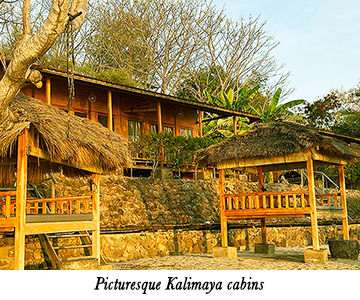 The best dive of the trip was "Canyon," an island split in two by an earthquake millions of years ago, creating a narrow swim-thru crevice 300 meters long. In the minor surge, I easily kicked past painted rocks occupied by unique little crabs. I emerged, into an utter "wow" experience of undisturbed corals on rolling hills, indeed a unique landscape. As I cruised the fields of corals, four sizeable white-tip sharks circled me, acting excited as if they had never seen a diver. With visibility greater than 100 ft., the corals appeared as an endless carpet, home to Moorish idols, surgeonfish, butterflyfish, bannerfish, and multitudes of table corals with tropicals everywhere.
 Besides the spectacular reefs, the diversity of the corals, and the massive schooling of small tropicals, Kalimaya is a macro paradise. One dive was muck for half an hour, where I found anemone crabs, dancing shrimp, harlequin shrimp, a sleeping shark, a pigmy cuttlefish, and two large adults, changing shapes, textures, and color. Kicking over to coral heads, I saw mantis shrimps darting in and out but rarely stopping long enough for a portrait. I got a great shot of a mature ribbon eel, its throat bulging with water as it sucked in plankton. And, then, there were shots of gaping green and spotted eels with cleaner shrimp dancing between their teeth. At Habibi's Fall, my guide took me to a small cave filled so thick with silver dollar fish and glassy sweepers I couldn't see the walls at times.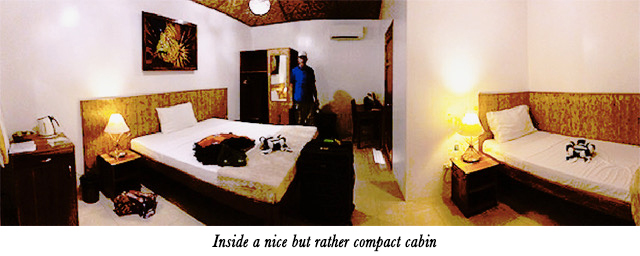
 Divers Compass: Komodo Resort was $2,303 double occupancy, and Kalimaya was $1,738 for 7 nights/6 days of diving. . . .Komodo included three dives/day, and Kalimaya two dives/ day ($50 for a third). . . . .Komodo had nitrox, Kalimaya did not. . . . .Round trip from Bali ran about $500. The boat transfer from Komodo to Kalimaya was $800 for 10 of us (there's a public ferry that takes eight hours, plus two hours to get to it and afterward to get to Kalimaya. . . . To reach Kalimaya from Bali, you fly to either Lombok or Bima . . . . Chambers are located in Labuan Bajo for Komodo Resort and Denpasar for Kalimaya (four hours by car/flight).
I want to get all the stories! Tell me how I can become an Undercurrent Online Member and get online access to all the articles of Undercurrent as well as thousands of first hand reports on dive operations world-wide

| Home | Online Members Area | My Account |
Login
|
Join
|
| Travel Index |
Dive Resort & Liveaboard Reviews
|
Featured Reports
|
Recent
Issues
|
Back Issues
|
|
Dive Gear
Index
|
Health/Safety Index
|
Environment & Misc.
Index
|
Seasonal Planner
|
Blogs
|
Free Articles
|
Book Picks
|
News
|
|
Special Offers
|
RSS
|
FAQ
|
About Us
|
Contact Us
|
Links
|
3020 Bridgeway, Ste 102, Sausalito, Ca 94965
All rights reserved.