
 |

 Email Signup
|
Subscribe
|
Login
Email Signup
|
Subscribe
|
Login
For Divers since 1975 The Private, Exclusive Guide for Serious Divers Since 1975 |
"Best of the Web: scuba tips no other source dares to publish" -- Forbes |
Go West Diving, All West Apartments, CuraçaoContents of this Issue: Go West Diving, All West Apartments, Curaçao The Curaçao Aquarium - Not for Animal Lovers Stony Coral Disease Closes Bonaire Dive Sites Cage Diving with Great White Sharks Coming to Nova Scotia? Maybe Too Many Divers and Snorkelers Reduce Molokini Fish Populations Will Insurance Issues put Caribbean Dive Operators Out of Business? Two Liveaboards Capsize and Sink in April A New Dive Site? It's Garbage! A Unique and Serious Injury at Ramon's in Belize How Special is a PADI 5-Star Designation? Full-face Snorkeling Mask Implicated Again We Can Only Dream About Petit Mustique Editorial Office: Ben Davison Publisher and Editor Undercurrent 3020 Bridgeway, Suite 102 Sausalito, CA 94965 going Dutch in the Caribbean from the May, 2023 issue of Undercurrent
Dear Fellow Diver, "You cannot miss a dive at the Aquarium," a friend told me. It's not often you travel across the world to dive in an aquarium.
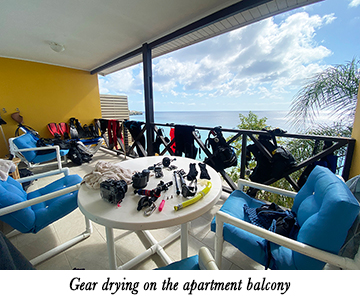
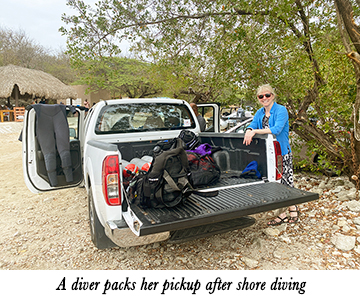
We had jumped off the jetty and swum under a low bridge that served the Royal Sea Aquarium Resort, the Curaçao Sea Aquarium, and the Dolphin Academy, unwittingly passing a concentration camp for larger marine life. As we finned past, we became part of the attraction as paid aquarium visitors watched us through a viewing port. I was angry. My buddies and I wanted to free the sad captives, but how? Concealing a pair of bolt cutters inside your wetsuit would be hard. It's a dive worth missing unless you know how to conceal those bolt cutters. With a little effort in a slight surge, we kicked to the ocean side, where eventually the coral was spectacular, and tropicals abounded. The dive center had a laid thick rope on the bottom to guide divers in and out, but returning, we got lost on the featureless sandy seabed, so we popped up to find our way back to the shore. We had driven to Ocean Encounters, a smart urban dive center, with our tanks, and for $10 each, we used their lockers and facilities to change clothes, shower, and rinse our gear. We had booked our Curaçao trip through Go West Diving, on the western edge of the island's northernmost point, and their package included a rental truck. We could grab full tanks around the clock, so we made seven shore dives -- the longest swim to the reef was about 13 minutes, the shortest 5 -- diving as long as we liked and as deep as we liked. At Alice in Wonderland, Go West's house reef, we kicked out over healthy corals and sponges to the submerged statue of Chichi, shall we say, a well-rounded Caribbean woman crafted by local artisans at Serena's Art Factory. She was not alone. Around the island, I discovered several small statues of Christian and native deities sequestered in the reef. It made diving fun. At Caracasbaai, a small tugboat sunk for divers sits in 15 feet of water, an easy swim from shore. I found an octopus doing its best to merge with the rusty metal when it should have hidden among the tube sponges adorning the wreck. My buddy spotted a seahorse among the coral and then another, and we were all startled when a large hawksbill turtle with a massive remora clinging to its shell suddenly took off in front of us. We kicked down to 60 feet, among most of the usual Caribbean fish, spotting innumerable scorpionfish lying in wait for innocent fish. After an hour, we left the water and staggered across the beach to our truck, the most strenuous part of the dive. My UK buddies and I take several dive trips annually, so we conserve our money. We stayed a two-minute drive from Go West in a one-bedroom apartment at the All West Apartments, where one of us slept on the sofa. The tired, basic, less-than-lovely apartments needed updating, but they cater to divers and had plenty of filled tanks for shore diving and a storage room for wet dive gear. We had breakfast on our patio with a beautiful ocean view, but the direct hot afternoon sun was too much to bear after a day's diving, even in late March.
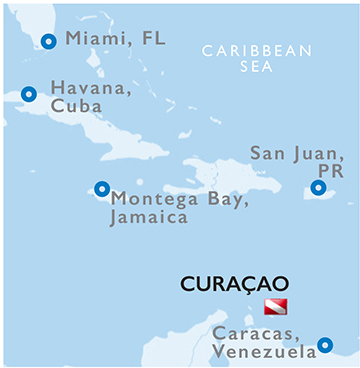
The Dutch Antilles ABC islands (Aruba, Bonaire, Curaçao) are not far off the coast of Venezuela and away from the hurricane belt, one reason the coral reefs have less damage than islands farther north. The west side wall of northern Curaçao is preserved in glorious color, with a myriad of sponges augmenting the Caribbean corals. While less vibrant than those of the Indo-Pacific, they are amazingly varied. One can shore dive on the east side, which provides spectacular blown holes in the rocks, but stumbling over the boulder-strewn seabed into big waves to get to deep water tempts a serious accident. We came to Curaçao with a book describing the shore-dive sites (The Dive Sites of Aruba, Bonaire, and Curaçao published in 2000) and purchased an up-to-date map at Go West Diving.
After our first boat dive, the guides figured out that we three didn't need looking after, but we'd generally dived loosely with the group: after about 55 minutes, the guide would send up a surface marker, and we'd all rise together. Some days, there were only seven divers; other days, we had as many as 18, so one guide accompanied each of two groups. One great thing about the boat rides -- flying fish skipped alongside us on every boat ride. Incredible. The steeply sloping reefs on the west side are covered in bright sponges and crowded pillar coral, brain coral, mushroom coral, and fan corals and decorated with colorful feather stars. Underwater reef outcrops were invariably clad with bright red sponges; some enormous orange and purple tube sponges stood several feet high. The reefs were crowded with fish life, such as southern rays, giant moray eels, snowflake morays, honeycomb morays, and snake eels. Hawksbill turtles were not uncommon. Spiny puffers lurked everywhere, and lobsters peered out from holes during daylight hours. Sadly, I saw lots of invasive lionfish despite the efforts of local divers to eradicate them. While I saw no evidence of stony coral tissue loss disease, it has reached Curaçao and is plaguing neighboring Bonaire.
We dived Black Coral Gardens with dive center manager JR Sparks, a jovial American with a flowing white beard. Like at most Curaçao dive sites, we saw a few banded shrimp and morays, including one sizeable green moray, but there was little to distinguish this site from many others. We joked that JR had taken us to a site we'd already dived and he simply changed the name.
Curaçao diving had much in common with Bonaire -- only 50 miles away -- with even a wreck similar to Bonaire's Hilma Hooker, the 100-foot-deep Superior Producer, a 165-foot freighter that sank in the harbor in 1977. But those damn cruise ships make it difficult to dive; if they're in port, no diving the wreck.
With water at 79°F, I began to chill midway during most dives. A 5mm suit wasn't enough because I had no workout during the slow, easy dives. Adam, from England's Yorkshire, wore a thick 7mm wetsuit, whereas another, Tim, wore a 3mm shorty over his 5mm. Although I've dived worldwide, I enjoyed Curaçao's easy diving conditions, excellent visibility, and calm waters. For new divers, it's a great place to get started, practice buoyancy, and see plenty of fish. We rarely ventured deeper than 60 feet and rarely used over half an aluminum 80 tank of air on a dive. Enjoy yourself. And take a pass on diving The Aquarium. -- F.M. Our Undercover Diver's Bio: A mother of two, I've been diving since 1979, but after a hiatus, became enthusiastic in the mid-'90s, visiting cold water sites such as Scapa Flow and the Outer Hebrides of Scotland, Iceland, and Vancouver Island, as well as the Caribbean, the Galapagos, Egypt, Yemen, and Chuuk. Nowadays, I often travel with friends, leaving my long-suffering husband at home tending the garden.
|


 I didn't know what to expect, but I discovered it's not a dive site called "the aquarium." It's an underwater area with several fenced pens; in one were a couple of dolphins, and in another, a lonely reef shark. That's part of The Aquarium, a SeaWorld-like tourist attraction near the capital Willemstad, and the treatment of these animals is appalling.
 Our kitchen was adequately equipped, so we picked up groceries at markets 20
minutes away. We ate like college kids, preparing meatballs and spaghetti, chicken
with patatas bravas (all frozen), tinned tuna salad, or sausage-and-mash, and
drank lots of $10 a bottle Chilean wine. I had imagined preparing more splendid
meals, and while fresh fruit was available, the only fresh vegetables were broccoli
and carrots -- I guess they travel well. The markets had no fresh fish or
meats, and while fishermen supposedly sell their catches at a nearby jetty, we saw
none. We did find a restaurant in Willemstad -- it's a picturesque mini version of
Amsterdam, a pretty little toy town, complete with a Victorian-era pontoon bridge
across St. Anna Bay -- where we could afford the burritos. We survived just fine and didn't bust our budget.
Our kitchen was adequately equipped, so we picked up groceries at markets 20
minutes away. We ate like college kids, preparing meatballs and spaghetti, chicken
with patatas bravas (all frozen), tinned tuna salad, or sausage-and-mash, and
drank lots of $10 a bottle Chilean wine. I had imagined preparing more splendid
meals, and while fresh fruit was available, the only fresh vegetables were broccoli
and carrots -- I guess they travel well. The markets had no fresh fish or
meats, and while fishermen supposedly sell their catches at a nearby jetty, we saw
none. We did find a restaurant in Willemstad -- it's a picturesque mini version of
Amsterdam, a pretty little toy town, complete with a Victorian-era pontoon bridge
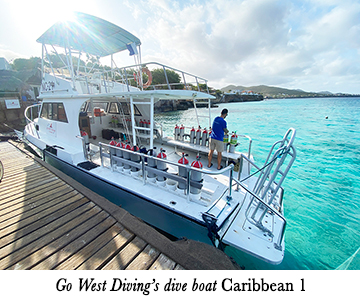
across St. Anna Bay -- where we could afford the burritos. We survived just fine and didn't bust our budget.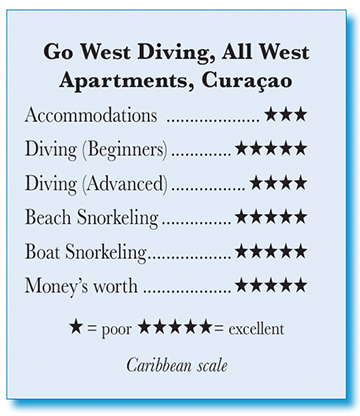 Boat dives required 10-to-45-minute trips aboard the Caribbean 1, a twin-engine 38-foot Delta Custom (they have a couple of other dive boats). I took a giant stride off the back and when I returned I grabbed the drifting tagline. When it was my turn to grab the ladder, I'd hand up my fins (they'll take your BCD/tank if you wish) and step up just a few rungs. It was all easy diving, especially for a soon-to-be grandmother.
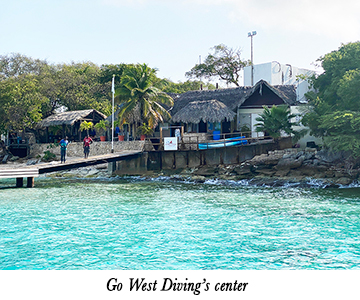 Go West Diving has a tiny parking lot with steps down to the dive center, where they check your certification at the counter and provide your rental gear. Outside are several rinse tanks, an outdoor shower, and a place to store gear overnight, and it's about 50 paces out the jetty to the dive boat. A small restaurant adjacent to the shop offers decent meals, including fresh fish; a burger, fries, and two beers cost $25.
 None of the sites had big fish, although plenty of toothy barracuda hung around, as did hoards of little trunkfish and pairs of French and gray angelfish. Massive ranks of blue tangs browsed the algae while stoplight parrotfish, porkfish, orange-colored big-eyes, and sergeant majors darted among the coral heads. Herds of yellow cowfish outnumbered the solitary scrawled filefish, and grunts clustered in the shadows. In the blue water, oceanic triggerfish often flashed silvery in the sunlight. Almost every dive was like diving in an aquarium -- but not The Aquarium.
 Watamula(from the Dutch word for watermill) at the northern tip of the island is a bit different dive. We requested a second dive there from the boat skipper, Piku, a Curaçaoan who spoke Papiamento and bowed to our request. Soft corals swayed gently in the light current. The pristine hard coral seemed larger than elsewhere, much cone-shaped and clustered, reminiscent of turrets in a medieval city. Orange and yellow crabs hid in the crevices, and spiny crabs looked positively prehistoric. A lone stingray attempted to bury itself in a tiny patch of sand. Big porcupine fish hid in the shadows, and schoolmasters hovered in bronzed groups. Besides ubiquitous adult turtles, I spotted a baby turtle that looked like it was learning to swim. I hope it had the good sense to avoid the moray lurking on the bottom. Oceanic triggerfish formed an enticing silvery curtain out in deep water. After an hour, our guide, Adam, who had let us do our own thing, sent up his surface-marker buoy, and we duly gathered around him to ascend.
 Diver's Compass: Go West Diving organized our package, which included unlimited shore diving, five two-tank boat dives, accommodations, and a Toyota pickup with two rows of seats (essential for shore diving). With our extras of food, wine, and gasoline, we spent $1300 each for our 10 nights . . . They have plenty of rental gear, including new Cressi shorties, and run boat snorkeling trips in the afternoon . . . . US dollars are widely accepted . . . . While Papiamento is the language of the ABC islands, everyone speaks English . . . . February through June is the driest period, often with no rain at all. Some rain may fall during January, July, August, and September. October, November, and December are the wettest . . . . Go West Diving rents good equipment, so save excess baggage charges by renting the heavier stuff . . . . Curaçao has a hyperbaric chamber . . . You can find videos of many of Curaçao's dive sites at:
I want to get all the stories! Tell me how I can become an Undercurrent Online Member and get online access to all the articles of Undercurrent as well as thousands of first hand reports on dive operations world-wide

| Home | Online Members Area | My Account |
Login
|
Join
|
| Travel Index |
Dive Resort & Liveaboard Reviews
|
Featured Reports
|
Recent
Issues
|
Back Issues
|
|
Dive Gear
Index
|
Health/Safety Index
|
Environment & Misc.
Index
|
Seasonal Planner
|
Blogs
|
Free Articles
|
Book Picks
|
News
|
|
Special Offers
|
RSS
|
FAQ
|
About Us
|
Contact Us
|
Links
|
3020 Bridgeway, Ste 102, Sausalito, Ca 94965
All rights reserved.