
 |

 Email Signup
|
Subscribe
|
Login
Email Signup
|
Subscribe
|
Login
For Divers since 1975 The Private, Exclusive Guide for Serious Divers Since 1975 |
"Best of the Web: scuba tips no other source dares to publish" -- Forbes |
Your Guide to Diving Micronesia
|
||||||||||||||||||||||||||||||||||||||||||||||||||||||||||||||||||||||||||||||||||||||||||||||||||||||||||||||||||||||||||||||||||||||||||||||||||||||||||||||||||||||||||||||||||||||||||||||||||||
|
Attention!
You must be an Undercurrent Online Member to view the complete members-only reports and articles. Some articles that can be fully accessed by the public have a  button.. button.. 
|
Latest Reader Reports from Micronesiafrom the serious divers who read UndercurrentAll Reader Reports from Micronesia |
All 10,000+ Reports |
Aggressor Fleet Report
in Micronesia
 "Excellent Dive Experience" filed Jun 10, 2026 by Norbert Melnick (Experience: Over 1000 dives) |
 |
|
The Aggressor Fleet has a great reputation and this trip lived up to that reputation and more. The staff was extremely professional f... ... Read more
|
|
|
Aggressor Fleet Report
in Micronesia/Palau
"Great diving, strong currents, excellent crew" filed Mar 31, 2026 by Kirsten Olson (Experience: 101-250 dives, 3 reports, Reviewer  ) )
|
|
|
We had a very enjoyable week aboard the Palau Aggressor in early January 2026. I think we hit the perfect week for weather, with very l... ... Read more |
|
|
NECO Marine Report
in Micronesia
"Good but with some issues" filed Mar 20, 2026 by Victor Kenton (Experience: Over 1000 dives, 2 reports) |
 |
|
NECO is efficiently run. On time, nice boat, prefilled Nitrox. Unfortunately, a couple of problems. On the first day, an older Aust... ... Read more |
|
|
Sam's Tours/Palau Royal Resort Report
in Micronesia
"Healthy Corals, Abundant Fish Life" filed Mar 18, 2026 by Ellen Sakoloff (Experience: 501-1000 dives, 4 reports, Reviewer )
|
|
|
[None]There were 12 divers from Marin Scuba Club, California.A few of us arrived 5 nights early to decompress from travel and explore P... ... Read more |
|
|
NECO Marine Report
in Micronesia
"Good but with some issues" filed Mar 13, 2026 by Victor Kenton (Experience: Over 1000 dives, 2 reports) |
|
|
NECO is efficiently run. On time, nice boat, prefilled Nitrox. Unfortunately, a couple of problems. On the first day, an older Aust... ... Read more |
|

| See Instant Reader Reports On All Destinations
Subscribers Can Submit a Reader Report Here |
|
Complete Articles Available to Undercurrent Online
Members; Some Publicly Available as Indicated
|
||||||||||||||||||||||||||||||||||||||||||||||
| ||||||||||||||||||||||||||||||||||||||||||||||

Micronesia Sections from Our Travelin' Diver's ChapbooksReader Reports filed for that year |
Micronesia Liveaboards | |||||||
For Members Only | |||||||
| 2026 | |||||||
For Public | |||||||
| 2025 | 2024 | 2023 | 2022 | 2020 | 2019 | 2018 | 2017 |
| 2016 | 2015 | 2014 | 2013 | 2012 | 2011 | 2010 | 2009 |
| 2008 | 2007 | 2006 | 2005 | 2004 | 2003 | 2002 | 2001 |
Land Based Dive Resorts in Micronesia | |||||||
For Members Only | |||||||
| 2026 | |||||||
For Public | |||||||
| 2025 | 2024 | 2023 | 2022 | 2020 | 2019 | 2018 | 2017 |
| 2016 | 2015 | 2014 | 2013 | 2012 | 2011 | 2010 | 2009 |
| 2009
(Marshall Islands) |
2008 | 2008
(Marshall Islands) |
2007 | 2006 | 2005 | 2004 | 2003 |
| 2003
(Midway Is) |
2002 | 2001 | |||||
Editor's Book Picks for Scuba Diving Micronesia
Including Palau, Truk (Chuuk), Yap, Bikini Atoll & Marshall Islands and Kosrae
The books below are my favorites about diving in this part of the world All books are available at a significant discount from Amazon.com; just follow the links. -- BD
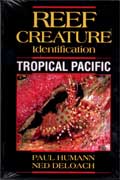 Reef Creature Identification: Tropical Pacific
by Paul Humann and Ned Deloach
Paul Humann and Ned Deloach have done it again, releasing a definitive identification guide to 1600 extraordinary reef creatures of the Tropical Pacific. with this 500+ page softbound guide, you get upwards of 2000 exceptional photos of shrimp and crabs and stars and worms and lobsters and nudibranchs and slugs and squid and bivalves . . . well, all those invertebrates that move along the reefs of this region without fining, so it seems. There are several photos of some creatures to help you identify them during different life stages, and about ten percent of the book is descriptive copy so you can tie down your identification. Even if you have no plans to go to the tropical Pacific, just to thumb through the pages, gawk at the complexity and uniqueness of these animals, and read a thumbnail sketch will give any serious diver vicarious thrills for endless hours.
Click here to buy it at Amazon.
 Reef Fish Identification: Tropical Pacific
by Gerald Allen, Rodger Steene, Paul Humann, & Ned Deloach
At last, here's a comprehensive fish ID guide covering the reefs of the Pacific and Indian Oceans. The generous 500-page text, displaying 2,500 underwater photographs of 2,000 species, identifies the myriad fishes that inhabit the warm tropical seas between Thailand and Tahiti. The concise text accompanying each species portrait includes the fish's common, scientific and family names, size, description, visually distinctive features, preferred habitat, typical behavior, depth range, and geographical distribution. This is an essential book for every diver traveling westward. 6x9 inches.
Click here to buy it at Amazon.
 Dive Sites of the Great Barrier Reef
by Neville Coleman.
With 2900 reefs in 220,000 square miles, the enormous Great Barrier Reef has incredible dives -- and some very ordinary ones. If you're contemplating a trip, Neville Coleman's Dive Sites of the Great Barrier Reef and the Coral Sea will help you ensure you pick the best. This 176 page book, with good maps and scores of colorful photos, describes the significant sites, the topography and the critters, then rates and ranks them so you can pick the best. Don't even consider a trip to Australia without consulting this. $24.95
 Indo-Pacific Coral Reef Field Guide
by Gerald R. Allen, Roger Steene.
I was trying to pack light for a change. Surely the Solomon Sea would have good identification books aboard. Not so; the only book on the boat belonged to a fellow passenger. It was one that I had not seen before, the Indo-Pacific Coral Reef Field Guide, by two of the best fish guys around, Gerry Allen and Roger Steene. The problem was this fellow passenger kept it in a plastic baggie most of the trip and I had to beg to see it. Great book, good traveling size, and it covers everything from fish, shells, marine plants, mammals, corals, and invertebrates to sea birds and more. Now I've got my own, and it won't do you any good to beg me to borrow it. This is one of two books that I will not travel to the Pacific without. Good for travel to the Red Sea, East Africa, Seychelles, Mauritius, Maldives, Andaman Sea, Malaysia, Indonesia, Philippines, Australia, Micronesia, Polynesia, and Hawaii, it has 1,800 color illustrations in a 6x8 1/2 paperback format with 378 pages. $39.95.
 There's a Cockroach in My Regulator
by Undercurrent
The Best of Undercurrent: Bizarre and Brilliant True Diving Tales from Thirty Years of Undercurrent.
Shipping now is our brand new, 240-page book filled with the best of the unusual, the entertaining, and the jaw dropping stories Undercurrent has published. They’re true, often unbelievable, and always fascinating. We’re offering it to you now for the special price of just $14.95.
Click here to order.
You might find some other books of interest in our Editor's Book Picks section.
| Home | Online Members Area | My Account |
Login
|
Join
|
| Travel Index |
Dive Resort & Liveaboard Reviews
|
Featured Reports
|
Recent
Issues
|
Back Issues
|
|
Dive Gear
Index
|
Health/Safety Index
|
Environment & Misc.
Index
|
Seasonal Planner
|
Blogs
|
Free Articles
|
Book Picks
|
News
|
|
Special Offers
|
RSS
|
FAQ
|
About Us
|
Contact Us
|
Links
|
3020 Bridgeway, Ste 102, Sausalito, Ca 94965
All rights reserved.