
 |

 Email Signup
|
Subscribe
|
Login
Email Signup
|
Subscribe
|
Login
For Divers since 1975 The Private, Exclusive Guide for Serious Divers Since 1975 |
"Best of the Web: scuba tips no other source dares to publish" -- Forbes |
Improving Rebreather Safety: Part IContents of this Issue: Mayan Princess, Roatan, Honduras Cancun, Cabo San Lucas, Fiji, Truk. . . Give Your Buddies a Free Undercurrent Subscription Improving Rebreather Safety: Part I Widow Blames Dive Gear for Death of Filmmaker Parents of Drowned Boy Sues PADI and Boy Scouts Editorial Office: Ben Davison Publisher and Editor Undercurrent 3020 Bridgeway, Suite 102 Sausalito, CA 94965 up to 10 times more dangerous than open-circuit diving from the August, 2012 issue of Undercurrent
How can rebreather diving be made safer? That was the core question at numerous presentations and discussions at Rebreather Forum 3 (RF3), held in Orlando last May. Sponsored by PADI, Divers Alert Network and the American Academy of Underwater Scientists, the conclave brought together more than 400 industry insiders from the diving, scientific, media and government communities, along with photographers and consumers, to talk rebreathers and hopefully help steer the topic forward. In his opening remarks, PADI CEO Drew Richardson proposed that the number-one goal of RF3 be contributing to rebreather diving safety and reducing incidents. The issue is of critical importance when manufacturers like Poseidon Diving Systems and Hollis, in conjunction with PADI and other training agencies, are now promoting rebreathers for recreational divers, which is a source of controversy. The concern is that rebreathers may be too complex and time consuming for a typical openwater diver who is still mastering basic diving skills. However, PADI has developed a simplified diving protocol using rebreathers designed specifically for recreational use that it believes will prove effective. Though no one knows the actual risks, there have been more than 200 reported rebreather fatalities worldwide since 1998, about 10 per year before 2005 and about 20 per year since then. On average, there are about 110 scuba diving fatalities annually in the U.S., Canada, U.K. and Europe combined. Given that there are millions of open-circuit divers compared to, at most, 15,000 closed-circuit divers, the fatality rate for rebreather diving is significantly higher than its open-circuit counterpart, as industry insiders are all too aware. During one open session, Andrew Fock, head of hyperbaric medicine at the Albert Hospital in Melbourne, Australia, asked the audience, "How many people in this room believe that the current rebreather safety record is acceptable?" No one raised a hand. Pushing the Envelope (Again) Rebreathers were primarily used by military divers until the late 1980s, when pioneers like Bill Stone, Olivier Isler, Stuart Clough and Rob Palmer began experimenting with them for cave exploration, just as technical diving was emerging. Though the early tech community seized upon their potential for extending bottom times and optimizing decompression, it wasn't until the late 1990s for the first production units like the Cis-Lunar Mk-IV, Ambient Pressure Diving's Inspiration and the KISS Classic to become available.
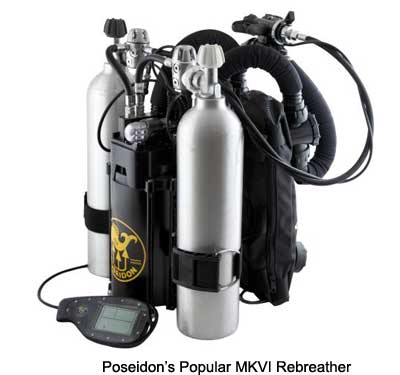
Today, rebreather diving represents one of the fastest growing areas of sport diving. Poseidon reported that it sold more of its recreational MKVI rebreathers in the last four months than in the previous two years, and PADI is certifying new recreational rebreather instructors to meet the demand. In countries such as the U.K., which is regarded as the rebreather's "ground zero," it's becoming rare to see a set of double tanks, once the norm for wreck diving, on a dive boat. ANDI, IANTD and TDI, the three oldest technical training agencies and the ones tresponsible for the majority rebreather training, estimated that they collectively issued 30,000 basic, intermediate and advanced rebreather certifications from 1990 to 2011, and will issue as many as 3,000 this year. These numbers will grow significantly as PADI recreational rebreather courses proliferate. Rebreather technology has greatly expanded the tech diver's underwater envelope, and has also been a boon to photographers and videographers. Dives that would be logistically difficult or even impossible on open-circuit are routinely done with rebreathers. However, as David Conlin from the National Park Service explained at RF3, "The real value of rebreathers is not deep diving, but staying longer at 70 to 100 feet. You can work at those depths nearly all day long when the conditions are good." Conlin reported that rebreathers have increased Park Service divers' productivity by nearly 40 percent. "We gain nearly one day for every three days we're in the field." Killing Them Softly Fock, an accomplished rebreather diver, offered an important and sobering presentation on the risks of rebreather diving, titled "Killing Them Softly." One problem he cites is the lack of an accident reporting system that records and details the cause of diver fatalities and near-misses, which inform and improve diver safety. In many cases, information about specific fatalities is sequestered, for fear of litigation. As a result, existing accident data is incomplete and, in many cases, inaccurate. Fock analyzed available data from 1998-2010 and, with the caveat that they are "best guess numbers," he concluded that rebreather diving is likely five to 10 times as risky as open-circuit diving, accounting for about 4.5 deaths per 100,000 dives, compared to about 0.4 to 0.5 deaths per 100,000 dives for open-circuit scuba. This makes rebreather diving more risky than skydiving (at .99 deaths per 100,000 jumps), but far less risky than base jumping (at 43 deaths per 100,000 jumps. He found no difference in fatality rates among manual or electronic units, or specific brands of rebreathers; accidents were roughly proportional to market share. Fock also pointed out that while the data suggests that deeper dives carry greater risks, a large number of rebreather fatalities occur in shallow depths within the recreational envelope.
Creating a Safety Culture Though veteran explorers and educators Jill Heinerth and Terrence Tysell chaired a discussion on training, the majority of the talk centered around diving culture -- what happens after training. One of the biggest safety issues is that divers become complacent and don't adhere to a pre-dive checklist when assembling and preparing their unit for diving as they (presumably) learned in class. Furthermore, they neglect required post-dive maintenance. (Some experienced rebreather divers don't follow checklists either.) Even worse, some divers choose to dive knowing there are problems with their unit, such as a faulty sensor or small leaks. Methodically working through your rebreather's checklist, which typically includes a five-minute prebreathe (and only diving if everything checks out) is the best way to insure that the unit is functioning properly and avoid problems that could jeopardize safety during the dive. The use of checklists is standard in aviation, and is increasingly becoming so in medicine, because they save lives. They must be used in rebreather diving as well. Presenters saw this problem as an issue of creating a safety culture to support rebreather diving. Richie Kohler, a technical wreck diver and shipwreck historian (he was one of the divers profiled in the best-selling book Shadow Divers), made an impassioned case for the use and efficacy of checklists in his presentation "Failure Is NOT an Option: The Importance of Checklists." During the presentation, Kohler put up a picture of eight close friends and mentors -- including his rebreather instructor -- who lost their lives as a result of pilot error. "They were not fools, but each of them made foolish mistakes and died as a result," Kohler explained. Checklists are designed to prevent such mistakes from occurring. In another session, Heinerth presented her "Five Golden Rules" for rebreather diving. They are: be properly trained for the dive you are about to conduct; follow your checklist; pre-breathe your unit; make the decision to dive (responsibly); and be prepared to abort the dive safely (with sufficient bailout gas). Heinerth told a story of being on a dive boat with five rebreather veterans. During her pre-breathe, she detected a small problem with her rebreather. She told her fellow divers she would be sitting out the dive, only to be pressured by the others to dive anyway. "It's only a minor problem," some opined to her. "You can still fly the unit manually." To her credit, Heinerth didn't back down. How do we as a community encourage divers to do checklists and support their adoption? "Industry leaders need to become role models," said Heinerth. "We need to make it cool to do checklists." She is working with industry pioneers like Richard Pyle, database coordinator for natural sciences at the Bishop Museum in Honolulu, and Kevin Gurr, CEO of VR Technology, to create a set of best practices for rebreather diving, dubbed "Blueprint For Survival 3.0." The title refers to the original set of 10 safety principles for cave diving developed by legendary cave explorer Sheck Exley in his monograph, "Basic Cave Diving: A Blueprint for Survival." The early dive technology community created a similar set of consensus standards for open-circuit diving, titled "Blueprint for Survival 2.0," which was published in the now defunct aqua- CORPS Journal. Experts agree that a number of safety issues might be resolved through better engineering. Indeed, this is the basis behind PADI's so-called "Type R" rebreathers that are suitable for recreational divers. For example, a Type R rebreather will turn itself on if the user forgets and jumps in the water, and won't operate without the scrubber canister correctly in place or if the cylinders are turned off. What is becoming clearer, however, is that better engineering solutions are needed for knowing precisely the composition of the breathing gas in the loop at any point in the dive. Unlike open-circuit diving, of course, where the fraction of gas is constant and known with certainty, the gas mix in a closed-circuit diver's breathing loop dynamically changes with every breath and gas addition. Years from now, we will likely look back at our current technology and regard it as primitive, or what explorer and engineer Bill Stone, CEO of Stone Aerospace, refers to "test-pilot era" technology. "You actually dived those units without knowing exactly what you were breathing? OMG!" It'll be like us looking back at early cave divers using J-values as reserve and empty Clorox bottles for buoyancy, and going, Really? One More Thing Though it's not the trigger, the primary cause of death in most rebreather fatalities is drowning. Some of these fatalities might have been prevented by the use of a retainer strap to hold in the diver's mouthpiece. Full-face masks and retainer straps have long been the standard in military diving, and they were also a key recommendation from Rebreather Forum 2, held in 1996. While full masks introduce other problems for our diving applications and are not very suitable to sport diving, retaining straps arguably have the potential of saving lives. Rebreather instructor Paul Haynes who is a former military diver and business development director and trainer for DIVEX, made a strong case for retainer straps at the RF3, recommending that the efficacy of using straps be taken up as a research question. "We might all consider experimenting on ourselves." In next month's issue: Part II of this article, about the problem with oxygen sensors. Michael Menduno, based in Berkeley, CA, published and edited the monthly magazine aquaCorps: The Journal for Technical Diving (1990-1996), which helped usher technical diving into the mainstream of sport diving. He also organized the first Tek, EuroTek and AsiaTek conferences, as well as Rebreather Forums 1.0 and 2.0. |


 As far as the causes or "triggers" that precipitated accidents, Fock
concluded that the source of most problems was the human-machine
interface, or so-called "pilot error," involving assembly, pre-dive preparation,
maintenance, training, and high-risk behaviors like ignoring
checklists, carrying insufficient bailout and diving beyond one's limits.
"The question is whether the risk can best be mitigated by training
[reinforced by dive culture] or engineering out potential problems, or
both," Fock said.
As far as the causes or "triggers" that precipitated accidents, Fock
concluded that the source of most problems was the human-machine
interface, or so-called "pilot error," involving assembly, pre-dive preparation,
maintenance, training, and high-risk behaviors like ignoring
checklists, carrying insufficient bailout and diving beyond one's limits.
"The question is whether the risk can best be mitigated by training
[reinforced by dive culture] or engineering out potential problems, or
both," Fock said.
I want to get all the stories! Tell me how I can become an Undercurrent Online Member and get online access to all the articles of Undercurrent as well as thousands of first hand reports on dive operations world-wide

| Home | Online Members Area | My Account |
Login
|
Join
|
| Travel Index |
Dive Resort & Liveaboard Reviews
|
Featured Reports
|
Recent
Issues
|
Back Issues
|
|
Dive Gear
Index
|
Health/Safety Index
|
Environment & Misc.
Index
|
Seasonal Planner
|
Blogs
|
Free Articles
|
Book Picks
|
News
|
|
Special Offers
|
RSS
|
FAQ
|
About Us
|
Contact Us
|
Links
|
3020 Bridgeway, Ste 102, Sausalito, Ca 94965
All rights reserved.