
 |

 Email Signup
|
Subscribe
|
Login
Email Signup
|
Subscribe
|
Login
For Divers since 1975 The Private, Exclusive Guide for Serious Divers Since 1975 |
"Best of the Web: scuba tips no other source dares to publish" -- Forbes |
Raja Ampat Dive Lodge, IndonesiaContents of this Issue: Raja Ampat Dive Lodge, Indonesia Improving Rebreather Safety: Part II Is a Caribbean Cruise for Serious Divers? More Etiquette from the Scuba Snobs Anatomy of a Dive Death Investigation One Cavern Plus Panic Equals Four Deaths Books to Make You Smarter Divers This Was a 13-Year-Old’s First Dive Editorial Office: Ben Davison Publisher and Editor Undercurrent 3020 Bridgeway, Suite 102 Sausalito, CA 94965 not all the great diving here is only by liveaboard from the September, 2012 issue of Undercurrent
Dear Fellow Diver:
Earlier that day, we started our first dive pulling ourselves by hand over the coral into the current at Cape Kri. The lodge brochure recommends bringing gloves but I didn't wear them until I sliced my thumb open hanging on at Chicken Reef. They also advise you to bring your own reef hook. My partner didn't have gloves (she accidentally left them in Singapore) or a hook, so one guide would precede her, hook the reef and pass the cord back to her. She would pull herself to the hook, where a second guide waited with the cord to his hook. In this leapfrog fashion, her "dive sherpas" got her through the initial rigorous minutes. Many dives began into the current, the logic being that if we started the dive drifting with the two-knot current, we'd blow right past the reef well before we got to the end of our 60-minute dive time and end up in blue water. So we typically pushed into the wind until we went around a corner or ascended to the top of the reef where, likely as not, the current would change vectors for a gentle drift back in the direction we had come. We would take a five- to 15-minute safety stop on top, passing over luminous displays of purple, yellow, orange and ecru dendronephthya soft corals, dotted with bi-color crinoids and packed with juvenile fish. And fish is what you will see. My count: six species of triggerfish, five species of sweetlips, four kinds of trevallies, three of barracuda, two tunas, various batfish, turtles, more butterflies than I'd ever seen, barramundi cod and so on. Of sharks, there were just black- or white-tip reefs and the ornate wobbegong, but they were on every dive. If you get tired of the big stuff, the guides will find dozens of different nudibranchs, sea horses, pipefish, shrimp, eels, etc.
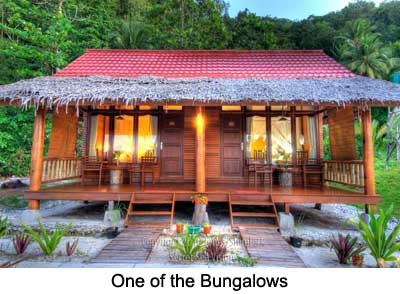
Our superior room faced the ocean, but coral, rocks and mangroves prevented any beach entry. Standard rooms were located in a row behind our two-unit bungalow. The A/C and ceiling fans provided respite from the dense July humidity. The queen bed was firm and its mosquito netting came in handy. I took Malarone as a malaria prophylaxis, and my typhoid and tetanus shots were up to date, but there's no preventative for dengue fever, so I used the netting inside and bug spray outside. The large but spartan bathroom had a roomy shower in which, water pressure being at a premium, I ran around to get wet. Staff changed towels every other day, linen at mid-week, and they cleaned rooms and made beds daily. Bottled water was provided and we were urged to refill our empties from coolers in the open-air dining room. I had signed up for four dives a day but was chagrined to learn that the fourth dive was either a Mandarinfish encounter off the dock at 5:30 p.m. or a night dive at 6:30 off the same dock. The Mandarins popped out on cue, but the dock area was lousy with lionfish, and I constantly checked my position so as not to bump into one. I finally cajoled the staff into two afternoon boat dives, but didn't get back until 6:30 p.m. when we had to hustle to clean up for dinner at 7:30. I usually knocked off after the third dive and did my logs -- quite a task when there are hundreds of species to identify but only one well-thumbed, three-volume set of fish books in the lodge. Evening would find us sipping a Bintang beer on the dock, watching the clouds turn slowly pink then tangerine. For alcohol, it's Bintang or nothing. Alcohol is not sold in airports, or rarely anywhere else, so BYOB from home. When there are more guests, meals are buffet style, but our solitary status earned us table service. Breakfasts included eggs, beef bacon or sausage, Asian noodles, fruit, cold cereals and toast. Chef Donny Indrawan pulled out all the stops at lunch. After an appetizer of cold or hot spring rolls or salad, there would be chicken or beef satay in a spicy peanut sauce, grilled calamari, chicken curry or sautéed shrimp in garlic, veggies, and a dessert of black rice pudding or ice cream and cake. Dinner followed the same pattern, with a Western dish like baked spaghetti or tenderloin of beef substituted for one of the Indonesian dishes, then fruit for dessert. After dinner, I would chat with the dive guides who dropped by to use the wi-fi in the lounge and confirm the following day's plan. The TV room was always occupied by staff members watching Indonesian shows, so I would wander back to my room to read and fall into the Land of Nod before awakening to the snare drum percussion of rain on the corrugated roof of the bungalow, followed by a rattle of branches and the tympani of the odd coconut or two. June through August is the so-called dry season, but this year, it rained every day at one time or another. We were lucky; we had two glorious days of sun and four overcast days when it rained on and off.
Our gear would already be set up on the boat. The aluminum 80s were always filled to 3300 psi by a new electric compressor 150 feet upwind of the diesel generator. By 8 a.m., we were off on a 30-minute ride on mostly flat seas to nearby reefs. By 12:30 p.m., we'd be back for lunch, rinsing our suits in the tank reserved for rubber. However, by mid-week, I figured out that suits were the only things being rinsed. My regulator and backpack were given just a quick hose-off on the boat, and the wings slowly whitened with salt. There was a separate tank at the shop for cameras and computers, one for suits, one for booties, and another for masks, fins and snorkels, but only the suit and camera tanks were filled. The dive shop had an open storage area with a milk crate for each of us, and a shower allowed us to clean up before lunch. The camera room was never opened, nor was there a photo pro on site. After a dive, handing up my weights and BC before climbing the narrow ladder made a lot more sense than trying to wedge myself and my gear under the lowhanging sun cover. After banging my head several times on the pipes supporting the cover and conducting an ad-hoc class in colloquial English, I also learned not to stand upright in the boat.
An all-day, three-tank trip to the north end of Gam Island was nixed because of rough water, so Kris took us to his favorite spot, Citrus Ridge, a saddle between Gam and Yangelo where the "bommies are full" of yellow and orange soft corals, open and feeding in the current. We stayed with a banded sea krait, a poisonous sea snake with a tiny mouth, for five minutes as it foraged in the coral heads. At Manta Sandy, a line of rocks denotes a highway down which the rays are supposed to pass on cue. However, no one told Manta Central Casting, so my partner wandered off on her own and then frantically banged on her tank when the manta swam through the 80-foot visibility, while the rest of us were amusing ourselves watching the blind shrimp and goby show in the sand. I spotted a large scribbled puffer hanging above the reef and slowly sidled up next to him until we were side by side, only two feet of water separating us. The fish at Raja have no fear. Between dives the boat would stop at a village or small island, and the guys would serve coffee or tea, cake or fruit, and large bottles of water. At the islet of Friwen, hundreds of giant fruit bats wheeled overhead in a perfect blue sky. That afternoon at Chicken Reef, the guides motioned me to a vantage point behind a small coral head form, where I watched three black-tips and three giant trevally thrash a school of baitfish. Passing a vast field of blue coral at Kembuba Reef, we parted a river of thousands of yellowtail fusiliers, one bank blending into the blue beneath us, one burnished bronze by the sun above. Rounding the northeast corner, the slope was darkened by clouds of small-toothed emperors accompanied by a few dozen long-nose emperor guards. Further on, blue triggers consorted with humpback unicorns aided by blue surgeons. Rising to a pastel seascape of soft corals, we surfaced at a deserted white sand beach, and rested on calm water near arching palms. Is it remote? Yes. Is it hard to get to? Yes. Does it lack a few amenities? Yes. Could the dive operation benefit from an on-site professional? Yes. Was this flat-out the most outrageous fish-and-critter-rich diving I have ever done on the healthiest reefs I have ever seen and do I wish I was there now? Yes. -- D.L.
|


 Ting ting! Rico Londam, my dive guide,
rapped his steel pointer on his tank. Blacktip
reef sharks were down the coral slope.
Ting ting! Guide Jamie Lambaihang tapped his
own tank. Bumphead parrotfish were grazing
the top of the reef. Ting ting! A school of
yellow-tail barracuda. Ting ting! Several
hundred horse-eye trevally whirled in a slow
silver vortex. Ting ting! Come look at this
pygmy seahorse! Ting ting! Ting ting! My
head was swiveling off my shoulders, and I
was making no progress in our drift along
Crossover Reef in the Dampier Strait of Raja
Ampat. How could I possibly be expected to see the entire reef if we stopped
every minute to see a new wonder,
or in the case of schools of fish,
thousands of wonders? This was my
last dive of the 19 I made at Raja
Ampat Dive Lodge, and there were
four guides in the 83-degree water
with me and my partner, the only
two guests at the lodge that week
in July (it was entirely booked
for August).
Ting ting! Rico Londam, my dive guide,
rapped his steel pointer on his tank. Blacktip
reef sharks were down the coral slope.
Ting ting! Guide Jamie Lambaihang tapped his
own tank. Bumphead parrotfish were grazing
the top of the reef. Ting ting! A school of
yellow-tail barracuda. Ting ting! Several
hundred horse-eye trevally whirled in a slow
silver vortex. Ting ting! Come look at this
pygmy seahorse! Ting ting! Ting ting! My
head was swiveling off my shoulders, and I
was making no progress in our drift along
Crossover Reef in the Dampier Strait of Raja
Ampat. How could I possibly be expected to see the entire reef if we stopped
every minute to see a new wonder,
or in the case of schools of fish,
thousands of wonders? This was my
last dive of the 19 I made at Raja
Ampat Dive Lodge, and there were
four guides in the 83-degree water
with me and my partner, the only
two guests at the lodge that week
in July (it was entirely booked
for August).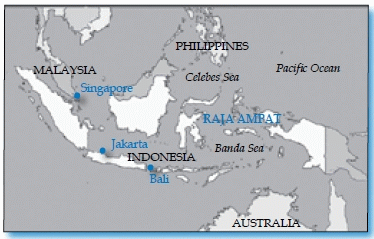 This profusion of life is not easy to get reach. We flew from New York to
Singapore and decompressed before flying all night to Jakarta, Makassar and
Sorong, where we were met by Jamie and another guide, Kris Pinustena, at 8 a.m.
After shopping for snacks, they took us to the dock for a two-and-a-half hour
boat ride to the resort. We passed through a large pod of dolphins and a pocket
of marlin before gliding up to the hilly island of Mansuar, with its palm
trees lit gold in the noon sun. Just east of Mansuar is Kri Island, home to
Kri Eco Resort and Sordido Bay Resorts. Despite our being the only two guests,
the lodge, built in 2009, still had a full complement of 40 staff members. When
short of divers, it offers locals from Sorong rooms at half price for the weekend.
Eight Coast Guard men arrived with their families on a patrol boat, which
they used to ferry the kids to snorkeling spots.
This profusion of life is not easy to get reach. We flew from New York to
Singapore and decompressed before flying all night to Jakarta, Makassar and
Sorong, where we were met by Jamie and another guide, Kris Pinustena, at 8 a.m.
After shopping for snacks, they took us to the dock for a two-and-a-half hour
boat ride to the resort. We passed through a large pod of dolphins and a pocket
of marlin before gliding up to the hilly island of Mansuar, with its palm
trees lit gold in the noon sun. Just east of Mansuar is Kri Island, home to
Kri Eco Resort and Sordido Bay Resorts. Despite our being the only two guests,
the lodge, built in 2009, still had a full complement of 40 staff members. When
short of divers, it offers locals from Sorong rooms at half price for the weekend.
Eight Coast Guard men arrived with their families on a patrol boat, which
they used to ferry the kids to snorkeling spots.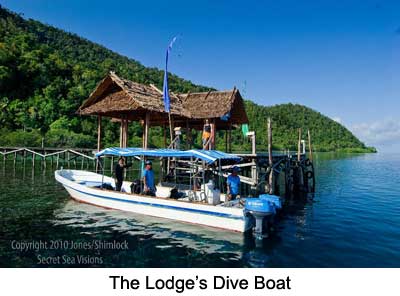 At 7:45 a.m., I would pull on my damp suits and shake my booties. I'm
referring not to the sway of my posterior, but rather a method of dislodging any
insect having sought overnight refuge in my footwear. No kidding. Once, I found
a cricket the size of my forefinger in a dive sock. When I unknowingly stuck my
foot in, I thought it was the dreaded Black Scorpion of Mansuar, to the great
glee of my partner.
At 7:45 a.m., I would pull on my damp suits and shake my booties. I'm
referring not to the sway of my posterior, but rather a method of dislodging any
insect having sought overnight refuge in my footwear. No kidding. Once, I found
a cricket the size of my forefinger in a dive sock. When I unknowingly stuck my
foot in, I thought it was the dreaded Black Scorpion of Mansuar, to the great
glee of my partner. The guides were friendly,
attentive, interested in our wellbeing,
and adept at finding macro
life, but they were guides, not
divemasters or instructors. While
the boats had first-aid kits and
DAN double oxygen kits, there were
no radios. Communication with the
lodge was by cell phone. When I
asked what they would do if a
diver was lost, they said they
would call the lodge manager, who
would in turn phone the authorities on Sorong, and then make individual calls
to the Kri lodges and liveaboards in the area. Several times, we surfaced to
find the boat hundreds of yards away and had to use our Dive Alerts in unison
to get their attention. We were often within swimming distance of land, and
liveaboards and other craft were in the area, yet watching the driver pull the
starter cord on one engine a dozen times before it caught made me cognizant of
where I was.
The guides were friendly,
attentive, interested in our wellbeing,
and adept at finding macro
life, but they were guides, not
divemasters or instructors. While
the boats had first-aid kits and
DAN double oxygen kits, there were
no radios. Communication with the
lodge was by cell phone. When I
asked what they would do if a
diver was lost, they said they
would call the lodge manager, who
would in turn phone the authorities on Sorong, and then make individual calls
to the Kri lodges and liveaboards in the area. Several times, we surfaced to
find the boat hundreds of yards away and had to use our Dive Alerts in unison
to get their attention. We were often within swimming distance of land, and
liveaboards and other craft were in the area, yet watching the driver pull the
starter cord on one engine a dozen times before it caught made me cognizant of
where I was. Divers Compass: I booked with Diversion Dive Travel, the
Australian agency that handles reservations for the lodge (
Divers Compass: I booked with Diversion Dive Travel, the
Australian agency that handles reservations for the lodge ( 
I want to get all the stories! Tell me how I can become an Undercurrent Online Member and get online access to all the articles of Undercurrent as well as thousands of first hand reports on dive operations world-wide

| Home | Online Members Area | My Account |
Login
|
Join
|
| Travel Index |
Dive Resort & Liveaboard Reviews
|
Featured Reports
|
Recent
Issues
|
Back Issues
|
|
Dive Gear
Index
|
Health/Safety Index
|
Environment & Misc.
Index
|
Seasonal Planner
|
Blogs
|
Free Articles
|
Book Picks
|
News
|
|
Special Offers
|
RSS
|
FAQ
|
About Us
|
Contact Us
|
Links
|
3020 Bridgeway, Ste 102, Sausalito, Ca 94965
All rights reserved.