
 |

 Email Signup
|
Subscribe
|
Login
Email Signup
|
Subscribe
|
Login
For Divers since 1975 The Private, Exclusive Guide for Serious Divers Since 1975 |
"Best of the Web: scuba tips no other source dares to publish" -- Forbes |
For Regulators, Light is RightContents of this Issue: S/V Mandarin Siren, Raja Ampat, Indonesia The Latest Smuggling Device: Scuba Scooters The Cost of Search and Rescue Missions For Regulators, Light is Right Think Twice Before Putting Your Gear in Rinse Tanks Legal Complications of Being Injured Abroad Is Closing Reefs to Divers the Best Way to Protect Them? Editorial Office: Ben Davison Publisher and Editor Undercurrent 3020 Bridgeway, Suite 102 Sausalito, CA 94965 seven lightweight regulators that are heavy duty for dive trips from the March, 2011 issue of Undercurrent
Your regulator is not the heaviest item of equipment you might carry to an exotic diving destination; however, manufacturers have latched on to the appeal of producing lightweight equipment to save excess-baggage charges. I guess if you can save a couple pounds, you can carry a few extra T-shirts instead, and as someone who is often reduced to the minimum when it comes to packing clothes, it certainly appeals to me. Working as a team with Nigel Wade, a veteran of comparison tests, I got hold of the seven regulators sold in the U.S. that weigh the least in their given brand line-ups and we tried them at depth, side-by-side. We conducted the tests at Taba in Egypt, close to the border with Israel, because there is deep, clear water near the shore, and we were able to dive without interruption or the need for a boat. We made several dives with each regulator, each of us using them two at a time on our independent twin-tank setups. Leisure divers rarely go deeper than 100 feet while on vacation, so we settled on 140 feet, while breathing Nitrox 30, as our test depth, probably the greatest depth a single-tank diver is likely to find himself at, even in an emergency.
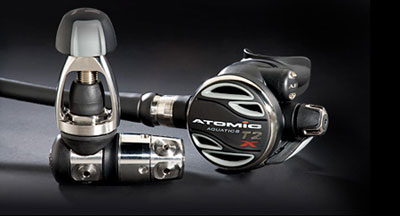
It's important to know that your regulator will perform to expectations, especially if you find yourself sharing via an octopus with another diver at that depth. We checked to see if each one was capable of delivering gas to two divers who might be breathing heavily while sharing off an octopus at depth. We inverted each one, as a panicking diver might in an air-sharing situation, to find out how viable each was under those circumstances. We checked out the efficacy of the purge control of each and let each drop from the mouth as a diver might carelessly, to find out what loss of gas might be encountered. The Venturi plus/minus (dive/pre-dive) control was compared at depth to see if it made a difference. Lastly, we looked at how disruptive the flow of exhaust bubbles was when a diver was stationary and looking directly forward. We weighed them as first and second-stage only, connected by the hose, and not with any octopus rigs fitted. A-clamp versions naturally weigh more, because of the extra metal, than those with DIN connections. Here are the results, listed in alphabetic order by manufacturer. Apeks Flight (A-clamp); 1.6 pounds; $760 list price. When the people at Apeks set out to make the world's lightest regulator, they employed new high-tech thermoplastics so that the second stage was as light as can be. The diaphragm-style first stage is still a bit of a lump, but it continues with the Apeks tradition of top performance at depth. It has an ingenious design that comprises a strong, forged solid brass skeletal body, surrounded by the plastic jacket material. The two are connected by a lightweight, intermediate braided hose with a unique connection that disbars the diver from swapping to a longer hose if that was preferred. By the second dive, the action of breathing had become slightly wet, suggesting a poorly-located exhaust mushroom valve. The inter-stage pressure was obviously set too high, because the pressure would build up between breaths, causing the second stage to bleed gas. With two divers inhaling as hard as possible at depth, the delivery was as generous and sure as at any other time. Inverted, it was wetter, with bigger droplets of water to contend with than we would have liked. The purge button was disappointing because if you pressed the wrong part, the purge was weak and, in some places, it would not purge at all. When it was at full flow, it felt strong enough to purge the regulator, but we did not feel that any air rushed into the mouth. When dropped carelessly from the mouth, it did not free flow at all, excellent in that respect. There seemed to be no discernable effect with the Venturi lever in either position while at depth. Exhaled bubbles were relatively disruptive to vision when stationary. Overall, it was a very comfortable regulator to use at any depth, although we felt the example we were using could have been improved by a competent technician. We were expecting big things from Apeks, but all the other regulators tested seemed at least as adequate when breathing normally from them. (www.aqualung.com/us/content/view/102/280) Atomic T2X (A-clamp); 1.85 pounds; $1,550. This titanium, balanced-piston first stage weighs little. It is combined with a second stage that has a unique, automatic depth-sensitive Venturi adjustment and a comfortable mouthpiece. One unusual design feature means the valve seat stays out of contact with the poppet, so there's no engraving during storage with subsequent unwanted free-flows. It doesn't need servicing for up to three years. It squeaked and creaked at first at the surface, but not when it was submerged, where it provided a wide funnel of air that diffused into the mouth, thanks to a wonderful mouthpiece and the beautifully machined universal joint on the hose junction that takes the stress out of hose routing. Inverted, it provided only a fine mist of water that was totally manageable for uninterrupted breathing. The Venturi was depth-sensitive and automatically adjusted, but it did tend to momentarily gush a free-flow when carelessly dropped out of the mouth. Once the valve cracking- pressure control was turned down a little, it wouldn't do it. Turning it face-up stopped that immediately, too. The purge control was sublime in its efficacy, easy to locate, and gave total control of how much air it passed to the diver, although we had to push it in a long way to get a lot of flow, when it will give a full tonsil rattling. With two up breathing heavily, there was no discernable difference in its performance. The exhaust-T was not totally perfect for no visual disruption but overall, it really instilled confidence and was excellent. The price says it all. (www.atomicaquatics.com)
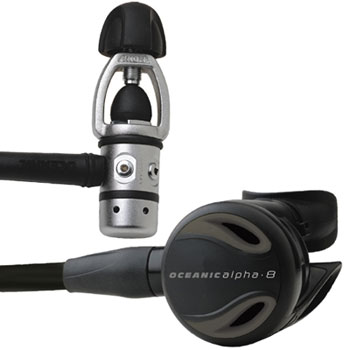
Beuchat VRT 30 (A-clamp); 2.3 pounds; $275. It never ceases to surprise us that Beuchat is often considered to be a new brand when it is probably the longestestablished French manufacturer of dive gear. In fact, it makes a lot of stuff on behalf of other brands, too. This VRT 30 has a very nice and neat second stage, combined with a beautifully finished piston-style first stage. That said, it was the only one that did not give sufficient space between the ports to allow convenient fitting of a gas-integrated computer transmitter, and it was among the heaviest tested here. Inverted, it felt wet, with large droplets of water to deal with, making it feel very uncomfortable and certainly wetter than I would have liked. The purge control was small but instantly accessible, progressive from weak to strong, delivering plenty of air, without any pitfalls. It doesn't overflow. We thought it was comfortable to breathe from. There were no squeaks when sipping air. It gives a lot of confidence because it doesn't feel like it's going to let you down. We thought it to be a good workhorse regulator. It did not free flow whatsoever when dropped from the mouth at depth with the Venturi switch on minus, but free flowed alarmingly on the plus position. The exhaust-T was very small, and exhaled bubbles caused some disruption of vision when stationary. The first stage fluttered like hammer-drill, with two of us inhaling hard together from two second stages connected to it while at depth. It was not the biggest performer, but very adequate, and despite its failings under duress, I favored it for comfort over the one I had alongside it during our long ascents. (www.beuchat-usa.com) Cressi Ellipse Black MC5 (DIN) 1.6 pounds; $300. This Ellipse has a little MC5 diaphragm-type first stage, combined with a lightweight second stage that has a novel oval shape. Although it had a slightly mechanical feel, the effort of breathing could not be faulted. Even with two divers heaving off it as hard as they could at 130 feet, it delivered without hesitation, though it might have been a little noisier at this time than some others. The purge seemed gentle, and we looked for a sweet spot, thinking it might provide a big rush of gas, but it did not. However, it cleared the regulator of water in a moment, and there was not a hint of an uncontrollable free flow. Carelessly dropped from the mouth, it released air only for a moment, despite the position of the Venturi control. In fact, the Venturi control made little difference to breathing at depth, so I left it permanently in the minus position. Inverted, it proved to be one of the drier we tried, at all angles. Exhaled bubbles came up straight around the face when looking straight ahead, and I chose to incline my head nose-down to counteract that. (www.cressi.it/Catalogue) Halcyon Aura/H50D (DIN with 40-inch hose); 2.1 pounds; $490. If you have mistaken this for a Scubapro Mk17 diaphragm first stage combined with an R395 second stage, you may be forgiven. Taking on a new aura and wearing the colors of the Halcyon brand, this high-performing, cold-water regulator is very comfortable. It felt lightweight and gave a nice, comfortable breathe, although the gas supply felt diffused, filling my mouth without being whooshy. There was no degradation of performance with two divers breathing from it as hard as we could at the maximum depth. The purge is easy to locate, and was positive and progressive with little resistance, delivering more than enough gas with a powerful blast if required. Inverted, it could still be comfortably breathed from, despite an ingress of water that was turned into a fine mist. When dropped from the mouth at depth, it steadfastly refused to free flow in any Venturi setting; neither did these settings appear to affect the work of breathing at depth. The exhaled bubbles were a little disruptive, coming up in front of my eyes when looking straight ahead. (www.halcyon.net) Mares Carbon 42 (A-clamp); 2.2 pounds; $1,000. Carbon fiber is used extensively in the airframes of airliners, so it's no surprise to find a regulator manufacturer using it in a second stage, despite it looking a bit like recycled plastic. This one combines with the mini M42 diaphragm-type first stage and lightweight braided hose to provide a low, all-up weight. Having said that, the first stage is heavier than would at first appear. Nevertheless, the port arrangement of this first stage made hose-routing a dream. We found no change in performance under the duress of two heavy breathers at depth. Inverted, it was slightly damp because of a fine mist but still very usable. The valve could be heard opening and closing. The purge control was easily accessed, progressive in action from weak to medium flow, and obviously better when shallower than 65 feet, but with no tremendous rush of air that can catch an unsuspecting diver off-guard. It gave a nice comfortable breathe, and delivered air at all rates with a low, cracking pressure, and no squeaks when only sipping air. Although it obviously has a big capacity to deliver, the valve was slightly hesitant to crack open and start the flow on each breath. It steadfastly refused to free-flow when casually dropped out of the mouth at depth. There were no adjustments to play with. It has a nice mouthpiece and felt very lightweight in the mouth. Exhaust bubbles are distributed nicely and well directed away from the eyes, but I could feel the exhaust port resting on my chin, which was slightly distracting. (http://carbon.mares.com) Oceanic Alpha 8 SP5 (A-clamp); 2.2 pounds; $280. Since we started doing these deep-water comparisons, the bottom-of-the-range Alpha second stage, combined with a piston-type first-stage, has always surprised us by performing so well. No wonder it's often been the choice for use for divers who go deeper than most. This is its latest incarnation and it begs the question: Do you need to pay more? It felt comfortable and lightweight in the mouth, and there was no creak or creep, no noise to speak of, and its second-stage is unobtrusive. General breathing comfort was good, although the air felt like it came into the mouth in a narrow cone. There was absolutely no discernable difference with two divers heaving heavily on it at 130 feet deep. When dropped from the mouth at depth, it emitted a light flow of air that stopped almost immediately. There was no Venturi adjustment. Inverted, it gave a totally dry breathe at nearly all angles. Its purge button was easy to feel for and gave a good range of airflows, depending on how hard it was pushed. The exhaust-T was very small, so exhaled bubbles were quite obtrusive and disruptive of vision when the diver was stationary. (www.oceanicworldwide.com) John Bantin is the technical editor of DIVER magazine in the United Kingdom. For 20 years, he has used and received virtually every piece of equipment available in the U.K. and the U.S., and makes around 300 dives per year for that purpose. He is also a professional underwater photographer. |



I want to get all the stories! Tell me how I can become an Undercurrent Online Member and get online access to all the articles of Undercurrent as well as thousands of first hand reports on dive operations world-wide

| Home | Online Members Area | My Account |
Login
|
Join
|
| Travel Index |
Dive Resort & Liveaboard Reviews
|
Featured Reports
|
Recent
Issues
|
Back Issues
|
|
Dive Gear
Index
|
Health/Safety Index
|
Environment & Misc.
Index
|
Seasonal Planner
|
Blogs
|
Free Articles
|
Book Picks
|
News
|
|
Special Offers
|
RSS
|
FAQ
|
About Us
|
Contact Us
|
Links
|
3020 Bridgeway, Ste 102, Sausalito, Ca 94965
All rights reserved.