
 |

 Email Signup
|
Subscribe
|
Login
Email Signup
|
Subscribe
|
Login
For Divers since 1975 The Private, Exclusive Guide for Serious Divers Since 1975 |
"Best of the Web: scuba tips no other source dares to publish" -- Forbes |
Two Inexpensive Weapons against Jellyfish StingsContents of this Issue: Morning Star, Blackbeard's Cruises, The Bahamas Two Inexpensive Weapons against Jellyfish Stings Kungkungan Bay Resort, North Sulawesi, Indonesia Looking for the Strong and Sturdy Blue Cross/Blue Shield Won't Cover Bent Diver's Chamber Costs You've Come a Long Way, Nitrox Is Diving Off Limits for Pregnant Women? Divers' Feedback on Global Warming Editorial Office: Ben Davison Publisher and Editor Undercurrent 3020 Bridgeway, Suite 102 Sausalito, CA 94965 from the March, 2007 issue of Undercurrent
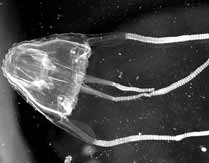
The delicate jellyfish is one of the ocean’s most-feared creatures. Already more than a dozen people have felt its sting in north Queensland during Australia’s summer season. But medical researchers have found two easy ways to reduce the pain.
Queensland hospitals have started giving magnesium sulphate infusions to patients suffering from stings after finding that the compound helps to shut off the body’s automatic response to the venom. The treatment was most recently tested on Welshman Chris Newbrook, who was snorkeling in the Whitsunday Islands during his honeymoon in December when he was attacked by an Irukandji. After the sting to his neck brought on chest pains and difficulty in breathing, he was airlifted to the hospital and spent two days in intensive care. His symptoms quickly diminished after he was treated with magnesium, and he was released soon after. |

 Australian doctors say that hot
water is the most effective way to
relieve the pain of any jellyfish
sting. According to a new study
in the Medical Journal of Australia,
doctors and medical students
in Western Australia purposefully
stung themselves with jellyfish to compare four treatments—
ice, vinegar, aluminum sulphate and hot water. The
latter was the only successful treatment, relieving 88 percent
of the pain, while the other treatments were only temporary.
Sting patients treated with hot water at 115 degrees
Fahrenheit got significant pain relief in 4 to 10 minutes,
and the heat also appeared to stop inflammation. (Another
traditional treatment was a stream of urine, but 98.6 degrees
doesn’t qualify as hot enough.) The doctors think the hotwater
treatment can also be a good pain blocker even with
more serious jellyfish stings.
Australian doctors say that hot
water is the most effective way to
relieve the pain of any jellyfish
sting. According to a new study
in the Medical Journal of Australia,
doctors and medical students
in Western Australia purposefully
stung themselves with jellyfish to compare four treatments—
ice, vinegar, aluminum sulphate and hot water. The
latter was the only successful treatment, relieving 88 percent
of the pain, while the other treatments were only temporary.
Sting patients treated with hot water at 115 degrees
Fahrenheit got significant pain relief in 4 to 10 minutes,
and the heat also appeared to stop inflammation. (Another
traditional treatment was a stream of urine, but 98.6 degrees
doesn’t qualify as hot enough.) The doctors think the hotwater
treatment can also be a good pain blocker even with
more serious jellyfish stings. 
I want to get all the stories! Tell me how I can become an Undercurrent Online Member and get online access to all the articles of Undercurrent as well as thousands of first hand reports on dive operations world-wide

| Home | Online Members Area | My Account |
Login
|
Join
|
| Travel Index |
Dive Resort & Liveaboard Reviews
|
Featured Reports
|
Recent
Issues
|
Back Issues
|
|
Dive Gear
Index
|
Health/Safety Index
|
Environment & Misc.
Index
|
Seasonal Planner
|
Blogs
|
Free Articles
|
Book Picks
|
News
|
|
Special Offers
|
RSS
|
FAQ
|
About Us
|
Contact Us
|
Links
|
3020 Bridgeway, Ste 102, Sausalito, Ca 94965
All rights reserved.