
 |

 Email Signup
|
Subscribe
|
Login
Email Signup
|
Subscribe
|
Login
For Divers since 1975 The Private, Exclusive Guide for Serious Divers Since 1975 |
"Best of the Web: scuba tips no other source dares to publish" -- Forbes |
Your Guide to Diving Antigua
|
|||||||||||||||||||||||||||||||||||||||||||||||||||||||||||||||||||||||||||||||||
|
Attention!
You must be an Undercurrent Online Member to view the complete members-only reports and articles. Some articles that can be fully accessed by the public have a  button.. button.. 
|
Latest Reader Reports from Antiguafrom the serious divers who read UndercurrentAll Reader Reports from Antigua |
All 10,000+ Reports |
|
Indigo Divers /Jolly Beach Resort Report
in Antigua
"Better than expected" filed Nov 27, 2023 by Bevan Ratciffe (Experience: 501-1000 dives, 3 reports, Reviewer  ) )
|
 |
|
The Jolly Beach Resort is an older resort recently reopened after the pandemic. It has been painted up but lots of little things like b... ... Read more |
|
|
DiveCarib/Hodges Bay Resort Report
in Antigua/Falmouth Harbor
"Family Trip with Diving" filed Nov 26, 2022 by Van Freidin (Experience: Over 1000 dives, 10 reports, Sr. Reviewer  ) )
|
|
|
2nd day for diving was about 45 minute drive from the resort. Traffic is light and having a private van on call for the 10 days made ev... ... Read more |
|
|
Indigo Divers/Hodges Bay Resort Report
in Antigua
"Fun island. Underwater OK" filed Nov 26, 2022 by Van Freidin (Experience: Over 1000 dives, 10 reports, Sr. Reviewer )
|
|
|
Our first dive was less than perfect. We entered the water and grabbed a current line, where we hung on for dear life, waiting for othe... ... Read more |
|
|
Jolly diving Report
in Antigua
"fabulous extremely informal dive operation" filed Sep 26, 2019 by marc (Experience: Over 1000 dives, 6 reports, Reviewer )
|
 |
|
[None]Paul Roos and his Wife Cornelia Wagentrotz love diving and are extremely conscientious engaged and helpful. we had them pick us ... ... Read more |
|
|
Care Less Diving Report
in Antigua/deep
"Yet even <5 more testing -- ignore" filed Apr 13, 2019 by Dave Eagleray (Experience: 251-500 dives) |
|
|
some tests < 5 and
<4 and
<$ xyz
lorem ipsum ...... ... Read more
|
|

| See Instant Reader Reports On All Destinations
Subscribers Can Submit a Reader Report Here |
|
Complete Articles Available to Undercurrent Online
Members; Some Publicly Available as Indicated
|
||||||||
|
| |||||||
Antigua Sections from Our Travelin' Diver's ChapbooksReader Reports filed for that year |
Land Based Dive Resorts in Antigua | |||||||
For Members Only | |||||||
For Public | |||||||
| 2024 | 2023 | 2020 | 2019 | 2017 | 2014 | 2012 | 2009 |
| 2008 | 2005 | 2003 | 2002 | ||||
Editor's Book Picks for Scuba Diving Antigua
The books below are my favorites about diving in this part of the world All books are available at a significant discount from Amazon.com; just follow the links. -- BD
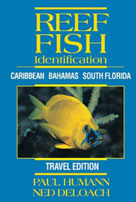 Travel Edition of Reef Fish Identification: Caribbean, Bahamas,
South Florida
Travel Edition of Reef Fish Identification: Caribbean, Bahamas,
South Florida
by Paul Humann and Ned DeLoach
Today's airline weight restrictions not only limit the amount of dive gear and cameras you can pack for overseas trips, but also those valuable prized marine life identification books. And with spotty Internet access overseas, it's not like you can look a critter of or fish up easily online. For the divers who still want a book in their hands post-dive to look up the fishes they encounter, Paul Humann and Ned DeLoach are offering "Travel Edition of Reef Fish Identification: Caribbean, Bahamas, South Florida." It's lightweight enough to thrown in your carry-on but rugged enough to withstand frequent saltwater washings on board.
Click here to buy it at Amazon.
 World Atlas of Coral Reefs
by Mark D. Spalding, Corinna Ravilious,
Edmund P. Green, United Nations World Conservation Monitoring Center.
If there is one book that belongs in every traveling diver's library, this is it. The superb World Atlas of Coral Reefs has everything you want to know about the reefs from Costa Rica and Cuba to the Coral Sea and Cayman. The information is specific and up to date. The photos, maps and layout superb. And the price, for this 424 page, full color, hard bound volume, is a steal at $31.50
The Atlas was released in September by the United Nations World Conservation Monitoring Center to document and conserve the world's coral reefs. Clearly written with divers in mind, it's an invaluable resource for global travelers. Here's what you'll find.
- 94 maps, including global maps of biodiversity and reef stresses, regional maps showing 3-D bathymetry and high resolution maps showing reefs, mangroves, population centers, dive centers and protected areas.
- 280 color photographs, showing reefs, wildlife, people and places, Including 84 photographs taken from space by Shuttle astronauts.
- Text explaining the formation, structure and ecology of coral reefs; their various uses and abuses at the hands of humans; and the techniques used in coral reef mapping.
- Detailed texts describing the distribution and status of coral reefs in every country.
- Data tables listing information on biodiversity, human use, and protected areas. These include statistics on coral reef area, biodiversity, fish consumption, and threats.
For example, you can learn about pollution damage to the reefs at Providenciales and the lack of human impact, as well. Or, where extensive bleaching took place in Honduras 1998. You'll read that Milne Bay in Papua New Guineas has the most extensive reef system in that country and where, in Fiji, the bumphead parrotfish and tridachna clams will not be found, thanks to overfishing. Order now.
 |
 |
 |
The Reef Set: Reef Fish, Reef Creature and Reef Coral (3 Volumes):
Paul Humann ID Books
by Paul Humann, Ned Deloach
The three set fish, creature and coral ID books by Paul Humann are the unparalleled sources for information on Caribbean sea life and identification. Paul and his partner Ned Deloach recently released updated and expanded editions of each, with scores of new critters, even better photos, and information unavailable anywhere else. Why, the Reef Fish Identification book, at more than 500 pages, is 20 percent larger than the previous volume, which came out in 1994. Whenever I travel to the Caribbean, I tote all three books and spend my down hours figuring out what I saw and where to look to find rare creatures. Paul's splendid Reef Creature book (420 pages), covers sponges, nudibranchs, octopus, crustaceans, Christmas tree worms and plenty more. His Reef Coral ID book (276 pages) helps you identify all the hard and soft corals, spawning, and even the growth on top of corals, as well as algae and other plant life. Beginners may want to ID only fish, but I'd recommend that all three books be part of every diver's library. And, if you have an old set, by all means replace it. You'll be delighted at the additions and improvements. Each book normally retails for $40, but are discounted when you order here. And the boxed 3-volume set is available now at a bigger discount, up to 30%. Click below to buy them at Amazon:
* Reef Fish Identification: Florida Caribbean Bahamas,
* Reef Creature Identification: Florida Caribbean Bahamas, and
* Reef Coral Identification: Florida Caribbean Bahamas
* The Boxed Set of all three (you can save up to 30%)
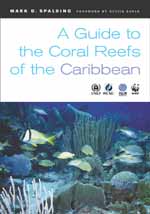 A Guide to the Coral Reefs of the Caribbean
by Mark Spalding
This book doubles as a guide to the natural history of the coral reefs and a diver's travel guide. In addition to providing information about some of the most popular diving and snorkeling, it also offers practical suggestions to divers who want to protect these sites. Author Mark Spalding, a coral reef scientist who has worked on coral reefs in over thirty countries, delves into the eco-problems with a focus on what each person can do to protect the reefs. The guide section covers 35 dive destinations with key information on the reefs, marine parks, remote places, and unusual species as well as excellent maps and a photographic field guide of the marine flora and fauna.
Order Now at a reduced price of only $16.47.
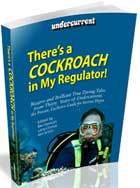 There's a Cockroach in My Regulator
by Undercurrent
The Best of Undercurrent: Bizarre and Brilliant True Diving Tales from Thirty Years of Undercurrent.
Shipping now is our brand new, 240-page book filled with the best of the unusual, the entertaining, and the jaw dropping stories Undercurrent has published. They’re true, often unbelievable, and always fascinating. We’re offering it to you now for the special price of just $14.95.
Click here to order.
You might find some other books of interest in our Editor's Book Picks section.
| Home | Online Members Area | My Account |
Login
|
Join
|
| Travel Index |
Dive Resort & Liveaboard Reviews
|
Featured Reports
|
Recent
Issues
|
Back Issues
|
|
Dive Gear
Index
|
Health/Safety Index
|
Environment & Misc.
Index
|
Seasonal Planner
|
Blogs
|
Free Articles
|
Book Picks
|
News
|
|
Special Offers
|
RSS
|
FAQ
|
About Us
|
Contact Us
|
Links
|
3020 Bridgeway, Ste 102, Sausalito, Ca 94965
All rights reserved.