
 |

 Email Signup
|
Subscribe
|
Login
Email Signup
|
Subscribe
|
Login
For Divers since 1975 The Private, Exclusive Guide for Serious Divers Since 1975 |
"Best of the Web: scuba tips no other source dares to publish" -- Forbes |
Testing Quirky and Not-So-Quirky FinsContents of this Issue: REEF Field Survey, Kona, Hawaii Diver Car-Rental Scam in Cozumel 2008 Diving Almanac & Yearbook Sea Dragon, Exuma Cays, Bahamas Regulator Recall from Oceanic and Aeris How to Emergency Breathe From a BCD Testing Quirky and Not-So-Quirky Fins Women Divers May Be Better Than Men Shields and Repellants to Keep the Sharks Away Have A Good Diving Tip? Tell Us About It Diving, The Rich Person’s Sport Editorial Office: Ben Davison Publisher and Editor Undercurrent 3020 Bridgeway, Suite 102 Sausalito, CA 94965 which are worth putting your feet into? from the January, 2008 issue of Undercurrent
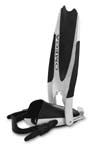
After looking at a number of oddly designed fins at the October show of the Diving Equipment and Marketing Association (DEMA), I sat down with John Bantin, who has tested dive equipment for the British magazine Diver for many years. I’ve been taken by John’s honest and forthright opinion and because he is a contract writer, magazine advertisers and advertising income have never influenced his point of view. John and I were discussing quirky fin designs; he had tested some and was off in November to test more. I asked if he would share his test review with Undercurrent readers. Here is his report. -- Ben Davison It’s almost every inventor’s dream to build a better mousetrap. It seems that those not concerned with the demise of rodents put their efforts into building a better set of fins for divers. Every year a new batch of “revolutionary” fins hits the stores and most sink later without a trace. Some survive. Divers who feel they are getting nowhere underwater fall easy prey to the salesman with a more expensive set of fins to offer. Few dive-store owners would countenance their staff making the recommendation to customers to get in better physical condition! Of course, some fins do work better than others, and sometimes it’s hard to differentiate between the good and the not so good. However, some have an obvious unique selling proposition. Omega Amphibian Fins I always put my fins on before everyone else, but the disadvantage is that everyone else stands on top of them. There’s no way I can move without their acquiescence. These amphibian fins promise to solve that problem.
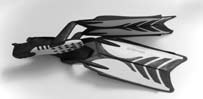
These fins fold up against your shins so that you are essentially walking around in rubber slippers. When the time comes to deploy them as fins, you can simply push down the blade with an opposing heel and they snap-lock into place with a loud click. On the deck of a dive boat, however, I found that walking on any shiny surface, such as pool-side tiles, made me feel as insecure and as likely to slip over as when wearing conventional fins. The promise is that after the dive, when you climb onto the lower rung of the boat ladder, it’s a simple matter to stand on the release with the opposing heel and let the blade fold up, powered by its built-in spring. Alas, the dream of folding the fins before climbing the ladder was never fulfilled because the current caused by the vessel swinging on its mooring made it impossible to get the opposite heel on the clip release. However, if you can fold them up, they protect your shins from the ladder rungs. After a week’s intensive diving I did notice wear on my feet adjacent to the foot-pocket where the fins hinged. The fins were certainly not as effective in the water as the Italian-made industry standard Mares Quattros, but nevertheless they worked a lot better than some others. They do make shore diving easier. No more stumbling about trying to get your fins off afterwards. The manufacturer has confidence in them since it gives the fins a lifetime warranty. (Suggested retail price is $229; www.omegaaquatics.com) Aileron Fins These fins have their blades cantilevered away from the line of the foot-pocket by a couple of integrated struts. The idea is that you can walk while wearing them. Secondly, because the blade is away from the turbulence caused by the leg and fin, they perform better than conventional fins. They are available with a slipper-style foot-pocket or an open-heel design with a strap. Both had a foot-pocket reminiscent of a rubber clog. The question for me was would they provide a boost in performance that would be worth the ridicule I was sure to suffer if I turned up on a liveaboard sporting a pair? The blades seemed similar to those of conventional paddle fins. There were no soft rubber inserts to give lateral flex and provide a scooping effect, and no split to emulate a fastswimming fish. My expectation was that they would be as inefficient as an old-fashioned pair of flippers but I decided to give them a try, armed with an underwater speedometer and a pair of industry-standard Mares Plana Avanti Quattros for comparison.
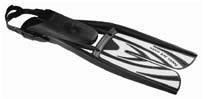
I made several runs, swimming my heart out with the speedo held in front of me. Each time, I noted the highest speed I could muster, and the Ailerons failed to keep their promise. The best I could manage was a heart-busting 2.4 mph, and that was the best of many runs (always waiting until I was fully rested before giving it another go). In contrast, I achieved an almost effortless 2.85 mph with the Quattros on a single run. Not only that, while finning at the surface with the Ailerons, I splashed more than usual because the fins tended to break the surface. The only perceived benefit seems to be the ability to walk around easily while wearing them. However, I always say that a diver in the water without fins is endangered -- as is the diver out of the water who wears fins. So why walk about anyhow? (Foot-pocket fins retail at $80, open-heel fins are $170; www.innovativescuba.co.uk) Scubapro Twin Jet Max Fins These fins are a variant of the “Nature’s Wing” split-fin design. Because I was going to be doing some high-speed snorkeling in Tanzanian waters to photograph whale sharks, I was dependent upon my fins to do the business for me. I chose to take the Twin Jet Max with me. My hunch that they would be good proved right. They seemed to be almost identical to the Atomic split fin I had previously tested, and they matched the results got with both the classic Mares Avanti Quattros and the heavy-duty Apollo Biofin Pro XT all-rubber split fin. They looked like they should be really effective. Like both Apollo and Atomic fins, they have heavyweight side rails to keep the massive blade rigid at the sides, while the split allows the blades to bend inwards as you apply the pressure. Unlike those worthy rivals, these fins are vented between blade and foot-pocket just like the original heavy-duty Jet fins.
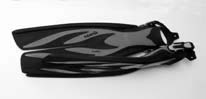
The foot-pocket encompasses my foot right up to and including the heel, so all my effort comes from my thighs. There were no calf or shin cramps during long highspeed chases. There is plenty of room in the foot-pockets for my drysuit boots, too. The heel straps are nothing auspicious so I substituted stainless-steel spring straps. Scubapro now offers them as an option. Checking with an underwater speedometer in the pool, I found I could easily achieve 3 m.p.h., which is pretty good for me. I get slightly less with Mares Plana Avanti Quattros. In fact, I was beating 3 m.p.h. while gently finning up to the start line. When I have compared many fins in the past, that speed was all that could be achieved with some other fins! What does all this prove? These fins actually do work with less effort than some others. My verdict is that these are a serious set of fins for those who are serious about finning. (Suggested retail price is $220: www.scubapro.com) Mares Raptor Fins The Italian company Mares has always been at the forefront of fin design but it has eschewed the split-fin idea for years. Working with the boffins at Genova University, with their famous motorized underwater test bench, Mares has come up with some designs that have been so good, notably the Mares Plana Avanti Quattro, that they have dominated the market worldwide -- except America, that is. American divers want split fins, so Mares has introduced the Raptor. It has a slim-looking fin with a blade that has the characteristic split, but the blade is prevented from bending too much at the outer edges by exceedingly strong side bars. Panels of softer compound allow some flex in the center part of the blade that curves dramatically away from the foot-pocket in a fixed downward arc. The foot-pocket itself is incorporated into a sleek, single-piece unit together with the blade so that there are no edges to disrupt the water flow. A single piece of hard plastic goes from the heel to the blade tip and the foot-pocket has inserts of a softer compound to give some grip when standing in the fins.
These use the latest version of the Mares Advanced Buckle System that cantilevers out to allow you to put your foot easily into the foot-pocket and then clams shut to pull the strap tight. You can do these conveniently with the opposing foot, and that means you don’t have to stoop while wearing your tank to do it. Unfortunately, when it came do undoing the buckles after a dive, I was out of luck. You have to squeeze two opposing little releases together. I was totally unable to free up the buckles, nor could the deckhand who tried to help. I first used them on a dive around a 350-foot-long wreck in the Red Sea. The Rosalie Moller is 170 feet deep. I sprinted down the line to the stern, then to the bow and back to the line. It took only a few minutes. The two divers I had passed on my way said they saw me go by “like a bullet.” I then gave them to fellow diver, Irishman Damien Joyce, to try on the following dive. He came back beaming. “My goodness, these things are mighty! They go like the clappers when you want to accelerate.” He summed them up well. Just as it did with the Plana Avanti Quattro, Mares has again come up with a winning design for a fin, this time with a split blade. I would not be surprised to see these adopted for common use by dive guides throughout the world, just as its worthy predecessors from the Genovese manufacturer already have. (Suggested retail price is $140; www.mares.com) Batin will review Force Fins in the next issue. |



I want to get all the stories! Tell me how I can become an Undercurrent Online Member and get online access to all the articles of Undercurrent as well as thousands of first hand reports on dive operations world-wide

| Home | Online Members Area | My Account |
Login
|
Join
|
| Travel Index |
Dive Resort & Liveaboard Reviews
|
Featured Reports
|
Recent
Issues
|
Back Issues
|
|
Dive Gear
Index
|
Health/Safety Index
|
Environment & Misc.
Index
|
Seasonal Planner
|
Blogs
|
Free Articles
|
Book Picks
|
News
|
|
Special Offers
|
RSS
|
FAQ
|
About Us
|
Contact Us
|
Links
|
3020 Bridgeway, Ste 102, Sausalito, Ca 94965
All rights reserved.