
 |

 Email Signup
|
Subscribe
|
Login
Email Signup
|
Subscribe
|
Login
For Divers since 1975 The Private, Exclusive Guide for Serious Divers Since 1975 |
"Best of the Web: scuba tips no other source dares to publish" -- Forbes |
CoCo View Resort, Roatán, HondurasContents of this Issue: CoCo View Resort, Roatán, Honduras Sipadan Dive Operators Evicted Mike Ball Returns to Fight Global Warming Jean-Michel Cousteau Tells All Two Equipment Problems with Aqualung/Seaquest Gear Endemic Computer Problems: Part I When Your Computer Is Discontinued Diver’s Shark Tales from Around the Globe The Dangers and Thrills of Deep Wreck Diving Editorial Office: Ben Davison Publisher and Editor Undercurrent 3020 Bridgeway, Suite 102 Sausalito, CA 94965 10 years later, the same diver paradise from the July, 2004 issue of Undercurrent
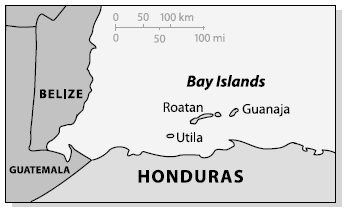
Dear Fellow Diver, It had been close to 10 years since I last visited CoCo View Resort. The hiatus didn't reflect how well I thought of CoCo View: one of the top places for serious dives in the Caribbean. There were just too many other destinations to visit when I get a vacation. The CoCo View I remembered had lots of good diving, four boat dives per day, unlimited shore diving, night wall diving, and a great variety of coral, sponges, and colorful reef fish and critters ... a cabana over the shallow water flats, where I could watch fish lurking in the shadows ... a wall open to the sounds of the sea ... a light breeze blowing through the screens ... and notorious no-see-ums, pesky bugs that leave red welts about the size of a pencil eraser ... plentiful but unspectacular food ... plenty of other divers around for swapping lies and stories ... and bargain prices. Most of all, I remembered it as a respite from Northern California, where the 50-degree water and 15-foot visibility requires a full 7mm wet suit with hoods and gloves. As I rode CoCo View's motor boat through the mangrove
channels to the resort, my stateside concerns washed away.
The warm, humid, sea air carried on a gentle breeze transported
me to a state of immediate relaxation. After a resort
briefing, my partner and I headed to our cabana, looking forward
to an afternoon dive. And she could join it! Unlike
the past, there was no checkout dive for us, although a group
of first time arrivals were required to do the checkout dive.
We filled out the requisite forms and waivers and displayed
our C-cards. One guest, with a logbook but no C-card, was
not allowed to dive the entire week. Head divemaster Osmond gave a short orientation, emphasizing that divers were responsible for their own profiles. They assigned us individual cubbies and storage areas, seven steps from the boat, near two large fresh water rinse tanks. They assigned my partner and me to one of four EZ Diver boats for the week, ensuring that we got to know the divers onboard and that we didn't repeat sites unless we cared to. We had 12 divers on our 50-foot E2 Diver III. Most of the deck was covered to protect us from the elements, and an area was dedicated to cameras -- the crews handled camera gear well. BCDs and regulators were set up before every dive on aluminum 80s filled to 3,000 psi, and between dives they offered snacks of pineapple or coconut. CoCo View almost built its reputation on one dive site, Mary's Place. It had been closed to divers for many years, but it's open again, but only to divers who take the mandatory once-a-week briefing to be told not to stir up the bottom, to keep moving, and not to hit the walls with tanks. It wasn't the dive it could be, because the group was herded through it without the time to look and appreciate. On the other hand, Calvin's Crack was super -- a dramatic topographical relief, combined with the deep blue backdrop of the Caribbean. At Forty-Foot Point there were schools of jacks, several barracuda, and free-swimming moray eels, two of whom engaged in a toothy turf battle. My dive buddy's eyes became the size of saucers, wondering if she was going to have to "save" the underdog. Methinks someone must be feeding the fish in the area, but I did not see our divemaster, Jimmy, participate in this practice, though he did "call" the fish by free flowing his regulator. By the way, most sites are less than a 10-minute boat trip. For the second morning or afternoon dive, you get dropped off along the way, and then dive as long as you want before coming ashore at the resort. Jimmy gave solid pre-dive briefings, pointing out the current, which direction to travel, where to find the creatures, and what our profile would be. He was good at finding interesting animals, and never hurried us. While it was group diving, I often lingered, took photos, figured out where the group was in the clear water, and caught up. With CoCo View's freedom there is responsibility. The boat heads out twice and after the first dive drops divers, sometimes with no more than a 20 to 30 minute surface interval, at various destinations for a second dive that they end on shore. Nitrogen can build up, so I made it a practice to make 5-minute safety stops. A longer surface interval would give more latitude on the second and fourth dives that end at the resort. Many sites had plenty to see during the stop. But diving isn't deep, so one can still get plenty of bottom time. The profiles typically began on top of the reef, then a short swim to the wall and over the edge to a planned depth of 70 feet. (My deepest plunge was 96 feet.) I'd follow the group, moving along the wall for up to 25 minutes, rise to the reef top and swim back, piddling around under the boat until the 60-minute stated dive time was up. Of course, when I dived off the shore, there were no restrictions. In May, we had no current or surge, 100+ feet of visibility, and water that was 84 to 86 degrees. A couple of days the wind kicked up 4-5 foot swells, which made climbing the stern ladders more difficult and potentially dangerous. In these conditions, they floated a current line, so I removed my fins well away from the slapping stern platform, and then pulled myself to the stern, handed up my fins, and climbed aboard. Or I could swim underwater to the unique wet-well in the center of the boat, remove my fins, and simply climb the ladder to emerge on the main deck amidships. Nifty. A great range of colorful corals -- plate, pillar, brain, lettuce, staghorn, and elkhorn -- huge barrel sponges, other sponges from brown to blue and wild red to purples, and prolific sea fans dominate the landscape. The coral is in good shape, though staghorn and elkhorn have deteriorated since I was here last, most likely from runoff, silt from development, and storm damage. Because the staff stresses good buoyancy control and offers a clinic, hopefully the damage is not diver-caused. I watched the divemaster gently help another diver up from the floor where he was trying not to have an impact, but in his effort not to touch anything with his hands, he was kicking coral and gorgonians. Unlike a decade ago, I didn't see a nurse shark, and the divemaster said he hadn't seen one in a year. Nor did I see any large parrotfish. Squid, barracuda, and grouper were prevalent, as were French and Queen angelfish, small parrotfish, trumpet, and boxfishes. Everywhere, individual reef fish in awkward poses presented themselves at cleaning stations. I even saw a small school of chromis at a cleaning station on a green brain coral. Christmas tree worms and feather dusters sprouted from many coral heads. On one dive an eagle ray passed me within 10 feet, lazily winging its way across the grassy flats. I saw sea horses on every dive, and those were a rarity the last time I was here, but then again it seems to me it's only been in the past few years that divemasters anywhere could find seahorses with any regularity. By the way, many sites are within 10 minutes from the entrance to the channel. Our longest boat ride was 30 minutes, but we often cruised the blue water looking for whale sharks, which occasionally appear, although we saw none. One night the moon was full, the sky clear, and the air balmy, so my partner and I had dinner and waited for dark. Tanks are in a rack for the taking. The first divers in the water at night take the strobe from the night dive station and a numbered tag that corresponds to their room. They turn on the strobe when they hit the water. After a 100-yard swim across the sand flats while following a chain placed for navigation, they attach the strobe to an underwater buoy as a guide back to the chain. Each diver is to attach his room tag to the buoy before visiting Prince Albert, a wreck that is crawling with critters, from brittle stars to octopus. CoCo View Wall offers dramatic relief, while Neuman's Wall offers its wall as well as access to beautiful shallows, from 5 feet to 20 feet. Upon return, the diver is to remove his room tag. If there are no other tags on the buoy, it's his task to bring the strobe back. My buddy and I turned left toward CoCo View Wall. A large barracuda escorted us on our seaward side. I probed the cracks and holes in the reef, my lights shocking resting fish and illuminating the red eyes of shrimp. Brittle stars, barely visible in the bottom of sponges during the day, were everywhere, as were arrow crabs and banded coral shrimp. We turned off our lights. The full moon made its way through the water column, silhouetting the wondrous shapes of the wall. The white sand bottom reflected the moonlight so we could see farther without the lights than with them. I wiggled my hand to stir up the cyalume-colored phosphorescence. Moving back toward the opening in the wall, I saw dim glowing UFOs floating in space -- the next group of night divers. We did a quick tour of the Prince Albert wreck and swam back to the beach, concluding a day of five hours underwater. I think wrecks sunk just for divers create a contrived experience. There is no story of storms, darkness, or hidden reefs leading to the history of the vessel -- the only story being the hoops they had to go through to get government approval to sink the vessel. For some reason, the sunken Mr. Bud, sitting upright on a sandy bottom, seemed different. The wheelhouse window is looking out onto the wall. Sitting in the helmsman's chair in the blue water of the Caribbean, I reflected on the Andrea Gale, another fishing boat resting at the bottom of the North Sea, while watching the glassy sleepers, angelfish, and small groupers, as well as barracuda who patrol the structure. During cocktail hour, I enjoyed a smashing piña colada, a reasonable $3.50 (beer and sodas ran $1.00-$1.50). Food served for the cafeteria-style dinner was ordinary, a cut above mediocre, though I suppose fine by third world standards and CoCo View prices. Still, I never went away hungry. There was generally a choice of beef or chicken, and fish, and one night steak and lobster. The beef and fish were typically overcooked, the fish bony and strong flavored. A barbeque -- chicken, pork chops, and pork ribs -- on the cay was the best meal. While the salad bar was excellent, the vegetables were often overcooked. But desserts would always save the day. Coconut cream pie and key lime pie were the highlights. Lunch was generally a hot entree, sandwich, pasta salad, rice and beans, and soup. Breakfast is fresh fruit, cereal, pancakes, waffles, eggs fixed any style, sausage, bacon, or ham. The kitchen staff and servers seemed to have an occasional "attitude," shall we say. Once after Ev, the owner, had given them some instructions and turned her back, they made faces at her, in full view of guests. We did go out on our own one evening; two couples and the 15-minute cab ride billed to our rooms were $15/couple. Dinner at the recommended Romeo's featured dry lobster served with tartar sauce, a poor substitute for a steak, and good shrimp. The setting was scenic, although enhanced by the aroma of French Harbor's industrial yet colorful waterfront. West End town is more for expats and tourists, with a lot of pretentious white kids in dread locks, and shops and bars. My rustic yet comfortable cabana, the size of a large master bedroom, made me
feel as if I were on my own private island. The seaward wall, only a screen looking
out on the reef, allowed a fresh breeze and the sound of the waves to be our constant
companions, lulling us to sleep. With the help of overhead fans, I was very comfortable.
Change is coming to CoCo View. Owners Bill and Ev Evans completed the sale of the resort the week before we arrived. The new owners, I was told, are executives from Holiday Inn who had been looking for a dive resort. The promise was they were going to keep the ambiance, and the staff will be the same, by and large good news. But perhaps this article will help them make a few improvements at the edges, while keep the CoCo View experience, one highly regarded by years of faithful returnees, intact. P.S. from Ben: In 2003, many Undercurrent readers reported serious cases of food poisoning at CoCo View, which we reported on. The problem, apparently due to Honduran cheese, seems to have been solved since last August, and we have had no further reports of illness. Our reviewer, known to eat everything in sight, had no problems, nor did anyone during his stay. So, case closed.
|

 They asked me for a contribution to the local dive chamber
and whether I knew how to use
the dive tables, a tough question
for someone as computer-dependent as
I. My hems -- and haws -- did not
affect or limit my diving.
They asked me for a contribution to the local dive chamber
and whether I knew how to use
the dive tables, a tough question
for someone as computer-dependent as
I. My hems -- and haws -- did not
affect or limit my diving.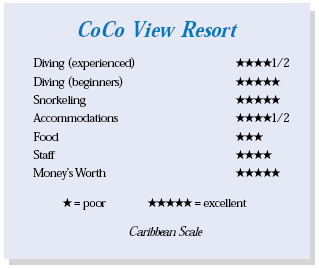 There are rooms with A/C, but they are not cabanas, and they are 10 feet from
the water, whereas the cabanas are built over the water. The housekeepers always had
our room prepared when we came in from our morning dive and placed fresh flowers in the bathroom daily. And we had plenty
of hot water. But I spent little time
in my room, since I was usually diving
(I did 19 dives in 5.5 days). Some
people played ping-pong, pool, or shot
darts. And, while there are kayaks for
paddling the mangroves, Rebecca, the
activities director, tried to get people
excited about kayak races and hermit
crab races -- two activities that will
probably never excite the abundance of
middle-aged and older divers who visit
CoCo View. A small gym has aerobic and
weight machines; they have a spa and
massages (without upscale subtleties of
dim lights, soft music, or the privacy
to disrobe). And wireless Internet
connection, for a fee. While they
offered a dolphin swim at Anthony's
Key, Anthony's had sold out CoCo Views spaces. The night boat dive did not happen,
nor did the night out on the town, because too few people signed up. But I took the
island tour on my last day. The botanical garden's collection of native and nonnative
plants was surely worth the visit, and at the iguana farm we had plenty of photo
ops with incredible lizards, in a variety of greens, reds, yellows, and oranges.
Traveling the length of Roatan, the contrast of local squalor and emerging wealth,
due largely to Americans moving in and development, is stark.
There are rooms with A/C, but they are not cabanas, and they are 10 feet from
the water, whereas the cabanas are built over the water. The housekeepers always had
our room prepared when we came in from our morning dive and placed fresh flowers in the bathroom daily. And we had plenty
of hot water. But I spent little time
in my room, since I was usually diving
(I did 19 dives in 5.5 days). Some
people played ping-pong, pool, or shot
darts. And, while there are kayaks for
paddling the mangroves, Rebecca, the
activities director, tried to get people
excited about kayak races and hermit
crab races -- two activities that will
probably never excite the abundance of
middle-aged and older divers who visit
CoCo View. A small gym has aerobic and
weight machines; they have a spa and
massages (without upscale subtleties of
dim lights, soft music, or the privacy
to disrobe). And wireless Internet
connection, for a fee. While they
offered a dolphin swim at Anthony's
Key, Anthony's had sold out CoCo Views spaces. The night boat dive did not happen,
nor did the night out on the town, because too few people signed up. But I took the
island tour on my last day. The botanical garden's collection of native and nonnative
plants was surely worth the visit, and at the iguana farm we had plenty of photo
ops with incredible lizards, in a variety of greens, reds, yellows, and oranges.
Traveling the length of Roatan, the contrast of local squalor and emerging wealth,
due largely to Americans moving in and development, is stark. Diver's Compass: Depending upon season and accommodations, prices
run from $700-$900/diver/week, double occupancy, diving and food
included. ... CoCo View incinerates its garbage, and the strong
smoky smell often permeated the rooms. ... I took a red eye from
L.A., arriving at CoCo View at 11 a.m., through San Salvador then
on to the Roatan airport. A CoCo View rep helped us clear customs
with all our bags quickly. ... Nitrox was available at an additional
charge of $6/tank or $100/week. ... They have good gear for
rent, including computers. They offer certifications from refresher to divemaster
courses and specialty courses. There is also a camera, video, and digital center,
with a helpful staff able to solve basic photo equipment issues. ... I got one nosee-
um bite; my partner had many, and they weren't fun. Some people are more susceptible
than others. Use a repellent with at least 30 percent DEET. I use the
strongest that I can find. ... Each boat had oxygen, a first-aid kit, and a radio.
... Contact CoCo View at
Diver's Compass: Depending upon season and accommodations, prices
run from $700-$900/diver/week, double occupancy, diving and food
included. ... CoCo View incinerates its garbage, and the strong
smoky smell often permeated the rooms. ... I took a red eye from
L.A., arriving at CoCo View at 11 a.m., through San Salvador then
on to the Roatan airport. A CoCo View rep helped us clear customs
with all our bags quickly. ... Nitrox was available at an additional
charge of $6/tank or $100/week. ... They have good gear for
rent, including computers. They offer certifications from refresher to divemaster
courses and specialty courses. There is also a camera, video, and digital center,
with a helpful staff able to solve basic photo equipment issues. ... I got one nosee-
um bite; my partner had many, and they weren't fun. Some people are more susceptible
than others. Use a repellent with at least 30 percent DEET. I use the
strongest that I can find. ... Each boat had oxygen, a first-aid kit, and a radio.
... Contact CoCo View at 
I want to get all the stories! Tell me how I can become an Undercurrent Online Member and get online access to all the articles of Undercurrent as well as thousands of first hand reports on dive operations world-wide

| Home | Online Members Area | My Account |
Login
|
Join
|
| Travel Index |
Dive Resort & Liveaboard Reviews
|
Featured Reports
|
Recent
Issues
|
Back Issues
|
|
Dive Gear
Index
|
Health/Safety Index
|
Environment & Misc.
Index
|
Seasonal Planner
|
Blogs
|
Free Articles
|
Book Picks
|
News
|
|
Special Offers
|
RSS
|
FAQ
|
About Us
|
Contact Us
|
Links
|
3020 Bridgeway, Ste 102, Sausalito, Ca 94965
All rights reserved.